
Resources
Explore a wide range of valuable resources on GCED to deepen your understanding and enhance your research, advocacy, teaching, and learning.
3,453 Results found
 Behind the Numbers: Ending School Violence and Bullying Year of publication: 2019 Corporate author: UNESCO School-related violence in all its forms, including bullying, is an infringement of children’s and adolescents’ rights to education and health and well-being. No country can achieve inclusive and equitable quality education for all if learners experience violence in school.This report provides an overview of the most up-to-date evidence on school violence and bullying. It includes global and regional prevalence and trends, factors that influence vulnerability to school violence and bullying, and consequences. The publication brings together for the first time in one place a wealth of quantitative data from two large-scale international surveys: the Global School-based Student Health Survey (GSHS) and the Health Behaviour in Schoolaged Children (HBSC) study. The surveys cover 144 countries and territories in all regions of the world, and from a wide range of other global and regional surveys. The publication also includes an analysis of factors that contribute to effective national responses, based on a series of case studies commissioned by UNESCO of countries that have succeeded in reducing the prevalence of school violence and bullying or have maintained low levels of school violence over time. Au-delà des chiffres: en finir avec la violence et le harcèlement à l’école Year of publication: 2019 Corporate author: Organisation des Nations Unies pour l'éducation, la science et la culture (UNESCO) La violence en milieu scolaire sous toutes ses formes, y compris le harcèlement, porte atteinte aux droits des enfants et des adolescents à l’éducation, la santé et au bien-être. Aucun pays ne peut assurer une éducation de qualité inclusive et équitable si les élèves sont confrontés à la violence dans les écoles.Cette publication fournit un aperçu de la prévalence des différentes formes de violence et de harcèlement à l’école au niveau mondial. Elle présente les tendances en termes d’évolution de cette prévalence, globalement et dans les différentes régions du monde. Elle examine les facteurs qui rendent les jeunes plus vulnérables à la violence et au harcèlement à l’école, ainsi que les conséquences de ces phénomènes. Pour la première fois, cette publication rassemble une multitude de données quantitatives issues de deux vastes enquêtes internationales, l’Enquête mondiale en milieu scolaire sur la santé des élèves (Global School-based Student Health Survey, GSHS) et l’Enquête sur le comportement de santé des enfants d’âge scolaire (Health Behaviour in Schoolaged Children, HBSC), qui couvrent 144 pays et territoires de toutes les régions du monde ; mais aussi d’un grand nombre d’autres études internationales et régionales. Cette publication contient également une analyse des facteurs qui contribuent à l’efficacité des réponses nationales, fondée sur les études de cas commandées par l’UNESCO dans les pays étant parvenus à réduire la violence et le harcèlement dans leurs écoles ou à maintenir dans la durée les faibles taux de prévalence de ces phénomènes. Más allá de los números: poner fin a la violencia y el acoso en el ámbito escolar Year of publication: 2019 Corporate author: Organización de las Naciones Unidas para la Educación, la Ciencia y la Cultura (UNESCO) Todas las formas de violencia en la escuela, incluido el acoso, representan una vulneración del derecho de niños, niñas y adolescentes a la educación y a la salud y el bienestar. Ningún país puede lograr una educación inclusiva, equitativa y de calidad si sus estudiantes son víctimas de violencia en el ámbito escolar.Esta publicación ofrece una visión general de los datos más actualizados sobre violencia y acoso en el ámbito escolar. Incluye información acerca de tendencias y prevalencia a escala mundial y regional, los factores que influyen en la vulnerabilidad a la violencia y el acoso, y sus consecuencias. La publicación reúne por primera vez en un solo lugar una gran cantidad de datos cuantitativos extraídos de dos encuestas internacionales a gran escala: la Encuesta Mundial de Salud a Escolares (GSHS) y la Encuesta sobre las conductas saludables de los jóvenes escolarizados (HBSC) que abarcan 144 países y territorios de todas las regiones del mundo, así como de otras muchas encuestas mundiales y regionales. La publicación incluye asimismo un análisis de los factores que contribuyen al logro de respuestas nacionales eficaces, para lo que se basa en una serie de estudios de caso, encargados por la UNESCO, de países que han logrado reducir la prevalencia de la violencia y el acoso en las escuelas, o han mantenido niveles bajos de violencia escolar a lo largo del tiempo.
  إعادة التفكير في التربية والتعليم: نحو صالح عام عالمي؟ Year of publication: 2015 Corporate author: منظمة الأمم المتحدة للتربية والعلم والثقافة (UNESCO) ات، ّرات توتّد هذه التغيّولُات جديدة من التعقيد والتناقض. وتّتتسم تغيرات عالم اليوم بسويئا لها الأفراد والجماعات، من خلال تزويدهم بالمقدرة على ِّتهينتظر من التربية والتعليم أن ُيتي التعليم ّعمليف والاستجابة. وفي هذا السياق يسهم هذا المطبوع في النظر مجددا في ّالتكيم. إذ إنه يؤسس على دور رئيسي تؤديه اليونسكو، دور مرصد عالمي للتحولات الاجتماعية، ّوالتعلبهدف حفز نقاش السياسات العامة.م من رؤية إنسانية َمستلهل هذا المطبوع دعوة إلى الحوار بين جميع الجهات المعنية.فهو ّويمثللتعليم والتنمية، مبنية على احترام الحياة وكرامة الإنسان، وعلى التساوي في الحقوق، والعدالة الاجتماعية، والتنوع الثقافي، والتضامن الدولي، والتشارك في المسؤولية من أجل مستقبل مها مطبوعا ّقدد الرؤية التي ّمستدام. تلك هي أساسيات إنسانيتنا المشتركة. إن هذه الوثيقة تؤيم: ذلك ّ، «تقرير فور»؛ و التعل(١97٢)ًوغدام لتكون: عالم التربية اليوم ّمان: تعلَلْاليونسكو المع، «تقرير ديلور».(١996)الكنز المكنو.
  Mainstreaming SDG4-Education 2030 in sector-wide policy and planning: technical guidelines for UNESCO field offices Year of publication: 2016 Corporate author: UNESCO Mainstreaming SDG4-Education 2030 in sector-wide policy and planning offers technical guidelines for UNESCO field offices to ensure adequate technical support to national authorities. The guidelines take into account the different profiles of countries’ need and capacities, thus avoiding a one-size-fits-all approach. The document contains resources and pointers that can be combined and tailored to fit the particular context of each country. In all cases, UNESCO is expected to ensure that all the relevant information about SDG4-Education 2030 is properly disseminated in these guidelines. Field staff will adapt the guidelines provided here to the country they are serving to ensure that UNESCO plays its role as the leading United Nations agency in the field.
  Pourquoi enseigner l'holocauste Year of publication: 2014 Corporate author: Organisation des Nations Unies pour l'éducation, la science et la culture (UNESCO) The Holocaust was a turning point in human history. Understanding the genocide of the Jewish people and other crimes perpetrated by the Nazi regime remains of great signi cance in the modern world.Regardless of where we live or who we are, learning about this universal history can help engage students in a critical re action about the roots of genocide and the necessity to nurture peace and human rights to prevent such atrocities in the future.This short introduction provides an essential overview on education about the Holocaust that can support policymakers, educators and students alike in their understanding of genocide and why it is vital that we continue to teach about the Holocaust today. ¿Por qué enseñar sobre el holocausto? Year of publication: 2014 Corporate author: Organización de las Naciones Unidas para la Educación, la Ciencia y la Cultura (UNESCO) The Holocaust was a turning point in human history. Understanding the genocide of the Jewish people and other crimes perpetrated by the Nazi regime remains of great signi cance in the modern world.Regardless of where we live or who we are, learning about this universal history can help engage students in a critical re action about the roots of genocide and the necessity to nurture peace and human rights to prevent such atrocities in the future.This short introduction provides an essential overview on education about the Holocaust that can support policymakers, educators and students alike in their understanding of genocide and why it is vital that we continue to teach about the Holocaust today. Зачем преподавать историю Холокоста? Year of publication: 2014 Corporate author: Организация Объединенных Наций по вопросам образования, науки и культуры (UNESCO) The Holocaust was a turning point in human history. Understanding the genocide of the Jewish people and other crimes perpetrated by the Nazi regime remains of great signi cance in the modern world.Regardless of where we live or who we are, learning about this universal history can help engage students in a critical re action about the roots of genocide and the necessity to nurture peace and human rights to prevent such atrocities in the future.This short introduction provides an essential overview on education about the Holocaust that can support policymakers, educators and students alike in their understanding of genocide and why it is vital that we continue to teach about the Holocaust today. ما الداعي إلى التعليم بشأن محرقة اليهود Year of publication: 2014 Corporate author: منظمة الأمم المتحدة للتربية والعلم والثقافة (UNESCO) The Holocaust was a turning point in human history. Understanding the genocide of the Jewish people and other crimes perpetrated by the Nazi regime remains of great signi cance in the modern world.Regardless of where we live or who we are, learning about this universal history can help engage students in a critical re action about the roots of genocide and the necessity to nurture peace and human rights to prevent such atrocities in the future.This short introduction provides an essential overview on education about the Holocaust that can support policymakers, educators and students alike in their understanding of genocide and why it is vital that we continue to teach about the Holocaust today.
 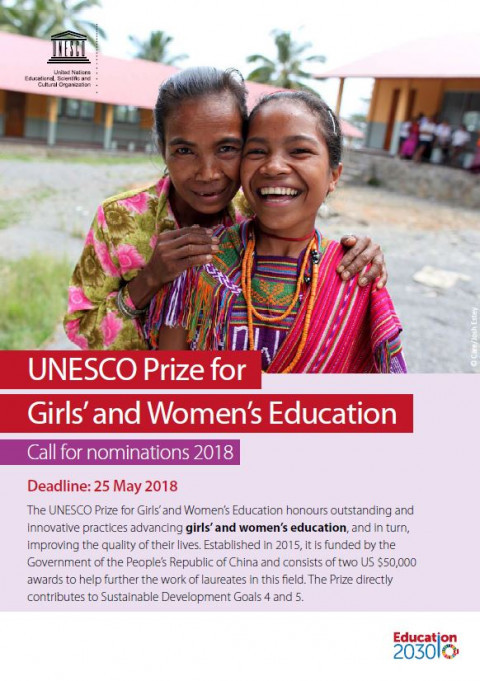 UNESCO Prize for Girls' and Women's Education: Call for Nominations 2018 Year of publication: 2018 Corporate author: UNESCO The UNESCO Prize for Girls’ and Women’s Education honours outstanding and innovative practices advancing girls’ and women’s education, and in turn, improving the quality of their lives. Established in 2015, it is funded by the Government of the People’s Republic of China and consists of two US $50,000 awards to help further the work of laureates in this field. The Prize directly contributes to Sustainable Development Goals 4 and 5.