
Resources
Explore a wide range of valuable resources on GCED to deepen your understanding and enhance your research, advocacy, teaching, and learning.
2,775 Results found
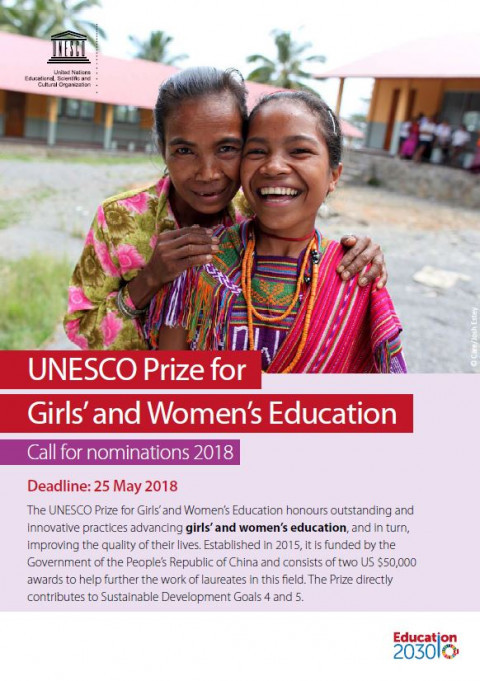 UNESCO Prize for Girls' and Women's Education: Call for Nominations 2018 Year of publication: 2018 Corporate author: UNESCO The UNESCO Prize for Girls’ and Women’s Education honours outstanding and innovative practices advancing girls’ and women’s education, and in turn, improving the quality of their lives. Established in 2015, it is funded by the Government of the People’s Republic of China and consists of two US $50,000 awards to help further the work of laureates in this field. The Prize directly contributes to Sustainable Development Goals 4 and 5. Prix UNESCO pour l'éducation des filles et des femmes: appel à candidatures 2018 Year of publication: 2018 Corporate author: Organisation des Nations Unies pour l'éducation, la science et la culture (UNESCO) Le Prix UNESCO pour l'éducation des filles et des femmes honore les pratiques exemplaires et novatrices qui font progresser l'éducation des filles et des femmes et, par conséquent, améliorent la qualité de leur vie. Crée en 2015, il est financé par le gouvernement de la République populaire de Chine et consiste de deux prix de 50 000 dollars des États-Unis afin d’aider les lauréats à poursuivre leur travail dans ce domaine. Le prix contribue directement aux objectifs de développement durable 4 et 5.
  تقرير اليونسكو العالمي: الاستثمار في التنوع الثقافي والحوار بين الثقافات Year of publication: 2009 Corporate author: منظمة الأمم المتحدة للتربية والعلم والثقافة (UNESCO) أن المعاني التي ارتبطت بهذا المصطلح، الذي يكاد يشمل كل شيء، متنوعة تماماً كما أنها كثيرة التغير. فالبعض يعتبر التنوع الثقافي عاملاً ايجابياً في حد ذاته، فهو يدلّ على تقاسم الثروة التي تجسدها كل ثقافة من ثقافات العالم، وبذلك يوضح الروابط التي توحدنا جميعاً في سياق عمليات التبادل والحوار. ويعتبر آخرون أن الفوارق الثقافية هي التي تجعلنا نعجز عن تبيّن إنسانيتنا المشتركة وهي بالتالي تكمن في جذور الكثير من النزاعات. ويصبح هذا التشخيص الأخير أقوى احتمالاً اليوم مع ما نتج عن العولمة من زيادة في نقاط التفاعل والاحتكاك بين الثقافات أدت إلى توترات وانسحابات ومطالبات تتعلق بالهوية، وبخاصة مما له طابع ديني، أصبحت مصادر محتملة للنزاع. ولذا، فإن التحدي الأساسي يتمثل في طرح رؤية منسجمة متماسكة للتنوع الثقافي توضح أن التنوع الثقافي، بدلاً من أن يكون مصدراً للخطر، يمكن أن يفيد العمل على صعيد المجتمع الدولي. وهذا بالذات هو الهدف الأساسي للتقرير الحالي.
  Global Education Meeting 2018: Brussels Declaration Year of publication: 2018 Corporate author: UNESCO Ministers, and other heads of delegations, as well as representatives of multilateral organizations, civil society, the teaching profession, youth and the private sector, met in Brussels, from 3 to 5 December 2018. This document describes key messsages and commitments for the 2019 High-Level Political Forum and the United Nations General Assembly.
  The Intersections Between Education, Migration and Displacement are not gender-neutral (Global Education The Intersections between Education, Migration and Displacement Monitoring Report, 2019) Year of publication: 2019 Corporate author: UNESCO The 2019 Global Education Monitoring Report emphasized the need to include migrants and refugees in national education systems, and also called for more planning to respond to the needs of these populations. As this short review has outlined, many of these needs have gender dimensions. These range from the vulnerability of rural‑to‑urban migrant girls who end up as domestic workers deprived of education opportunities to the vulnerability of refugee boys, often unaccompanied, who have limited opportunities to develop their skills. They encompass the deskilling of international migrant women in the ‘global care chain’ as well as the increasing chore burden that left‑behind girls face when a parent migrates.Still, research on the experiences of girls and women or boys and men in migration and displacement contexts – and how these can be affected by education – remains limited. More analysis on the intersection of gender, education, migration and displacement is needed on a wide variety of issues, including the gender-specific dimensions of remittance use, gender-responsive teaching practices and the empowerment impact of non-formal education opportunities. To fulfil their potential for instilling resilience, education systems need to recognize these needs and respond to them. Las intersecciones entre educación, migración y desplazamiento no son género-neutrales (Informe de Seguimiento de la Educación en el Mundo, 2019) Year of publication: 2019 Corporate author: Organización de las Naciones Unidas para la Educación, la Ciencia y la Cultura (UNESCO) El Informe de Seguimiento de la Educación en el Mundo de 2019 enfatizaba la necesidad de incluir a migrantes y refugiados en los sistemas educativos mundiales, y también marcaba la necesidad de aumentar las planificaciones que busquen dar respuestas a las necesidades de estas poblaciones. Como desarrolla este corto informe, muchas de estas necesidades tienen dimensiones vinculadas al género. Estas van desde las vulnerabilidades de niñas migrantes de contextos tanto rurales como urbanos que terminan como trabajadoras domésticas siendo privadas de oportunidades educativas, hasta las vulnerabilidades de niños varones refugiados, muchas veces sin acompañantes, que tienen limitadas oportunidades de desarrollar sus habilidades. Ellas abarcan tanto la falta de cualificación de las mujeres migrantes en la ‘cadena global de cuidado’ como el incremento de la carga de trabajos que recae sobre niñas que han sido dejadas de lado cuando el padre o la madre migra. Más allá de esto, investigaciones sobre las experiencias de mujeres y niñas o de hombres y niños en contextos de migración y desplazamiento – y cómo estos pueden ser afectados por la educación – continúan siendo limitadas. Es preciso ahondar en el análisis de la intersección entre género, educación, migración y desplazamiento en una gran variedad de asuntos, incluyendo las dimensiones género-específicas de uso de remesas, repuestas a prácticas educativas en base a género y el impacto que tienen sobre el empoderamiento las oportunidades de educación no formal. Para cumplir con el potencial de instalar resiliencia, los sistemas educativos precisan reconocer todas estas necesidades y responder a ellas.
 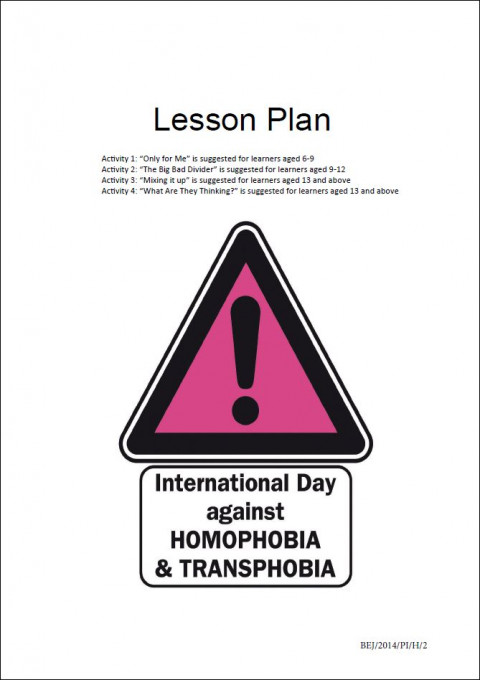 International Day against Homophobia & Transphobia: Lesson Plan Year of publication: 2014 Corporate author: UNESCO Each year, the world celebrates the International Day Against Homophobia and Transphobia (IDAHO) on May 17th. During the days surrounding IDAHO, private and public actors, ranging from the United Nations agencies, to city councils, police stations, human rights organiza-tions, individual citizens, schools and others, implement activities to mark the day. The theme of this year’s IDAHO is “Fighting homophobia and transphobia IN and THROUGH education”. This theme was selected in response to a growing awareness that homophobic and transphobic bullying in schools which are manifestations of homophobia and transphobia, are serious issues that students and educational staff face every day across the world.Over the years, teachers around the world have been developing activities in their classrooms, with the help of various organizations working on efforts to address and homophobia and transphobia in educational institutions. Building on the success of these experiences, UNESCO and the IDAHO Committee propose teachers take advantage of the International Day Against Homophobia and Transphobia to conduct an ‘IDAHO Lesson’. The four activities proposed below are aimed at both primary and secondary level classes. A list of resources from other organizations for teachers, for all subjects and all grades is included below to enable greater choice of possible activities. By conducting an “IDAHO Lesson”, you can create safer learning environments, address discrimination and encourage respect and tolerance between and amongst learners.(Title: International Day against Homophobia and Transphobia: Lesson Plan) Combattre l’homophobie et la transphobie : Propositions pédagogiques Year of publication: 2014 Corporate author: UNESCO Le présent programme pédagogique a été élaboré à l’occasion de l’IDAHO 2012, autour du thème « Combattre l’homophobie et la transphobie DANS et PAR l’éducation », en réponse à la prise de conscience que le harcèlement homophobe ou transphobe dans les écoles sont des manifestations de l’homophobie et de la transphobie auxquelles étudiants et membres du corps enseignant du monde entier doivent faire face au quotidien. Un problème sérieux qui ne peut être ignoré.Diverses études démontrent que le harcèlement homophobe ou transphobe peut avoir de graves répercussions sur la santé physique et mentale des jeunes gens et jeunes filles qui le subissent à un moment crucial de leur vie. Le harcèlement homophobe peut entraîner une baisse des performances d’apprentissage, voire, parfois, le décrochage scolaire. Les jeunes personnes lesbiennes, gays, bisexuelles, transgenres ou intersexes (LGBTI) victimes de harcèlement homophobe sont plus enclines à l’automutilation, et on dénombre parmi cette population beaucoup plus de cas de suicide que chez les autres jeunes. Les recherches révèlent aussi que les jeunes LGBTI ont tendance à adopter des comportements à haut risque tels que les rapports sexuels non protégés et la consommation de stupéfiants.
  Rapport de synthèse sur l'application par les États membres de la Recommandation de 1974 sur l'éducation pour la compréhension, la coopération et la paix internationales et l'éducation relative aux droits de l'homme et aux libertés fondamentales Year of publication: 2013 Corporate author: UNESCO Background: In accordance with 34 C/Resolution 87, 177 EX/Decision 35 (I) and 184 EX/Decision 20, the Executive Board has monitored the implementation of the 1974 Recommendation concerning Education for International Understanding, Cooperation and Peace and Education relating to Human Rights and Fundamental Freedoms. Pursuant to 192 EX/Decision 20 (III), the Director-General hereby submits the consolidated report on the implementation by Member States of the Recommendation.Purpose: This document reports on the results of the Fifth Consultation on the Implementation of the Recommendation concerning Education for International Understanding, Cooperation and Peace and Education relating to Human Rights and Fundamental Freedoms (covering the period 2009-2012). The analysis was prepared on the basis of 55 national reports from Member States received by the Secretariat. Informe de síntesis sobre la aplicación por los Estados Miembros de la Recomendación de 1974 sobre la Educación para la Comprensión, la Cooperación y la Paz Internacionales y la Educación relativa a los Derechos Humanos y las Libertades Fundamentales Year of publication: 2013 Corporate author: UNESCO Background: In accordance with 34 C/Resolution 87, 177 EX/Decision 35 (I) and 184 EX/Decision 20, the Executive Board has monitored the implementation of the 1974 Recommendation concerning Education for International Understanding, Cooperation and Peace and Education relating to Human Rights and Fundamental Freedoms. Pursuant to 192 EX/Decision 20 (III), the Director-General hereby submits the consolidated report on the implementation by Member States of the Recommendation.Purpose: This document reports on the results of the Fifth Consultation on the Implementation of the Recommendation concerning Education for International Understanding, Cooperation and Peace and Education relating to Human Rights and Fundamental Freedoms (covering the period 2009-2012). The analysis was prepared on the basis of 55 national reports from Member States received by the Secretariat.