
Resources
Explore a wide range of valuable resources on GCED to deepen your understanding and enhance your research, advocacy, teaching, and learning.
2,193 Results found
 Multi-Stakeholder Approaches to Education for Sustainable Development in Local Communities: Towards Achieving the Sustainable Development Goals in Asia Year of publication: 2020 Corporate author: UNESCO The idea for this publication first emerged from the ‘10th Asia-Pacific RCE Regional Meeting and Symposium on the Sustainable Development Goals: From Goals to Action’, held from 2 to 4 November 2017 at the India Habitat Centre in New Delhi, India. The case studies presented at the symposium became the basis for this publication.The cases presented in this publication show how RCEs create solutions that enable sustainable development practices in local communities by utilizing education, innovative learning methods and multi-stakeholder partnerships. Local stakeholders take ownership of the sustainability processes, consistently address the targeted SDGs, and demonstrate RCE contributions to the ESD for 2030 priority action areas – policy, education and training settings, educators, youth and community.
 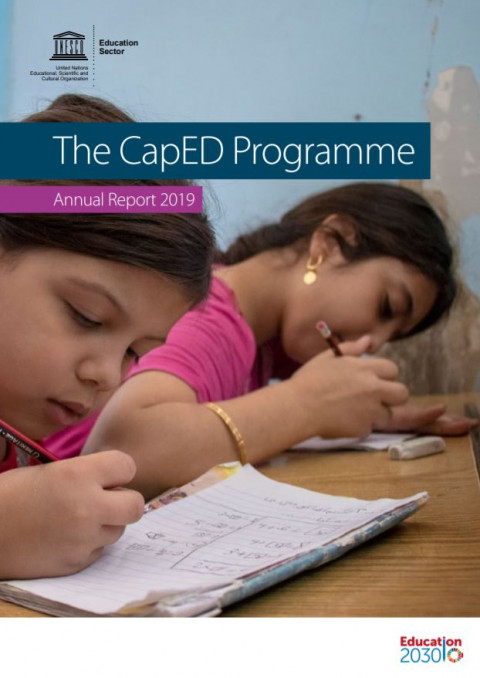 The CapED Programme: Annual Report 2019 Year of publication: 2020 Corporate author: UNESCO UNESCO is the United Nation’s specialized agency for education and is mandated to lead and coordinate progress towards Sustainable Development Goal 4 – “Ensure inclusive and equitable quality education and promote lifelong learning opportunities for all”.The CapED Programme is central to delivering on this mandate through capacity development. It mobilizes UNESCO’s worldwide network of specialized Institutes and offices and works with partners to assist countries as they develop and implement national plans to deliver on SDG4 commitments.The Annual Report 2019 provides information on achievements and progress made in the 26 countries where CapED is operational. Programme CapED: rapport annuel 2019 Year of publication: 2020 Corporate author: UNESCO Institution spécialisée des Nations Unies pour l'éducation, l'UNESCO est chargée de conduire et de coordonner les efforts entrepris pour atteindre l'Objectif de développement durable 4 : « Assurer l'accès de tous à une éducation de qualité, sur un pied d'égalité, et promouvoir les possibilités d'apprentissage tout au long de la vie ».Le Programme CapED de développement des capacités pour l'éducation joue un rôle central dans l'exercice de ce mandat. Il mobilise le réseau mondial des instituts spécialisés et des bureaux de l'UNESCO et, en collaboration avec ses partenaires, aide les pays à élaborer et mettre en oeuvre leurs plans nationaux afin d'honorer les engagements qu'ils ont pris au titre de l'ODD 4.Le Rapport annuel 2019 met en lumière les résultats obtenus et les progrès accomplis dans les 26 pays où le Programme CapED intervient.
 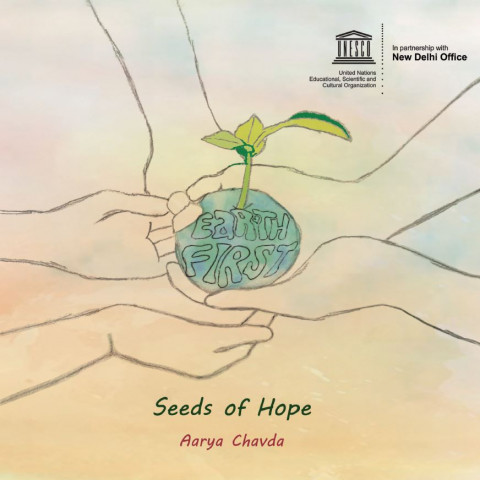 Seeds of Hope Year of publication: 2020 Author: Aarya Chavda Corporate author: UNESCO At an age of 10, author and illustrator of her 3 books, Aarya Chavda extends her support by donating her art proceeds to fundraise for the welfare of underpriviledge Cancer patients.Through her campaign on 'Preservation of Cultural Heritage', She also demonstrates her commitment and contributes in spreading awareness through her programs at government and private institutions.In this series of narrative illustrations, she portrays that climate change will not occur at some point in the distance future - "It is happening her and now". She urges everyone to treasure this thought of saving our planet for the future generation.
  Textbooks and Inclusive Education: Background Paper Prepared for the 2020 Global Education Monitoring Report, Inclusion and Education Year of publication: 2020 Author: Eckhardt Fuchs | Marcus Otto | Simiao Yu Corporate author: UNESCO | Global Education Monitoring Report Team This report, based on an analysis of a sample of textbooks from 28 countries, shows that the subject of inclusion has become increasingly significant in terms of both structure and subject matter, and particularly in the contexts of human rights and citizenship. Social diversity is also increasingly taken into account and reflected upon, albeit with varying emphasis on the differing dimensions of diversity, given that genuinely intersectional perspectives via which these are linked only occur in isolated and rudimentary cases. With regard to inclusiveness in the gender-related dimension, the overall picture of the textbook sample under analysis here is a heterogeneous one; further, the incorporation of LGTBQIA+ perspectives remains insufficient. Nevertheless, the textbooks examined here do show increasing critical reflection on the social discrimination of different groups, and, ultimately, we do observe a significant trend towards a more pronounced consideration and representation of different social groups and minorities.
  미디어․정보 리터러시 갖춘 시민 되기: 비판적으로 사고하고 현명하게 클릭하기! Year of publication: 2022 Author: Alton Grizzle | Carolyn Wilson | Ramon Tuazon | C.K. Cheung | Jesus Lau | Rachel Fischer | Dorothy Gordon | Kwame Akyempong | Jagtar Singh | Paul R. Carr | Kristine Stewart | Samy Tayie | Olunifesi Suraj | Maarit Jaakkola | Gina Thésée | Curmira Gulston Corporate author: 유네스코 현명한 클릭으로 우리 사회를 개선할 수 있을까? 도서관을 비롯한 아카이브, 박물관, 미디어와 디지털 통신 회사 같은 콘텐츠 제공자는 모든 이를 포용하고 지속 가능한 개발을 이루어내려는 역할을 지니고 있다. 하지만 콘텐츠 제공자가 그와 같은 이상에 근거해서만 움직이는 것은 아니기 때문에 서비스 사용자들은 어려움을 겪게 된다. 모든 콘텐츠 제공자는 평생학습의 기회를 열어 주기도 하지만 동시에 잘못된 정보나 허위정보, 혐오 표현, 온라인 프라이버시 침해 등과 같은 과제도 안겨 준다. 미디어·정보 리터러시란 사람들이 취할 수 있는 혜택은 최대로 얻고, 입을 수 있는 피해는 최소화할 수 있도록 하는 일련의 역량을 의미한다. 미디어·정보 리터러시는 커뮤니케이션 콘텐츠와 해당 콘텐츠를 제공하는 기관 및 디지털 기술을 비판적이고 효과적으로 이용할 수 있는 역량이다. 이는 나이, 배경과 관계없이 모든 시민이 필수적으로 갖추어야 하는 능력이다. 이 선구적인 커리큘럼은 미디어·정보 리터러시 역량의 종합적인 프레임워크를 제공하며, 교육자와 학습자가 활용할 수 있는 체계적인 교육적 방안을 제안한다. 또한 다양한 모듈을 제시하여 오늘날의 커뮤니케이션 생태계를 이해하는 데 필수적인 역량 범위를 상세하게 다루고 있다. 이 자료에서는 미디어·정보 리터러시를 지금 우리 사회에서 새롭게 부상하고 있는 문제들, 즉 인공지능을 비롯해 디지털 시민 교육, 지속가능 발전 교육, 문화 리터러시 및 허위정보와 잘못된 정보의 급증 등과 연계하여 다루고 있다. 본 커리큘럼을 효과적으로 활용한다면 누구나 미디어·정보 리터러시를 갖춘 시민은 물론, 미디어·정보 리터러시 동료 교육자도 될 수 있을 것이다.
 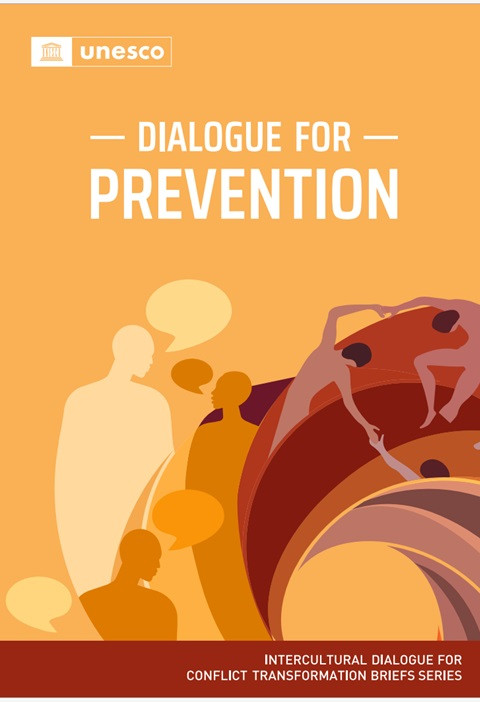 Dialogue for Prevention Year of publication: 2025 Corporate author: UNESCO In an era where geopolitical power struggles disrupt traditional peacebuilding, where identity and misinformation fuel divisions, and where trust in institutions is eroding, UNESCO’s Intercultural Dialogue for Conflict Transformation briefs series presents an adaptable, culturally grounded, and people-centred approach to peacebuilding. With 1.5 billion people living in contexts with low intercultural dialogue where global challenges such as absolute poverty, terrorism and forced displacement are more prevalent, this four-part series draws on firsthand experience, country case studies, and expert analysis to demonstrate the transformative potential of dialogue in fragile and conflict-sensitive settings. The Dialogue for Prevention brief, developed with the Auschwitz Institute for the Prevention of Genocide and Mass Atrocities, explores the powerful role intercultural dialogue can play in preventing large-scale identity-based violence, particularly in the upstream and downstream phases of conflict. Grounded in the idea that dialogue can bridge divides and foster mutual understanding, the brief argues that enabling environments for intercultural dialogue—marked by stability, inclusive governance, freedom of expression, horizontal equality, and social cohesion—also mitigate key risk factors for atrocity violence. Drawing on diverse examples from Cambodia, Colombia, Italy, and Kenya, it showcases creative, context specific applications of dialogue. Through practical guidance, the brief equips policymakers, practitioners and civil society seeking to embed dialogue into prevention strategies.
 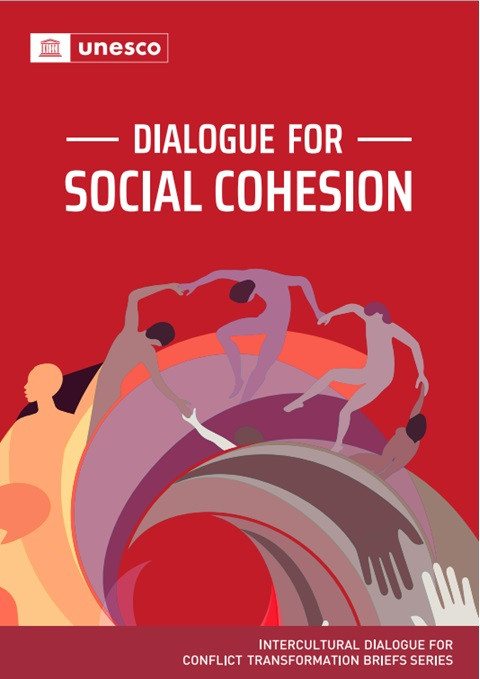 Dialogue for Social Cohesion Year of publication: 2025 Author: Isaure Vicarini | Euan Mackway-Jones Corporate author: UNESCO In an era where geopolitical power struggles disrupt traditional peacebuilding, where identity and misinformation fuel divisions, and where trust in institutions is eroding, UNESCO’s Intercultural Dialogue for Conflict Transformation briefs series presents an adaptable, culturally grounded, and people-centred approach to peacebuilding. With 89% of conflicts worldwide occurring in countries with limited capacity for intercultural dialogue, this four-part series draws on firsthand experience, country case studies, and expert analysis to demonstrate the transformative potential of dialogue in fragile and conflict-sensitive settings. The Dialogue for Social Cohesion brief—developed in collaboration with the Berghof Foundation and Search for Common Ground—bridges theory and practice to explore the horizontal (community-to-community) and vertical (citizen-to-state) dimensions of social cohesion and highlights how inclusive dialogue can support both. Case studies from Afghanistan, Germany, Somalia, and South Sudan illustrate how dialogue—whether through theatre, education, local governance, or environmental peacebuilding—can cultivate mutual understanding and trust, bridge identity-based divides, and restore, step by step, the social fabric in fractured societies. Through actionable recommendations, this brief equips practitioners, policymakers, and civil society with the essential guidance needed to tailor and embed dialogue in their respective contexts, helping to ensure that peace processes are inclusive, locally driven, and enduring.
 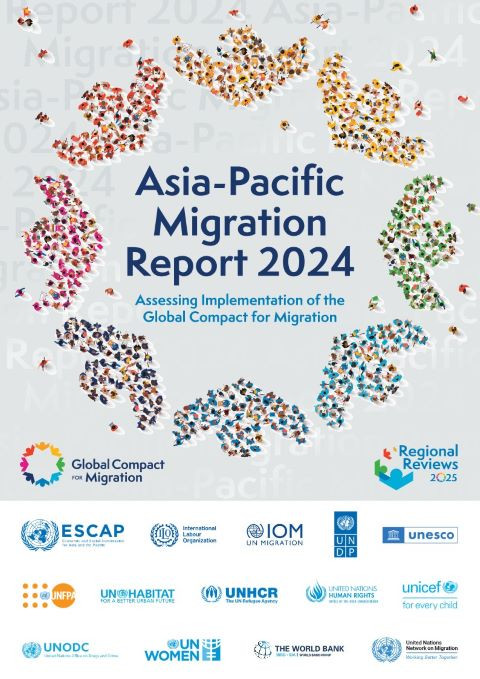 Asia-Pacific Migration Report 2024: Assessing Implementation of the Global Compact for Migration Year of publication: 2024 Corporate author: UN. Economic and Social Commission for Asia and the Pacific (UN. ESCAP) | International Labour Organization (ILO) | International Organization for Migration (IOM) | UN. Office of the United Nations High Commissioner for Human Rights (UN. OHCHR) | United Nations Centre for Human Settlement Programme (UN Habitat) | United Nations Entity for Gender Equality and the Empowerment of Women (UN Women) | United Nations Development Programme (UNDP) | UNESCO | UN. Office of the United Nations High Commissioner for Refugees (UNHCR) | UN. Office on Drugs and Crime (UNODC) | World Bank This report aims to assess the state of GCM implementation in the region, its progress and its challenges since the first Asia-Pacific Regional Review of Implementation of the Global Compact for Migration in 2021, in which a Chair’s summary was adopted. Chapters 2 to 5 each consider clusters of GCM objectives, as presented in General Assembly resolution 73/326 and following the same groupings as in the Asia-Pacific Migration Report (APMR) 2020. These chapters open with a summary of the discussions from the first regional review of the GCM, held in 2021, drawing from the Chair’s summary. Chapter 6 provides overarching recommendations to support and accelerate GCM implementation in Asia and the Pacific. At the end of the report are annexes with information on the GCM objectives and guiding principles, references to migration in Voluntary National Reviews to the High-Level Political Forum on Sustainable Development, and GCM pledges at the level of the State or City, Municipality and Local Authority.
  Assessment for Advocacy to Transform Communities, Programmes and Policies in the Global South Year of publication: 2024 Corporate author: UNESCO | Global Education Monitoring Report Team | PAL Network This paper was commissioned by the Global Education Monitoring Report as background information to assist in drafting the 2024 Spotlight Report on basic education completion and foundational learning in Africa. It has not been edited by the team. The views and opinions expressed in this paper are those of the author(s) and should not be attributed to the Global Education Monitoring Report or to UNESCO. The papers can be cited with the following reference: “Paper commissioned for the 2024 Spotlight Report on basic education completion and foundational learning in Africa”.