
Resources
Explore a wide range of valuable resources on GCED to deepen your understanding and enhance your research, advocacy, teaching, and learning.
2,772 Results found
 Lutte contre la violence de genre en milieu scolaire: orientations mondiales: Year of publication: 2016 Corporate author: UNESCO | United Nations Entity for Gender Equality and the Empowerment of Women (UN Women) More than 246 million children are subjected to gender-based violence in or around schools every year. This is a violation of their human rights, and a form of gender-discrimination that has far-reaching physical, psychological and educational consequences. Ending schoolrelated gender-based violence (SRGBV) is a priority for countries wishing to achieve ambitious global goals on inclusive and quality education for all and gender equality.WHAT IS THE AIM OF THIS GUIDANCE? This guidance aims to provide a comprehensive, one-stop resource on school-related gender-based violence (SRGBV), including clear, knowledge-based operational guidance, diverse case studies drawn from examples of promising practice and recommended tools for the education sector and its partners working to eliminate gender-based violence. It distils programme knowledge based on existing global literature, promising practices, expert recommendations and practitioner consensus.WHO IS THIS GUIDANCE FOR? The primary audience for this global guidance is the national education sector, including government policy-makers, education ministries, school administrators, educators and other school staff. The guidance may also have wider interest for other national and international stakeholders that are interested in addressing SRGBV, including NGOs, bilateral and multilateral agencies, teachers’ trade unions and policy-makers in other domestic sectors. The guidance is intended primarily for use in low- and middle-income settings, but is based on norms and principles that are universally applicable.WHAT IS COVERED IN THIS GUIDANCE? Promising practice case studies and recommended tools are embedded throughout the relevant sub-sections of the guidance. These provide readers with illustrative examples of implementation in real-life contexts and can serve as resources that have been successfully used – and can be adapted – for application in different contexts.This guidance complements other existing tools and materials for specific bilateral, multilateral and NGO audiences on violence against women and girls, and violence in schools. An expanded online version, which will be regularly updated, is available at www.endvawnow.org
 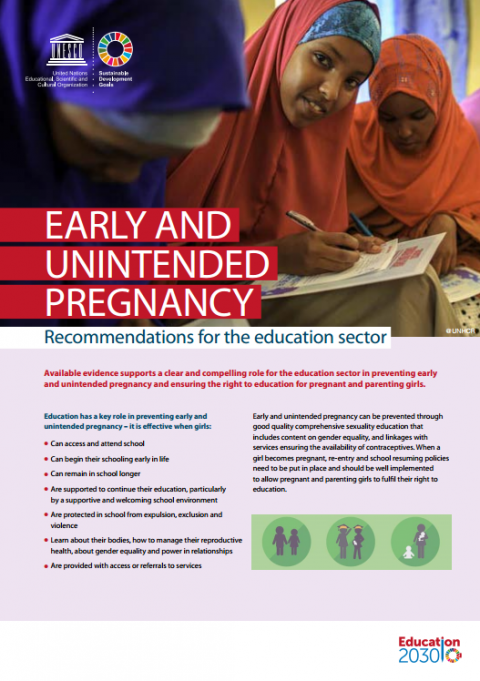 Early and unintended pregnancy: recommendations for the education sector Year of publication: 2017 Corporate author: Organisation des Nations Unies pour l'éducation, la science et la culture (UNESCO) Early and unintended pregnancy (EUP) is a major concern in many countries. It has a major impact on the lives of adolescents – especially girls – in terms of their health, social, economic and education outcomes. This brief contains the summary of recommendations from an evidence review to support the education sector to prevent and respond to EUP.
 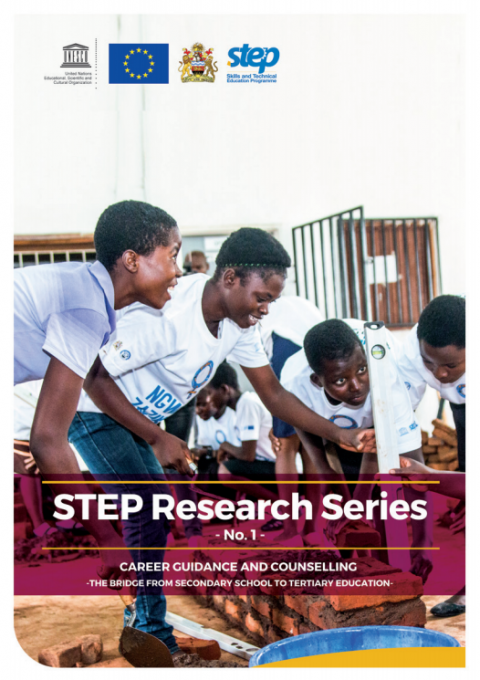 Career guidance and counselling: the bridge from secondary school to tertiary education; a review of current guidance and counselling programmes and practices in Malawi and their support in promoting technical and vocational training for girls Year of publication: 2017 Corporate author: UNESCO The objective of this report is to identify and review existing career G&C programmes and practices in secondary schools in Malawi. The review assesses to what extent such programmes and practices create an awareness of the importance of technical careers and how graduates from the secondary schools can access TEVET. Additionally, it assesses whether any affirmative action measures or approaches are used to increase girls’ interest in and applications to enter technical colleges.
  School-related gender-based violence: global guidance (Infographic) Year of publication: 2016 Corporate author: UNESCO | United Nations Entity for Gender Equality and the Empowerment of Women (UN Women) School-related gender-based violence: global guidance (Infographic) Lutte contre la violence de genre en milieu scolaire: orientations mondiales (Infographique) Year of publication: 2016 Corporate author: UNESCO | United Nations Entity for Gender Equality and the Empowerment of Women (UN Women) Lutte contre la violence de genre en milieu scolaire: orientations mondiales (Infographique)
 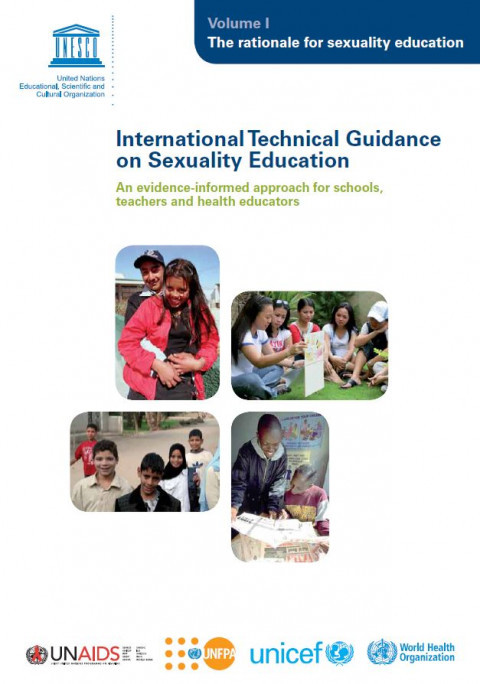 Orientaciones Técnicas Internacionales sobre Educación en Sexualidad: un enfoque basado en evidencia orientado a escuelas, docentes y educadores de la salud Year of publication: 2009 Corporate author: UNESCO El presente documento Orientaciones Técnicas Internacionales, basado en un riguroso análisis de la evidencia existente sobre programas de educación en sexualidad, está orientado a profesionales y a personas responsables de la toma de decisiones de los sectores salud y educación. Este documento (Volumen 1) se centra en aquellos elementos que justifican la educación en sexualidad y ofrece sólidas recomendaciones técnicas sobre las características que todo programa efectivo debe tener. El documento acompañante (Volumen 2) cubre los temas y objetivos de aprendizaje que se deben abordar en los diferentes tramos etarios en un programa básico de educación en sexualidad destinado a niños, niñas y jóvenes entre las edades de 5 a 18 y más años e incluye una bibliografía de referencias. El documento Orientaciones Técnicas Internacionales es relevante no sólo para los países más afectados por el VIH y el SIDA, sino también para los que exhiben una epidemia de baja prevalencia y alta concentración. Principes directeurs internationaux sur l'éducation sexuelle: une approche factuelle à l'intention des établissements scolaires, des enseignants et des professionnels de l'éducation à la santé Year of publication: 2009 Corporate author: UNESCO S’appuyant sur un examen rigoureux et actuel des donnees de programmes d’education sexuelle, ces Principes directeurs internationaux sur l’education sexuelle s’adressent aux decideurs et professionnels des secteurs de l’education et de la sante. Ils sont destines a aider les autorites en charge de ces deux secteurs et autres secteurs connexes a elaborer et mettre en oeuvre des programmes et des materiels d’education sexuelle en milieu scolaire. Le Volume I met l’accent sur le bien-fonde d’une education sexuelle et fournit des conseils techniques avises sur les caracteristiques des programmes efcaces. Il s’accompagne d’un document parallele (Volume II) qui decrit les themes a aborder et les objectifs d’apprentissage a atteindre dans le cadre d’un ‘cours de base minimum’ d’education sexuelle destine aux enfants et aux jeunes ages de 5 a 18 ans et plus, et qui contient une bibliographique de ressources utiles. Ces Principes directeurs internationaux sont d’une grande utilite non seulement pour les pays les plus affectes par le VIH et le SIDA, mais aussi pour les pays qui connaissent une prevalence faible et un contexte d’epidemie concentree.
 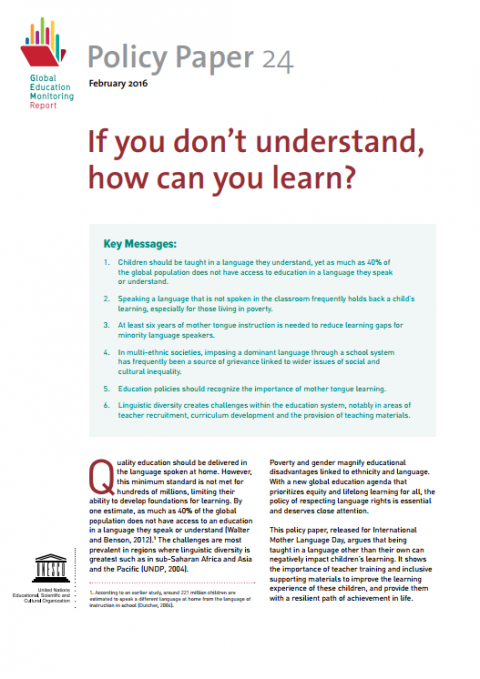 فيكف مهفت لا تنك اذإ ؟مَّلعتت نأ كل Year of publication: 2016 Corporate author: UNESCO Key Messages:1. Children should be taught in a language they understand, yet as much as 40% of the global population does not have access to education in a language they speak or understand.2. Speaking a language that is not spoken in the classroom frequently holds back a child’s learning, especially for those living in poverty.3. At least six years of mother tongue instruction is needed to reduce learning gaps for minority language speakers.4. In multi-ethnic societies, imposing a dominant language through a school system has frequently been a source of grievance linked to wider issues of social and cultural inequality.5. Education policies should recognize the importance of mother tongue learning. 6. Linguistic diversity creates challenges within the education system, notably in areas of teacher recruitment, curriculum development and the provision of teaching materials. 听不懂,怎能学会? Year of publication: 2016 Corporate author: UNESCO Key Messages:1. Children should be taught in a language they understand, yet as much as 40% of the global population does not have access to education in a language they speak or understand.2. Speaking a language that is not spoken in the classroom frequently holds back a child’s learning, especially for those living in poverty.3. At least six years of mother tongue instruction is needed to reduce learning gaps for minority language speakers.4. In multi-ethnic societies, imposing a dominant language through a school system has frequently been a source of grievance linked to wider issues of social and cultural inequality.5. Education policies should recognize the importance of mother tongue learning. 6. Linguistic diversity creates challenges within the education system, notably in areas of teacher recruitment, curriculum development and the provision of teaching materials.
 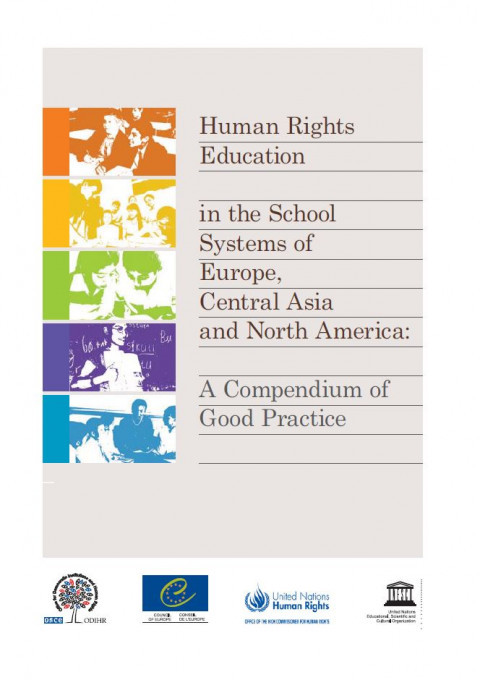 Образование в области прав человека в школьной системе Европы, Центральной Азии и Северной Америки: сборник примеров успешных практик Year of publication: 2009 Corporate author: Council of Europe | UNESCO | UN. Office of the United Nations High Commissioner for Human Rights (UN. OHCHR) | OSCE. Office for Democratic Institutions and Human Rights (ODIHR) Сборник примеров успешных практик «Образование в области прав человека в школьной системе Европы, Центральной Азии и Северной Америки» включает 101 пример успешных практик в сфере образования в области прав человека в начальной, средней школе и в педагогических учебных заведениях в регионе ОБСЕ, на который также распространяются полномочия ЮНЕСКО, УВКПЧ ООН и, частично, географический мандат СЕ.Настоящее издание состоит из пяти основных разделов:Раздел I. Законодательные акты, руководящие принципы и стандарты; Раздел II. Подходы и практики улучшения учебной атмосферы; Раздел III. Учебные пособия для преподавателей и учащихся; Раздел IV. Повышение квалификации преподавателей; Раздел V. Методы оценки.Образование в области прав человека определяют как образование, обучение и информирование, направленное на формирование всеобщей культуры прав человека. Комплексное образование в области прав человека дает не только знания о правах человека и действующих механизмах их защиты, но и навыки, необходимые для продвижения, защиты и реализации прав человека в повседневной жизни. Воспитание демократической гражданственности нацелено на осуществление образовательных практик и мероприятий, призванных помочь молодым людям и взрослым принимать активное участие в жизни общества, основанного на принципах демократии, а также осуществлять свои права и обязанности в обществе. Воспитание в духе взаимного уважения и понимания подчеркивает важность самоуважения, уважения других людей и улучшения отношений между людьми, представляющими различные культурные традиции.Настоящая книга задумана как средство поддержки качества обучения в этих областях, как стимул для лиц, ответственных за формирование политики в области образования (сотрудников министерств образования и местных школьных советов), директоров, учителей, преподавателей педагогических учебных заведений, преподавателей, специалистов неформальной сферы образования и всех других заинтересованных лиц, а также как инструмент, содействующий формированию сетей и обмену опытом между специалистами в сфере образования.