
Resources
Explore a wide range of valuable resources on GCED to deepen your understanding and enhance your research, advocacy, teaching, and learning.
2,772 Results found
 2030年教育:仁川宣言和行动框架实现可持续发展目标4——确保包容和公平的优质教育,让全民终身享有学习机会 Year of publication: 2016 Corporate author: UNESCO 《仁川宣言》阐明了国际社会在全球教育方面的集体愿景和承诺。“2030年行动框架”为可持续发展目标4的实施提供了指导。
  Collection des meilleures pratiques en éducation pour une citoyenneté mondiale en Afrique centrale Year of publication: 2015 Corporate author: UNESCO This collection of best practices in human rights education in Central Africa and Ethiopia was prepared in order to respond to UNESCO’s demand to promote such initiatives and to ensure a multiplier effect considering human rights education in the region. The objective is to support the concept of UNESCO’s ‘Global Citizenship Education’ in the field of human rights education in identifying its best practices. In order to identify the best practices, UNESCO’s activities in the field of human rights education in the region were mapped out. This mapping out has shown big differences in implementing the initiatives focused on achieving global citizenship education through human rights education, particularly in primary and secondary education, as indicated in the first phase of the World Programme for human rights education. Nevertheless, various initiatives collected are either conducted/supported by UNESCO or not, in terms of three themes: citizenship education, intercultural dialogue, and the peace and security which are considered to be relevant to Africa in general and particularly to Central Africa, in order to address the main theme of global citizenship education. The selected best practices deal with the tertiary level and are in line with the second phase of the World Programme for human rights education, covering the period between 2009 and 2014 and focusing on higher and vocational education. The practices include 1) citizenship education which supports the principles set out in the Universal Declaration of Human Rights and which is reiterated in the two phases of the World Programme for human rights education, 2) the intercultural dialogue which supports education for understanding and evaluating unity in diversity, and which fits well with the objectives of the UN Decade of Education for Sustainable Development proclaimed by the UN General Assembly and managed by UNESCO, and 3) education for peace and security.It is obvious that many linkages exist among the three subjects mentioned above. Therefore, the examples presented in this collection can affect one or several problems. Each example is presented with the following sequence: identification, background, implementation, and results.
  Investing in Cultural Diversity and Intercultural Dialogue: UNESCO World Report Year of publication: 2009 Corporate author: UNESCO This report analyzes all aspects of cultural diversity, which has emerged as a key concern of the international community in recent decades, and maps out new approaches to monitoring and shaping the changes that are taking place. It highlights, in particular, the interrelated challenges of cultural diversity and intercultural dialogue and the way in which strong homogenizing forces are matched by persistent diversifying trends. The report proposes a series of ten policy-oriented recommendations, to the attention of States, intergovernmental and non-governmental organizations, international and regional bodies, national institutions and the private sector on how to invest in cultural diversity.Emphasizing the importance of cultural diversity in different areas (languages, education, communication and new media development, and creativity and the marketplace) based on data and examples collected from around the world, the report is also intended for the general public. It proposes a coherent vision of cultural diversity and clarifies how, far from being a threat, it can become beneficial to the action of the international community. Investir dans la diversité culturelle et le dialogue interculturel: rapport mondial de l'UNESCO Year of publication: 2009 Corporate author: Organisation des Nations Unies pour l'éducation, la science et la culture (UNESCO) Au carrefour de la réflexion intellectuelle, scientifique et politique, ce second Rapport mondial vise à faire le point sur tout ce qui se dit, se pense et se fait au nom de la diversité culturelle, et à identifier les conditions nécessaires pour faire de la diversité un atout et non une menace, une source de renouveau pour les politiques publiques au service du développement, de la cohésion sociale et de la paix.Ce Rapport mondial vise à dresser un état des lieux des enjeux de la diversité culturelle, à examiner un certain nombre d’idées reçues et à proposer des recommandations opérationnelles dans un certain nombre de domaines transversaux tels que les identités et le dialogue, l’avenir des langues et l’éducation interculturelle, le pluralisme des médias et des industries culturelles, le monde de l’entreprise, les savoirs locaux, la biodiversité, le développement durable, la gouvernance et les droits de l’homme. Invertir en la diversidad cultural y el diálogo intercultural: informe mundial de la UNESCO Year of publication: 2009 Corporate author: Organización de las Naciones Unidas para la Educación, la Ciencia y la Cultura (UNESCO) La diversidad cultural ha comenzado a suscitar un interés fundamental al iniciarse el nuevo siglo. Sin embargo, los significados que se le asignan a esta expresión "comodín" son tan variados como cambiantes. Algunos consideran que la diversidad cultural es intrínsecamente positiva, en la medida en que se refiere a un intercambio de la riqueza inherente a cada cultura del mundo y, por ende, a los vínculos que nos unen en los procesos de diálogo e intercambio. Para otros, las diferencias culturales son la causa de que perdamos de vista lo que tenemos en común en cuanto seres humanos y, por lo tanto, constituyen la raíz de numerosos conflictos.Este segundo diagnóstico resulta hoy tanto más digno de crédito cuanto que la mundialización ha aumentado los puntos de interacción y fricción entre las culturas, originando tensiones, repliegues y reivindicaciones en relación con la identidad, en particular de índole religiosa, que se convierten en fuentes potenciales de conflicto. Por consiguiente, el desafío fundamental consistiría en proponer una perspectiva coherente de la diversidad cultural y, por su conducto, aclarar cómo, lejos de ser una amenaza, puede contribuir a las medidas que adopte la comunidad internacional. Éste es el objetivo esencial del presente informe.
  Reaching the Unreached: Indigenous Intercultural Bilingual Education in Latin America Year of publication: 2009 Author: Luis Enrique López Corporate author: UNESCO The paper focuses on the educational situation of the most marginalized children and adolescents in Latin America: those belonging to indigenous homes and communities. To illustrate indigenous marginalization and exclusion as well as the development of intercultural bilingual education (IBE) six countries have been chosen: Bolivia, Ecuador, Guatemala, Mexico, Paraguay and Peru. Atteindre les exclus: indigène éducation interculturelle bilingue en Amérique latine Year of publication: 2009 Author: Luis Enrique López Corporate author: UNESCO Le document met l'aCECnt sur la situation de l'éducation des enfants les plus marginalisés et les adolescents en Amérique latine: ceux appartenant à des foyers et des communautés autochtones. Pour illustrer la marginalisation et l'exclusion des autochtones ainsi que le développement de l'éducation interculturelle bilingue (BIE) six pays ont été choisis: la Bolivie, l'Equateur, le Guatemala, le Mexique, le Paraguay et le Pérou.
 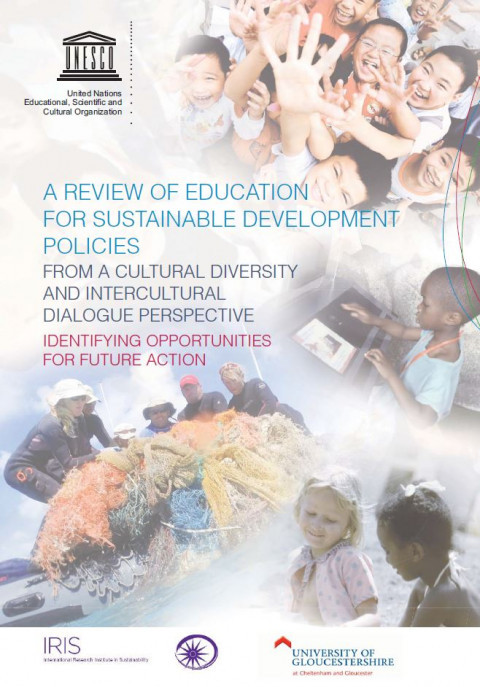 A Review of education for sustainable development policies from a cultural diversity and intercultural dialogue perspective: identifying opportunities for future action Year of publication: 2009 Author: Daniella Tilbury | I. Mulà Corporate author: UNESCO This review highlights the striking absence of culture in ESD, a gap also acknowledged by participants at the UNESCO World Conference on Education for Sustainable Development held in Bonn, Germany, from 31 March to 2 April 2009. The final declaration emphasizes that ESD is about 'creative and critical approaches, long-term thinking, innovation and empowerment for dealing with uncertainty', and for solving complex problems, highlighting in particular the interdependence of environment, economy, society, and cultural diversity from local to global levels. The review and its methodology provide an instructive example of ways to articulate the linkages between cultural diversity, intercultural dialogue and ESD, required for a sustainable future. Un examen de l'éducation pour les politiques de développement durable à partir d'une diversité culturelle et de la perspective d'un dialogue interculturel: l'identification des possibilités d'action future Year of publication: 2009 Author: Daniella Tilbury | I. Mulà Corporate author: Organisation des Nations Unies pour l'éducation, la science et la culture (UNESCO) Cet avis met en évidence l'absence frappante de la culture dans l'EDD, un écart aussi reconnu par les participants auconférencemondial de l'UNESCO sur l'éducation pour le développement durable tenu à Bonn, en Allemagne, du 31 Mars au 2 Avril 2009. La déclaration finale souligne que l'EDD est sur ' approches créatives et critiques, la pensée à long terme, l'innovation et l'autonomisation pour faire face à l'incertitude », et pour résoudre des problèmes complexes, en soulignant en particulier l'interdépendance de l'environnement, l'économie, la société et la diversité culturelle du niveau local au niveau mondial. L'examen et sa méthodologie fournissent un exemple instructif de façons d'articuler les liens entre la diversité culturelle, le dialogue interculturel et EDD, nécessaire pour un avenir durable.
  Proceedings of the international congresses of: education for shared values for intercultural and interfaith understanding, (and) religion in peace and conflict: responding to militancy and fundamentalism Year of publication: 2005 Corporate author: UNESCO The results of this conference, and its direct linkages with the Associated Schools Project Network in your region, will support efforts to mould education so that it becomes more conducive to the development of world citizens, proud of their identities and able to contribute to a sustainable and peaceful future for the world’s peoples.