
Resources
Explore a wide range of valuable resources on GCED to deepen your understanding and enhance your research, advocacy, teaching, and learning.
3,797 Results found
 2022 세계시민교육 보고서: 국제 수업 교류 사례 및 세계시민교육 교원학습공동체 연구 자료 Year of publication: 2022 Corporate author: 서울특별시교육청 2022 세계시민교육 보고서는 크게 두 파트로 나누어 Part.1에서는 국내 12개 초·중·고등학교의 국제 수업 교류 사례와 수업설계, 학습지도안 활동사진 등을 담고 있고 Part. 2에서는 수달스, 더불어 평화 등 5개 세계시민교육 교원학습공동체의 연구 자료를 수록하고 있다.
  초등 글로벌 이슈 중심 사회과 프로젝트 수업이 세계시민성 함양에 미치는 영향 (시민교육연구; Vol. 56, No. 2) Year of publication: 2024 Author: 오고은 Corporate author: 한국사회과교육학회 오늘날 세계화로 인해 상호 의존성과 연결성이 극도로 심화된 상황에서 한 국가의 힘만으로는 해결하기 어려운 여러 글로벌 이슈들이 나타나게 되었다. 이러한 상황에서 사회과의 세계시민교육은 학생들이 글로벌 이슈를 해결하고 세계를 더욱 정의로운 곳으로 만들기 위해 행동할 수 있도록 하는 세계시민성을 함양해야 할 역할을 담당하고 있다. 본 연구는 이에 대응하여 초등학생들의 세계시민성을 함양할 수 있도록 하는 사회과의 효과적인 교수-학습 방법을 제시하고자 하였다. 이를 위해 사회과 프로젝트 수업과 이슈 중심 수업(쟁점 중심 수업)을 결합하여 글로벌 이슈 중심 사회과 프로젝트 수업을 제안하였다. 이 수업은 학생 중심으로 글로벌 이슈를 심도 깊게 탐구하고 이를 해결할 수 있는 실천 경험을 풍부하게 제공하여 세계시민성의 인지, 사회-정서, 행동적 영역을 총체적으로 향상시킬 것으로 예상되었다. 실제로 수업 실험을 한 결과, 실험 집단 학생들의 세계시민성을 이루는 인지, 사회-정서, 행동적 영역의 전 영역에서 세계시민성 지표 점수가 향상된 것을 확인할 수 있었다. 이는 글로벌 이슈 중심 사회과 프로젝트 수업이 학생들이 세계화의 시대에 갖추어야 하는 세계시민성을 총체적으로 함양하는 데 매우 효과적인 방식임을 보여준다. 특히, 공교육 상황에서 주로 활용되는 강의식 수업과의 비교에서도 글로벌 이슈 중심 사회과 프로젝트 수업이 세계를 더욱 정의로운 곳으로 변화시키는 역량인 세계시민성의 행동적 영역을 더욱 효과적으로 향상시키는 것으로 나타났다. 결론적으로, 오늘날 세계에서 행동적 영역의 세계시민성 함양이 더욱 강조되는 상황에 비추어, 본 연구에서 제시하는 글로벌 이슈 중심 사회과 프로젝트 수업을 세계시민교육에서 더욱 적극적으로 활용해야 할 당위성이 제기된다.
  유아교사들의 유아세계시민교육 인식과 실천 방안 탐색 (교육문화연구; Vol. 30, No. 3) Year of publication: 2024 Author: 나예원 | 김고은 Corporate author: 인하대학교 교육연구소 본 연구는 유아교사들의 유아세계시민교육에 대한 인식과 실천 방안에 대해 질적으로 탐색하는 것을 목적으로 하였다. 이를 위해 현장에서 유아세계시민교육을 실행하고 있는 유아교사 5명을 대상으로 개별 심층면담을 2회 실시하였다. 구조적 코딩과 내성 코딩을 사용하여 수집된 자료로부터 개념을 도출하고, 반복적으로 재범주화를 수행하여 최종 주제를 도출하였다. 분석 결과, 유아교사들은 아는 만큼 세계시민교육이 달라지며, 유아세계시민교육이 포괄적인 내용을 담고 있어 다른 교육들과의 연결 속에서 교육과정 전 과정에서 통합적으로 접근할 필요가 있다고 인식하였다. 또한 유아교사들은 이러한 유아세계시민교육이 모든 연령의 유아를 위한 교육이라고 인식하고 있었다. 구체적인 실천 방안을 살펴보면, 유아교사들은 유아의 관심을 파악하고, 관심을 더 끌어내기도 하며, 학급의 문제에 유아를 참여시키고, 세계시민교육의 핵심 개념을 짚어주고, 일상에서 가르칠만한 순간을 적절히 활용하는 것으로 나타났다. 본 연구 결과는 유아교사의 목소리를 통해 유아교육현장에 적합한 세계시민교육 적용 가능성 및 구체적인 방안에 대한 시사점을 얻고 교사 지원방안을 마련하는 데 기반을 제공해 준다는 점에서 의의가 있다.
  대학생의 세계시민교육을 통한 세계시민성 형성에 관한 연구 (교육문화연구; Vol. 30, No. 3) Year of publication: 2024 Author: 박선영 Corporate author: 인하대학교 교육연구소 본 연구는 대학생들이 전 지구적 문제 해결에 중추적 역할을 수행하고, 이를 위한 역량을 함양하는 대학의 세계시민교육필요성을 중심으로 세계시민교육의 중요성과 효과를 분석하고자 하였다. 연구는 '세계시민교육의 이해'라는 교양과목을수강한 학생 35명을 대상으로 교육 전후의 세계시민성 변화를 설문조사와 개인 성찰 에세이를 통해 분석하였다. 그 결과, 세계시민성 구성요소인 지식, 기술, 태도, 실천의지 모든 변인에서 통계적으로 유의미한 향상이 관찰되었다. 특히 기술과 실천의지의 향상이 두드러졌으며, 이는 팀 프로젝트를 통한 문제 해결 방안 마련이라는 교수학습 방법의영향으로 나타났다. 개인성찰 에세이 분석 결과 학생들은 학습 과정에서 세상 문제에 관한 관심 제고, 무지에 대한반성과 성찰, 비판적 관점 형성, 세계시민으로서의 정체성과 소속감 형성, 공동선을 위한 행동의지 발현, 문제 해결과정에서 느낀 자긍심, 팀 활동을 통해 배운 협력의 중요성을 성찰하였다. 본 연구는 문제 해결 팀 프로젝트 교수법의세계시민교육이 대학생의 세계시민성을 효과적으로 함양할 수 있는 중요한 교육 방법임을 시사한다.
 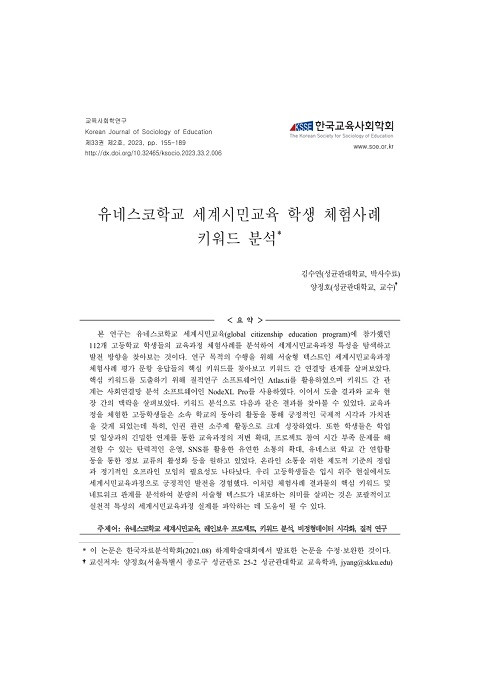 유네스코학교 세계시민교육 학생 체험사례 키워드 분석 (교육사회학연구; Vol. 33, No. 2) Year of publication: 2023 Author: 김수연 | 양정호 Corporate author: 한국교육사회학회 본 연구는 유네스코학교 세계시민교육(global citizenship education program)에 참가했던 112개 고등학교 학생들의 교육과정 체험사례를 분석하여 세계시민교육과정 특성을 탐색하고 발전 방향을 찾아보는 것이다. 연구 목적의 수행을 위해 서술형 텍스트인 세계시민교육과정 체험사례 평가 문항 응답들의 핵심 키워드를 찾아보고 키워드 간 연결망 관계를 살펴보았다. 핵심 키워드를 도출하기 위해 질적연구 소프트웨어인 Atlas.ti를 활용하였으며 키워드 간 관계는 사회연결망 분석 소프트웨어인 NodeXL Pro를 사용하였다. 이어서 도출 결과와 교육 현장 간의 맥락을 살펴보았다. 키워드 분석으로 다음과 같은 결과를 찾아볼 수 있었다. 교육과정을 체험한 고등학생들은 소속 학교의 동아리 활동을 통해 긍정적인 국제적 시각과 가치관을 갖게 되었는데 특히, 인권 관련 소주제 활동으로 크게 성장하였다. 또한 학생들은 학업 및 일상과의 긴밀한 연계를 통한 교육과정의 저변 확대, 프로젝트 참여 시간 부족 문제를 해결할 수 있는 탄력적인 운영, SNS를 활용한 유연한 소통의 확대, 유네스코 학교 간 연합활동을 통한 정보 교류의 활성화 등을 원하고 있었다. 온라인 소통을 위한 제도적 기준의 정립과 정기적인 오프라인 모임의 필요성도 나타났다. 우리 고등학생들은 입시 위주 현실에서도 세계시민교육과정으로 긍정적인 발전을 경험했다. 이처럼 체험사례 결과물의 핵심 키워드 및 네트워크 관계를 분석하여 분량의 서술형 텍스트가 내포하는 의미를 살피는 것은 포괄적이고 실천적 특성의 세계시민교육과정 실제를 파악하는 데 도움이 될 수 있다.
  Leave No One Behind Year of publication: 2016 Corporate author: Global Goals At the heart of the Sustainable Development Goals is a commitment to leave no one behind. That’s because, although we have made huge progress towards a better world, too many people have been left behind because of who they are or where they live.
  Neither Villains Nor Victims: Towards an Educational Perspective on Radicalisation Year of publication: 2015 Author: Stijn Sieckelincka, Femke Kaulingfreksb, Micha de Wintera This study questions whether the perspectives of security and intelligence serve educators well enough in the early stages of radicalization. Assigned to signal deviant behaviour, educators are unwittingly drawn into a villain-victim imagery of their students. This imagery seems to impede a genuine educational outlook on radicalization. Key notions of this outlook may be ‘critically addressing ideals’ and ‘forming pedagogical coalitions’. Neither Villains Nor Victims: Towards an Educational Perspective on Radicalisation Year of publication: 2015 Author: Stijn Sieckelincka, Femke Kaulingfreksb, Micha de Wintera Cette étude cherche à déterminer si les perspectives de sécurité et de renseignement sont vraiment utilisées à bon escient par les éducateurs dans les premiers stades de la radicalisation. Chargé de signaler les comportements déviants, les éducateurs sont amenés à se représenter leurs étudiants comme des "méchants" ou des victimes. Cette perspective empêche de porter un regard pertinent sur la radicalisation dans le milieu éducatif. Deux éléments-clés pour développer une approche plus adaptée consistent à porter un regard critique sur les idéaux et former des "coalitions" pédagogiques.
  Global citizenship education: citizenship education for globalizing societies Year of publication: 2015 Author: Werner Wintersteiner | Heidi Grobbauer | Gertraud Diendorfer | Susanne Reitmair-Juárez Corporate author: Austrian Commission for UNESCO This text reflects the work we have been doing for many years in the area of Global Citizenship Education (GCED) in Austria. Two endeavors particularly stand out: first, the continuing Masters programme GCED at the Alps-Adriatic University (Alpen-Adria Universität) in Klagenfurt, which is a specialized course of study for educationalists, teacher trainers, NGO associates and teachers (participants may either graduate with a certificate after two years or an MA degree after three years respectively), and second, our cooperation with the Austrian UNESCO Associated Schools Project Network. This was the originally intended audience for the German version of this brochure, which constitutes the programmatic basis for our training programs. We understand GCED as a concept that is located at the interface between civic education, global education and peace education, as well as education for sustainable development and intercultural learning. Our approach is characterized by these four features:* theoretical grounding and a particular focus on terminology in order to foster competence of judgment regarding political concepts* investigating the historical dimension of GCED in depth in order to account for colonialism and neocolonialism* socio-critical orientation in order to set us apart from strands of GCED that ultimately perpetuate concepts of Western hegemony* didactic implementation that is systematic and based on appropriate theoretical work in order to avoid pragmatismWith this English edition (the section specific to the Austrian context was omitted) we wish to initiate a dialog with colleagues in the whole world and hope to engage in lively exchange. Education à la citoyenneté mondiale: éducation à la citoyenneté pour les sociétés de mondialisation Year of publication: 2015 Author: Werner Wintersteiner | Heidi Grobbauer | Gertraud Diendorfer | Susanne Reitmair-Juárez Corporate author: Austrian Commission for UNESCO Ce texte reflète le travail que nous faisons depuis de nombreuses années dans le domaine de l'éducation à la citoyenneté mondiale (ECM) en Autriche. Deux projets se démarquent particulièrement: d'abord, le programme de maîtrise ECM à l'Université alpine-adriatique de Klagenfurt, qui est un cours spécialisé pour les pédagogues, les formateurs d'enseignants, les associés des ONG et les enseignants (les participants peuvent soit être diplômés Avec un certificat après deux ans ou un MA après trois ans respectivement), et deuxièmement, notre coopération avec le Réseau autrichien du projet des écoles associées de l'UNESCO. Il s'agissait du public initialement destiné à la version allemande de cette brochure, qui constitue la base programmatique de nos programmes de formation. Nous considérons l'ECM comme un concept situé à l'interface entre éducation civique, éducation globale et éducation à la paix, ainsi que l'éducation pour le développement durable et l'apprentissage interculturel. Notre approche se caractérise par ces quatre caractéristiques: fondement théorique et un accent particulier sur la terminologie afin de favoriser la compétence de jugement sur les concepts politiques étudier la dimension historique de l'ECM en profondeur afin de rendre compte du colonialisme et néocolonialisme orientation socio-critique afin Nous distinguent des filières de l'ECM qui, en fin de compte, perpétuent les concepts d'une mise en œuvre didactique de l'hégémonie occidentale systématique et basée sur un travail théorique approprié pour éviter le pragmatisme. Avec cette édition en anglais (la section spécifique au contexte autrichien a été omis), nous souhaitons initier un dialogue avec des collègues dans le monde entier et espérer engager des échanges animés.