
Resources
Explore a wide range of valuable resources on GCED to deepen your understanding and enhance your research, advocacy, teaching, and learning.
3,446 Results found
 Gender Inequality in Education and its Impact on Economic Growth in Algeria: An Applied Study for the Period (1980-2014) Year of publication: 2017 Author: Latifa Al-Sabti | Taleb Warrad Corporate author: University of Jordan Most of the developing countries suffer from gender inequality in education, health, employment opportunities, wages and opportunities of representation and political empowerment. It was found that this inequality - according to the findings of most previous studies on this topic- had a negative effect on economic growth. As economic growth is one of the important macroeconomic goals, this has induced the researcher to investigate the relationship between them in Algeria. This study aimed mainly at investigating the impact of gender inequality in education on the economic growth in Algeria, using annual data covering the period from 1980 to 2014, in order to achieve this objective, an econometric model has been designed based on the economic theories and the published researches, using data obtained from the World Bank's (WB) and UNESCO websites. The Results of the econometric analysis showed the existence of significant positive relationship between gender inequality in secondary education and economic growth in Algeria (which means that there is a gender equality in secondary education enrollment according to the definition of Gender Parity Index), and the existence of a negative significant relationship between gender inequality in primary education and economic growth in Algeria (which means that there is a gender inequality in primary education enrollment according to the definition of Gender Parity Index), also showed the presence of a positive significant relationship between each of the trade openness, physical capital and economic growth, and the presence of a negative significant relationship between labor supply and economic growth in Algeria. The study recommended the need of Algeria to work on the elimination of the causes of gender inequality in education, or at least minimizing them as much as possible because of their negative impact on economic growth, and supporting the educational system through the construction of new schools in rural and urban areas, the paving of roads to facilitate access of pupils safely to schools, equipping schools with the required means to complete the educational process as it should be, to spread awareness through various media of the importance of female education, to enact legislations that obligate the education of females, to encourage the demand for females in the labor market as an attempt to raise their rate of enrollment to education as a major determinant for getting a good job. عدم المساواة في التعليم بين الجنسين وأثرها على النمو الاقتصادي في الجزائر: دراسة تطبيقية للفترة (1980-2014) Year of publication: 2017 Author: Latifa Al-Sabti | Taleb Warrad Corporate author: University of Jordan تعاني أغلب الدول النامية من عدم المساواة بين الجنسين في التعليم، الصحة، فرص التشغيل، الأجور وفرص التمثيل والتمكين السياسي وغيرها، حيث وُجد أن هذه الأخيرة - حسب ما توصلت إليه أغلب الدراسات السابقة في هذا الموضوع-لها تأثير سلبي على النمو الاقتصادي، والذي يعد من الأهداف الاقتصادية المهمة على المستوى الكلي، ما دفع بالباحث إلى دراسة العلاقة بينهما في الجزائر.هدفت الدراسة بشكل أساسي إلى اختبار أثر عدم المساواة في التعليم بين الجنسين على النمو الاقتصادي في الجزائر، باستخدام بيانات سنوية تغطي الفترة من 1980 إلى 2014، ولتحقيق ذلك تم تصميم نموذج قياسي يستند إلى النظريات الاقتصادية والدراسات العلمية المنشورة ومن ثم تطبيقه على الجزائر، كما تم استخدام اختبارات التحليل القياسي المناسبة، أما البيانات فتم الحصول عليها من موقع البنك الدولي (WB) وموقع منظمة اليونسكو.بينت نتائج التحليل القياسي وجود علاقة إيجابية طردية ذات دلالة إحصائية بين متغير عدم المساواة بين الجنسين في التعليم الثانوي والنمو الاقتصادي في الجزائر (ما يعني أن هناك مساواة بين الذكور والإناث في الالتحاق بالتعليم الثانوي)، ووجود علاقة عكسية ذات دلالة إحصائية بين متغير عدم المساواة بين الجنسين في التعليم الابتدائي والنمو الاقتصادي في الجزائر (ما يعني أنه ليس هناك مساواة بين الذكور والإناث في الالتحاق بالتعليم الابتدائي)، كما بينت وجود علاقة طردية إيجابية ذات دلالة إحصائية بين كل من الانفتاح التجاري، رأس المال وعكسية بين عرض العمل وبين النمو الاقتصادي في الجزائر.أوصت الدراسة بضرورة العمل على القضاء على مسببات عدم المساواة في التعليم بين الجنسين في الجزائر أو على الأقل التقليل منها قدر الإمكان لما لها من أثر سلبي على النمو الاقتصادي، وذلك عن طريق دعم المنظومة التعليمية من بناء مدارس جديدة بالمناطق الريفية والنائية، تعبيد الطرقات لتسهيل وصول التلاميذ بأمان إلى المدارس، تجهيز المدارس بالوسائل اللازمة لإتمام العملية التعليمية على أكمل وجه، نشر الوعي عبر وسائل الإعلام المختلفة بأهمية تعليم الإناث، سن تشريعات بإجبارية تعليم الإناث، تشجيع الطلب على الإناث في سوق العمل كمحاولة لرفع معدل إقبالهن على التعليم باعتباره محددا أساسيا للحصول على وظيفة جيدة.
  Educational Contexts, Feminism and Gender identities of Adolescents from a Rural Mayan Town in Yucatan (Iberoamerican Journal of Education; vol. 89, no. 1) Year of publication: 2022 Author: Silvia Montejo Murillo Corporate author: Organization of Ibero-American States for Education, Science and Culture (OEI) The purpose of this article is to compare and explore the gender identity of adolescent women from a rural Mayan locality, from two of their educational contexts: the telesecundaria school and daily life in the community. Interviews and participant observation were used to obtain qualitative primary data. Among the main findings, it stands out that the institutional structure and rigidity of the school limits adolescents from being able to act at certain times from social attributes different from those offered by their locality. Likewise, the school contributed to the individualization of the participants and trained them to have foreign values as a desirable representation of “development”, aspects that do not necessarily contribute to the idea of “community”. Contextos educativos, educación e identidades de género de adolescentes de una localidad rural maya en Yucatán (Revista Ibero-americana de Educação; vol. 89, núm. 1) Year of publication: 2022 Author: Silvia Montejo Murillo Corporate author: Organización de Estados Iberoamericanos para la Educación, la Ciencia y la Cultura (OEI) El propósito de este artículo es comparar y explorar la identidad de género de mujeres adolescentes de una localidad rural maya, desde dos de sus contextos educativos: la escuela telesecundaria y la vida cotidiana en la comunidad. Se utilizaron entrevistas y observación participante para obtener los datos primarios cualitativos. Entre los principales hallazgos se destaca, que la estructura y rigidez institucional de la escuela, limita a las adolescentes poder actuar en ciertos momentos desde atributos sociales distintos a los que les ofrece su localidad. Asimismo, la escuela contribuyó a la individualización de las participantes y las formó para tener como representación deseable del “desarrollo” los valores del exterior, aspectos que no contribuyen necesariamente a la idea de “comunidad”.
  Generation Equality Accountability Report 2022 Year of publication: 2022 Corporate author: United Nations Entity for Gender Equality and the Empowerment of Women (UN Women) In the UN Decade for Action on Gender Equality, people around the world have pledged to move from rhetoric to action and to work together to drive lasting change, starting now. Through the 2021 Generation Equality Forum in Mexico and France, world leaders and partners committed to eliminating gender inequalities and to financing and implementing laws, policies, and programmes to meet priority actions and targets in a Global Acceleration Plan for Gender Equality. The aim is simple but profound: deliver irreversible, quantifiable results for women and girls in all their diversity.Together, commitment makers and signatories of a series of Action Coalitions, along with the Compact for Women, Peace and Security and Humanitarian Action have begun to build an ambitious global movement. It unites diverse partners committed to collective accountability for women and girls. This accountability is the driving force of this report, which takes stock of the bold commitments made at the Forum one year into implementation. Through a survey of commitment-makers, the report sheds light on the nature of the commitments and assesses measurable progress. It highlights trends and notes where more work is needed.Generation Equality was born from the idea that the world could make catalytic progress on gender equality if a wide range of stakeholders united around a transformative vision and worked together to achieve it. These preliminary findings demonstrate that, while more remains to be done, collective action is powerful in making commitments real in the lives of women and girls.
 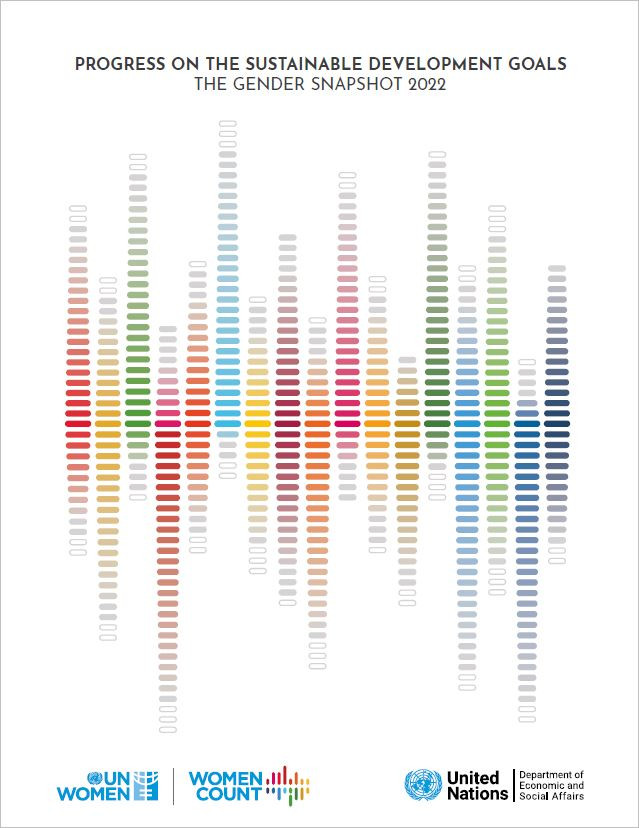 Progress on the Sustainable Development Goals: The Gender Snapshot 2022 Year of publication: 2022 Author: Ginette Azcona | Antra Bhatt | Julia Brauchle | Guillem Fortuny Fillo | Yongyi Min | Heather Page | Yuxi Zhang Corporate author: United Nations Entity for Gender Equality and the Empowerment of Women (UN Women) | UN. Department of Economic and Social Affairs (UN. DESA) The latest available Sustainable Development Goal (SDG) 5 data show that the world is not on track to achieve gender equality by 2030. COVID-19 and the backlash against women’s sexual and reproductive health and rights are further diminishing the outlook for gender equality. Violence against women remains high; global health, climate, and humanitarian crises have further increased risks of violence, especially for the most vulnerable women and girls; and women feel more unsafe than they did before the pandemic. Women’s representation in positions of power and decision-making remains below parity. Only 47 per cent of data required to track progress on SDG 5 are currently available, rendering women and girls effectively invisible.Nearly halfway to the 2030 endpoint for the SDGs, the time to act and invest in women and girls is now.“Progress on the Sustainable Development Goals: The gender snapshot 2022” presents the latest evidence on gender equality across all 17 Goals, calling out the long road ahead to achieve gender equality. It emphasizes the interlinkages among the goals, the pivotal force gender equality plays in driving progress across the SDGs, and women and girls’ central role in leading the way forward.
  Advocacy for Impact: Gender and Education Year of publication: 2022 Author: Justine Brice | Elodie Gnonlonfoun | Marina Gutiérrez García de Viedma | Chattalie Jayatilaka Corporate author: United Nations Girls' Education Initiative (UNGEI) There has been an urgent need to include a gender-inclusive, anti-racist and decolonial lens in advocacy strategies in recent years. In the rare circumstances these lenses were applied, they were not effectively utilised when designing and implementing an advocacy campaign regarding education. Often, an intersectional approach was not used to consider context-specific power dynamics impacting girls’ ability to access education. The first objective of this report is to understand the “best practices to design and implement advocacy strategies that are gender-inclusive and anti-racist in the development sector, with a focus on gender and education”. The second objective was to examine the evidence regarding the effectiveness and impact of different advocacy strategies. Thirdly, the study aimed to understand the “best tools and approaches to measure advocacy impact." This research was conducted by an LSE student research team exploring gender-inclusive and anti-racist advocacy strategies.
  SDG Pulse 2024: The Pulse of Progress Towards the Sustainable Development Goals Year of publication: 2024 Corporate author: United Nations Conference on Trade and Development (UNCTAD) The SDG Pulse reveals progress in various areas, but setbacks continue to undermine momentum. Economic and social distress, particularly for those most in need, is exacerbated by the war in Ukraine, and in Gaza, leading to longer and more expensive trade routes, increased hunger and food insecurity, and rising CO2 emissions, impacting developing countries’ ability to meet the SDGs, and the need for reliable information becomes even more critical. SDG Pulse serves three main purposes: firstly, to update on the evolution of selected official SDG indicators and complementary data and statistics; second, to report on progress in developing new concepts and methodologies for SDG indicators for which UNCTAD is a global custodian; and third, to showcase UNCTAD’s support to member States in implementing the 2030 Agenda. Building on the previous edition, SDG Pulse continues to track progress according to four transformations identified at UNCTAD’s intergovernmental meeting in Bridgetown (UNCTAD, 2021). The report also delves into thematic issues relevant to the 2030 Agenda bringing to the forefront key messages related to trade and multilateralism, development finance, economic diversification, and sustainability and resilience. This year’s In-Focus topic explores gender equality in trade. Despite global advancements, gender inequality persists, affecting women's lives through economic participation, education, health, and political empowerment worldwide. UNCTAD’s new gender equality in trade indicator set helps illuminate gender gaps in trade to inform effective policy actions and accelerate just and equal development. This overview provides a glance at recent developments and analysis related to sustainable development.
  10 questions pour mieux comprendre la peine de mort pour les personnes LGBTQIA+ Year of publication: 2022 Author: Céline Martin Corporate author: Ensemble contre la Peine de Mort (ECPM) Ensemble Contre la Peine de Mort (ECPM) présente dans ce rapport l’état de la peine de mort dans le monde pour les LGBTQUIA+. Le rapport interroge les liens entre le genre, l’orientation sexuelle et la peine de mort pour explorer les discriminations subies par les personnes faisant partie de minorités sexuelles sous un angle juridique.Ce dossier permet au grand public d’analyser les législations complexes des pays appliquant la peine de mort suite à des relations sexuelles consenties entre personnes de même sexe, qui revêtent des particularités historiques, religieuses ou fondées sur la moralité imposée par le gouvernement au pouvoir. Ensemble Contre la Peine de Mort (ECPM) presents in this report the state of the death penalty worldwide for LGBTQIA+ people. The report questions the links between gender, sexual orientation and the death penalty, exploring the discrimination suffered by people belonging to sexual minorities from a legal angle.This publication enables the general public to analyze the complex legislation of countries applying the death penalty for consented sexual relations between people of the same sex, which take on historical, religious or morality-based particularities imposed by the government in power.
  Leaving No One Behind: Impact of COVID-19 on the Sustainable Development Goals (SDGs); Flagship Publication Year of publication: 2021 Author: Babatunde Abidoye | Joanna Felix | Serge Kapto | Laurel Patterson Corporate author: United Nations Development Programme (UNDP) | Frederick S. Pardee Center for International Futures This report by UNDP, in partnership with the Pardee Center for International Futures at the University of Denver, is part of a series examining the impact of COVID-19 on the Sustainable Development Goals (SDGs) and a potential pathway for socioeconomic recovery from the effects of the pandemic. The analysis explores a range of possible future effects of COVID-19 on different aspects of development while also highlighting the benefits of bold choices that can power the global recovery effort, accelerate the achievement of the 2030 Agenda, and support investments that reap long-term benefits for sustainable development.This second flagship report extends the analysis to the People and Prosperity pillars of the 2030 Agenda and focuses on 69 countries in the low and medium human development groups. Pre-existing structural limitations and systemic challenges in their health and education systems, combined with porous safety nets and fiscal constraints, put low and medium human development countries at risk of being disproportionately impacted by the regressive effects of the pandemic and left further behind in SDG achievement.