
Resources
Explore a wide range of valuable resources on GCED to deepen your understanding and enhance your research, advocacy, teaching, and learning.
1,471 Results found
 L'éducation pour une culture de la paix, les droits de l'homme, la citoyenneté, la démocratie et l'intégration régionale: manuel de référence de la CEDEAO, pour une utilisation par le formateur de formateurs Year of publication: 2013 Corporate author: UNESCO Dakar | Economic Community of West African States (ECOWAS) Le manuel comprend sept modules traitant de la culture de la paix et gestion des conflits; Droits de l'homme; Civisme et citoyenneté; Démocratie et bonne gouvernance; Genre et développement; La santé publique, l'environnement et le développement durable; et l'intégration régionale. Chaque module comporte des sous-thèmes avec des introductions, des documents de référence, des objectifs généraux pour guider le formateur et tables pédagogiques génériques qui sont suffisamment souples pour être adaptés aux ressources pédagogiques disponibles dans les différents pays de la CEDEAO. Il est également adapté et adaptable à la formation des enseignants impliqués à la fois dans la prestation de l'éducation formelle et non formelle à différents niveaux d'enseignement et d'apprentissage. Le but ultime du Manuel est de construire une masse critique de citoyens de la CEDEAO dotés de compétences compétentes, non seulement pour les domaines cognitif et psycho-moteur de l'éducation, mais aussi des habiletés affectives pour les valeurs positives, les attitudes et les comportements qui favorisent la paix, la tolérance et pacifique co-existence des citoyens communautaires. Programa Mundial para Educação em Direitos Humanos: segunda fase, plano de ação Year of publication: 2012 Corporate author: UN Office of the High Commissioner for Human Rights According to Human Rights Council resolution 12/4, the second phase of the World Programme (2010–2014) will focus “on human rights education for higher education and on human rights training programmes for teachers and educators, civil servants, law enforcement officials and military personnel at all levels” and “Member States should also continue the implementation of human rights education in primary and secondary school systems”. The plan of action focuses on human rights education in two broadly defined sectors, i.e. higher education and training for civil servants, law enforcement officials and the military. Programme mondial en faveur de l'Éducation aux droits de l'Homme: deuxième phase, plan d'action Year of publication: 2012 Corporate author: UN Office of the High Commissioner for Human Rights According to Human Rights Council resolution 12/4, the second phase of the World Programme (2010–2014) will focus “on human rights education for higher education and on human rights training programmes for teachers and educators, civil servants, law enforcement officials and military personnel at all levels” and “Member States should also continue the implementation of human rights education in primary and secondary school systems”. The plan of action focuses on human rights education in two broadly defined sectors, i.e. higher education and training for civil servants, law enforcement officials and the military.
  World programme for human rights education: second phase; plan of action Year of publication: 2012 Corporate author: UN Office of the High Commissioner for Human Rights According to Human Rights Council resolution 12/4, the second phase of the World Programme (2010–2014) will focus “on human rights education for higher education and on human rights training programmes for teachers and educators, civil servants, law enforcement officials and military personnel at all levels” and “Member States should also continue the implementation of human rights education in primary and secondary school systems”. The plan of action focuses on human rights education in two broadly defined sectors, i.e. higher education and training for civil servants, law enforcement officials and the military. Educação para a cultura da paz, os direitos humanos, a cidadania, a democracia e a integração regional: manual de referência da CEDEAO, à intenção do(a) formador/formador(a) de formadores/formadoras Year of publication: 2013 Corporate author: UNESCO Dakar | Economic Community of West African States (ECOWAS) The manual comprises seven modules dealing with the Culture of Peace and Conflict Management; Human Rights; Civism and Citizenship; Democracy and Good Governance; Gender and Development; Public Health, Environment and Sustainable Development; and Regional Integration. Each module has sub-themes with introductions, reference materials, general objectives to guide the trainer and generic pedagogical tables that are flexible enough to be adapted to available teaching resources in the different ECOWAS countries. It is also suitable and adaptable to the training of teachers involved in both formal and non-formal education delivery at different levels of teaching and learning. The ultimate goal of the Manual is to build a critical mass of ECOWAS citizens equipped with competent skills, not only for cognitive and psycho-motor domains of education, but also affective skills for positive values, attitudes and behaviors that promote peace, tolerance and peaceful co-existence of community citizens. Education à la culture de la paix, aux droits humains, à la citoyenneté, à la démocratie et à l'intégration régionale: manuel de référence de la CEDEAO, à l'usage de la formatrice/du formateur de formateurs/formatrices Year of publication: 2013 Corporate author: UNESCO Dakar | Economic Community of West African States (ECOWAS) The manual comprises seven modules dealing with the Culture of Peace and Conflict Management; Human Rights; Civism and Citizenship; Democracy and Good Governance; Gender and Development; Public Health, Environment and Sustainable Development; and Regional Integration. Each module has sub-themes with introductions, reference materials, general objectives to guide the trainer and generic pedagogical tables that are flexible enough to be adapted to available teaching resources in the different ECOWAS countries. It is also suitable and adaptable to the training of teachers involved in both formal and non-formal education delivery at different levels of teaching and learning. The ultimate goal of the Manual is to build a critical mass of ECOWAS citizens equipped with competent skills, not only for cognitive and psycho-motor domains of education, but also affective skills for positive values, attitudes and behaviors that promote peace, tolerance and peaceful co-existence of community citizens.
 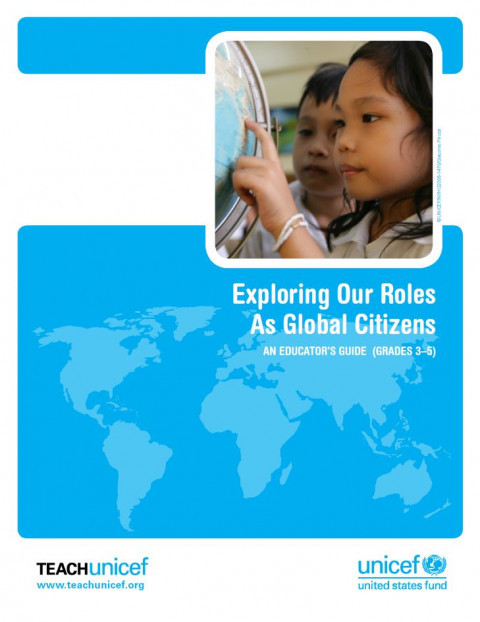 Exploring our roles as global citizens: an educator's guide (grades 3-5) Year of publication: 2013 Author: Elizabeth O. Crawford Corporate author: TeachUNICEF ‘Exploring Our Roles as Global Citizens’ is a four-lesson unit with extension activities and a student-led inquiry project that is designed to introduce the concept of global citizenship, including relevant knowledge, skills, values, and civic actions; to educate students about universal human rights outlined in the Convention on the Rights of the Child (CRC) and what their responsibilities are to ensure these rights are protected; to foster students’ skills in developing perspectives, critical and creative thinking, research, and decision-making about a chosen global issue using a student-led inquiry model; and to empower students to recognize and use their individual strengths to make a positive difference in their local communities. Lesson 1: What Is Global Citizenship? This lesson engages students in reflecting upon what it means to be a global citizen. Although students are often taught the concepts of citizenship and the characteristics of good citizenship during the elementary years, students may not have considered previously their roles as citizens in a global society. Using authentic examples of global citizenship among youth as a springboard for discussion, students determine how they are citizens at various levels. Afterward, students begin their inquiry of a chosen global issue about which they will take informed action at the end of the unit. Lesson 2: We Are Citizens of the World and We Have Rights! Building upon their prior learning about citizenship, students are introduced to human rights, or those rights to which all persons are entitled. Students learn about the Convention on the Rights of the Child (CRC) and create a concept map outlining categories and examples of human rights. Afterward, students relate human rights to contemporary global issues and how it is our responsibility to take action when the rights of others are violated. Lesson 3: Global Citizens Take Responsibility In this lesson, students learn about their individual and collective responsibility to protect human rights. Through analysis of authentic photographs depicting responsible citizenship, students explore the idea that global citizens are proactive when the rights of others are threatened. To demonstrate their learning, students role-play characteristics of global citizenship. Subsequently, in cooperative groups, students continue their global issue research and begin to consider how they will take informed action as global citizens. Lesson 4: Global Change Begins With Me In this culminating lesson, students reflect upon their learning about global citizenship and how they can be positive change agents in their communities. Students first explore how individuals take action to solve a problem or to improve conditions for others. Using these examples as inspiration, students determine how they, too, can be “changemakers.” As a final assessment, students synthesize what they have learned by creating a comprehensive definition of global citizenship, and develop an action plan to address the global issue they have researched. Exploring our roles as global citizens: an educator's guide (grades 3-5) Year of publication: 2013 Author: Elizabeth O. Crawford Corporate author: TeachUNICEF La définition se fonde sur le travail séminal dans les états et un large éventail d'organisations de travail pour faire avancer les connaissances mondiales et de la pensée critique. Un processus d'articulation minutieuse et vetting a abouti à la définition de la compétence globale proposée ici: la compétence globale est la capacité et la disposition pour comprendre et agir sur les questions d'importance mondiale. Globalement les personnes compétentes sont au courant, curieux et intéressés à en apprendre sur le monde et comment il fonctionne. Ils peuvent utiliser les grandes idées, des outils, des méthodes et des langues qui sont au cœur de toutes les disciplines (mathématiques, la littérature, l'histoire, la science et les arts) pour engager les questions pressantes de notre temps. Ils déploient et développer cette expertise comme ils enquêtent sur ces questions, reconnaissent de multiples points de vue, de communiquer leurs points de vue de manière efficace, et prendre des mesures pour améliorer les conditions. Eduquer pour Global Competence: Préparer les jeunes d'engager le monde est destiné aux enseignants, administrateurs, éducateurs informels, les décideurs, les leaders communautaires, les chercheurs, les parents, les étudiants et toutes les autres parties intéressées à préparer nos jeunes pour le 21e siècle. Devenir meilleur à l'éducation pour la compétence globale implique de repenser les pratiques et en reconnaissant qu'il n'y a pas de recettes simples pour le succès. En tant que tel, ce livre est destiné à être utilisé avec souplesse - parcourir, faire des liens, et de se concentrer sur les chapitres que vous trouverez les plus pertinents pour votre travail. Expérience avec des idées, des concepts de défi, et de partager avec des collègues. En fin de compte ce livre doit travailler pour vous. Il est destiné à être lu de la manière qui répond le mieux à vos besoins, inspire votre curiosité, et prouve fructueuse dans la salle de classe. Le premier chapitre offre un rationnel pour l'éducation mondiale dans notre pays et dans le monde. Le deuxième chapitre présente un cadre conceptuel pour la compétence globale et explique le rôle clé des fondations disciplinaires et interdisciplinaires dans l'apprentissage des élèves. Chapitre trois, quatre, cinq et six focus, respectivement, sur quatre capacités essentielles associées à la compétence mondiale: enquête dans le monde, reconnaissant les perspectives, communiquer des idées, et de prendre des mesures. Le chapitre sept considère les principes de base de l'enseignement pour l'enseignement de la compétence globale. Chapitre huit examine ce que les étudiants et les établissements d'enseignement peuvent faire pour promouvoir la compétence globale - et comment ils pourraient créer une culture de compétence globale pour les jeunes et les adultes. Enfin, le chapitre neuf places compétence globale dans le cadre plus large des systèmes d'éducation du public dans et au-delà des États-Unis.
 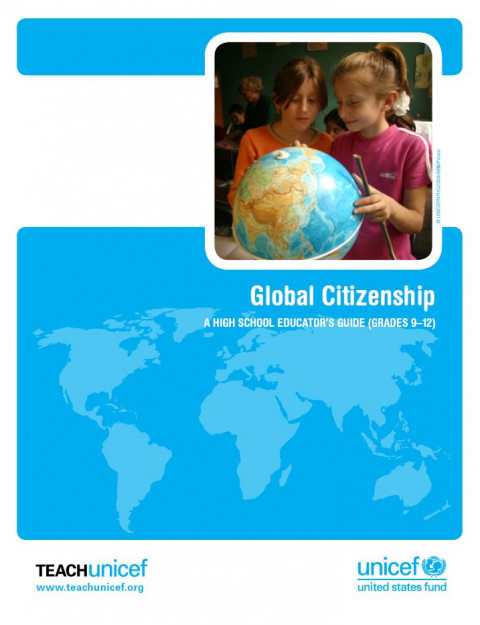 Global citizenship: a high school educator's guide (grades 9-12) Year of publication: 2013 Corporate author: TeachUNICEF Global Citizenship is a unit of four lessons designed to introduce the concept of global citizenship and place it in the context of international human rights; to engage students in a guided inquiry into the meaning of global citizenship and its relationship to national citizenship; to educate about how the United Nations has framed global rights and responsibilities for the 21st century and is acting on them via the Millennium Development Goals (MDGs); and to investigate how the U.S. Fund for UNICEF has engaged individuals in support of global citizenship as well as to engage students in designing and implementing a plan to act locally in support of global issues. La citoyenneté mondiale: Guide d'un éducateur de l'école secondaire (les niveaux 9-12) Year of publication: 2013 Corporate author: TeachUNICEF La citoyenneté mondiale est une unité de quatre leçons visant à introduire le concept de la citoyenneté mondiale et le placer dans le contexte des droits de l'homme internationaux; pour engager les élèves dans une enquête guidée dans le sens de la citoyenneté mondiale et de sa relation à la citoyenneté nationale; d'éduquer sur la façon dont l'Organisation des Nations Unies a formulé des droits et des responsabilités mondiales pour le 21e siècle et est d'agir sur eux par l'intermédiaire des Objectifs du Millénaire pour le développement (OMDs); et d'enquêter sur la façon dont le Fonds américain pour l'UNICEF a engagé des individus à l'appui de la citoyenneté mondiale, ainsi que d'engager les élèves dans la conception et la mise en œuvre d'un plan d'agir localement en faveur des enjeux mondiaux.