
Resources
Explore a wide range of valuable resources on GCED to deepen your understanding and enhance your research, advocacy, teaching, and learning.
685 Results found
 Les clichés du gaming, comment chasser le racisme ou le patriarcat des jeux vidéos ? Year of publication: 2024 Corporate author: France Inter Produit phare de l’industrie culturelle, le jeu vidéo a, au même titre que le cinéma, une dimension politique et sociale. Certains titres, ont été jugés comme étant racistes. Alors, comment décoloniser le jeu vidéo ?A flagship product of the cultural industry, video games have, like cinema, a political and social dimension. Some titles, like Resident Evil 5, have been deemed racist. So how do we decolonize video games?
  être citoyen numérique, ça te dit ? Year of publication: 2022 Corporate author: TRALALERE Vinz est très excité, il a été sélectionné pour participer au concours du meilleur citoyen numérique ! En effet, dans les vidéos qu’il a déjà réalisées, il respecte, sans le savoir, la Charte pour l’éducation à la culture et à la citoyenneté numériques. Une belle occasion pour Vinz de nous expliquer les notions de charte et de citoyenneté numérique. Vinz is very excited - he's been selected to take part in the best digital citizen competition! In fact, in the videos he's already made, he unknowingly respects the Charter for Education in Digital Culture and Citizenship. This is a great opportunity for Vinz to explain the concepts of the Charter and of digital citizenship.
 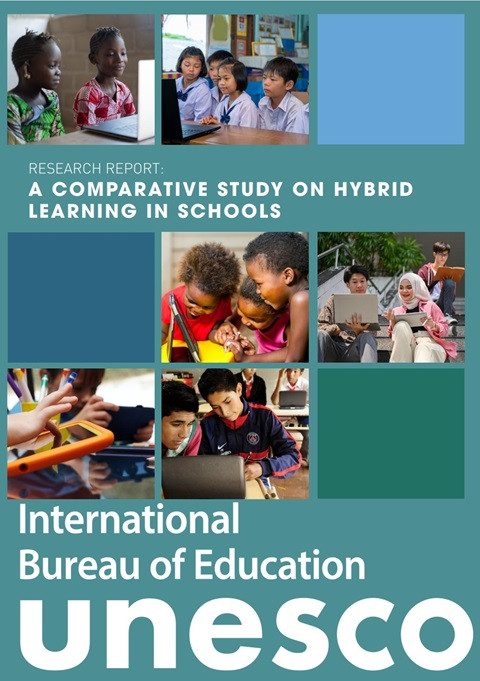 Research Report: A Comparative Study on Hybrid Learning in Schools Year of publication: 2024 Corporate author: UNESCO International Bureau of Education (IBE) During the COVID-19 lockdown, policymakers and educators faced an unprecedented challenge disrupting all levels of education. The initial optimism about replacing physical classes with virtual lessons diminished as complex interconnected issues emerged. To address the need for continuous and sustainable learning, school systems implemented variations of hybrid learning during the pandemic, seeking to integrate physical and virtual classes. These approaches prompted this comparative study led by UNESCO-IBE. The initial phase of this study involved collecting and analysing data on hybrid strategies from six countries. The research aimed to examine factors influencing hybrid learning implementation during the lockdown, with a subsequent focus on developing and validating a practical Hybrid Learning Framework for Schools. The cross-case analysis was designed not to rank or compare, but to understand and connect different scenarios and contexts. Phase I focuses on current hybrid learning practices and influencing factors, while Phases II and III will concentrate on using the information gathered to create and validate a Hybrid Learning Framework for Schools. Aligned with UNESCO-IBE’s overarching vision of a comprehensive, personalized, and democratized curriculum accessible to all, hybrid learning facilitates inclusive education across diverse regions, overcoming geographical and temporal limitations. The approach aims to unlock the unique potential of every learner, fostering a more flexible educational environment.
  Artificial Intelligence and Democracy Year of publication: 2024 Author: Daniel Innerarity Corporate author: UNESCO Montevideo | Latin American Council of Social Sciences (CLACSO) UNESCO’s Recommendation on the Ethics of Artificial Intelligence, adopted by all Member States in November 2021, is the first global policy framework for artificial intelligence (AI) and outlines different aspects of this technology that directly impact political life. The initial considerations of the Recommendation outline the potential ramifications of AI across diverse domains, notably its implications for democracy. This report builds on these analyses and recommendations, aligning with the core values and principles outlined in the Recommendation. It delves into the current and potential impact of artificial intelligence on democracy and the benefits that both artificial intelligence and digitalization, in general, could bring to enhancing collective decision-making processes. This analysis is structured around four key topics:1. The democratic expectations and disappointments of digitization2. The new digital public space: the democratic conversation3. The democracy of data: the politics of Big Data4. Democracy as a form of political decision-making: algorithmic governance Finally, this report offers recommendations for the democratic governance of artificial intelligence aimed at mitigating neative impacts and fostering a more democratic approach to AI governance. Inteligencia artificial y democracia Year of publication: 2024 Author: Daniel Innerarity Corporate author: UNESCO Montevideo | Latin American Council of Social Sciences (CLACSO) La Recomendación sobre la ética de la inteligencia artificial de la UNESCO, aprobada por todos los Esta- 1 dos miembros en noviembre de 2021, es el primer marco político global para la inteligencia artificial (IA) y señala diversos aspectos de esta tecnología que tienen impacto directo en la vida política. En sus consideraciones iniciales alude a sus posibles efectos en diversos ámbitos y, concretamente, en la de- mocracia. El presente informe pretende ampliar y concretar esos análisis y recomendaciones, desde los valores y principios de la Recomendación, poniendo foco en el impacto que la inteligencia artificial tie- ne y puede tener en la democracia, así como en las virtualidades que tanto la IA como la digitalización en general pueden tener en la mejora de los procedimientos de toma de decisión colectiva. Para abordar esta temática se plantean cuatro grandes asuntos:1. Las expectativas y las decepciones democráticas de la digitalización A modo de introducción se presentarán las principales demandas y expectativas sociales respecto al impacto de la digitalización en la democracia que se han ido configurando en los últimos años, tanto por personas expertas como por la opinión pública en general.2. El nuevo espacio público digital: la conversación democrática La democracia requiere de una conversación social de calidad y un espacio público que reúna deter- minadas propiedades, sin las cuales la democracia no puede sobrevivir o se verá debilitada. En este documento se abordarán las características de esta necesaria conversación en el entorno digital, se identificarán los problemas subyacentes y se propondrán posibles medidas para mejorarla.3. La democracia de los datos: la política del big data Los tres elementos que modificarán la política de este siglo son los sistemas cada vez más inteligentes y automatizados, una tecnología más integrada e interoperable y una sociedad más cuantificada. Si bien los datos son fundamentales para el gobierno de la sociedad, el documento se preguntará críticamente por la dimensión política y democrática de la big data.4. La democracia como forma de decisión política: gobernanza algorítmica La democracia es una forma de decisión colectiva. El documento examinará la compatibilidad de la proliferación de sistemas automáticos de decisión con los principios normativos del autogobierno de- mocrático. El incremento de la gobernanza algorítmica plantea diversos problemas y desafíos para la democracia, principalmente la identificación de las tareas que pueden ser resueltas por un algoritmo sin dañar los valores democráticos y el conjunto de condiciones que asegurarían esa compatibilidad. Por último, se efectuarán algunas recomendaciones para la gobernanza democrática de la inteli- gencia artificial para evitar o mitigar los impactos negativos y hacer que la gobernanza de la inteligen- cia artificial sea más democrática.
  Inteligencia Artificial centrada en los Pueblos Indígenas: Perspectivas desde América Latina y el Caribe Year of publication: 2023 Author: Luz Elena González Zepeda | Cristina Elena Martínez Pinto Corporate author: UNESCO Montevideo Este reporte es una invitación para entender la necesidad de una IA participativa que respete y se enriquezca con la diversidad cultural, convirtiéndose en una herramienta para el desarrollo sostenible y la promoción de libertades fundamentales.Se presenta como un llamado a la acción para incorporar activa y respetuosamente las perspectivas de los pueblos indígenas en la IA, apuntando hacia una futura sabiduría colectiva que honre la riqueza de las experiencias y conocimientos humanos.Todo esto, sobre la base de la Recomendación sobre la Ética en la Inteligencia Artificial de la UNESCO, que funciona como una brújula de orientación ética y un cimiento normativo mundial, que permitirá desarrollar IA al servicio de la sociedad, con especial énfasis a los grupos poblacionales más vulnerables, y respetuosa de los derechos humanos.
  The ABCs of Artificial Intelligence: A Lesson in Geopolitics Year of publication: 2024 Author: Angèle Le Névé Corporate author: Association Relative à la Télévision Européenne (ARTE) As artificial intelligence becomes more and more a part of our daily lives, what are its political and geopolitical repercussions? Asma Mhalla, a specialist in political issues surrounding technology, explains the basics of AI and how it is used by industry and governments to promote their ideas. Le B.A.-BA de l'intelligence artificielle: Une leçon de géopolitique Year of publication: 2024 Author: Angèle Le Névé Corporate author: Association Relative à la Télévision Européenne (ARTE) Alors que l'intelligence artificielle prend de plus en plus de place dans notre quotidien, quelles sont ses répercussions politiques et géopolitiques ? Asma Mhalla, spécialiste des enjeux politiques de la Tech explique les bases de l'IA et comment elle est utilisée par les industriels et les États pour véhiculer leurs idées.
 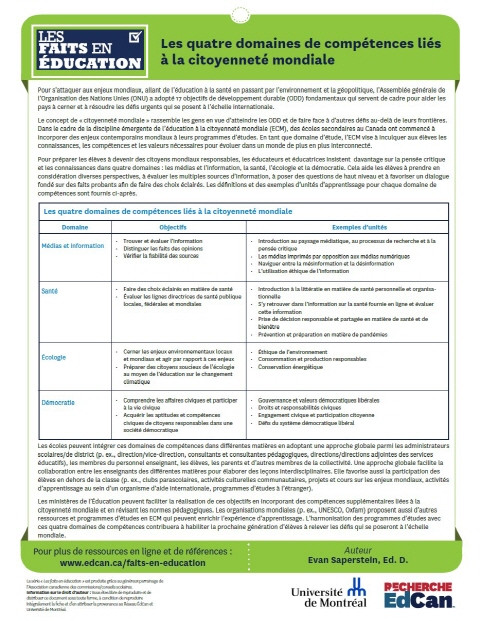 The Four Areas of Competence Linked to Global Citizenship Year of publication: 2023 Author: Evan Saperstein Corporate author: Université de Montréal | Association Canadienne d'Education Ce document présente les quatre domaines de compétences liées à la citoyenneté, et comment les intégrer à l'éducation des élèves. Pour préparer les élèves à devenir des citoyens mondiaux responsables, les éducateurs et éducatrices insistent davantage sur la pensée critique et les connaissances dans quatre domaines : les médias et l’information, la santé, l’écologie et la démocratie. This document presents the four areas of competency linked to citizenship, and how to integrate them into pupils' education. To prepare students to become responsible global citizens, educators are placing greater emphasis on critical thinking and knowledge in four areas: media and information, health, ecology and democracy. Les quatre domaines de compétences liés à la citoyenneté mondiale Year of publication: 2023 Author: Evan Saperstein Corporate author: Université de Montréal | Association Canadienne d'Education Ce document présente les quatre domaines de compétences liées à la citoyenneté, et comment les intégrer à l'éducation des élèves. Pour préparer les élèves à devenir des citoyens mondiaux responsables, les éducateurs et éducatrices insistent davantage sur la pensée critique et les connaissances dans quatre domaines : les médias et l’information, la santé, l’écologie et la démocratie. This document presents the four areas of competency linked to citizenship, and how to integrate them into pupils' education. To prepare students to become responsible global citizens, educators are placing greater emphasis on critical thinking and knowledge in four areas: media and information, health, ecology and democracy.