
Resources
Explore a wide range of valuable resources on GCED to deepen your understanding and enhance your research, advocacy, teaching, and learning.
3,433 Results found
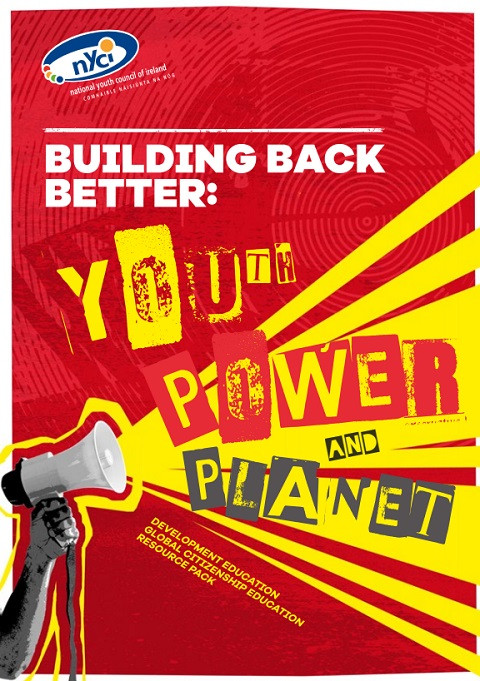 Building Back Better: Youth, Power and Planet Year of publication: 2020 Author: Valerie Duffy | Leo Gilmartin | Eva Janssens | Dermot O’Brien Corporate author: National Youth Council of Ireland (NYCI) Building Back Better: Youth, Power and Planet is about power. The understanding of power in youth work is vitally important for the development of young people as they navigate through their lives and society.The aim of this resource is to support young people and youth workers in understanding power, seeing power, claiming power, and activating power. It includes a wealth of background information on concepts around power and terminology, as well as a guide on ‘How to Use this Resource’, activities, stimulus sheets. This toolkit explores the issue of power and helps you make links to the Sustainable Development Goals.It is designed for global educators, youth workers, development education practitioners, trainers, climate activists, changemakers of all shapes and sizes but in particular those working with the current generation of young people.Building Back Better contains 4 main sections:Section 1. Defining PowerSection 2. Seeing PowerSection 3. Claiming PowerSection 4. Activating PowerIt also contains:an introduction to power in theory and in practice 10 activities with interactive exercisesaction power templates for planningstriking visuals, case studies on human development for adapting This was resource was created by the NYCI Youth 2030 programme.
  Emerging Horizons: Youth Insights on Climate Change and Breakthrough Solutions; 2024 Leading Minds on Climate Action Year of publication: 2024 Corporate author: UNICEF Innocenti | United Nations Development Programme (UNDP) This paper shares insights from a participatory foresight workshop designed and facilitated by UNICEF Innocenti in the framework of the Youth4Climate: Sparking Solutions event co-hosted by UNDP and the Government of Italy. This convened 100 youth-led solutions in the areas of climate education, energy, food and agriculture, and urban sustainability. By using the Three Horizons foresight approach, a dialogue was created that delineated the patterns of change young people envisaged, their shared visions for the future, and the high potential innovations they felt could be leveraged to bring that future about. The paper identifies research and policy questions to be further explored by young climate leaders, UNDP, UNICEF, and their partners.
 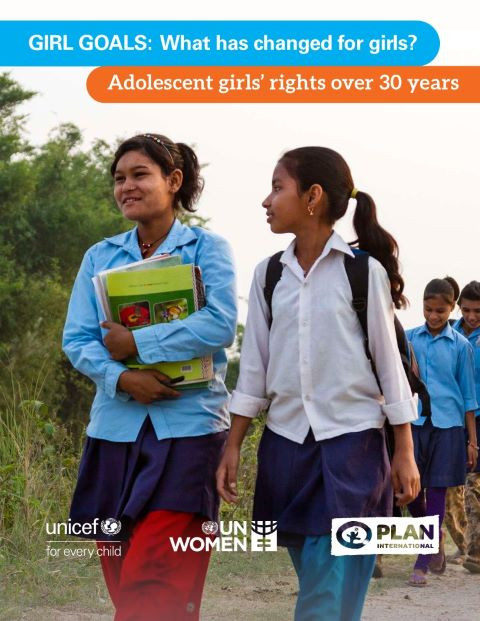 Girl Goals: What has Changed for Girls? Adolescent Girls’ Rights over 30 Years Year of publication: 2025 Corporate author: United Nations Children's Fund (UNICEF) | United Nations Entity for Gender Equality and the Empowerment of Women (UN Women) | Plan International This report makes three key recommendations on action we can take now to advance adolescent girls’ rights at scale, in ways that account for fiscally constrained contexts and multiple competing priorities: 1. Ensure tangible and actionable support for adolescent girls’ voices, advocacy and action. The current generation of girls are raising their voices to be heard and are already at the forefront of making change around the world. With the right support, resources and seats at the table, adolescent girls can help transform the world for the better, shaping better policy outcomes for themselves and everyone. This is not about girls’ voices above all others, or endless consultation, but about specific, meaningful actions that ensure girls get the support they need and are heard on policy issues that matter to them. 2. Establish and track explicit targets for change for adolescent girls, who are too often invisible and sidelined Setting explicit targets to monitor outcomes for adolescent girls is key to making progress. Context-specific prioritization will be necessary, but there are some issues that stand out globally. Gaps in progress (such as child marriage gains accruing disproportionately to wealthier households) demonstrate the need forprogrammes that address poverty and economic realities alongside harmful social norms. The disproportionate number of adolescent girls not in education, employment or training, not entering the labour market as young women, and left behind when it comes to digital skills, is a threat to the gains made for girls and to economic growth that will benefit everyone. Stagnation on issues like underweight also stand out. Country- specific priorities supported by data- driven accountability mechanisms and investments are needed to translate policy commitments into change on the ground. 3. Resource and deliver smartly to unlock the social and economic dividend Governments and partners should invest in solutions proven to change outcomes across multiple SDGs at scale – for example, investing in education and skills, cash transfers and economic empowerment programmes designed to support girls. Existing systems, from maternal health care to school curricula, should be adapted to meet girls’ needs rather than creating small- scale, separate projects. Streamlined, evidence-based ‘add-ons’ – such as adding parenting support to existing maternal health-care programmes – can be cost effective and accelerate outcomes if well designed. Change is possible, and this report shows that great gains have been made. Smart investments now can transform the world for girls, families, communities and national economies. It is time to act.
  The Impact of Holocaust education: how to assess policies and practices? International Seminar, 27 January 2014, UNESCO, Paris; Report Year of publication: 2014 Corporate author: UNESCO International Bureau of Education (IBE) | Georg Eckert Institute for International Textbook Research (Germany) | Hungary. Permanent Delegation to UNESCO UNESCO, which is charged with “promoting awareness of Holocaust remembrance through education” by resolution 34 C/61 of its General Conference, marked the International Day of Commemoration in Memory of Victims of the Holocaust on 27 January 2014 by convening an international seminar for members of the global community who are involved with and committed to this mandate. The event, titled “The Impact of Holocaust Education: How to Assess Policies and Practices”, aimed at highlighting current practices and debates in the field of research in Holocaust education. It was organized in partnership between UNESCO, including its International Bureau of Education, and the Georg Eckert Institute for International Textbook Studies with the support of the Delegation of Hungary to UNESCO.
  Learning to live together: have we failed? A summary of the ideas and contributions arising from the forty-sixth session of UNESCO's International Conference on Education, Geneva, 5-8 September 2001 Year of publication: 2003 Corporate author: UNESCO International Bureau of Education (IBE) | UNESCO Brasilia The present book is based mainly on the work of the forty-sixth session of the International Conference on Education (ICE), organized by UNESCO’s International Bureau of Education (IBE) and held in Geneva from 5 to 8 September 2001. The theme of the conference was ‘Education for All for Learning to Live Together: Contents and Learning Strategies - Problems and Solutions’. Unless stated otherwise, the numerous quotations chosen to illustrate the points made in this book are from ICE documents and contributions. The Conclusions and Proposals for Action adopted by the 2001 ICE are provided in Chapter V.The ICE is the only regularly occurring event during which Ministers of Education from all over the world can meet. It therefore serves as a unique and highly appreciated international forum for high-level dialogue on educational issues and their policy implications.The 2001 ICE brought together over 600 participants from 127 countries, including in particular 80 Ministers and 10 Vice-Ministers of Education, as well as representatives of intergovernmental and non-governmental organizations. The themes of the 2001 ICE were, and still are, very relevant all over the world: those in charge of education have become well aware of the necessity and complexity of living together, as well as of the role and limits of education in this respect.The ICE was inspired by abundant literature dealing with the principle issues that participants debated, including: Preparatory reports; National reports presented by the Member States; Examples of initiatives and good practice (including those presented at the conference as video case studies); Messages from Ministers of Education attending the Conference; And contributions from the numerous researchers, experts, educationists and decision makers at all levels of education who also participated in the Netforum between April and August 2001. More information and opinions on the vast issue of Education for All for Learning to Live Together were added during the Conference itself, in the form of keynote addresses, presentations and debates during the two plenary sessions, six thematic workshops and the special session devoted to partnerships with civil society.The present book draws on this wealth of experience, research, opinions, ideas and visions of the future. It seeks to contribute to bringing the debate on Education for All for Learning to Live Together closer to actors of the global educational community. By setting out ins concise way the key issues and proposed actions, and illustrating them with concrete examples, numerous quotations and a number of questions, this book is intended particularly for teacher trainers, teachers themselves and their professional organizations, as well as for all actors in civil society who endeavour to improve the quality of education, to encourage dialogue and to foster in this way the capacity for living together.Neither a ‘conference report’ nor a scientific or academic work, this book is intended to be a sort of ‘gallery of photographs’ of the forty-sixth session of the ICE – its atmosphere of dialogue, the themes of its debates, and the first-hand descriptions and experiences exchanged. Far from prescribing norms or standards, it intends to share information, ideas and practices, rather like the ICE itself, in a spirit of exchange and dialogue. Learning to live together: have we failed? A summary of the ideas and contributions arising from the forty-sixth session of UNESCO's International Conference on Education, Geneva, 5-8 September 2001 Year of publication: 2003 Corporate author: UNESCO International Bureau of Education (IBE) | UNESCO Brasilia Le présent ouvrage repose principalement sur les travaux de la quarante-sixième session de la Conférence Internationale sur l'Éducation (CIE), organisée par le Bureau International d'Éducation (BIE) de l'UNESCO et tenue à Genève du 5 au 8 Septembre 2001. Le thème de la conférence était ‘L'éducation pour tous pour apprendre à vivre ensemble: contenus et stratégies d'apprentissage - problèmes et solutions’. Sauf indication contraire, les nombreuses citations choisies pour illustrer les points soulevés dans ce livre sont des documents de l'CIE et les contributions. Les Conclusions et Propositions d'Action adoptées par la CIE de 2001 sont présentés au Chapitre V.L'CIE est l'événement qui se produit seulement régulièrement au cours de laquelle les ministres de l'éducation de partout dans le monde peuvent se rencontrer. Il sert donc comme un forum international unique et très apprécié pour le dialogue de haut niveau sur les questions d'éducation et de leurs implications politiques.La CIE de 2001 a réuni plus de 600 participants de 127 pays, y compris en particulier 80 inistres et 10 Vice-Ministres de l'Éducation, ainsi que des représentants d'organisations intergouvernementales et non gouvernementales. Les thèmes de la CIE 2001 étaient, et sont encore, très pertinent partout dans le monde: les responsables de l'éducation ont pris conscience de la nécessité et de la complexité de vivre ensemble, ainsi que du rôle et des limites de l'éducation à cet égard .L'CIE a été inspiré par une abondante littérature portant sur les principaux points de débat, y compris:Rapports Préparatoires;Les rapports nationaux présentés par les États membres;Exemples d'initiatives et bonnes pratiques (y compris celles qui sont présentées à la conférence que des études de cas vidéo);Messages des Ministres de l'Éducation présents à la Conférence;Et les contributions des nombreux chercheurs, des experts, des éducateurs et des décideurs à tous les niveaux de l'éducation qui a également participé à l'Netforum entre Avril et Août de 2001. Plus d'informations et d'opinions sur la grande question de l'éducation pour tous pour apprendre à vivre ensemble ont été ajoutés au cours de la Conférence elle-même, sous la forme de discours d'ouverture, des présentations et des débats au cours des deux sessions plénières, six ateliers thématiques et la session extraordinaire consacrée aux partenariats avec la société civile.Le présent ouvrage se fonde sur cette richesse de l'expérience, de la recherche, des opinions, des idées et des visions de l'avenir. Elle vise à contribuer à ramener le débat sur l'éducation pour tous pour apprendre à vivre ensemble plus près des acteurs de la communauté éducative mondiale. En énonçant ins de manière concise les questions clés et les actions proposées, et en les illustrant par des exemples concrets, de nombreuses citations et un certain nombre de questions, ce livre est particulièrement destiné aux formateurs d'enseignants, les enseignants eux-mêmes et leurs organisations professionnelles, ainsi que pour tous les acteurs dans la société civile qui s'efforcent d'améliorer la qualité de l'éducation, d'encourager le dialogue et de favoriser ainsi la capacité de vivre ensemble.Ni un ‘rapport de la conférence’, ni une œuvre scientifique ou universitaire, ce livre est destiné à être une sorte de «galerie de photos» de la quarante-sixième session de la CIE - son atmosphère de dialogue, les thèmes de ses débats, et la descriptions et les expériences de première main échangées. Loin de prescrire des normes ou des normes, elle a l'intention de partager des informations, des idées et des pratiques, un peu comme l'CIE lui-même, dans un esprit d'échange et de dialogue.
 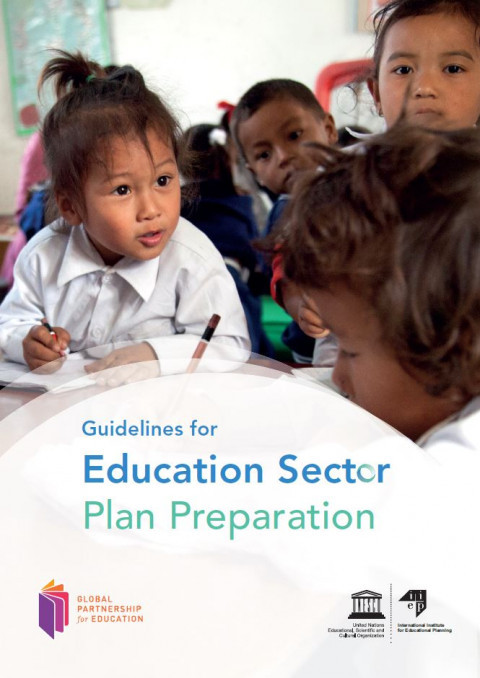 Guidelines for education sector plan preparation Year of publication: 2015 Corporate author: UNESCO International Institute for Educational Planning (IIEP) | Global Partnership for Education (GPE) At the World Education Forum, in Dakar in 2000, the international community pledged that no country with a credible plan to achieve the Education for All goals would be thwarted by a lack of resources. Since then, the development of an education sector plan (ESP) has become a priority in many countries. ESPs present the policies and strategies for national education reform, and are a powerful tool for coordinating partners and for mobilizing additional domestic and external resources. They have become a critical instrument for governments to signal to all potential investors that their education policies are credible, sustainable, and worthy of investment. The consensus on the need for credible ESPs is strong. However, what does a credible plan require in terms of government leadership, knowledge and data, institutional and human capacities, and dialogue among the education stakeholders? What are the criteria that establish the credibility of a plan?The purpose of these guidelines is to assist countries in preparing credible education sector plans. A second document, Guidelines for Education Sector Plan Appraisal, can be utilized to check whether the plan responds to the expected requirements. In certain contexts of vulnerability, confl ict, or crisis, countries may also consider the development of a transitional education plan, more short-term and action-oriented, and adjusted to the context and available capacities for situation analysis and data requirements. Specifi c guidelines are being prepared. However references to fragile contexts or vulnerability situations are streamlined in these guidelines. These guidelines are not exhaustive. They should be adapted to country contexts and needs. They present an overview of sector analysis, consultative processes, policy reform, strategy development, plan implementation, and monitoring. They do not replace technical manuals on specific tools and methodologies that are used at the various steps of the development of a plan. Guide pour la préparation d'un plan sectoriel d'éducation Year of publication: 2015 Corporate author: UNESCO International Institute for Educational Planning (IIEP) | Global Partnership for Education (GPE) At the World Education Forum, in Dakar in 2000, the international community pledged that no country with a credible plan to achieve the Education for All goals would be thwarted by a lack of resources. Since then, the development of an education sector plan (ESP) has become a priority in many countries. ESPs present the policies and strategies for national education reform, and are a powerful tool for coordinating partners and for mobilizing additional domestic and external resources. They have become a critical instrument for governments to signal to all potential investors that their education policies are credible, sustainable, and worthy of investment. The consensus on the need for credible ESPs is strong. However, what does a credible plan require in terms of government leadership, knowledge and data, institutional and human capacities, and dialogue among the education stakeholders? What are the criteria that establish the credibility of a plan? The purpose of these guidelines is to assist countries in preparing credible education sector plans. A second document, Guidelines for Education Sector Plan Appraisal, can be utilized to check whether the plan responds to the expected requirements. In certain contexts of vulnerability, confl ict, or crisis, countries may also consider the development of a transitional education plan, more short-term and action-oriented, and adjusted to the context and available capacities for situation analysis and data requirements. Specifi c guidelines are being prepared. However references to fragile contexts or vulnerability situations are streamlined in these guidelines. These guidelines are not exhaustive. They should be adapted to country contexts and needs. They present an overview of sector analysis, consultative processes, policy reform, strategy development, plan implementation, and monitoring. They do not replace technical manuals on specifi c tools and methodologies that are used at the various steps of the development of a plan.
 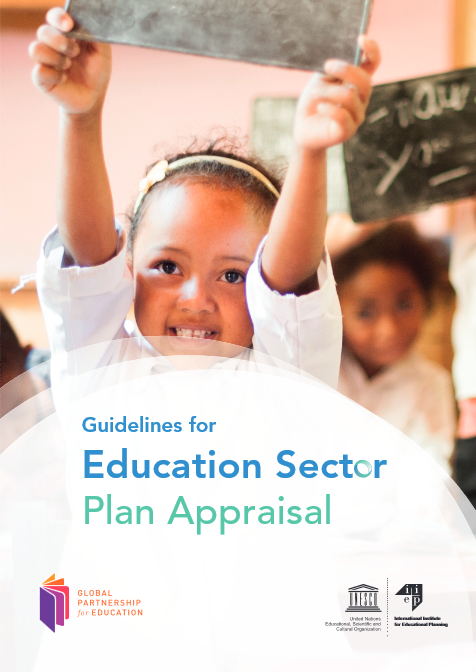 Guidelines for education sector plan appraisal Year of publication: 2015 Corporate author: UNESCO International Institute for Educational Planning (IIEP) | Global Partnership for Education (GPE) At the World Education Forum, in Dakar in 2000, the international community pledged that no country with a credible plan to achieve the Education for All goals would be thwarted by a lack of resources. Since then, the development of an education sector plan (ESP) has become a priority in many countries. ESPs present the policies and strategies for national education reform, and are a powerful tool for coordinating partners and for mobilizing additional domestic and external resources. They have become a critical instrument for governments to signal to all potential investors that their education policies are credible, sustainable, and worthy of investment.The consensus on the need for credible ESPs is strong. However, what does a credible plan require in terms of government leadership, knowledge and data, institutional and human capacities, and dialogue among the education stakeholders? What are the criteria that establish the credibility of a plan? The purpose of these guidelines is to assist education stakeholders in appraising the soundness, relevance, and coherence that form the credibility of ESPs. The primary objective of an appraisal report is to support the finalization of a credible ESP. It provides a fair review of the ESP strengths and areas in need of improvement before the endorsement by partners which signifies their commitment to support the implementation of the ESP. These guidelines are meant to be adapted to national contexts and needs. The stakeholders should discuss the scope and the methodology of the appraisal to be used, and develop a common vision of the whole process. The appraisal process should be participatory, and grounded in the political and technical dialogue for ESP development. It should involve consultations, interviews with key stakeholders, and field visits, in addition to a desk review of the ESP and any other relevant documents. It is good practice to organize a validation workshop of the appraisal report’s findings, conclusions, and recommendations to feed into the ESP finalization. The appraisal process should occur early enough in the ESP development process to allow time for decision-makers to open consultations on these conclusions and recommendations in order to improve the final version of the ESP. Guide pourl’évaluation d’un plan sectoriel d’éducation Year of publication: 2015 Corporate author: UNESCO International Institute for Educational Planning (IIEP) | Global Partnership for Education (GPE) Le Partenariat mondial pour l’éducation (GPE, du sigle anglais) est le seul mécanisme mondial et multilatéral visant à ce que tous les enfants puissent aller à l’école et y recevoir une éducation de qualité. Rassemblant près de 60 gouvernements de pays en développement, ainsi que des gouvernements donateurs, des organisations de la société civile, des fondations privées, des institutions internationales, des enseignants et le secteur privé, il propose un soutien financier pour l’élaboration et la mise en œuvre de plans sectoriels d’éducation de qualité dans les pays les plus pauvres. Le GPE réunit dirigeants nationaux et mondiaux pour concevoir des stratégies coordonnées, donnant à chaque enfant l’opportunité d’apprendre dans un contexte éducatif stimulant et sûr. En soutenant des programmes de développement qui visent à atteindre les objectifs éducatifs d’un pays (parité, bons résultats d’apprentissage, accès universel à l’enseignement primaire), le Partenariat veille à ce que les investissements dans le secteur de l’éducation portent leurs fruits. Le GPE a contribué à améliorer les résultats des pays en matière d’éducation, non seulement en réunissant ses partenaires pour élaborer des plans sectoriels d’éducation, dont la qualité est quantifiable, mais aussi en investissant dans des domaines stratégiquement essentiels mais sous-financés de ces plans, et en mobilisant l’expertise des partenaires nationaux pour tirer le meilleur parti de leurs atouts respectifs. Le GPE a alloué 3,9 milliards de dollars EU au cours des dix dernières années, en soutien aux réformes éducatives dans certains des pays les plus pauvres du monde. En 2014, près de la moitié de ses financements a été attribuée à des pays fragiles ou touchés par des conflits.