
Resources
Explore a wide range of valuable resources on GCED to deepen your understanding and enhance your research, advocacy, teaching, and learning.
2,657 Results found
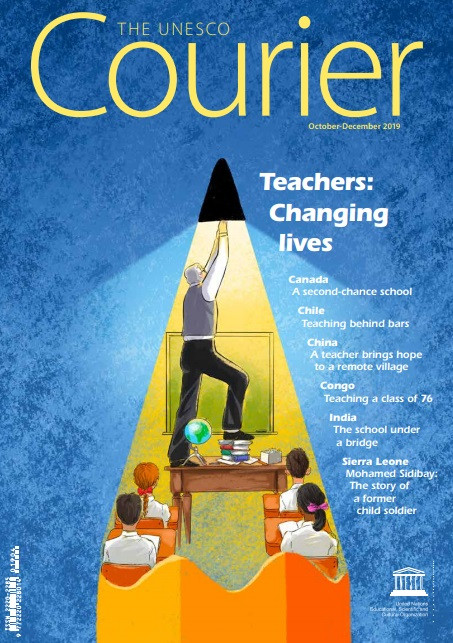 Docentes que cambian el mundo (El Correo de la UNESCO 4, Octubre-Diciembre 2019) Year of publication: 2019 Corporate author: Organización de las Naciones Unidas para la Educación, la Ciencia y la Cultura (UNESCO) Sin duda, todo el mundo reconoce la función esencial que desempeñan los docentes. A título individual, cada uno de nosotros puede mencionar el nombre de al menos un maestro que le influyó decisivamente, a veces hasta el punto de reorientar toda su vida. En el ámbito internacional, los Objetivos de Desarrollo Sostenible (ODS) de las Naciones Unidas, en particular el ODS 4, destacan la importancia del profesorado en la consecución de la Agenda 2030 de desarrollo sostenible.Y, sin embargo, la profesión docente está en crisis. El desarrollo de la neurociencia cognitiva y las múltiples aplicaciones de las nuevas tecnologías en el sector educativo imponen al magisterio la necesidad de adaptarse, de reinventarse.
  Inclusive early childhood care and education: background paper prepared for the International Forum on inclusion and equity in education, every learner matters Year of publication: 2019 Author: Sheldon Shaeffer Corporate author: UNESCO | Open Society Foundation Experiences around the world show that it is necessary to respond to the specific needs of each category of exclusion (sex, poverty, remoteness, ethnicity, language, legal status,and developmental delay anddisability) and to each excluded child–without further marginalizing or labelling them. The overall focus should be on inclusive ECCE policies, strategies, and practicesto remove all barriers, and promote optimal development and learning for all children, build ramps for participation and inclusion, and thereby help all relevant ministriesto become fully inclusive, both in vision and in practices. Only then can we really achieve the goal of good quality education for all. Educación y atención inclusiva para la primera infancia: documento de referencia para el Foro Internacional sobre Inclusión y Equidad en la Educación «Todas y todos los estudiantes cuentan» Year of publication: 2019 Author: Sheldon Shaeffer Corporate author: Organización de las Naciones Unidas para la Educación, la Ciencia y la Cultura (UNESCO) | Open Society Foundation Las experiencias en todo el mundo demuestran que es necesario responder a las necesidades específicas de cada categoría de exclusión (sexo, pobreza, lejanía, etnia, idioma, condición jurídica, retraso en el desarrollo y discapacidad) y de cada niño o niña excluido, sin marginarlos ni etiquetarlos más. La atención debe centrarse en políticas, estrategias y prácticas de AEPI inclusivas para eliminar todos los obstáculos y promover el desarrollo y el aprendizaje óptimos de todos los niños, construir rampas para la participación y la inclusión y, de ese modo, ayudar a todos los ministerios pertinentes a ser plenamente integradores, tanto en la visión como en la práctica. Sólo entonces podremos alcanzar realmente el objetivo de una educación de buena calidad para todos.
 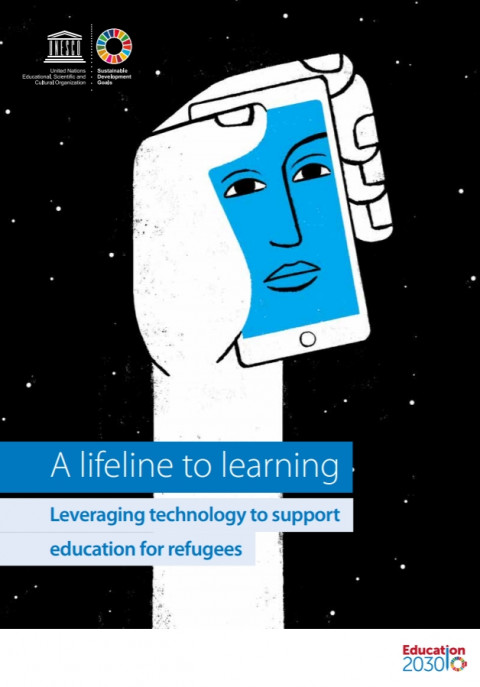 A Lifeline to Learning: Leveraging Mobile Technology to Support Education for Refugees Year of publication: 2018 Corporate author: UNESCO This publication examines the evidence base for key assumptions on using mobile technology to address individual refugees’ learning challenges, broader education system challenges, and challenges to providing refugees with specific levels and types of education. The report presents findings from a review of 117 relevant papers and reports, and lessons drawn from the implementation of 52 projects that use mobile learning for refugees and the actual use of 35 digital apps or platforms. While acknowledging a limited reach, the report identifies effective mobile solutions and organizational strategies that should be scaled up.
  Inclusive Education for Persons with Disabilities - Are We Making Progress? Year of publication: 2019 Corporate author: UNESCO | Leonard Cheshire (UK) The paper ‘Inclusive education for persons with disabilities – Are we making progress?’ has been developed as a background paper for the UNESCO International Forum on inclusion and equity in education – Every learner matters, being held in Cali, Colombia from 11-13 September 2019. The Forum is being organised in commemoration of the 25th anniversary of the passing of the Salamanca Statement and Framework for Action. The paper will explore the global progress towards inclusive education, the successes achieved and learnings observed specifically in countries of the global South. In these countries the concerns of universal access to and retention in education is still a concern for many governments, but large-scale exclusion of children with disabilities (an estimated 32 million or 1 out of 3 are out of school) remains the order of the day and is not always high on government agendas. Educación inclusiva para personas con discapacidades - ¿estamos logrando avances? Year of publication: 2019 Corporate author: Organización de las Naciones Unidas para la Educación, la Ciencia y la Cultura (UNESCO) | Leonard Cheshire (UK) El informe «Educación inclusiva para personas con discapacidades: ¿estamos logrando avances?» ha sido elaborado como documento de referencia para el Foro Internacional sobre Inclusión y Equidad en la Educación UNESCO «Todas y todos los estudiantes cuentan», que se celebrará en Cali (Colombia) del 11 al 13 de septiembre de 2019. El Foro ha sido organizado para conmemorar el 25 aniversario de la aprobación de la Declaración de Salamanca y Marco de Acción sobre Necesidades Educativas Especiales. En este informe se explora el avance mundial hacia la educación inclusiva, los éxitos logrados y las conclusiones observadas específicamente en países del hemisferio sur, donde los problemas en torno al acceso universal a la educación y la continuidad en ella siguen siendo motivo de preocupación para numerosos gobiernos y donde la exclusión a gran escala de niños con discapacidad (se estima que unos 32 millones de niños no están escolarizados, lo que supone 1 de cada 3) sigue estando a la orden del día y no siempre es una prioridad en los programas gubernamentales.
  Casebook on human dignity and human rights Year of publication: 2011 Corporate author: UNESCO Article 3 of the Declaration reads as follows:1. Human dignity, human rights and fundamental freedoms are to be fully respected.2. The interests and welfare of the individual should have priority over the sole interest of science or society
  [Video] Education Transforms Lives Year of publication: 2017 Corporate author: UNESCO Education transforms lives every day and in every corner of society. This video explores the power of education and UNESCO’s role in leading and coordinating the Education 2030 Agenda, which is part of a global movement to eradicate poverty through 17 Sustainable Development Goals by 2030.Education is the right of every woman, man and child. Together, we are shaping the global citizens of tomorrow, empowered on the path of education to build a more sustainable future.UNESCO's campaign "Education transforms lives" supports the effort to build peace in the minds of men and women. [Видео] Образование меняет жизни Year of publication: 2017 Corporate author: Организация Объединенных Наций по вопросам образования, науки и культуры (UNESCO) Образование преображает жизнь людей каждый день во всех слоях общества. Ролик повествует о важности образования и роли ЮНЕСКО в ведении и координации Повестки дня «Образование-2030», которая является частью глобального движения для искоренения бедности посредством достижения 17 Целей устойчивого развития до 2030 года.Каждая женщина, каждый мужчина и каждый ребенок имеют право на образование. Вместе мы создаем мировых сограждан завтрашнего дня и даем им силу образования для построения более устойчивого будущего.Кампания ЮНЕСКО "Образование преображает жизнь людей" направлена на то, чтобы нести мир в сознание мужчин и женщин.
 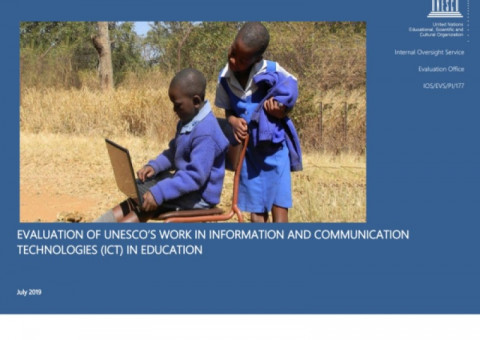 Evaluation of UNESCO's work in information and communication technologies (ICT) in education Year of publication: 2019 Author: Seán Ó Siochru and Graham Attwell Corporate author: UNESCO ICT in Education is a fast-growing area globally that offers many strategic opportunities. As the leader and coordinator of the SDG 4 – Education 2030 with the aim to “Ensure inclusive and equitable quality education and promote lifelong learning opportunities for all”, UNESCO has the mandate and expertise needed to strategically position itself as a world leader in this field. UNESCO’s work in ICT in Education aims at enhancing the quality and relevance of learning and at strengthening inclusion. While technology can facilitate wider access to education and bridge learning divides, can advance gender equality and inclusion as well as digital skills development, the rapidly changing technologies and work processes require the development of new pedagogies, both for the use of ICT for teaching and learning in the classroom and through open access and distance learning. Compared to other players, UNESCO leverages its comparative strengths in its ICT in Education interventions - especially its impartiality, convening power, and policy expertise - through an inclusive and humanistic approach to achieving quality education in coherence with Sustainable Development Agenda 2030. Its expertise across all levels of Education and its multidisciplinary potential of working across its Programme Sectors are also considered among UNESCO’s specific strengths. The evaluation revealed that UNESCO achieved important results, at the level of the learning environment, at the policy level and in institutional capacity building, but it also showed that UNESCO still needs to strengthen its positioning and visibility within the wider landscape of ICT in Education. For example, UNESCO has to continue positioning itself for producing forward-looking knowledge on ICT in Education and as a laboratory of ideas for future-oriented thinking. While the evaluation came across various specific interventions successfully addressing the needs of disadvantaged groups, the evaluation found that considerations of inclusion and gender equality were not consistently mainstreamed into policy-related and capacity building interventions. Other challenges are mainly linked to the current dispersion of resources and fragmentation of expertise across different entities within the Organization, which also leads to reduced visibility. While the key entities active in this area recognize that they are working within a common theme, collaboration and coordination still needs to be improved. The strategic measures proposed by the evaluation towards an overall organizational framework for ICT in Education aim at establishing an enabling environment for inter- and multidisciplinary approaches and greater coherence and collaboration.