
Resources
Explore a wide range of valuable resources on GCED to deepen your understanding and enhance your research, advocacy, teaching, and learning.
3,229 Results found
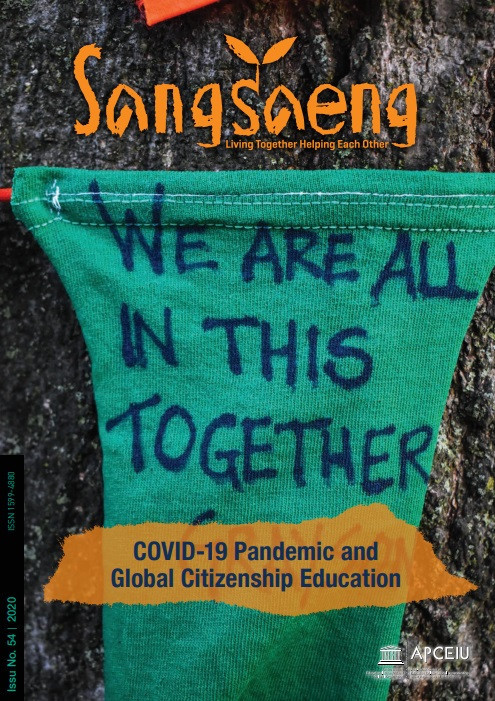 COVID-19 Pandemic and Global Citizenship Education (SangSaeng no.54, 2020) Year of publication: 2023 Corporate author: APCEIU Considering the significance of the global pandemic crisis, the 54th edition of SangSaeng focuses on the “COVID-19 Pandemic and Global Citizenship Education.” This issue invites readers to explore how the pandemic has affected the global community and reflect on how we should and can work together to address our common, multifaceted challenges while enhancing global citizenship and solidarity. Contents03 Editor’s Note04 Special Column What Changes Do We Want in the Post-Coronavirus World? / Hyun Mook Lim 08 FOCUS: COVID-19 Pandemic and Global Citizenship Education08 Reflecting on Global Citizenship Education in the Era of the Pandemic / Soon-Yong Pak12 Choosing Our Post-Pandemic World / Ilan Kelman16 Political Economy of COVID-19 and Global Cooperation / Chang-Yup Kim21 Peace in the Time of Global Pandemic / Yonas Adaye Adeto25 The Pandemic Stall of 2020 / Virginia A. Miralao30 Marine Conservation Efforts in Uncertain Times / Kerstin Forsberg35 Plague, Prejudice and Protest: The Role of Education in Pandemic World / Lynn Davies39 Media and Information Literacy Matters in Preparing for Post-Pandemic World / Divina Frau-Meigs 44 GCED Youth NetworkYouth Voices on the COVID-19 Pandemic and a New Work / Diego Manrique, Tshering Zangmo and Zanji Sinkala in collaboration with Hadi Althib 50 APCEIU in Action
 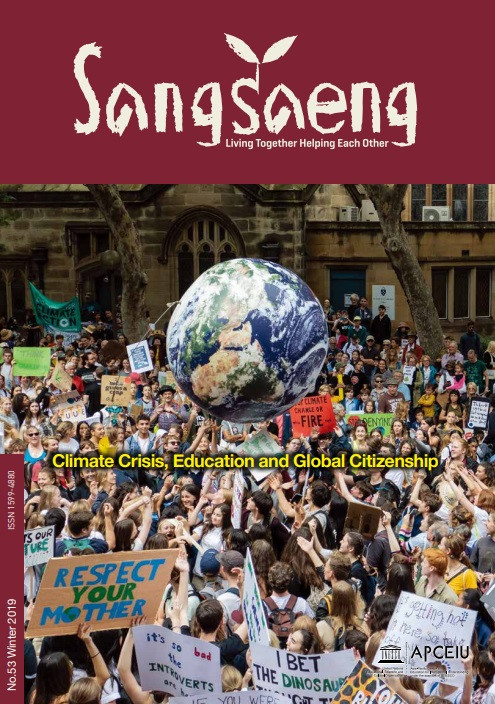 Climate Crisis, Education and Global Citizenship (SangSaeng no.53, 2019) Year of publication: 2023 Corporate author: APCEIU In view of the rapidly growing concerns about the climate crisis, the 53rd issue of SangSaeng focuses on how we should respond to the challenge under the theme of “Climate Crisis, Education and Global Citizenship.” Contents 03. Editor’s Note 04. Special Column Reimagining Our Future in Light of the Climate Crisis/Helena Norber-Hodge, 08. Focus 08 Empowering Learners for Climate Action and Transformation /Alexander Leicht 12 Changing Education, Not the Planet /Sun-kyung Lee 16 Power of a Global Classroom/Lynette Shultz and Carrie Karsgaard 19 Sustainability Starts with Teachers/Shepherd Urenje 24. Best Practices 24 Y-Adapt Inspires Youth-led Climate Change Action/ Brigitte Rudram 29 Local Energy Transition, from Imagination to Everyday Life/ Soyoung Kim 32. Story Time Pluto, a Stubborn Planet / Aprilia Sanie 34. Peace in My Memory 34 Global Citizenship Education in a Divided World / Makoto Kobayashi, 37 Clearing Streets of Burkina Faso / Francois Compaore 40. Understanding the Asia and the Pacific Melting Discoveries in Altai Plateau /In Uk Kang 44. GCED Youth Network Youth as the motor for GCED /Diego Manrique and GCED Youth Network 48. Letter The Journey of Making Peace in the Arab World /Khalaf Al'Abri, 50. APCEIU in Action
  Teaching Across Borders: A Guide to Follow-up Activities for APTE Alumni Teachers Year of publication: 2023 Corporate author: APCEIU | Korea R. Ministry of Education IntroductionLaunched in 2012, the Asia-Pacific Teacher Exchange for Global Education (APTE) marks its 10th anniversary this year with a solid record of steady growth. The Programme started with only two countries— Mongolia and the Philippines—and has since added five more: Cambodia, Indonesia, Lao PDR, Malaysia, and Thailand. Even the COVID-19 pandemic has not impeded the APTE’s development and instead provided the basis for an online form of educational exchange. Over the past decade, more than 2,000 teachers in Korea and the partner countries participated in the APTE and guided numerous students. This was thanks to the unwavering support of teachers who sought dissemination of the value of Global Citizenship Education, a key element of UNESCO’s educational agenda. We express our deepest appreciation to the teachers and students who took part in the APTE. Human ties going beyond national borders are rare and precious. This project has tied many people around the world, with the teachers and students who participated continuing efforts to further consolidate their ties. To assist and facilitate teachers’ efforts toward follow-up activities after participating in the APTE, the Asia-Pacific Centre of Education for International Understanding (APCEIU) under the auspices of UNESCO has released these guidelines on follow-up activities. Encouraging all teachers who are determined to continue Global Citizenship Education in the wider world, we extend our heartfelt gratitude to the writers and researchers for their dedication toward the publication of this book. We sincerely hope that these guidelines promote follow-up activities for international education exchange and its sustainability
  세계시민교육 국내 이행현황 연구보고서: 유·초중등학교 교육과정을 중심으로 Year of publication: 2018 Corporate author: 유네스코 아시아태평양 국제이해교육원 “세계시민교육 국내 이행현황 연구보고서 - 유·초중등학교 교육과정을 중심으로”가 발간되었다. 본 연구보고서는 세계시민교육의 실행과 성과에 대한 국가 수준의 모니터링 및 평가 연구가 희소하다는 문제의식에 기초하여 작성된 결과물이다. 특히, 국내 17개 시·도교육청 산하 유치원, 초·중·고등학교 교육과정 활동에서 세계시민의 개념이 어떻게 반영 및 실행되고 있는지를 살펴보기 위하여 탐색적 연구를 설계하고 관련 자료 조사를 실시하는데 주안점을 두었다. 또한 연구조사 결과를 토대로 동 보고서는 향후 세계시민교육이 교육현장에서 보다 명확하게 이행되고 확산될 수 있도록 하는 정책적 제언도 담고 있다.
  SDG 4.7: 세계시민교육 지표수립을 위한 기초연구 Year of publication: 2018 Corporate author: 유네스코 아시아태평양 국제이해교육원 “SDG 4.7 세계시민교육 지표수립을 위한 기초연구 보고서”가 발간되었다. 본 연구보고서는 국제적으로 합의된 글로벌 지표의 부재로 현재까지 정의가 완료되지 않은 지속가능발전목표 (SDG) 4.7 지표 개발을 위한 기초 연구이다. 즉, 동 보고서는 세계시민교육 및 SDG 4.7 지표에 관한 기존의 국내·외 연구결과를 종합적으로 검토하여 글로벌 지표에 관한 주요 논의를 정리하고, 국내 지표 개발을 위한 함의를 도출하는 데에 목적을 두고 있다. 이를 위하여 유네스코 통계원 (UIS)의 최신 SDG 4.7.1 메타데이터 연구와 국내·외 연구결과에 기초하여 국내에서 활용할 수 있는 정보와 데이터를 검토하고 있다.
 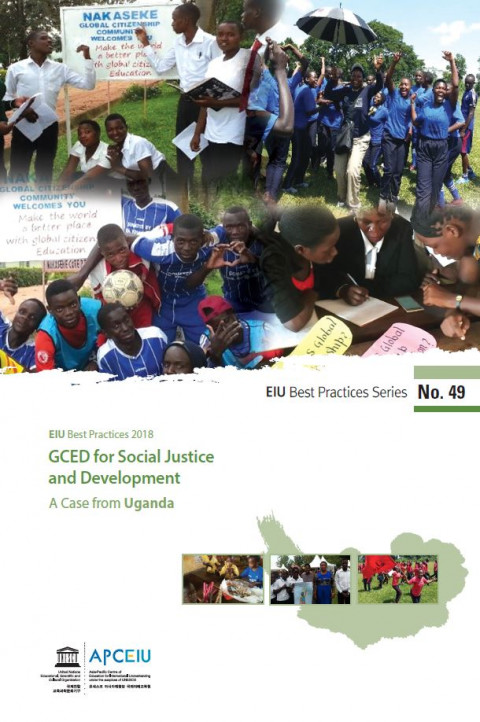 EIU Best Practices Series No. 49: GCED for Social Justice and Development; A Case from Uganda Year of publication: 2018 Corporate author: APCEIU Creating a peaceful, trusting and supportive learning environment is a strong driver for a nation’s sustainable development. Any society whose citizens have no cognitive, socio-emotional and behavioral values like respect for self and humanity, is doomed for chaos. The concepts of Education for International Understanding(EIU) and Global Citizenship Education(GCED) in this programme emerge from the need for harmonious living in the society. Sustainable human and economic development is built upon the successful dissemination and implementation of EIU/GCED practices. To understand this better, let’s use the analogy of a bird that gains its momentum to fly from its feet, lungs and wings.The contributor uses this analogy to illustrate that EIU/GCED is the foundation that exerts momentum for social development.The contributor saw it necessary that for any sustainable development to flourish in Ugandan society, pragmatic values have to be perfectly blended with public awareness for they serve as the foundation of all economic, social, cultural and political efforts. The national value system should be based on a strong foundation on which all national efforts are rooted. The social aspirations of the citizens should be the ones that propel development needs and national priorities.To effect sustainable development, we need to see schools as strategic intervention points. Recent times have, however, witnessed that the level of discipline and value inculcation gradually declined to near extinction. The distortion of the social setting that inculcated the ethical values in the young generation has called for a need to remedy the gap. The EIU/GCED is strategically tailored to inculcate Table of Contents moral principles and values in the children through the direct contact and support of the teachers of Early Childhood Development (ECD), both primary and postprimary levels.The Nakaseke Core Primary Teachers’ College (PTC) is mandated to mainstream and promote the social uprightness of the community being a primary stakeholder in the integration of EIU/GCED in the Ugandan Primary Schools (PS) and Primary Teachers Education (PTE) Curriculum. Consequently, the training programmes were designed to enhance the capacity of PTC’s administrators, tutors and support staff, pre-service student teachers, district education officers and primary school teachers to inculcate the EIU/GCED moral values and principles among the learners. Students are then expected to apply EIU/GCED principles to their families and communities, and uphold the values of integrity, honesty, justice, responsibility, respect for humanity, hard work, unity and creativity.
  Reconciliation, Peace and Global Citizenship Education: Pedagogy and Practice Year of publication: 2019 Corporate author: APCEIU The Asia-Pacific Centre of Education for International Understanding launched the publication entitled Reconciliation, Peace and Global Citizenship Education: Pedagogy and Practices. This book is the result of the fruitful discussions and presentations made during the 4th International Conference on Global Citizenship Education held on 3-4 September 2019 in Seoul, Republic of Korea.The intention of this publication is not only to continue and deepen the discourses made by the speakers of the Conference, but also to provide the readers with opportunity to explore how pedagogy and practices of Global Citizenship Education can contribute to building peace and reconciliation across the globe. Part. I Global Citizenship Education for peace and reconciliation: OverviewLearning to live together and a life worth livingHow GCED can contribute to peace, reconciliation and sustainable developmentTransformative pedagogy for building peacePromoting peace through mindfulness programmes in schoolsGlobal memory, global citizenship and reconciliationThe role of Media and Information Literacy Part. II Global Citizenship Education for peace and reconciliation: Putting it into practiceFacing History and Ourselves in South AfricaClassrooms in Peace in ColombiaPreparing young people to be global citizens through integrated schools in Northern Ireland Part. III Global Citizenship Education for peace and reconciliation: Supporting effective implementationPolicy development and implementationChallenges in curriculum and textbook development for low-and middle-income country
  A Study on the Status of Implementation of Global Citizenship Education in Lifelong Education in South Korea Year of publication: 2019 Corporate author: APCEIU The Asia-Pacific Centre of Education for International Understanding published a report titled "A Study on the Status of Implementation of Global Citizenship Education in Lifelong Education in South Korea". In the recognition of the need for an analysis on the status of implementation for the effective and systematic implementation of Global Citizenship Education (GCED) in the Republic of Korea, APCEIU conducted a study on the status of the implementation of GCED embedded in the curriculum of primary and secondary schools in 2018. As a follow-up study, this research paper examines the practice of civic education in the field of lifelong learning for adults and the formation, status and implementation process of GCED in which it appears and explores the potential for activation.
 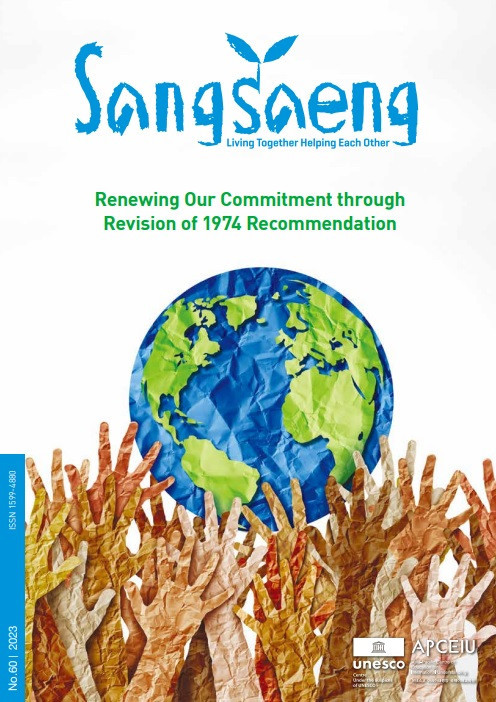 Renewing Our Commitment through Revision of 1974 Recommendation (SangSaeng no.60, 2023) Year of publication: 2023 Corporate author: APCEIU After nearly 50 years, UNESCO is in the process of revising “the 1974 Recommendation”. The revision aims to ensure the sustained relevance of the Recommendation within the evolving global and educational landscape in the face of contemporary and future threats to peace, and notably included the concept of ‘global citizenship’. Recognising its profound significance, SangSaeng No. 60 focuses on the theme of “Renewing. Our Commitment through the Revision of the 1974 Recommendation” to delve into the intrinsic value and significance underpinning the revision of this normative instrument. Contents 03 Editor's Note 04 Special Column Peace Educators Reflect on Revision of 1974 Recommendation / Betty Reardon & Tony Jenkins Renewing Our Commitment to Build a Culture of Peace through Education / Toh Swee-Hin 12 FOCUS: Renewing Our Commitment through Revision of the 1974 Recommendation Highly Capable, Profoundly Human / Elisa Guerra Revisiting UNESCO 1974 Recommendation / Bert J. Tuga & Edward Shiener S. Landoy Creatively Innovative Thinking for 21st Century / Patrice Ssembirige Observations on Revision of 1974 Recommendation / Rilli Lappalainen 26 Special Report What You Need to Know about Revision of 1974 Recommendation / UNESCO and APCEIU 28 Best Practices Tell Me About My Planet / Elvira Sarsenova Crucial Strategy to Mainstream GCED in Education / Rebecca Rosario Bercasio 36 Story Time Bringing GCED to Life Through the Power of Social Impact Films / Virginia Pittaro 40 Understanding the Asia-Pacific Region Mosaic of Sri Lankan Cultural Life / Nirmal Ranjith Dewasiri 44 GCED YOUTH NETWORK Youth Addressing Pressing Social Issues / Umair Mushtaq & Anna Susarenco 48 Letter Butterfly Effect of Embracing Opportunities / Khalifa Affnan 50 APCEIU in Action
 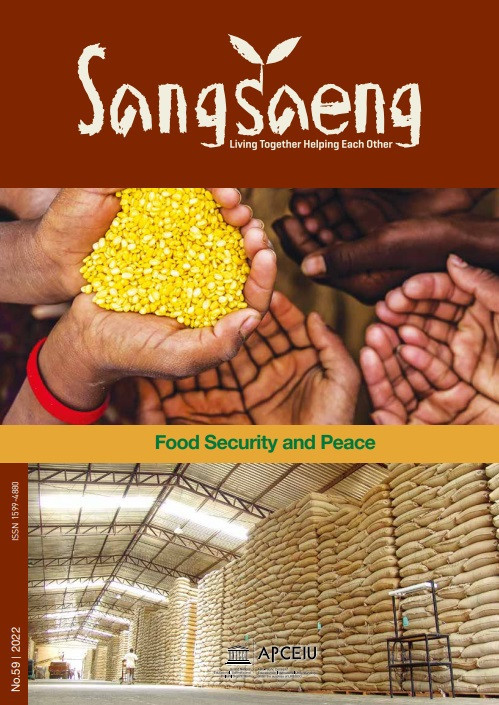 Food Security and Peace (SangSaeng no.59, 2022) Year of publication: 2023 Corporate author: APCEIU The food security issue is vital in pursuing the United Nations’ Sustainable Development Goals, which specifically include a goal of zero hunger. Hunger is both a cause and a result of conflicts. In this perspective, SangSaeng No. 59 focuses on the issue of “food security and peace” in order to examine the impacts of food insecurity and food crises and to explore possible alternatives or solutions to prevent conflicts and secure peace. Contents 03 Editor’s Note 04 Special ColumnRepositioning Youth for Responsible Citizenship / Michael Boakye-Yiadom and Raymond Chegedua Tangonyire, SJ. 08 FOCUS: Food Security and Peace 08 Conflict of Securing Food – ‘Food Insecurity is in Effect Creating an Existential Threat to Human Existence’ / Gavin E L Hall 12 Prioritizing Food Justice – Thinking About Water/Food Nexus for Latin America / Mayari Castillo 16 Feeding the Planet’s Survival – Climate Crisis and Food Security are Paramount Issues for Students to Connect with Nature / Simon Klein 21 Best Practices 21 Archipelagos of Certainty and Inclusion – Identifying Diverse Strategies to Make Learning Effective for Disabled / Eduardo Esteban Perez Leon 25 Adventure Education in Youth Work – Using Rick to Connect People and Nature to Unlearn Unhealthy Behaviours / Tina Trdin 30 InterviewRoad to Peace and Hope in Times of Crisis – Lee Chul Soo’s Works on Peace and Living Beings / APCEIU 36 Story TimeMessage of a Warlus / Marisol Bock 40 Peace in My MemoryPeace at Home / Ivy Joshia 44 Understanding the Asia and the PacificRenaissance of Traditional Archery in Asia / Lee Seunghwan 48 LetterMaking History with the EIU Photo Class Programme / Fanny Amalia Surya Tantular 50 APCEIU in Action