
Resources
Explore a wide range of valuable resources on GCED to deepen your understanding and enhance your research, advocacy, teaching, and learning.
3,451 Results found
 L’éducation dans un monde post-Covid: considérations supplémentaires (Réflexion en cours; No. 43, 2021) Year of publication: 2021 Author: Renato Opertti Corporate author: UNESCO International Bureau of Education (IBE) Ce document de discussion analyse certaines implications des idées proposées dans le document initial « L’éducation dans un monde post-COVID : Neuf idées pour l’action publique » (2020) produit par la Commission internationale sur les futurs de l’éducation. Parmi les contributeurs de ce document figurent des experts éminents ayant une large expérience professionnelle et politique, provenant de diverses régions du monde. L’ensemble de ces neuves idées interconnectées éclaire la voie à suivre pour transformer l’éducation et les systèmes éducatifs et concevoir l’avenir dans une optique progressiste. D’une part, il réaffirme les principes de base, la compréhension et les engagements concernant l’éducation en tant que bien commun mondial et droit de l’homme universel ; il exprime également la nécessité de réinventer le multilatéralisme pour un nouvel ordre mondial et, surtout, de mobiliser des idées et des fonds pour transformer l’éducation. D’autre part, le document plaide en faveur d’un programme éducatif global, incluant les questions critiques suivantes: (i) visualiser les éducateurs comme des décideurs dans les systèmes éducatifs ; (ii) considérer les étudiants comme des acteurs actifs ayant des droits ; (iii) reconnaître la valeur et la spécificité de l’espace scolaire ; (iv) aborder les dilemmes autour de la capacité de la technologie à combler les inégalités ; et (v) revoir les contenus d’enseignement pour la durabilité des jeunes générations. Educación en un mundo post-COVID: consideraciones adicionales (Reflexiones en Progreso; No.43, 2021) Year of publication: 2021 Author: Renato Opertti Corporate author: UNESCO International Bureau of Education (IBE) Este documento de discusión analiza algunas implicaciones de las ideas propuestas en el documento seminal “Educación en un mundo post-COVID: Nueve ideas para la acción pública” (2020) producido por la Comisión Internacional sobre el Futuro de la Educación. Entre los colaboradores del informe se encuentran destacadas figuras con una amplia experiencia profesional y política procedentes de diversas regiones del mundo. El conjunto de nueve ideas interconectadas ilumina el camino a seguir hacia la transformación de la educación y los sistemas educativos y hacia un futuro reinventado visto a través de una lente progresista. Por un lado, reafirma los principios, entendimientos y compromisos básicos con respecto a la educación como bien común global y derecho humano universal. También, articula la necesidad tanto de reinventar el multilateralismo para un nuevo orden global como, fundamentalmente, de movilizar ideas y financiación para transformar la educación. Por otro lado, el documento aboga por una agenda educativa integral que incluya los siguientes aspectos críticos: (i) visualizar a los educadores como tomadores de decisiones en los sistemas educativos; (ii) valorar a los estudiantes como agentes activos con derechos; (iii) reconocer el valor y la especificidad del espacio escolar; (iv) abordar los dilemas en torno a la capacidad de la tecnología para servir como igualadora de oportunidades; y (v) revisar los contenidos educativos para la sostenibilidad de las generaciones más jóvenes.
 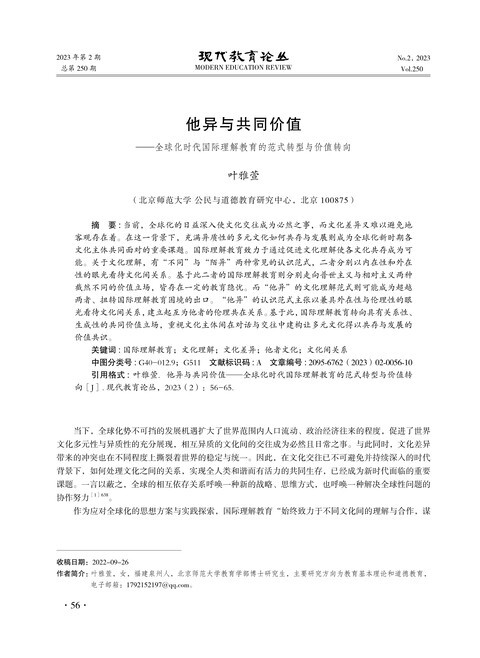 他异与共同价值: 全球化时代国际理解教育的范式转型与价值转向 (现代教育论丛; No.2, 2023) Year of publication: 2023 Author: 叶雅萱 当前,全球化的日益深入使文化交往成为必然之事,而文化差异又难以避免地客观存在着。在这一背景下,充满异质性的多元文化如何共存与发展则成为全球化新时期各文化主体共同面对的重要课题。国际理解教育致力于通过促进文化理解使各文化共存成为可能。关于文化理解,有“不同”与“陌异”两种常见的认识范式,二者分别以内在性和外在性的眼光看待文化间关系。基于此二者的国际理解教育则分别走向普世主义与相对主义两种截然不同的价值立场,皆存在一定的教育隐忧。而“他异”的文化理解范式则可能成为超越两者、扭转国际理解教育困境的出口。“他异”的认识范式主张以兼具外在性与伦理性的眼光看待文化间关系,建立起互为他者的伦理共在关系。基于此,国际理解教育转向具有关系性、生成性的共同价值立场,重视文化主体间在对话与交往中建构让多元文化得以共存与发展的价值共识。
  World Report on the Culture of Peace: Civil Society Report at Midpoint of the Culture of Peace Decade Year of publication: 2005 Corporate author: Foundation for a Culture of Peace The year 2005 marks the midpoint of the International Decade for a Culture of Peace and Non-Violence for the Children of the World (2001-2010) as proclaimed by the United Nations General Assembly.The present report has been submitted to the UN Secretary-General for the General Assembly's consideration at its next session under the relevant agenda item which will review the midpoint of the Culture of Peace Decade. This initiative responds to the invitation contained in operative paragraph 10 of General Assembly resolution A/59/143.The report is based on the accounts submitted by 700 organizations from all regions of the world. From the information received, it can be concluded that the culture of peace is advancing.The report provides the first comprehensive view of the progress made by the global movement for a culture of peace, since it was called for in 1999 by General Assembly resolution A/53/243 (annexed to the end of this report). Rapport Mondial de la Culture de la Paix: Rapport de la société civile à mi-parcours de la Décennie de la Culture de Paix Year of publication: 2005 Corporate author: Foundation for a Culture of Peace L'année 2005 se situe à mi-parcours de la Décennie internationale de la promotion d'une culture de la nonviolence et de la paix au profit des enfants du monde (2001-2010), conformément à la proclamation de l'Assemblée générale de l'Organisation des Nations Unies.Le présent rapport a été présenté au secrétaire général de l'Organisation des Nations Unies pour être étudié lors de la 60e session de l'Assemblée générale, lorsque sera abordé le point de l'ordre du jour relatif aux cinq premières années de la Décennie pour une culture de la paix. Cette initiative répond à l'invitation formulée au paragraphe 10 de la résolution A/59/143 de l'Assemblée générale.Le rapport est élaboré à partir d'informations présentées par 700 organisations provenant de toutes les régions du monde. Toutes les informations reçues permettent de conclure que la culture de la paix progresse.Le rapport fournit le premier panorama exhaustif des progrès réalisés par le mouvement mondial pour une culture de la paix depuis sa proclamation en 1999 par l'Assemblée générale dans sa résolution A/53/243 (en annexe au présent rapport). Informe Mundial de Cultura de Paz: Informe de la sociedad civil en la mitad del Decenio de Cultura de Paz Year of publication: 2005 Corporate author: Foundation for a Culture of Peace El año 2005 marca la mitad del Decenio Internacional de una cultura de paz y no violencia para los niños del mundo (2001-2010), tal y como proclamó la Asamblea General de las Naciones Unidas.Este informe se ha presentado al Secretario General de las Naciones Unidas para la consideración de la Asamblea General en su 60º periodo de sesiones dentro del punto del orden del día donde se examinarán los primeros cinco años del Decenio de una Cultura de Paz. Esta iniciativa responde a la invitación recogida en el párrafo operativo 10 de la resolución A/59/143 de la Asamblea General.El informe se basa en la información presentada por 700 organizaciones provenientes de todas las regiones del mundo. De toda la información recibida, se puede concluir que la cultura de paz está avanzando.El informe proporciona la primera visión exhaustiva del progreso hecho por el movimiento global por una cultura de paz, desde que fue proclamado en 1999 por la Asamblea General en su resolución A/53/243 (anexada al presente informe). تقرير عن ثقافة السلام في العالم Year of publication: 2005 Corporate author: Foundation for a Culture of Peace أعلنت الجمعية العامة للأمم المتحدة العقد الدولي من أجل ثقافة للسلام وعدم العنف ضد أطفـال العـالم خلال الفترة 2001 – 2010 قرارها 53/25 بتاريخ 10 نوفمبر 1998 .وعلاوة على ذلك، أقرت الجمعية العامة سنة 1999 إعلان وبرنامج عمل من أجل ثقافة السلام.وفي سنة 2000 أنشئت مؤسسة ثقافة السلام دف الإسهام بناء وتدعيم ثقافة السلام مـن خـلال التفكير، والبحوث، والتعليم، والعمل الموقع. وقد تابعت المؤسسة بنشاط تنفيذ إعلان وبرنامج عمل الأمم المتحدة والأنشطة التي نفذت أثناء العقد الدولي.وبناء على ذلك، أعدت المؤسسة، طبقً للقرار 59 / 143 بتاريخ 15 ديسمبر 2004 التقرير العـالمي الحالي عن ثقافة السلام وقدمته إلى الأمين العام للأمم المتحدة لكي تنظر فيه الجمعية العامة. ويضم هذا الكتيب تقرير اتمع المدني منتصف عقد ثقافة السلام. وهو يتضمن معلومات جمعتها وقدمتها ما يقرب من 700 منظمة على مستوى العالم وهي التي حللت الأنشطة التي نفذت لتعزيز ثقافة السلام وعدم العنف وكذلك التقدم الذي تحقق أثناءالنصف الأول من العقد الدولي.ويوضح الكتيب المعوقات التي اعترضت تنفيذ القيم التي تضمنها الإعلان وبرنامج العمل. كمـا ذكـرت الجمعية العامة مراراً، فإ الدول الأعضاء تزال مدعوة تواصل إعطاء مزيد من التركيز وتوسـيع أنشـطتها الداعمة لثقافة السلام وعدم العنف على المستويات الوطنية، والإقليمية، والدولية.
  Report of the Director-General of the United Nations Educational, Scientific and Cultural Organization on the follow-up to the implementation of the Declaration and Program of Action on a Culture of Peace Year of publication: 2013 Corporate author: United Nations. Secretary-General, 2007-2016 (Ban, Ki-moon) | UNESCO. Director-General, 2009-2017 (Bokova, I.G.) This is a report submitted by the Director-General of the United Nations Educational, Scientific and Cultural Organization, pursuant to General Assembly resolution 67/1, to follow up on the implementation of the Declaration and Program of Action on a Culture of Peace. The Director-General has reviewed an overview of the activities carried out to promote a culture of peace and non-violence, jointly with the United Nations Educational, Scientific and Cultural Organization (UNESCO) as the lead agency in the United Nations system on this subject. تقرير المديرة العامة لمنظمة الأمم المتحدة للتربية والعلم والثقافة عن متابعة تنفيذ الإعلان وبرنامج العمل المتعلقين بثقافة السلام Year of publication: 2013 Corporate author: United Nations. Secretary-General, 2007-2016 (Ban, Ki-moon) | UNESCO. Director-General, 2009-2017 (Bokova, I.G.) هذا هو تقريـر مقـدم مـن المـديرة العامـة لمنظمـة الأمـم المتحـدة للتربيـة والعلم والثقافة عملاً بقرار الجمعية العامة ٦٧/١، لمتابعة تنفيذ الإعلان وبرنامج العمل المتعلقين بثقافة السلام. وقد استعرضت المديرة العامة لمحة عامة عن الأنشطة المنفذة لترويج ثقافة السلام واللاعنف، بالاشتراك مع منظمة الأمم المتحدة للتربية والعلم والثقافة (اليونيسكو) باعتبارها الوكالة الرائدة في منظومة الأمم المتحدة المعنية بهذا الموضوع.
  Backtalk: The Participatory Film and Its Residency in the Space of Cultural Violence and Creative Education towards a Conceptual Understanding of Peace Year of publication: 2017 Author: Ruchika Gurung Corporate author: Mahatma Gandhi Institute of Education for Peace and Sustainable Development (MGIEP) Cultural violence is defined as the beliefs, attitudes and values that justify structural and direct violence (Galtung 1990). It dulls us into seeing exploitation and repression as normal or in not actively witnessing it, and the media plays a vital role in its dissemination. Media and in particular film studies occupies a space through which notions of culture, ideology, peace and violence are negotiated.While the observational approach to film is well established in education, participatory filmmaking as an educational tool is what this paper addresses, with reference to concepts of cultural violence and peace education.This paper uses Brantmeier’s (2011) five stage model, that encourages social and cultural change towards a future that is nonviolent, sustainable and renewable, and Bery’s (2003) conceptualisation of empowerment to propose that participatory film functions as a transformative creative process and challenges notions of identity and culture while helping learners describe the world around them (Zembylas & Bekerman 2013).Through analysing existing cases in the field of participatory video (Schwab-Cartas & Mitchell 2014), the author argue that participatory film functions as a tool for creative education practices that promotes a more hands-on approach to raising awareness about cultural violence and engaging with identity formation, and as a creative tool for knowledge creation and dissemination.