
Resources
Explore a wide range of valuable resources on GCED to deepen your understanding and enhance your research, advocacy, teaching, and learning.
3,797 Results found
 Education for peace: planning for curriculum reform; guidelines for integrating an education for peace curriculum into education sector plans and policies Year of publication: 2015 Corporate author: UNESCO | UNESCO International Bureau of Education (IBE) | UNESCO International Institute for Educational Planning (IIEP) This Resource and Development Capacity Package was developed based on the belief that, as part of a wider social, economic and political effort, education can play a significant role in a country’s peace-building efforts. Its purpose is to assist Member States in integrating or strengthening peace education programs in their national education systems to promote peace and prevent future conflict. UNESCO, IBE, and IIEP developed this resource within the framework of UNESCO’s Intersectoral Project, Promoting a culture of peace and nonviolence in Africa through education for peace and conflict prevention. The Package contains Technical Guidelines and Capacity Development training modules on policy, program design and curriculum planning to integrate peace and conflict prevention into all aspects of the education system. It is meant for curriculum developers and planners from Africa. The development of the package received the support of the UNESCO Addis-Ababa Office, which assisted in the testing of materials in Addis-Ababa (Ethiopia) and Yaounde (Cameroon).This resource will furthermore help to ensure that curricula, teaching and learning resources and teacher education are in line with the post-2015 vision of education for holistic development. This vision reconceptualises education in terms of global citizenship and responsibility by focusing on inclusion and social cohesion that is global in orientation. In this regard, Global Citizenship Education (GCED) seeks to empower learners with knowledge, skills, values and attitudes that are needed to forge more just and inclusive societies, capable of resolving existing conflicts and emerging global challenges. Éducation pour la paix: la planification de la réforme du curriculum; lignes directrices pour l'intégration d'un programme d'éducation pour la paix dans les plans et politiques du secteur éducatif Year of publication: 2015 Corporate author: Organisation des Nations Unies pour l'éducation, la science et la culture (UNESCO) | UNESCO International Bureau of Education (IBE) | UNESCO International Institute for Educational Planning (IIEP) Cette trousse de ressources et de développement des capacités a été élaborée sur la base de la conviction que, dans le cadre d'un effort plus large social, économique et politique, l'éducation peut jouer un rôle important dans les efforts de consolidation de la paix d'un pays. Son but est d'aider les États membres à intégrer ou renforcer les programmes d'éducation à la paix dans leurs systèmes nationaux d'éducation pour promouvoir la paix et prévenir les conflits futurs. UNESCO, le BIE, et l'IIPE ont développé cette ressource dans le cadre du projet intersectoriel de l'UNESCO, Promouvoir une culture de la paix et de la non-violence en Afrique par l'éducation pour la paix et la prévention des conflits. Le paquet contient des directives techniques et des modules de formation de renforcement des capacités sur la politique, la conception des programmes et de la planification des programmes pour intégrer la paix et de prévention des conflits dans tous les aspects du système d'éducation. Il est destiné aux concepteurs de programmes et les planificateurs de l'Afrique. Le développement de l'emballage a reçu le soutien du Bureau d'Addis-Abeba de l'UNESCO, qui a participé à l'essai des matériaux à Addis-Abeba (Ethiopie) et Yaoundé (Cameroun).Cette ressource sera en outre aider à faire en sorte que les programmes, les ressources d'enseignement et d'apprentissage et la formation des enseignants sont en ligne avec la vision post-2015 de l'éducation pour le développement holistique. Cette vision reconceptualise l' éducation en termes de citoyenneté et de responsabilité globale en mettant l'accent sur l'inclusion et la cohésion sociale qui est mondiale dans l'orientation. À cet égard, Éducation à la Citoyenneté Mondiale (ECM) vise à habiliter les apprenants des connaissances, des compétences, des valeurs et des attitudes qui sont nécessaires pour forger des sociétés plus justes et inclusives, capables de résoudre les conflits existants et nouveaux défis mondiaux.
 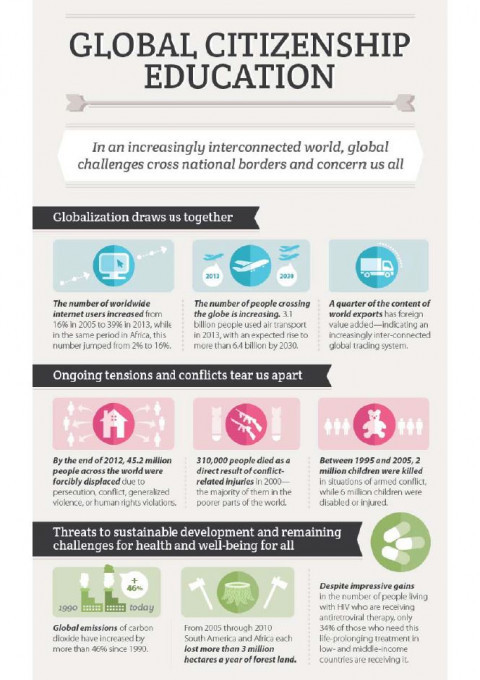 Global Citizenship Education infographic Year of publication: 2014 Corporate author: UNESCO In an increasingly interconnected world, global challenges cross national borders and concern us all. With issues like these threatening human and environmental well-being, we need to re-think the role and relevance of education. We need Global Citizenship Education. Global Citizenship Education is transformative. What are the barriers to this kind of education? What needs to change in education? What is UNESCO doing? What can you do?
 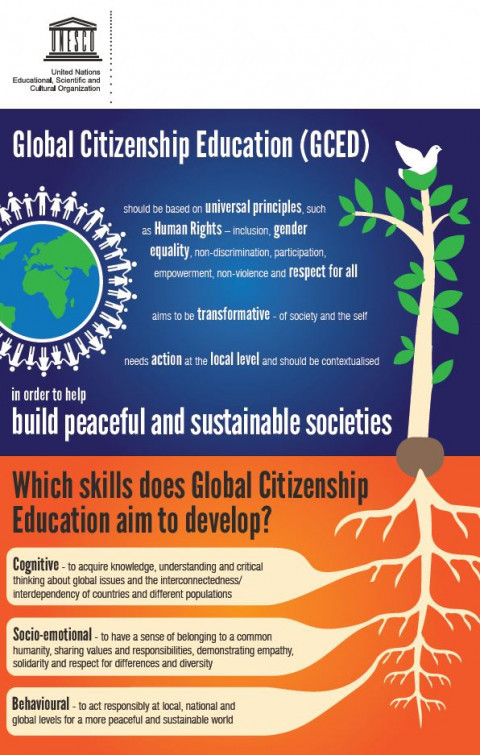 Global Citizenship Education (GCED) infographic Year of publication: 2015 Corporate author: UNESCO Which skills does Global Citizenship Education aim to develop? How can effectively implement Global Citizenship Education? Who are the key players? Éducation à la citoyenneté mondiale infographique Year of publication: 2015 Corporate author: Organisation des Nations Unies pour l'éducation, la science et la culture (UNESCO) Quelles compétences pour l' Education citoyenneté mondiale visant à développer? Comment peut-on effectivement mettre en œuvre l'éducation à la citoyenneté mondiale? Quels sont les principaux acteurs?
  Second UNESCO Forum on Global Citizenship Education: building peaceful and sustainable societies: final report Year of publication: 2015 Corporate author: UNESCO The Second UNESCO Forum on Global Citizenship Education (GCED) was organized in Paris from 28 to 30 January 2015 under the overall theme 'Building peaceful and sustainable societies: preparing for post-2015'. The Forum was organized in support of the UN Secretary General's Global Education First Initiative (GEFI) and on the occasion of UNESCO's 70th Anniversary. The Forum was organized by the Division for Teaching, Learning and Content, Educatio Sector, UNESCO, with the support of Austria, the Sultanate of Oman and the Republic of Korea. Other partners also included the United Nations Secretary-General's Global Education First Initiative (GEFI), UNESCO's Mahatma Gandhi Institute of Education for Peace and Sustainable Development (MGIEP), UNESCO's Asia-Pacific Centre of Education for International Understanding (APCEIU), the King Abdullah Bin Abdulaziz International Centre for Interreligious and Intercultural Dialogue (KAICIID) and the Learning Matrix Task Force. Some 250 participants from 61 countries from all regions of the world attended the Forum. These included decision-and policy-makers, practitioners, teachers, development partners, academics, the private sector, civil society representatives (national, regional and international level) as well as learners and youth representatives. The Forum was organized around three plenary sessions and 20 concurrent sessions. Topics under consideration included, among others, GCED in the post-2015 education agenda, measuring GCED learning outcomes, teaching practices, peace and human rights education, respect for diversity and inter-religious education, tackling discrimination and violence, education for sustainable development, youth involvement, the use of ICT and social media, and others. For an overview of the programme, please see Annex I. Second UNESCO Forum on Global Citizenship Education: building peaceful and sustainable societies: final report Year of publication: 2015 Corporate author: Organisation des Nations Unies pour l'éducation, la science et la culture (UNESCO) Le deuxième Forum de l'UNESCO sur l'éducation à la citoyenneté mondiale (ECM) a été organisé à Paris du 28 au 30 Janvier 2015 sous le thème général «Construire des sociétés pacifiques et durables: préparer l'après-2015». Le Forum a été organisé à l'appui d’Éducation Globale Première Initiative du Secrétaire général de l'ONU (EGPI) et à l'occasion du 70e anniversaire de l'UNESCO. Le Forum a été organisé par la Division de l'enseignement, l'apprentissage et du contenu, Secteur Educatio, l'UNESCO, avec le soutien de l'Autriche, le Sultanat d'Oman et la République de Corée. D'autres partenaires comprenaient également ’Éducation Globale Première Initiative du Secrétaire général du Secrétaire général de l’ONU (EGPI), Mahatma Gandhi Institute de l'UNESCO de l'éducation pour la paix et le développement durable (MGIEP), Asie-Pacifique Centre de l'UNESCO de l'éducation pour la compréhension internationale (APCEIU), le roi Abdallah Bin Abdulaziz Centre international pour le dialogue interreligieux et interculturel (KAICIID) et le Groupe de travail Matrice d'apprentissage. Quelque 250 participants de 61 pays de toutes les régions du monde ont participé au Forum. ceci inclut décisions et les décideurs politiques, les praticiens, les enseignants, les partenaires de développement, des universitaires, le secteur privé, les représentants de la société civile (niveau national, régional et international), ainsi que les apprenants et les représentants de la jeunesse.Le Forum a été organisé autour de trois sessions plénières et 20 sessions simultanées. Sujets à l'étude comprenaient, entre autres, ECM dans l'agenda de l'éducation post-2015, la mesure des résultats ECM d'apprentissage, les pratiques d'enseignement, éducation à la paix et les droits de l'homme, le respect de la diversité et de l'éducation inter-religieux, la lutte contre la discrimination et la violence, l'éducation pour le développement durable, la participation des jeunes, l'utilisation des TIC et des médias sociaux, et d'autres. Pour un aperçu du programme, s'il vous plaît voir l'annexe I.
  Second UNESCO Forum on Global Citizenship Education video Year of publication: 2015 Corporate author: UNESCO Highlights of the Second UNESCO Forum on Global Citizenship Education (GCED) Building peaceful and sustainable societies: preparing for post-2015 (28-30 January 2015, UNESCO HQs, Paris). The Forum was organized by the Division for Teaching, Learning and Content, Education Sector, UNESCO, with the support of Austria, the Sultanate of Oman and the Republic of Korea, and the UN Secretary-General's Global Education First Initiative (GEFI). Second UNESCO Forum on Global Citizenship Education video Year of publication: 2015 Corporate author: Organisation des Nations Unies pour l'éducation, la science et la culture (UNESCO) Faits saillants du deuxième Forum de l'UNESCO sur l’éducation à la citoyenneté mondiale (ECM) Construire des sociétés pacifiques et durables: la préparation pour l'après-2015 (28-30 Janvier 2015, Siège de l'UNESCO, Paris). Le Forum a été organisé par la Division de l'enseignement, l'apprentissage et du contenu, Secteur de l'éducation, l'UNESCO, avec le soutien de l'Autriche, le Sultanat d'Oman et la République de Corée, et Première Éducation Mondiale Initiative du Secrétaire Général de l'ONU (PISG).
 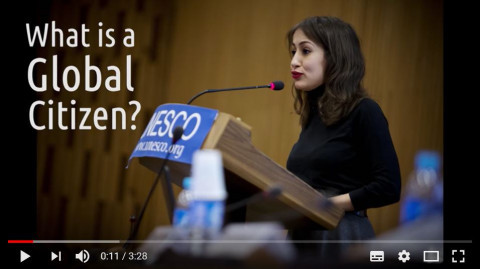 [Video] Global citizenship is ... Year of publication: 2015 Corporate author: UNESCO Participants of the Second UNESCO Forum on Global Citizenship Education (GCED) Building peaceful and sustainable societies: preparing for post-2015 (28-30 January 2015,UNESCO HQ, Paris) reflect on what Global Citizenship is. The Forum was organized by the Division for Teaching, Learning and Content, Education Sector, UNESCO, with the support of Austria, the Sultanate of Oman and the Republic of Korea, and the UN Secretary-General’s Global Education First Initiative (GEFI).