
Resources
Explore a wide range of valuable resources on GCED to deepen your understanding and enhance your research, advocacy, teaching, and learning.
3,229 Results found
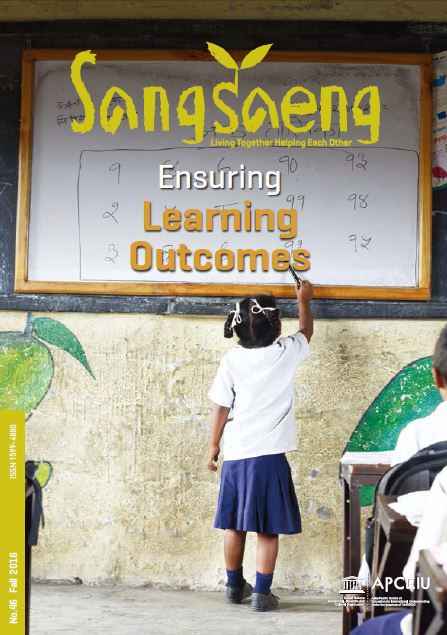 Ensuring Learning Outcomes (SangSaeng no. 46 Fall 2016) Year of publication: 2016 Corporate author: APCEIU The 46th issue of SangSaeng, “Ensuring Learning Outcomes,” has been released. With the Education 2030 Agenda emphasizing the role of measuring quality education outcomes, this fall edition of SangSaeng reviews the current assessment systems and introduces the ongoing struggles and endeavors in developing better measuring tools. 3 Director’s Message4 Special ColumnLearn to Live Together: Pillars of Education Start with Learn8 Focus: Ensuring Learning Outcomes8 Preparing Learners for a Different Future: Monitoring Education for Sustainable Development and Global Citizenship in the New Education Era14 Monitoring Knowledge for Better Learning Outcomes: The Southeast Asia Primary Learning Metrics’ Contribution to Global Citizenship and Its Measurement18 Competences for Democratic Culture: A Council of Europe Project for Teaching and Assessing the Democratic Competence of Student24 From 21st Century Competences to Global Citizenship and Global Competences 28 Special ReportExperiences and Difficulties of a Society: Developing Socio-cultural Skills of Kyrgyzstan Students34 Best Practices34 Embracing Sustainability: You Can Make a Difference39 Student Empowerment through Values in Action (SEVA): Training Students to Express Opinions, Reflect, Critically Evaluate,and Appreciate One’s Own Values and Those of Others44 LetterBe Global with a Compassionate Heart46 Peace in My MemoryFood for Peace in the 21st Century50 APCEIU in Action
 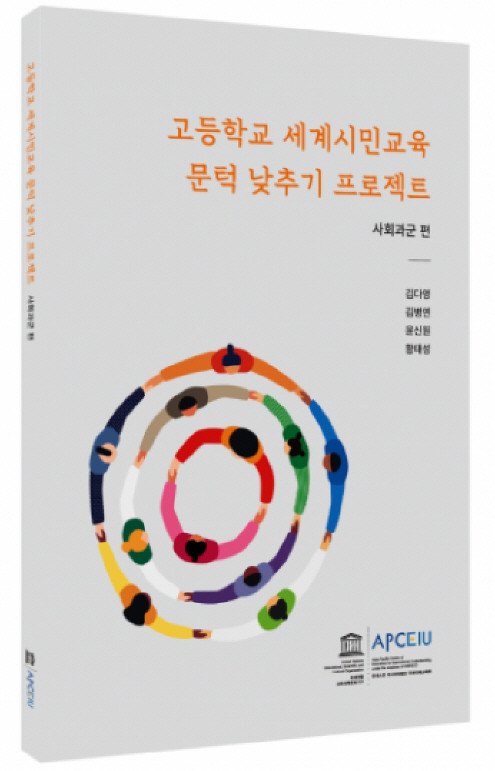 고등학교 세계시민교육 문턱 낮추기 프로젝트 – 사회과군 편 Year of publication: 2021 Author: 김다영 | 김병연 | 윤신원 | 황태성 Corporate author: 유네스코 아시아태평양 국제이해교육원 유네스코 아태교육원은 ⟪고등학교 세계시민교육 문턱 낮추기 프로젝트 – 사회과군 편⟫을 발간했다. ⟪고등학교 세계시민교육 문턱 낮추기 프로젝트⟫의 첫 시리즈인 이 책은 보다 많은 고등학교 선생님들이 학교 현장에서 세계시민교육을 실천할 수 있도록 진입장벽을 낮추고자 기획되었다. 특히 세계시민교육 관련 내용이 많이 포함되어 있는 사회과군 선생님들이 실제 수업에서 진행한 세계시민교육 교수학습 사례를 담았다. <목차>서문1장. 질문과 토론으로 이어가는 세계시민교육 1.1. 자문자답(自問自答), 저를 소개합니다 1.2. 2021년, 수업을 이렇게 설계했어요 1.3. 학생들과 함께 수업을 만들어갔어요사례 1] 불평등 현상과 사회정의사례 2] 사회정의 관점에서 세계화 바라보기사례 3] 평화의 관점에서 통일 문제 탐구 1.4. 수업을 되돌아보며 2장. 지구적으로 생각하고 지역적으로 행동하는 우리는 ‘세계시민’ 2.1. 선생님은 왜 ‘세계시민교육’을 하나요? 2.2. ‘세계시민교육’, 어렵지 않아요!사례 1] 세계화와 먹거리 문제사례 3] 지속가능발전을 위한 국제개발협력의 주체사례 2] 기후 위기와 지속가능한 세계 2.3. 미래 세대를 위한 교육, 우리 함께해요 3장. 지역이해와 활동 중심으로 구성하는 세계시민교육 3.1. 세계시민교육, 이렇게 만났어요 3.2. 세계시민교육, 무엇부터 시작해야 할까요? 3.3. 세계시민교육과 연결성사례 1] 영상을 통한 자연과 인간과의 관계 이해하기사례 2] 모둠 활동을 통한 나와 지역사회 연결하기 3.4. 세계시민교육과 인권사례 1] 세계인권선언 그림 카드 만들기사례 2] 인권 시 작성하고 낭송하기 3.5. 다문화교육과 세계시민교육사례 1] 영상을 통한 다문화교육사례 2] 포토스탠딩을 통한 다문화교육 3.6. 실천을 통한 세계시민교육사례 1] 100원 경매를 통한 기부 활동사례 2] SDGs 이해하고 실천하기 3.7. 글을 마치며
  Peace Education in Northeast Asia: A Situational Analysis Year of publication: 2021 Author: Soonwon Kang | Cheng Liu | Ketei Matsui | Batbaatar Monkhooroi | Boyoung Park | Muyu Huang | Oyuntsetseg Dugarsuren Corporate author: APCEIU Being central to education for international understanding and global citizenship, peace education has always been an important theme in UNESCO. For effective delivery of peace education, it is critical to examine and understand the relevance of peace education and its key issues and approaches at a given juncture. With this in mind, in 2020, APCEIU conducted a study on peace education in South Korea to review its current state and suggest some policy recommendations. Following up on this study, APCEIU initiated in 2021 a research project on peace education in Northeast Asia in order to identify how peace education is interpreted and practised in the countries of the region and explore possibilities of cooperation among peace educators, researchers, and practitioners in the region. Building on this research, APCEIU hopes to develop and carry out joint projects for peace education in the region.
 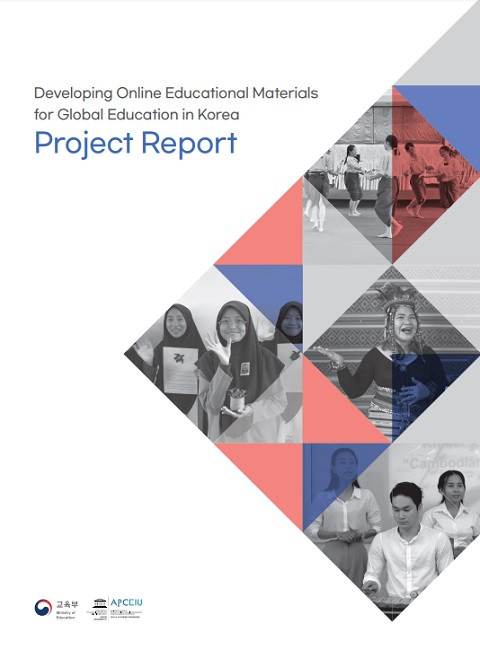 Developing Online Educational Materials for Global Education in Korea: Project Report Year of publication: 2020 Corporate author: APCEIU | Korea R. Ministry of Education This project aims to enhance the intercultural understanding of Korean teachers and students by utilizing global education and Global Citizenship Education(GCED) materials produced by partner countries’ teachers. Simultaneously, for the teachers from partner countries, the project is expected to enhance their educational competency, global competency, and online teaching competency required in this pandemic era. The project also aims to establish an online teaching and learning model by using online educational materials in Korean classrooms and accumulate and expand educational achievements in response to the spread of online exchange. 초청교사 온라인 교수자료 제작: 최종 보고서 Year of publication: 2020 Corporate author: 유네스코 아시아태평양 국제이해교육원 | 대한민국 교육부 본 프로젝트는 대상국 교사가 제작한 글로벌·세계시민교육 자료 활용을 통해, 국내 학교 교원 및 학생의 다문화 감수성을 제고하는 것을 목표로 한다. 동시에 강의자로 참여하는 대상국 교사의 교육 역량과 글로벌 역량, 그리고 언택트 시대에 요구되는 온라인 강의 역량을 향상시키고자 한다. 또한 외국 교사가 제작한 온라인 교수자료를 국내 교육 현장에 활용하여 이를 토대로 온라인 교수-학습 체제를 구축하고, 온라인 교류 확산 추세에 대응하며 교육성과를 축적·확산하고자 한다.
  Global Citizenship Education: A Policymaking Awareness and Advocacy Handbook Year of publication: 2021 Corporate author: APCEIU | UNESCO Bangkok GCED is critical for learners and countries to reach the SDG-Education 2030 targets. Many countries have GCED elements, either explicitly or implicitly, within their education policies. However, to fully realize SDG target 4.7 and to enable our learners to achieve the knowledge, skills, values and attitudes needed to succeed in an ever-changing and adaptable world, countries may need to explicitly build these components directly into various education policies. This policymakers’ handbook provides some guidance on how policymakers can develop and adapt local level policies in order to strengthen GCED learning.
  EIU Best Practices 2021: Developing a Learning Platform in Engineering; A Case from Denmark (EIU Best Practices Series; no.55) Year of publication: 2021 Author: Serena Leka Corporate author: APCEIU This monograph is one of APCEIU's EIU Best Practices Series, which aims to encourage educators, scholars, and activists to implement and share local initiatives on EIU. The Series No.55 introduces ‘ØkoEngineer’ which is a sustainability learning platform created to educate engineering students in Aarhus on sustainability concepts and how they couple with engineering design through the gamification of project-based learnings. The project aims to prepare the future engineers to play their crucial role in the significant global issues that we face. In response to the above challenges, future engineers, today's students are embracing initiatives that stimulate sustainability education. The students are motivated by the urge to relate sustainability with their domain-specific engineering theories. ØkoEngineer is a web-based game platform designed for integrating sustainability learning in engineering curricula.
  EIU Best Practices 2021: Reinforcing GCED Virtually; the AFS Effect+ for the Classroom, a Case from Brazil, Colombia, and New Zealand (EIU Best Practices Series; no.56) Year of publication: 2021 Author: Ana Carolina Cassiano Corporate author: APCEIU This monograph is one of APCEIU's EIU Best Practices Series, which aims to encourage educators, scholars, and activists to implement and share local initiatives on EIU. The Series No.56 introduces ‘the AFS Effect+ for the Classroom Programme’ which is launched in September 2020. The programme has engaged 150+ high-school teachers from Brazil, Colombia, and New Zealand who completed 20 hours of virtual teacher training, collaborated virtually with each other and piloted activities developed by AFS with their classrooms, reaching over 2,500 students. As a result of the programme, the AFS Effect+ for the Classroom: Toolkit for Educators is now available to teachers worldwide to use as a resource for teaching Active Global Citizenship & the SDGs for high school students. The toolkit is currently available in English, Spanish and Portuguese, and being disseminated through AFS Network Organizations which are present in 50+ countries.
  EIU Best Practices 2021: Upholding GCED through Amahoro Club; A Case from Burundi (EIU Best Practices Series; no.57) Year of publication: 2021 Author: Sinai Bakanibona Corporate author: APCEIU This monograph is one of APCEIU's EIU Best Practices Series, which aims to encourage educators, scholars, and activists to implement and share local initiatives on EIU. The Series No.57 introduces ‘Amahoro Clubs’ which means Peace Education Clubs. It is a project that has been initiated in other secondary schools of Burundi in terms of consolidating culture of peace and stability in Burundian society by applying different concepts of Global Citizenship Education in our life. This programme influence positively different social stratifications of people to know how to live together and be united by facing diverse challenges which can somber the population in violent conflicts. Amahoro Clubs serve as a platform in which people become aware of the various social issues. Students and teachers are gaining the necessary knowledge and skills that will help prevent the occurrence of conflicts.
 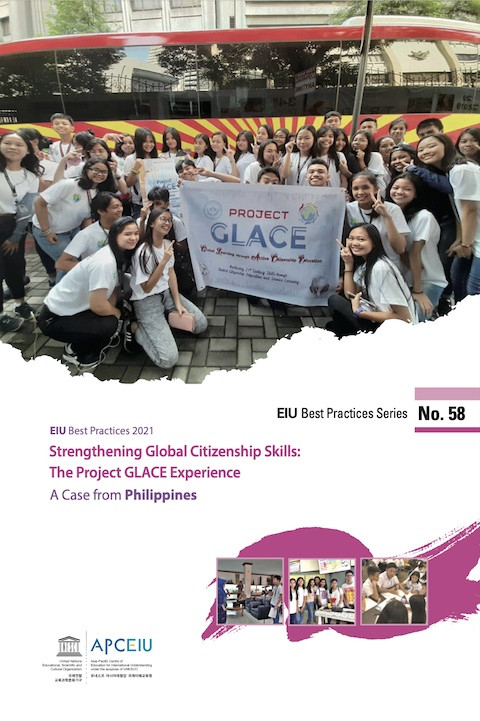 EIU Best Practices 2021: Strengthening Global Citizenship Skills; The Project GLACE Experience, A Case from Philippines (EIU Best Practices Series; no.58) Year of publication: 2021 Author: Marco Meduranda Corporate author: APCEIU This monograph is one of APCEIU's EIU Best Practices Series, which aims to encourage educators, scholars, and activists to implement and share local initiatives on EIU. The Series No.58 introduces ‘Project GLACE’ or ‘Global Learning through Active Citizenship Education’. It is an after-school enhancement program that sought to enhance students' global citizenship skills through afterschool learning sessions, off-campus intercultural education experiences, and service-learning or community outreach activities. Using the 4-I's (Inquire, Investigate, Innovate and Impact), selected teachers taught global citizenship education concepts for a span of 12 - 15 weeks with the first six to ten weeks exploring the themes of social justice and equity, identity and diversity, self-awareness and reflection, concern for the environment, commitment to sustainable development, and commitment to participation and inclusion.