
Resources
Explore a wide range of valuable resources on GCED to deepen your understanding and enhance your research, advocacy, teaching, and learning.
306 Results found
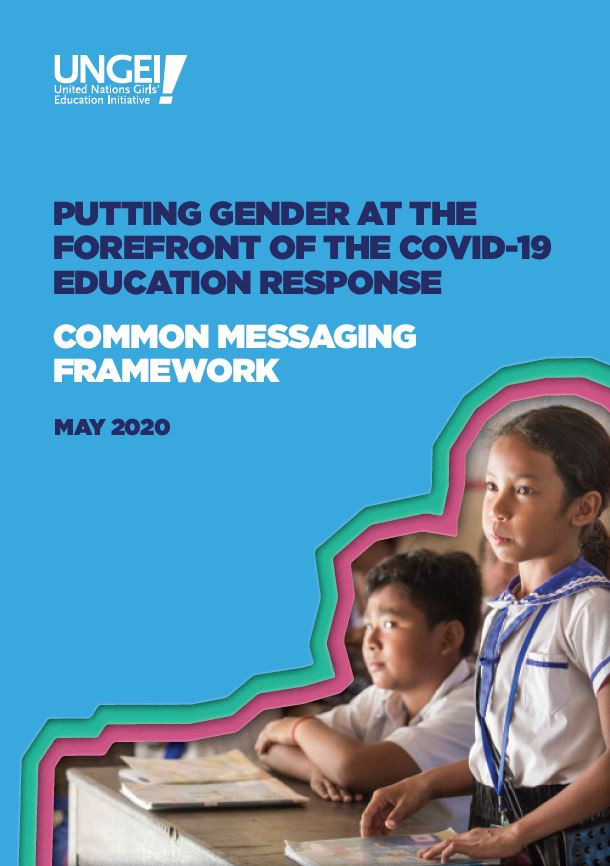 Mettre le genre au premier plan de la réponse éducative au COVID-19: Cadre de messagerie commun Year of publication: 2020 Corporate author: United Nations Girls' Education Initiative (UNGEI) Les fermetures d’écoles à l’échelle nationale dans le cadre des mesures visant à prévenir la propagation du COVID-19 ont perturbé l’éducation de toute une génération d’enfants et de jeunes. Les urgences sanitaires antérieures démontrent que les filles sont touchées de manière disproportionnée, les effets de l’inégalité entre les sexes et des structures de pouvoir inégales étant exacerbés en temps de crise.En tant que partenariat mondial dédié à la promotion de l’égalité des sexes dans et à travers l’éducation, nous devons tirer parti de la puissance de l’action collective pour placer le genre au premier plan de la réponse COVID-19 et renforcer la cohérence dans le plaidoyer et la communication entre les organisations partenaires et alliées.Cette initiative de messagerie commune représente une opportunité stratégique pour favoriser le dialogue et attirer l’attention sur les impacts sexospécifiques de COVID-19, plaider en faveur de stratégies pour répondre aux dimensions sexospécifiques de cette crise et envisager la réouverture en toute sécurité des écoles à travers une perspective sexospécifique. Poniendo el género en primer plano de la respuesta educativa ante el COVID-19: Marco común de la mensajería Year of publication: 2020 Corporate author: United Nations Girls' Education Initiative (UNGEI) El cierre de las escuelas a nivel nacional como parte de las medidas para prevenir el contagio del COVID-19 ha interrumpido la educación de toda una generación de niños, niñas y jóvenes. Las emergencias de salud anteriores han demostrado que las niñas se ven afectadas de manera desproporcionada con los efectos de la desigualdad de género y estructuras de poder desiguales exacerbadas en tiempos de crisis.Como asociación mundial dedicada a avanzar la igualdad de género en y a través de la educación, debemos ejercer el poder de la acción colectiva para posicionar al género en primer plano en la respuesta ante el COVID-19 y aumentar la coherencia en la defensa, promoción y comunicación entre las organizaciones socias y aliadas.Esta iniciativa común de mensajería representa una oportunidad estratégica para promover el diálogo y llamar la atención sobre los impactos de género del COVID-19, abogar por estrategias que respondan a las dimensiones de género de esta crisis y ver hacia una futura reapertura de las escuelas a través de una lente de género.
  Generation Equality Accountability Report 2022 Year of publication: 2022 Corporate author: United Nations Entity for Gender Equality and the Empowerment of Women (UN Women) In the UN Decade for Action on Gender Equality, people around the world have pledged to move from rhetoric to action and to work together to drive lasting change, starting now. Through the 2021 Generation Equality Forum in Mexico and France, world leaders and partners committed to eliminating gender inequalities and to financing and implementing laws, policies, and programmes to meet priority actions and targets in a Global Acceleration Plan for Gender Equality. The aim is simple but profound: deliver irreversible, quantifiable results for women and girls in all their diversity.Together, commitment makers and signatories of a series of Action Coalitions, along with the Compact for Women, Peace and Security and Humanitarian Action have begun to build an ambitious global movement. It unites diverse partners committed to collective accountability for women and girls. This accountability is the driving force of this report, which takes stock of the bold commitments made at the Forum one year into implementation. Through a survey of commitment-makers, the report sheds light on the nature of the commitments and assesses measurable progress. It highlights trends and notes where more work is needed.Generation Equality was born from the idea that the world could make catalytic progress on gender equality if a wide range of stakeholders united around a transformative vision and worked together to achieve it. These preliminary findings demonstrate that, while more remains to be done, collective action is powerful in making commitments real in the lives of women and girls.
  Progress on the Sustainable Development Goals: The Gender Snapshot 2022 Year of publication: 2022 Author: Ginette Azcona | Antra Bhatt | Julia Brauchle | Guillem Fortuny Fillo | Yongyi Min | Heather Page | Yuxi Zhang Corporate author: United Nations Entity for Gender Equality and the Empowerment of Women (UN Women) | UN. Department of Economic and Social Affairs (UN. DESA) The latest available Sustainable Development Goal (SDG) 5 data show that the world is not on track to achieve gender equality by 2030. COVID-19 and the backlash against women’s sexual and reproductive health and rights are further diminishing the outlook for gender equality. Violence against women remains high; global health, climate, and humanitarian crises have further increased risks of violence, especially for the most vulnerable women and girls; and women feel more unsafe than they did before the pandemic. Women’s representation in positions of power and decision-making remains below parity. Only 47 per cent of data required to track progress on SDG 5 are currently available, rendering women and girls effectively invisible.Nearly halfway to the 2030 endpoint for the SDGs, the time to act and invest in women and girls is now.“Progress on the Sustainable Development Goals: The gender snapshot 2022” presents the latest evidence on gender equality across all 17 Goals, calling out the long road ahead to achieve gender equality. It emphasizes the interlinkages among the goals, the pivotal force gender equality plays in driving progress across the SDGs, and women and girls’ central role in leading the way forward.
  Advocacy for Impact: Gender and Education Year of publication: 2022 Author: Justine Brice | Elodie Gnonlonfoun | Marina Gutiérrez García de Viedma | Chattalie Jayatilaka Corporate author: United Nations Girls' Education Initiative (UNGEI) There has been an urgent need to include a gender-inclusive, anti-racist and decolonial lens in advocacy strategies in recent years. In the rare circumstances these lenses were applied, they were not effectively utilised when designing and implementing an advocacy campaign regarding education. Often, an intersectional approach was not used to consider context-specific power dynamics impacting girls’ ability to access education. The first objective of this report is to understand the “best practices to design and implement advocacy strategies that are gender-inclusive and anti-racist in the development sector, with a focus on gender and education”. The second objective was to examine the evidence regarding the effectiveness and impact of different advocacy strategies. Thirdly, the study aimed to understand the “best tools and approaches to measure advocacy impact." This research was conducted by an LSE student research team exploring gender-inclusive and anti-racist advocacy strategies.
  SDG Pulse 2024: The Pulse of Progress Towards the Sustainable Development Goals Year of publication: 2024 Corporate author: United Nations Conference on Trade and Development (UNCTAD) The SDG Pulse reveals progress in various areas, but setbacks continue to undermine momentum. Economic and social distress, particularly for those most in need, is exacerbated by the war in Ukraine, and in Gaza, leading to longer and more expensive trade routes, increased hunger and food insecurity, and rising CO2 emissions, impacting developing countries’ ability to meet the SDGs, and the need for reliable information becomes even more critical. SDG Pulse serves three main purposes: firstly, to update on the evolution of selected official SDG indicators and complementary data and statistics; second, to report on progress in developing new concepts and methodologies for SDG indicators for which UNCTAD is a global custodian; and third, to showcase UNCTAD’s support to member States in implementing the 2030 Agenda. Building on the previous edition, SDG Pulse continues to track progress according to four transformations identified at UNCTAD’s intergovernmental meeting in Bridgetown (UNCTAD, 2021). The report also delves into thematic issues relevant to the 2030 Agenda bringing to the forefront key messages related to trade and multilateralism, development finance, economic diversification, and sustainability and resilience. This year’s In-Focus topic explores gender equality in trade. Despite global advancements, gender inequality persists, affecting women's lives through economic participation, education, health, and political empowerment worldwide. UNCTAD’s new gender equality in trade indicator set helps illuminate gender gaps in trade to inform effective policy actions and accelerate just and equal development. This overview provides a glance at recent developments and analysis related to sustainable development.
  For every child, a fair chance: The promise of equity Year of publication: 2015 Corporate author: United Nations Children's Fund (UNICEF) This report is based on an in-depth paper that was the centrepiece of discussions at the UNICEF Executive Board’s Special Session on Equity held in New York, in June 2015.The principle of equity guides UNICEF’s work with a sharp focus on the world’s most vulnerable children: those from the poorest households, girls, children with disabilities, migrant and refugee children, those living in remote areas, and children from ethnic or religious groups facing discrimination. The following pages build on evidence and experience from this work to make two main arguments for closing persistent gaps in equity. It examines seven sectors that are critical to progress for children: health; HIV and AIDS; water, sanitation and hygiene; nutrition; education; child protection; and social inclusion. In each sector, there are stark contrasts between global advances on one hand and the urgent, unmet needs of the world’s most vulnerable children on the other. Равные возможности Обещание равенства для всех детей: Обещание равенства Year of publication: 2015 Corporate author: United Nations Children's Fund (UNICEF) Настоящий отчет основан на подробном документе, который обсуждался на специальной сессии Исполнительного комитета ЮНИСЕФ, посвященной вопросам равенства и справедливости, в Нью-Йорке в июне 2015 года. Работа ЮНИСЕФ строится на принципе равенства и справедливости, при этом основное внимание уделяется наиболее уязвимым группам детей во всем мире: детям из наиболее бедных семей и девочкам, детям с ограниченными возможностями, детям, живущим в удаленных районах, и детям из этнических или религиозных групп, сталкивающимся с дискриминацией. Представленный доклад, основываясь на фактах и опыте такой работы, приводит два основных довода в пользу устранения укоренившихся диспропорций, касающихся равенства и справедливости. В ней рассмотрены семь сфер, имеющих решающее значение для развития детеи: здоровье; ВИЧ и СПИД, вода, санитария и гигиена; питание, образование: защита ребенка; социальная интеграция. В каждой сфере наблюдаются резкие контрасты между глобальными улучшениями, с одной стороны, и неотложными неудовлетворенными потребностями наиболее уязвимых детей во всем мире - с другой.
  Leaving No One Behind: Impact of COVID-19 on the Sustainable Development Goals (SDGs); Flagship Publication Year of publication: 2021 Author: Babatunde Abidoye | Joanna Felix | Serge Kapto | Laurel Patterson Corporate author: United Nations Development Programme (UNDP) | Frederick S. Pardee Center for International Futures This report by UNDP, in partnership with the Pardee Center for International Futures at the University of Denver, is part of a series examining the impact of COVID-19 on the Sustainable Development Goals (SDGs) and a potential pathway for socioeconomic recovery from the effects of the pandemic. The analysis explores a range of possible future effects of COVID-19 on different aspects of development while also highlighting the benefits of bold choices that can power the global recovery effort, accelerate the achievement of the 2030 Agenda, and support investments that reap long-term benefits for sustainable development.This second flagship report extends the analysis to the People and Prosperity pillars of the 2030 Agenda and focuses on 69 countries in the low and medium human development groups. Pre-existing structural limitations and systemic challenges in their health and education systems, combined with porous safety nets and fiscal constraints, put low and medium human development countries at risk of being disproportionately impacted by the regressive effects of the pandemic and left further behind in SDG achievement.
  Pursuing the Sustainable Development Goals in a World Reshaped by COVID-19: Foundational Research Report Year of publication: 2021 Author: Barry B. Hughes | Taylor Hanna | Kaylin McNeil | David K. Bohl | Jonathan D. Moyer Corporate author: United Nations Development Programme (UNDP) | Frederick S. Pardee Center for International Futures This report advances existing monitoring and forecasting initiatives in three ways. First, it provides, for selected goals and targets, especially those related to human development, projections for the path of progress that the world seemed to be on prior to the outbreak of the COVID-19 pandemic. Second, despite the still very high levels of uncertainty around the ultimate course of the pandemic, it considers the possible impact on longer-term progress. Third, it explores the potential impact of a broad and integrated program of initiatives intended to move us more quickly toward achieving the goals.The SDG Push scenario successfully increases the rate of progress toward the targets sufficiently to overcome the global losses of even the High Damage COVID scenario before 2030 for most target variables. On top of the baseline COVID scenario it greatly increases the number of countries reaching target levels by 2030 and 2050.