
Resources
Explore a wide range of valuable resources on GCED to deepen your understanding and enhance your research, advocacy, teaching, and learning.
2,657 Results found
 Human Rights: 13 Ideas Received To Be Deconstructed Year of publication: 2022 Author: Céline Branaa | Louise Pluyaud | Louise Savri Corporate author: Commission nationale consultative des droits de l'homme (CNCDH) Aimed at 14-20 year-olds, this book aims to raise awareness of human rights and reminds us of the major role they play in our lives and in the organization of contemporary society. Today, human rights are being challenged by various movements that question their usefulness, effectiveness and universality. The links between certain violations of fundamental rights, climate change, the dangers of digital technology and so many other contemporary issues are often misunderstood or even ignored. The NCCHR is convinced of the urgent need to reaffirm that human rights are the foundation of a democratic society. To this end, the members of the NCCHR set out to deconstruct 13 of the most common misconceptions heard or disseminated in the media and on social networks. Through 13 illustrated chapters, each corresponding to a preconceived idea, human rights appear at the heart of our civilization as a current and indispensable reference. Readers are invited to become actively involved in their promotion. This book is a reminder that fundamental rights are not a construct of the past, but a necessary tool for the present. Highlighting the richness of human rights, this book is an invitation to anticipate a common future in which the dignity and freedom of the human person represent an accessible promise. Les droits humains: 13 idées reçues à déconstruire Year of publication: 2022 Author: Céline Branaa | Louise Pluyaud | Louise Savri Corporate author: Commission nationale consultative des droits de l'homme (CNCDH) Destiné aux 14-20 ans, ce livre vise à faire connaître les droits humains et rappelle la place majeure qu’ils occupent dans nos vies ainsi que dans l’organisation de notre société contemporaine. Aujourd’hui, les droits humains sont remis en cause par différents mouvements qui contestent leur utilité, leur efficacité ou encore leur universalité. Les liens entre certaines violations des droits fondamentaux, le changement climatique, les dangers du numérique, et tant d’autres aspects contemporains restent d’ailleurs bien souvent incompris voire méconnus. La CNCDH est convaincue de l’urgence de réaffirmer que les droits humains constituent le fondement d’une société démocratique. À cette fin, les membres de la CNCDH ont souhaité déconstruire 13 des idées reçues les plus souvent entendues ou diffusées dans les médias et sur les réseaux sociaux. À travers 13 chapitres illustrés, correspondant chacun à une idée reçue, les droits humains apparaissent au cœur de notre civilisation à la manière d’une référence actuelle et indispensable. Le lecteur y est invité à devenir acteur de leur promotion. Cet ouvrage rappelle à quel point les droits fondamentaux ne sont pas une construction appartenant au passé mais bien un outil nécessaire pour le temps présent. Mettant en avant la richesse des droits humains cet ouvrage est invitation à anticiper un avenir commun dans lequel la dignité et la liberté de la personne humaine représentent une promesse accessible. Pour toutes et tous.
 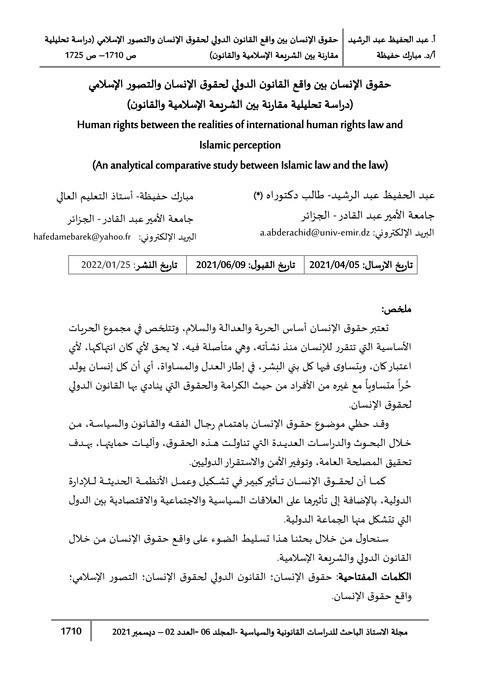 Human Rights Between The Realities of International Human Rights Law and Islamic Perception (An Analytical Comparative Study Between Islamic Law And the Law) (Journal of Professor Researcher for Legal and Political Studies; Vol.6, No.3) Year of publication: 2022 Author: Abderachid Abdelhafid | Hafeda Mebarek Corporate author: M'sila University Human rights are the basis of freedom, justice and peace. They consist of all the fundamental freedoms that have been established for human beings since their inception. They are inherent in human beings. No one shall violate them, on any account, and all human beings shall be equal, within the framework of justice and equality, that is, every human being shall be born free and equal to other individuals in terms of the dignity and rights proclaimed by international human rights law. The subject of human rights has received the attention of scholars, law and politics through numerous research and studies on human rights and their protection mechanisms, with a view to achieving public interest and international security and stability. Human rights also have a significant impact on the formation and functioning of modern regimes of international governance, as well as on the political, social and economic relations between the States that make up the international community. Through this research, we will try to highlight the reality of human rights through international law and Islamic law. حقوق الإنسان بين واقع القانون الدولي لحقوق الإنسان والتصور الإسلامي: دراسة تحليلية مقارنة بين الشريعة الإسلامية والقانون (مجلة الأستاذ الباحث للدراسات القانونية والسياسية; Vol.6, No.3) Year of publication: 2022 Author: Abderachid Abdelhafid | Hafeda Mebarek Corporate author: M'sila University تعتبر حقوق الإنسان أساس الحرية والعدالة والسلام ، وتتلخص في مجموع الحريات الأساسية التي تتقرر للإنسان منذ نشأته، وهي متأصلة فيه، لا يحق لأي كان انتهاكها، لأي اعتبار كان، ويتساوى فيها كل بني البشر، في إطار العدل والمساواة، أي أن كل إنسان يولد حُراً متساوياً مع غيره من الأفراد من حيث الكرامة والحقوق التي ينادي بها القانون الدولي لحقوق الإنسان. وقد حظي موضوع حقوق الإنسان باهتمام رجال الفقه والقانون والسياسة، من خلال البحوث والدراسات العديدة التي تناولت هذه الحقوق، وآليات حمايتها، بهدف تحقيق المصلحة العامة، وتوفير الأمن والاستقرار الدوليين. كما أن لحقوق الإنسان تأثير كبير في تشكيل وعمل الأنظمة الحديثة للإدارة الدولية، بالإضافة إلى تأثيرها على العلاقات السياسية والاجتماعية والاقتصادية بين الدول التي تتشكل منها الجماعة الدولية. سنحاول من خلال بحثنا هذا تسليط الضوء على واقع حقوق الإنسان من خلال القانون الدولي والشريعة الإسلامية.
  خطة العمل: البرنامج العالمي لل تثقيف في مجال حقوق الإنسان؛ المرحلة الأولى Year of publication: 2006 Corporate author: UN Office of the High Commissioner for Human Rights The Plan of Action for the first phase (2005-2007) of the World Programme was adopted by all United Nations Member States in July 2005. It proposes a concrete strategy and practical guidance for implementing human rights education in primary and secondary schools. On 10 December 2004, the General Assembly of the United Nations proclaimed the World Programme for Human Rights Education (2005-ongoing) to advance the implementation of human rights education programmes in all sectors. Building on the foundations laid during the United Nations Decade for Human Rights Education (1995-2004), this new initiative reflects the international community’s increasing recognition that human rights education produces far-reaching results. By promoting respect for human dignity and equality and participation in democratic decision-making, human rights education contributes to the long-term prevention of abuses and violent conflicts. To help make human rights a reality in every community, the World Programme seeks to promote a common understanding of the basic principles and methodologies of human rights education, to provide a concrete framework for action and to strengthen partnerships and cooperation from the international level down to the grass roots. План действий Всемирная программа образования в области прав человека : Первый этап Year of publication: 2006 Corporate author: UN Office of the High Commissioner for Human Rights The Plan of Action for the first phase (2005-2007) of the World Programme was adopted by all United Nations Member States in July 2005. It proposes a concrete strategy and practical guidance for implementing human rights education in primary and secondary schools. On 10 December 2004, the General Assembly of the United Nations proclaimed the World Programme for Human Rights Education (2005-ongoing) to advance the implementation of human rights education programmes in all sectors. Building on the foundations laid during the United Nations Decade for Human Rights Education (1995-2004), this new initiative reflects the international community’s increasing recognition that human rights education produces far-reaching results. By promoting respect for human dignity and equality and participation in democratic decision-making, human rights education contributes to the long-term prevention of abuses and violent conflicts. To help make human rights a reality in every community, the World Programme seeks to promote a common understanding of the basic principles and methodologies of human rights education, to provide a concrete framework for action and to strengthen partnerships and cooperation from the international level down to the grass roots. Plan de acción: programa Mundial para la Educación en Derechos Humanos, primera etapa Year of publication: 2006 Corporate author: UN Office of the High Commissioner for Human Rights The Plan of Action for the first phase (2005-2007) of the World Programme was adopted by all United Nations Member States in July 2005. It proposes a concrete strategy and practical guidance for implementing human rights education in primary and secondary schools. On 10 December 2004, the General Assembly of the United Nations proclaimed the World Programme for Human Rights Education (2005-ongoing) to advance the implementation of human rights education programmes in all sectors. Building on the foundations laid during the United Nations Decade for Human Rights Education (1995-2004), this new initiative reflects the international community’s increasing recognition that human rights education produces far-reaching results. By promoting respect for human dignity and equality and participation in democratic decision-making, human rights education contributes to the long-term prevention of abuses and violent conflicts. To help make human rights a reality in every community, the World Programme seeks to promote a common understanding of the basic principles and methodologies of human rights education, to provide a concrete framework for action and to strengthen partnerships and cooperation from the international level down to the grass roots. Plan d'action: programme mondial en faveur de l'Éducation aux droits de l'Homme, première phase Year of publication: 2006 Corporate author: UN Office of the High Commissioner for Human Rights The Plan of Action for the first phase (2005-2007) of the World Programme was adopted by all United Nations Member States in July 2005. It proposes a concrete strategy and practical guidance for implementing human rights education in primary and secondary schools. On 10 December 2004, the General Assembly of the United Nations proclaimed the World Programme for Human Rights Education (2005-ongoing) to advance the implementation of human rights education programmes in all sectors. Building on the foundations laid during the United Nations Decade for Human Rights Education (1995-2004), this new initiative reflects the international community’s increasing recognition that human rights education produces far-reaching results. By promoting respect for human dignity and equality and participation in democratic decision-making, human rights education contributes to the long-term prevention of abuses and violent conflicts. To help make human rights a reality in every community, the World Programme seeks to promote a common understanding of the basic principles and methodologies of human rights education, to provide a concrete framework for action and to strengthen partnerships and cooperation from the international level down to the grass roots.
  Plan of action: world programme for human rights education; first phase Year of publication: 2006 Corporate author: UN Office of the High Commissioner for Human Rights The Plan of Action for the first phase (2005-2007) of the World Programme was adopted by all United Nations Member States in July 2005. It proposes a concrete strategy and practical guidance for implementing human rights education in primary and secondary schools. On 10 December 2004, the General Assembly of the United Nations proclaimed the World Programme for Human Rights Education (2005-ongoing) to advance the implementation of human rights education programmes in all sectors. Building on the foundations laid during the United Nations Decade for Human Rights Education (1995-2004), this new initiative reflects the international community’s increasing recognition that human rights education produces far-reaching results. By promoting respect for human dignity and equality and participation in democratic decision-making, human rights education contributes to the long-term prevention of abuses and violent conflicts. To help make human rights a reality in every community, the World Programme seeks to promote a common understanding of the basic principles and methodologies of human rights education, to provide a concrete framework for action and to strengthen partnerships and cooperation from the international level down to the grass roots. Plan d’action Programme: mondial en faveur de l’éducation aux droits de l’homme; Première phase Year of publication: 2006 Corporate author: UN Office of the High Commissioner for Human Rights Le Plan d’action pour la première phase (2005-2007) du Programme mondial a été adopté par l’ensemble des États membres de l’ONU en juillet 2005. Il propose une stratégie concrète et des conseils pratiques pour intégrer l’éducation dans le domaine des droits de l’homme dans les écoles primaires et secondaires. Le 10 décembre 2004, l’Assemblée générale de l’ONU a adopté le Programme mondial d’éducation dans le domaine des droits de l’homme (qui est en cours depuis 2005) afin de promouvoir l’exécution des programmes d’éducation en la matière dans tous les secteurs2. S’appuyant sur le travail accompli au cours de la Décennie des Nations Unies pour l’éducation dans le domaine des droits de l’homme (1995-2004), cette nouvelle initiative traduit la reconnaissance croissante par la communauté internationale du fait que l’éducation dans le domaine des droits de l’homme produit des résultats d’une portée considérable. En favorisant le respect de la dignité humaine, l’égalité et la participation à la prise de décisions de façon démocratique, cette éducation contribue à prévenir à long terme les violations des droits de l’homme et les confl its violents. Pour aider à faire des droits de l’homme une réalité dans chaque société, la communauté internationale s’eff orce par le biais du Programme mondial à promouvoir une conception commune des principes fondamentaux et des méthodes d’éducation dans ce domaine, à mettre en place un cadre concret d’intervention et à renforcer les partenariats et la coopération sur tous les niveaux, depuis le niveau international jusqu’à l’échelon communautaire.