
Resources
Explore a wide range of valuable resources on GCED to deepen your understanding and enhance your research, advocacy, teaching, and learning.
3,446 Results found
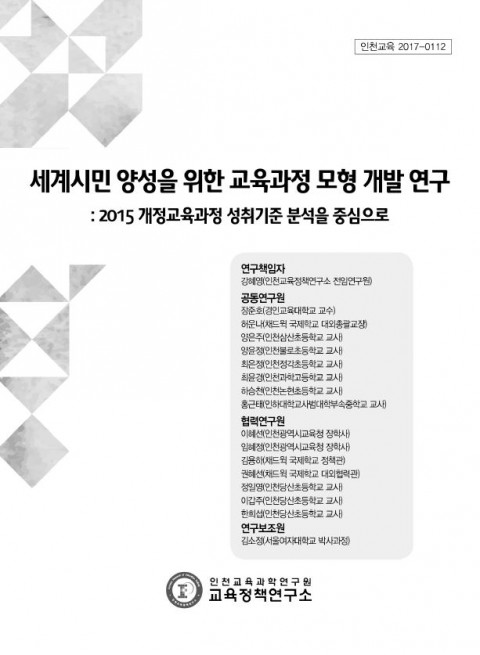 세계시민 양성을 위한 교육과정 모형 개발 연구: 2015 개정교육과정 성취기준 분석을 중심으로 Year of publication: 2017 Author: 강혜영 | 장준호 | 하은나 | 양은주 | 임윤정 | 최은정 | 최윤경 | 하승관 | 홍근태 Corporate author: 인천교육과학연구원 교육정책연구소 세계시민교육에 대한 중요성이 점차 강조되고 있음에도 현재 단위학교 현장에서는 세계시민교육의 개념과 관점이 혼재되어 있고 이를 교육과정 속에서 운영하는 사례도 부족한 실정이다. 이에 세계시민교육에 대한 방향을 제시하고 교육 현장에 보편적 가치를 반영하면서도 국가와 지역의 특수성을 기반으로 하는 경험중심의 세계시민교육이 뿌리 내릴 수 있도록 다양한 연구와 함께 시도교육청 차원의 노력이 시도되고 있다.인천광역시 교육청 역시 이러한 노력의 일환으로 다양한 연구를 수행하였고 본 연구는 학교가 교육과정 내에서 세계시민을 양성할 수 있는 교육과정 모형으로서 국가수준 교육과정에 해당하는 2015 개정교육과정의 성취기준 분석과 수업설계방법에 대한 제안을 목적으로 하고 있다.
 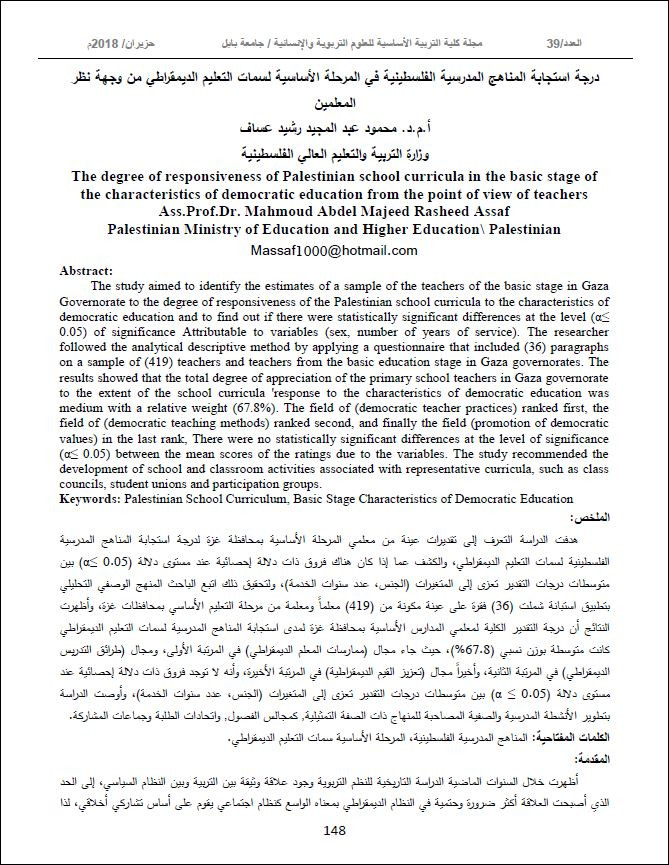 The Degree of Responsiveness of Palestinian School Curricula in the Basic stage of the Characteristics of Democratic Education from the Point of View of Teachers Year of publication: 2018 Author: Mahmoud Abdel Majeed Rasheed Assaf Corporate author: University of Babylon The study aimed to identify the estimates of a sample of the teachers of the basic stage in Gaza Governorate to the degree of responsiveness of the Palestinian school curricula to the characteristics of democratic education and to find out if there were statistically significant differences at the level (α≤ 0.05) of significance Attributable to variables (sex, number of years of service). The researcher followed the analytical descriptive method by applying a questionnaire that included (36) paragraphs on a sample of (419) teachers and teachers from the basic education stage in Gaza governorates. The results showed that the total degree of appreciation of the primary school teachers in Gaza governorate to the extent of the school curricula 'response to the characteristics of democratic education was medium with a relative weight (67.8%). The field of (democratic teacher practices) ranked first, the field of (democratic teaching methods) ranked second, and finally the field (promotion of democratic values) in the last rank, There were no statistically significant differences at the level of significance (α≤ 0.05) between the mean scores of the ratings due to the variables. The study recommended the development of school and classroom activities associated with representative curricula, such as class councils, student unions and participation groups. درجة استجابة المناهج المدرسية الفلسطينية في المرحلة الأساسية لسمات التعليم الديمقراطي من وجهة نظرالمعلمين Year of publication: 2018 Author: Mahmoud Abdel Majeed Rasheed Assaf Corporate author: University of Babylon هدفت الدراسة التعرف إلى تقديرات عينة من معلمي المرحلة الأساسية بمحافظة غزة لدرجة استجابة المناها المدرسية الفلسطينية لسمات التعليم الديمقراطي، والكشف عما إذا كان هنالك فروق ذات دالة إحصائية عند مستوى دالة (05.0≤ α (بين متوسطات درجات التقدير تعزى إلى المتغيرات )الجنس، عدد سنوات الخدمة(، ولتحقيق ذلل اتبع الباحث المنها الوصفي التحليلي بتطبيق استبانة شملت )36 )فقرة على عينة مكونة من )419 )معلما ومعلمة من مرحلة التعليم الأساسي بمحافظات غزة، وأظهرت النتائج أن درجة التقدير الكلية لمعلمي المدارس الأساسية بمحافظة غزة لمدى استجابة المناها المدرسية لسمات التعليم الديمقراطي كانت متوسطة بوزن نسبي )8.67 ،)%حيث جاء مجال )ممارسات المعلم الديمقراطي( في المرتبة الأولى، ومجال )طرائق التدريس وأخي ار مجال )تعزيز القيم الديمقراطية( في المرتبة الأخيرة، وأنث ال توجد فروق ذات دالة إحصائية عند الديمقراطي( في المرتبة الثانية، مستوى دالة (05.0 ≤ α (بين متوسطات درجات التقدير تعزى إلى المتغيرات )الجنس، عدد سنوات الخدمة(، وأوصت الدراسة بتطوير الأنشطة المدرسية والصفية المصاحبة للمنهاج ذات الصفة التمثيلية, كمجالس الفصول, واتحادات الطلبة وجماعات المشاركة.
  Citizenship education: does it have a place in the curriculum? Year of publication: 2005 Author: Carol Mutch Corporate author: NZCER Press The call for citizenship education as a compulsory part of the curriculum has met with a varied response worldwide. While everyone would espouse the ideals of ensuring our young people grow up to be active and fair-minded citizens, why does citizenship education not figure more prominently in our curriculum?This article discusses the past, present, and possible future of citizenship education in the New Zealand curriculum. L’éducation à la Citoyenneté: a-t-il une place dans le programme? Year of publication: 2005 Author: Carol Mutch Corporate author: NZCER Press L’appel à propositions sur l'éducation à la citoyenneté comme une partie obligatoire du programme a rencontré une réponse variée dans le monde entier. Alors que tout le monde serait épouser les idéaux de sorte que nos jeunes grandissent pour devenir des citoyens actifs et équitable d'esprit, pourquoi l'éducation à la citoyenneté figurait pas une place plus importante dans notre programme? Cet article décrit le passé, le présent et l'avenir possible de l'éducation civique dans le programme Nouvelle-Zélande. Global citizenship: a typology for distinguishing its multiple conceptions Year of publication: 2013 Author: Laura Oxley | Paul Morris Corporate author: Society for Educational Studies | Taylor & Francis The promotion of ‘Global Citizenship’ (GC) has emerged as a goal of schooling in many countries, symbolising a shift away from national towards more global conceptions of citizenship. It currently incorporates a proliferation of approaches and terminologies, mirroring both the diverse conceptions of its nature and the socio-politico contexts within which it is appropriated. This paper seeks to clarify this ambiguity by constructing a typology to identify and distinguish the diverse conceptions of GC. The typology is based on two general forms of GC: cosmopolitan based and advocacy based. The former incorporates four distinct conceptions of GC – namely, the political, moral, economic and cultural; the latter incorporates four other conceptions – namely, the social, critical, environmental and spiritual. Subsequently, we briefly illustrate how the typology can be used to evaluate the critical features of a curriculum plan designed to promote GC in England. The typology provides a novel and powerful means to analyse the key features of the very diverse range of educational policies and programmes that promote GC. La Citoyenneté Mondiale: une typologie pour distinguer ses multiples conceptions Year of publication: 2013 Author: Laura Oxley | Paul Morris Corporate author: Society for Educational Studies | Taylor & Francis La promotion de la «Citoyenneté Mondiale» (CM) a émergé comme un objectif de scolarisation dans de nombreux pays, symbolisant l'abandon des nationaux vers des conceptions plus globales de la citoyenneté. Il intègre actuellement une prolifération d'approches et terminologies, reflétant à la fois les diverses conceptions de la nature et les contextes socio-politico au sein duquel il est approprié. Ce document vise à clarifier cette ambiguïté en construisant une typologie pour identifier et distinguer les diverses conceptions de la CM. La typologie est basée sur deux formes générales de CM: cosmopolite base et sur la base de plaidoyer. L'ancien incorpore quatre conceptions distinctes de CM - à savoir la politique, morale, économique et culturelle; celui-ci comporte quatre autres conceptions - à savoir, le spirituel sociale, critique, de l'environnement et. Par la suite, nous illustrons brièvement comment la typologie peut être utilisé pour évaluer les caractéristiques essentielles d'un plan de programme conçu pour promouvoir la CM en Angleterre. La typologie fournit une nouvelle et des moyens puissants pour analyser les principales caractéristiques de la gamme très diversifiée de politiques et de programmes éducatifs qui favorisent la CM. National curricular guidelines and citizenship education in schools in Latin American countries Year of publication: 2013 Author: Martín Bascopé | Macarena Bonhomme | Cristián Cox | Juan Carlos Castillo | Daniel Miranda Corporate author: Centro de Estudios de Políticas y Prácticas en Educación (CEPPE) The aim of this study is to contrast two different sources of information regarding citizenship education in Latin America: curricular guidelines, and students’ civic attitudes and practices. When analyzing curricular guidelines, we consider the official national documents of the respective Ministries of Education, whereas regarding civic practices and attitudes, we analyze the results of the 2009 ICCS study. By using quantitative methods, we contrast the curricular emphasis and students’ results for each of the six countries considered. Our findings show that several curricular absences are associated with students’ low achievement in civic and citizenship knowledge and attitudes. Therefore, these results provide some guidelines for improving the official curricular documents and developing more empirical research on less-covered civic topics. Finally we encourage further research on classroom practices, especially on the topics highlighted in this research, such as authoritarianism, peaceful coexistence, national and regional identity, and accountability. Inside classroom research is very important to have a complete view of civic/citizenship curricular guidelines and practices, considering the limitations implied by looking at the intended curriculum (official documents) rather than the one implemented. Global citizenship education and its implications for curriculum goals at the age of globalization Year of publication: 2010 Author: Shahla Zahabioun | Alireza Yousefy | Mohammad H Yarmohammadian | Narges Keshtiaray Corporate author: Canadian Center of Science and Education As the inevitable process of the 21st century, globalization has affected and altered all aspects of human life including education. Therefore, one of the main tasks of any education system is to identify the features and impacts of such process. Thus, the present study was conducted aiming to discuss and examine global citizenship education and its implications for curriculum goals.This study is firstly defining global citizenship education concept as well as its significance and necessity and then it is going to explain global citizenship education concept and its purposes and implications for curriculum goals. This is an analytical research. The results indicate that global citizen holds peculiar features and requires special education in global aspects. Accordingly, the citizenship education compatible with global standards requires an overview of curriculum goals as one of the most important components of education system Global citizenship education and its implications for curriculum goals at the age of globalization Year of publication: 2010 Author: Shahla Zahabioun | Alireza Yousefy | Mohammad H Yarmohammadian | Narges Keshtiaray Corporate author: Canadian Center of Science and Education Comme le processus inévitable du 21e siècle, la mondialisation a affecté et changé tous les aspects de la vie humaine, y compris l'éducation. Par conséquent, l'une des principales tâches de tout système éducatif est d'identifier les caractéristiques et les impacts d'un tel processus. Ainsi, la présente étude a été menée en vue de discuter et d'examiner l'éducation à la citoyenneté mondiale et ses implications pour les objectifs du programme d'études.Cette étude est tout d'abord de définir la citoyenneté mondiale concept de l'éducation, ainsi que son importance et de la nécessité, et il va expliquer le concept d'éducation à la citoyenneté mondiale et de ses objectifs et implications pour les objectifs du programme d'études. Ceci est une recherche analytique. Les résultats indiquent que citoyen du monde détient des caractéristiques particulières et nécessite une éducation spéciale dans les aspects mondiaux. En conséquence, l'éducation à la citoyenneté compatibles avec les normes mondiales exige un aperçu des objectifs du curriculum comme l'un des éléments les plus importants du système d'éducation.