
Resources
Explore a wide range of valuable resources on GCED to deepen your understanding and enhance your research, advocacy, teaching, and learning.
2,657 Results found
 ОТЧЕТ по результатам проведенного исследования на тему «Мониторинг ситуации с профилактикой буллинга в средних образовательных школах Республики Казахстан» Year of publication: 2023 Corporate author: Қадір-қасиет (Казахстан) Общественное объединение «КадірКасиет» организовало и провело исследование, посвященное мониторингу ситуации с профилактикой буллинга в средних образовательных школах Казахстана. Целью исследования выступало изучение шести школ, в которых планируется внедрить пилотную программу «Ынсап» по противодействию буллингу в школах. Настоящий доклад подготовлен в рамках проекта «Фокус прав человека: женщины и дети», реализуемого ОО «Қадір-қасиет» и Агентством США по международному развитию (USAID).
  Participatory Diagnosis of Youth Perceptions and Attitudes Towards Hate Speech and Denialism of Gender Violence and Rights of Migrants From the Approaches of Global Citizenship Education Year of publication: 2024 Author: Bárbara Biglia | Aloe Cubero Corporate author: InteRed | Agencia Española de Cooperación Internacional para el Desarrollo (AECID) This diagnosis seeks to respond to the need to explore the perceptions and attitudes of youth regarding hate speech, specifically those that deny gender violence and the rights of migrants. We wanted to carry out this process recognizing the agency of young people and therefore we seek to generate collective and mobilizing reflections that increase their commitment as agents of change in our society. To this end, we place ourselves within the framework of Feminist Activist Research (IAF) using photovoice as a research strategy. Diagnóstico participativo a través de photovoice sobre percepciones y actitudes de la juventud en torno a los discursos de odio y negacionistas de la violencia de género y de los derechos de las personas migrantes desde los enfoques de la educación para Year of publication: 2024 Author: Bárbara Biglia | Aloe Cubero Corporate author: InteRed | Agencia Española de Cooperación Internacional para el Desarrollo (AECID) Este diagnóstico busca responder a la necesidad de explorar las percepciones y actitudes de la juventud en torno a los discursos de odio, específicamente sobre aquellos negacionistas de las violencias de género y en contra de los derechos de las personas migrantes. Hemos querido hacer este proceso reconociendo la agencia de las personas jóvenes y por ello buscamos generar reflexiones colectivas y movilizadoras que aumenten su compromiso como agentes de cambio en nuestra sociedad. Para tal fin, nos ubicamos en el marco de la Investigación Activista Feminista (IAF) haciendo uso del photovoice como estrategia de investigación.
  온라인 허위정보와 뉴스 미디어 Year of publication: 2020 Author: 박아란, 이나연, 오현경 Corporate author: 한국언론진흥재단 본 연구에서는 코로나19 사태 등 최근 국내외에서 발생한 주요 사안들과 관련하여 유포되고 있는 허위정보와 가짜뉴스의 사례와 개념 등을 정리하고 각국의 대응방안에 대해 조사하는 것을 목표로 한다. 특히 현재 진행 중인 코로나19 사태는 전 세계적으로 관심이 집중되고 있는 사안이니만큼 코로나19와 관련된 허위정보의 확산 및 피해 사례들을 중점적으로 살펴보고, 최근 선거를 치르거나 앞두고 있는 국가들의 사례를 통해 선거 관련 허위조작정보 문제에 대해서도 살펴봄으로써 사회적 혼란을 가져오고 불신을 양산하는 허위정보 문제에 효과적으로 대응할 수 있는 방안을 모색하고자 한다.
 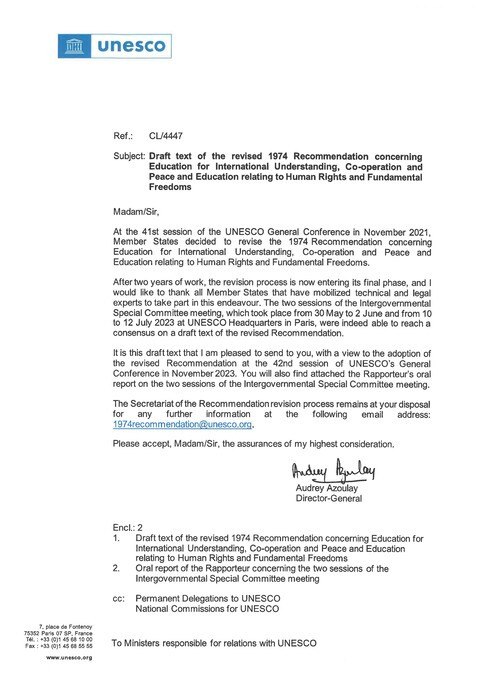 Draft Text of the Revised 1974 Recommendation Concerning Education for International Understanding, Co-Operation and Peace and Education Relating to Human Rights and Fundamental Freedoms Year of publication: 2023 Corporate author: UNESCO In accordance with the UNESCO Constitution and the Rules of Procedure concerning Recommendations to Member States and international conventions covered by the terms of Article IV, paragraph 4, of the Constitution, the draft text of the revised Recommendation concerning education for international understanding, co-operation and peace and education relating to human rights and fundamental freedoms, and the related preliminary report, were sent to UNESCO Member States through the circular letter CL/4401 (September 2022) for their written commentsand observations. On the basis of their comments, a second draft of the text was prepared. In circular letter CL/4433 (April 2023), the second draft together with the Definitive Report were submitted to Member States. The Special Committee meeting of experts designated by Member States took place from 30 May to 2 June 2023, as per the circular letter CL/4417 (November 2022), and from 10 to 12 July 2023, as per circular letter CL/4442 (June 2023).
  Addressing Hate Speech Through Education: A Guide for Policy-Makers Year of publication: 2023 Corporate author: UNESCO | UN. Office on Genocide Prevention and the Responsibility to Protect Hate speech is spreading faster and further than ever before as a result of social media user growth and the rise of populism. Both online and offline, hate speech targets people and groups based on who they are. It has the potential to ignite and fuel violence, spawn violent extremist ideologies, including atrocity crimes and genocide. It discriminates and infringes on individual and collective human rights, and undermines social cohesion. Education can play a central role in countering hateful narratives and the emergence of group-targeted violence. Educational responses to hate speech and all forms of hateful communication include:• Training teachers and learners on the values and practices related to being respectful global and digital citizens;• Adopting pedagogical and whole-school approaches to strengthening social and emotional learning;• Revising and reviewing curricula and educational materials to make them culturally responsive and to include content that identifies hate speech and promotes the right to freedom of expression;This policy guide developed by UNESCO and the United Nations’ Office on Genocide Prevention and the Responsibility to Protect explores these educational responses and provides guidance and recommendations to policy-makers on how to strengthen education systems to counter hate speech.
  Combatir el discurso de odio a través de la educación: una guía para los responsables de la formulación de políticas Year of publication: 2024 Corporate author: UNESCO | UN. Office on Genocide Prevention and the Responsibility to Protect Como producto de las redes sociales y del aumento del populismo, el discurso de odio se está difundiendo más rápido y con mayor alcance que nunca. Ya sea en línea o no, se dirige a las personas sobre la base de quiénes son y tiene el potencial de incitar a la violencia, así como engendrar ideologías extremistas y violentas, crímenes atroces e incluso el genocidio. Además, discrimina, infringe derechos humanos individuales y colectivos y socava la cohesión social.La educación puede cumplir un papel fundamental en la lucha contra los discursos de odio y el surgimiento de la violencia dirigida a grupos específicos. Las respuestas educativas al discurso de odio y a todas las formas de comunicación relacionadas incluyen:• La capacitación de docentes y estudiantes sobre los valores y las prácticas que necesitan para ser ciudadanos y ciudadanas respetuosos a nivel global y en el ámbito digital;• La adopción de pedagogías y enfoques escolares integrales para el fortalecimiento del aprendizaje social y emocional;• La adopción y revisión del currículo y de los materiales educativos para que sean culturalmente sensibles e incluyan contenido que identifique la presencia del discurso de odio y promueva el derecho a la libertad de expresión.Esta guía para la formulación de políticas, elaborada por la Oficina de las Naciones Unidas para la Prevención del Genocidio y la Responsabilidad de Proteger (OSAPG) y la UNESCO, analiza en detalle estas y otras respuestas educativas con la intención de brindar a las y los formuladores de políticas las orientaciones y recomendaciones sobre cómo fortalecer los sistemas educativos para combatir el discurso de odio.
  Lutter contre les discours de haine par l’éducation Year of publication: 2025 Corporate author: UNESCO | United Nations Office on Genocide Prevention and the Responsibility to Protect Lutter contre les discours de haine par l’éducationLes discours de haine se propagent plus vite et plus loin que jamais du fait de l’augmentation du nombre d’utilisateurs des médias sociaux et de la montée du populisme. En ligne comme hors ligne, les discours de haine ciblent des personnes et des groupes sur la base de ce qu’ils sont. Ces discours sont susceptibles d'inciter et d’attiser la violence et d’engendrer des idéologies extrémistes violentes, pouvant mener à des atrocités criminelles et des génocides. Ils sont discriminatoires, portent atteinte aux droits humains individuels et collectifs et menacent la cohésion sociale.L’éducation peut jouer un rôle essentiel dans la lutte contre les discours de haine et l’émergence de violences visant des groupes particuliers. Les réponses éducatives aux discours de haine et à toutes les formes de communication haineuse comprennent :• la formation des enseignants et des apprenants aux valeurs et aux pratiques permettant d’être des citoyens du monde et des citoyens numériques respectueux ;• l'adoption d'approches scolaires globales et pédagogiques pour renforcer l’apprentissage social et émotionnel ;• l'examen et la révision des programmes scolaires et des supports pédagogiques pour les rendre culturellement adaptés et inclure des contenus qui permettent d'identifier les discours de haine et promeuvent le droit à la liberté d’expression.Ce guide stratégique, élaboré par l’UNESCO et le Bureau de la prévention du génocide et de la responsabilité de protéger des Nations Unies, analyse ces réponses éducatives et fournit des conseils et des recommandations aux décideurs politiques sur la manière de renforcer les systèmes éducatifs pour lutter contre les discours de haine.
  الاستعراض الدوري الشامل وقدرته على تعزيز حرية التعبير والنفاذ إلى المعلومة وسالمة الصحفيين Year of publication: 2022 Author: Hina Jilani Corporate author: UNESCO This document introduces The Universal Periodic Review (UPR), including its function, content and guideline for practice, and evaluates its positive contributions to global human rights. The Universal Periodic Review (UPR) and its Potential to Foster Freedom of Expression, Access to Information and Safety of Journalists: Guidelines for National Human Rights Institutions (NHRIs) Year of publication: 2022 Author: Hina Jilani Corporate author: UNESCO This document introduces The Universal Periodic Review (UPR), including its function, content and guideline for practice, and evaluates its positive contributions to global human rights.