
Resources
Explore a wide range of valuable resources on GCED to deepen your understanding and enhance your research, advocacy, teaching, and learning.
3,446 Results found
 国际儿童发展合作研究报告 Year of publication: 2023 Corporate author: Chinese Academy of International Trade and Economic Cooperation 国际儿童发展合作对保障儿童权益至关重要。在联合国儿童基金会支持下,商务部国际贸易经济合作研究院开展了国际儿童发展合作课题研究。本报告介绍了美国、英国、日本和德国四个主要捐助国在国际儿童发展合作方面的相关案例,探讨了国际儿童发展合作的不同背景、战略、政策、体制机制和挑战,揭示了国际儿童发展合作的几个显著特点。报告同时分析了中国的国际儿童发展合作模式在过去的几十年里的演变,并结合新形势下儿童发展需求和挑战,为中国参与国际儿童发展合作提出了建议。
 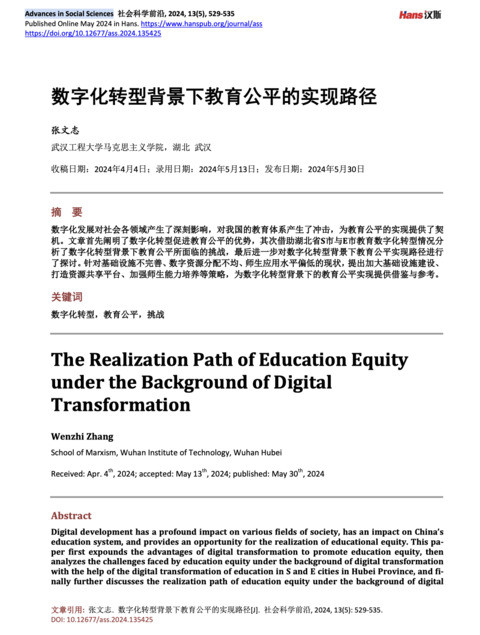 数字化转型背景下教育公平的实现路径 (社会科学前沿 第13卷 第5期) Year of publication: 2024 Author: 张文志 Corporate author: 汉斯出版社 数字化发展对社会各领域产生了深刻影响,对我国的教育体系产生了冲击,为教育公平的实现提供了契 机。文章首先阐明了数字化转型促进教育公平的优势,其次借助湖北省S市与E市教育数字化转型情况分 析了数字化转型背景下教育公平所面临的挑战,最后进一步对数字化转型背景下教育公平实现路径进行 了探讨。针对基础设施不完善、数字资源分配不均、师生应用水平偏低的现状,提出加大基础设施建设、 打造资源共享平台、加强师生能力培养等策略,为数字化转型背景下的教育公平实现提供借鉴与参考。
  L'Enseignement pour le développement durable de l'Arctique Year of publication: 2009 Author: Lars Kullerud Corporate author: Organisation des Nations Unies pour l'éducation, la science et la culture (UNESCO) Education is an essential component of sustainable development. However, for the Arctic there is a history of education systems that tried to force central school models on local people, including different degrees of suppression of local language. This has been improved today to various degrees in the Arctic states. However, lack of skilled teachers with local roots is a circumpolar challenge. Arctic higher educational institutions also face many challenges when attempting to be innovative and competitive due to their small size and geographic isolation. The model of the University of the Arctic allows for a dynamic development of shared education systems through mutual cooperation. This network can be a very efficient tool to for delivering a relevant curriculum for a changing North. Education for Arctic sustainable development Year of publication: 2009 Author: Lars Kullerud Corporate author: UNESCO Education is an essential component of sustainable development. However, for the Arctic there is a history of education systems that tried to force central school models on local people, including different degrees of suppression of local language. This has been improved today to various degrees in the Arctic states. However, lack of skilled teachers with local roots is a circumpolar challenge. Arctic higher educational institutions also face many challenges when attempting to be innovative and competitive due to their small size and geographic isolation. The model of the University of the Arctic allows for a dynamic development of shared education systems through mutual cooperation. This network can be a very efficient tool to for delivering a relevant curriculum for a changing North.
  National journeys towards education for sustainable development, 2011: reviewing national experiences from Chile, Indonesia, Kenya, the Netherlands, Oman Year of publication: 2011 Author: I. Mulà | Daniella Tilbury Corporate author: UNESCO This publication has sourced information from a series of national reviews commissioned by UNESCO in 2010 and written by authoritative stakeholders in Chile, Indonesia, Kenya, the Netherlands and Oman. The selection of countries was based on: i) work showcased at the 2009 World Conference on Education for Sustainable Development held in Bonn, Germany; ii) submissions to the monitoring and evaluation process for the Decade of Education for Sustainable Development (DESD); as well as iii) through evaluation material submitted by UNESCO staff in regional bureaux of education.The countries showcased in this report are not necessarily the ‘best’ examples of the region, as many other countries are also progressing effectively towards implementing ESD. Rather, the countries selected illustrate the wide diversity of ESD approaches and initiatives taking place in different parts of the learnt world. The national studies were then edited and harmonized before common themes and lessons learned were identified to support other national efforts in moving towards the second half of the UN Decade of Education for Sustainable Development. Good practices in education for sustainable development: using the Earth Charter Year of publication: 2007 Corporate author: UNESCO | Earth Charter International Secretariat This publication has been envisioned to offer stories – case studies from around the world – that highlight how groups and individuals are using the Earth Charter as a tool for education for sustainable development. These stories come from non-formal and formal educational settings and describe a variety of experiences, including the development of guidebooks for primary school teachers, the inclusion of sustainability values in universities’ departments of education, law, engineering and general studies; the reshaping of local, regional and national curricula; and, the creation of vital and engaging programs and workshops for children and youth.
  Measurement of global citizenship education Year of publication: 2013 Author: Vegard Skirbekk | Michaela Potančoková | Marcin Stonawski Corporate author: UNESCO In this study we provide an overview of Global Citizenship Education, focusing on definitions, methodological advances and data. We present an assessment of some of the existing initiatives for the measurement Global Citizenship Education, and make suggestions for how to move towards a globally consistent measure. Although there is some disagreement over how to measure global citizenship and global citizenship education, we also find consensus on parts of the concept. We are proposing to construct a composite indicator consisting of three complementary levels – the societal level (e.g., the level of democracy; macro level indicators of openness), the supplier level (e.g., provision of education; availability of training relevant for global citizenship); and the receiver level (civic identity, values, skills and knowledge). We conclude that one potential cost-effective approach could be to integrate evidence from several nationally representative surveys, providing us with world-wide coverage. We also discuss the feasibility and benefits of this measurement approach as well as its challenges. Measurement of global citizenship education Year of publication: 2013 Author: Vegard Skirbekk | Michaela Potančoková | Marcin Stonawski Corporate author: Organisation des Nations Unies pour l'éducation, la science et la culture (UNESCO) Dans cette étude, nous présentons un aperçu de l’Éducation à la Citoyenneté Mondiale, en se concentrant sur les définitions, les progrès méthodologiques et des données. Nous présentons une évaluation de quelques-unes des initiatives existantes pour la mesure d'éducation à la citoyenneté mondiale, et de faire des suggestions sur la façon de progresser vers une mesure cohérente au niveau mondial. Bien qu'il y ait un certain désaccord sur la façon de mesurer la citoyenneté mondiale et de l'éducation à la citoyenneté mondiale, on trouve aussi un consensus sur certaines parties du concept. Nous proposons de construire un indicateur composite constitué de trois niveaux complémentaires - le niveau de la société (par exemple, le niveau de la démocratie, les indicateurs macro-niveau d'ouverture), le niveau des fournisseurs (par exemple, la fourniture de l'éducation, la disponibilité de la formation pertinente à la citoyenneté mondiale) ; et le niveau du récepteur (identité civique, les valeurs, les compétences et les connaissances). Nous concluons qu'une approche potentielle rentable pourrait être d'intégrer des preuves de plusieurs enquêtes représentatives au niveau national, nous fournissant une couverture mondiale. Nous discutons aussi la faisabilité et les avantages de cette approche de mesures ainsi que ses défis. National identity and xenophobia in an ethnically divided society Year of publication: 2005 Author: Noah Lewin Epstein | Asaf Levanon Corporate author: UNESCO Recent studies have suggested that national identity is empirically related to negative sentiments of individuals towards foreigners. This type of analysis has hitherto been based on the notion that xenophobia is shaped by the specific nature of national identity in a given society. Representing a stronger and more exclusive perception of national identity, ethnic national identity (compared with civic national identity) is expected in this line of research to result in less favourable perceptions of immigrants. In this paper we expand this approach by arguing that, in deeply divided societies, national identity itself may have different meanings among different social groups. L'identité nationale et la xénophobie dans une société ethniquement divisée Year of publication: 2005 Author: Noah Lewin Epstein | Asaf Levanon Corporate author: Organisation des Nations Unies pour l'éducation, la science et la culture (UNESCO) Des études récentes ont suggéré que l'identité nationale est empiriquement associée à des sentiments négatifs des individus envers les étrangers. Ce type d'analyse a été jusqu'ici fondée sur la notion que la xénophobie est façonnée par la nature spécifique de l'identité nationale dans une société donnée. Représenter une perception plus forte et plus exclusive de l'identité nationale, l'identité nationale ethnique (par rapport à l'identité nationale civique) est attendue dans cette ligne de recherche pour aboutir à la perception moins favorable des immigrants. Dans cet article, nous étendre cette approche en faisant valoir que, dans les sociétés profondément divisées, l'identité nationale elle-même peut avoir des significations différentes entre les différents groupes sociaux.