
Resources
Explore a wide range of valuable resources on GCED to deepen your understanding and enhance your research, advocacy, teaching, and learning.
2,772 Results found
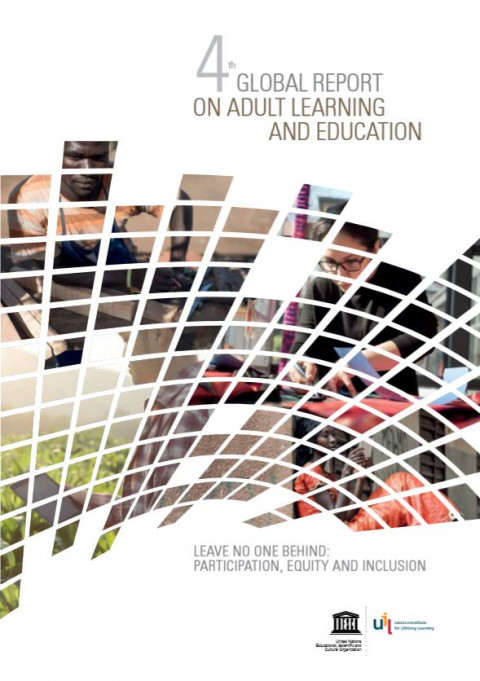 4th Global Report on Adult Learning and Education: Leave No One Behind: Participation, Equity and Inclusion Year of publication: 2019 Corporate author: UNESCO Institute for Lifelong Learning (UIL) This report demonstrates the important role participation in adult learning and education can play in achieving the Sustainable Development Goals, highlights the distance we have to travel, and offers clear guidance on how to move forward. As the report clearly also shows, it is only by prioritizing ALE, and rebalancing resources accordingly, that can we ensure that the commitment of the 2030 Agenda to ‘leave no one behind’ in the pursuit of equitable, inclusive and sustainable development is fully and fairly realized. 4e rapport mondial sur l’apprentissage et l’éducation des adultes: ne laisser personne pour compte: participation, équité et inclusion Year of publication: 2019 Corporate author: Institut de l’UNESCO pour l’apprentissage tout au long de la vie (UIL) Le présent rapport démontre le rôle crucial que la participation à l’apprentissage et à l’éducation des adultes peut jouer dans la réalisation des objectifs de développement durable, souligne la distance qu’il nous reste à parcourir pour y parvenir et propose des orientations claires sur la manière d’aller de l’avant. Il ressort clairement du GRALE 4 que, ce n’est qu’en accordant la priorité à l’apprentissage et à l’éducation des adultes et en rééquilibrant les ressources en conséquence, que nous réussirons à réaliser pleinement et justement l’engagement à travers le Programme de développement durable à l’horizon 2030 de « ne laisser personne pour compte » dans notre quête d’un développement équitable, inclusif et durable.
  Adult Education and the Challenge of Exclusion: UIL Policy Brief 10 Year of publication: 2020 Corporate author: UNESCO Institute for Lifelong Learning (UIL) The fourth Global Report on Adult Learning and Education (G RALE 4) shows that raising participation in adult learning and education (ALE) is pivotal for achieving not only Sustainable Development Goal (SDG) 4 on education, but also the other goals of the 2030 Agenda, spanning issues from climate change to poverty reduction. This places an onus on countries to review ALE policies and progress in the light of evidence on participation, and to invest in sustainable provision that is accessible to all learners, throughout their lives and in all the different contexts in which adults learn. L’éducation des adultes face au défi de l’exclusion : Note d’orientation de l’UIL n° 10 Year of publication: 2020 Corporate author: UNESCO Institute for Lifelong Learning (UIL) Le quatrième Rapport mondial sur l’apprentissage et l’éducation des adultes (GRALE, Global Report on Adult Learning and Education) révèle qu’il est crucial d’accroître la participation à l’apprentissage et à l’éducation des adultes (AEA) pour atteindre non seulement l’objectif 4 des objectifs de développement durable (ODD) sur l’éducation, mais aussi les autres objectifs de ce Programme, qui vont du changement climatique à la réduction de la pauvreté. Cela impose aux pays d’évaluer leurs politiques en matière d’apprentissage et d’éducation des adultes, de progresser à la lumière des données factuelles sur la participation, ainsi que d’investir dans une offre durable accessible à tous les apprenants, tout au long de la vie et dans les différents contextes d’apprentissage. La educación de adultos y el desafío de la exclusion : Informe de políticas del UIL 10 Year of publication: 2020 Corporate author: UNESCO Institute for Lifelong Learning (UIL) El cuarto Informe Mundial sobre el Aprendizaje y la Educación de Adultos (GRALE 4) muestra que aumentar la participación en el aprendizaje y la educación de adultos (AEA) es fundamental para alcanzar no solo el Objetivo de Desarrollo Sostenible (ODS) 4 sobre educación, sino también los otros objetivos de la Agenda 2030, que abarcan temas que van desde el cambio climático hasta la reducción de la pobreza. Esto exige que los países revisen las políticas y los progresos del AEA de acuerdo con los datos sobre participación e inviertan en una oferta sostenible que sea accesible a todos los educandos, a lo largo de su vida y en todos los diferentes contextos en los que los adultos aprenden.
  Optimising learning, education and publishing in Africa: the language factor; a review and analysis of theory and practice in mother-tongue and bilingual education in sub-Saharan Africa Year of publication: 2011 Author: Adama Ouane | Christine Glanz Corporate author: UNESCO Institute for Lifelong Learning (UIL) | Association for the Development of Education in Africa (ADEA) This analytical review consists of three sections. The first section lays the theoretical foundations and is covered by Ekkehard Wolff and Kathleen Heugh: 1) language politics and planning in the light of development and 2) theories of bi- and multilingual education models and their implementation in the African context. A second section analyses teaching practices and classroom interaction in schools in two chapters by Birgit Brock-Utne and Hassana Alidou. This is followed by a review of the use of African languages in literacy and non-formal education by Hassana Alidou1 . Next, a review study by Kathleen Heugh addresses the critical issue of costs by assessing the costs related to implementing mother tongue and strong bilingual education programmes. Finally, the third section explores the role of locally-based multilingual publishing in supporting and promoting African languages and developing the language industries and the creative sector. Here, Yaya Satina Diallo from Guinea and Peter Reiner2 from Namibia shed light on the promise and pitfalls of publishing in African languages.Each of these sections focuses on theoretical frameworks and specific strategies designed to optimise learning and education in multilingual Africa. The language issue is dealt with at the levels of: policy and development; costing and financing; educational reform and governance; education models; classroom interaction; formal and non-formal education settings; literacy and publishing. Optimiser l'apprentissage, l'éducation et l'édition en Afrique: le facteur langue; étude bilan sur la théorie et la pratique de l'enseignement en langue maternelle et l'éducation bilingue en Afrique subsaharienne Year of publication: 2011 Author: Adama Ouane | Christine Glanz Corporate author: UNESCO Institute for Lifelong Learning (UIL) | Association for the Development of Education in Africa (ADEA) This analytical review consists of three sections. The first section lays the theoretical foundations and is covered by Ekkehard Wolff and Kathleen Heugh: 1) language politics and planning in the light of development and 2) theories of bi- and multilingual education models and their implementation in the African context. A second section analyses teaching practices and classroom interaction in schools in two chapters by Birgit Brock-Utne and Hassana Alidou. This is followed by a review of the use of African languages in literacy and non-formal education by Hassana Alidou1 . Next, a review study by Kathleen Heugh addresses the critical issue of costs by assessing the costs related to implementing mother tongue and strong bilingual education programmes. Finally, the third section explores the role of locally-based multilingual publishing in supporting and promoting African languages and developing the language industries and the creative sector. Here, Yaya Satina Diallo from Guinea and Peter Reiner2 from Namibia shed light on the promise and pitfalls of publishing in African languages.Each of these sections focuses on theoretical frameworks and specific strategies designed to optimise learning and education in multilingual Africa. The language issue is dealt with at the levels of: policy and development; costing and financing; educational reform and governance; education models; classroom interaction; formal and non-formal education settings; literacy and publishing.
  Multicultural Education through ELT Textbooks: Developing a Checklist for English Materials Evaluation Based on Multiculturalism (The Journal of Curriculum and Evaluation; Vol. 20, No. 4) Year of publication: 2017 Author: Minah Kim | Doseon Eur Corporate author: Korea Institute for Curriculum and Evaluation (KICE) Multicultural education is recommended as an effort to resolve significant social challenges in Korea. This is reflected in the 2015 reform of national curriculum and instruction as it promotes cultural diversity and competence. As English textbooks are widely used in EFL classrooms in Korea by both students and teachers, it is useful to examine how much English textbooks are multiculturalism-friendly and -responsive. This study has 3 parts: 1) It makes a critical review of previous research on English textbooks evaluation checklists, 2) it then synthesizes them and proposes a new tentative multiculturalism-based criteria for English textbooks evaluation, and finally, 3) it applies the new subset of the criteria to an English textbook used in EFL classrooms in Korea to test its validity and practicality. Developing a multiculturalism-responsive criteria for English textbooks evaluation will provide multiculturalism-friendly classroom environments in which EFL learners can grow not only linguistically but also 'multiculturally'. 영어교육과 다문화주의: 다문화주의 기반 영어 교재 평가 체크리스트 개발 (교육과정평가연구; Vol. 20, No. 4) Year of publication: 2017 Author: 김민아 | 어도선 Corporate author: 한국교육과정평가원 다문화 수용성이 중요한 사회적 담론으로 부상함에 따라 2015년 영어과 교육과정 개정에 다문화 이해가 성취기준으로 제시되었다. 영어 교재(교과서 포함)가 학습자의 다문화 이해에 영향을 미칠 수 있으므로 영어 교재가 다문화주의의 이념과 원리를 잘 반영하고 있는지를 살피는 일은 매우 중요하다. 본 연구는 영어 교재 평가와 관련한 기존 연구와 이미 소개된 체크리스트를 분석 하고 종합한 후 우리 사회의 영어교육 환경에 적합한 다문화주의 기반 영어 교재 평가 체크리스트를 체계적이고 상세하게 제시하는 것을 목적으로 하고 있다. 이 도구의 타당성과 효용성을 검증하기 위해 고교 영어교과서에 이 체크리스트를 적용하여 교과서의 다문화 요소를 분석하고 평 가하였으며, 다문화 반영이 미흡하게 나타난 것으로 평가 결과를 보여주었다. 이 연구를 통해 학 습자들이 언어적으로 뿐 아니라 ‘다문화적으로’ 성장할 수 있는 다문화 친화적인 영어교육 환경이 조속히 마련되기를 기대하고 있다.
 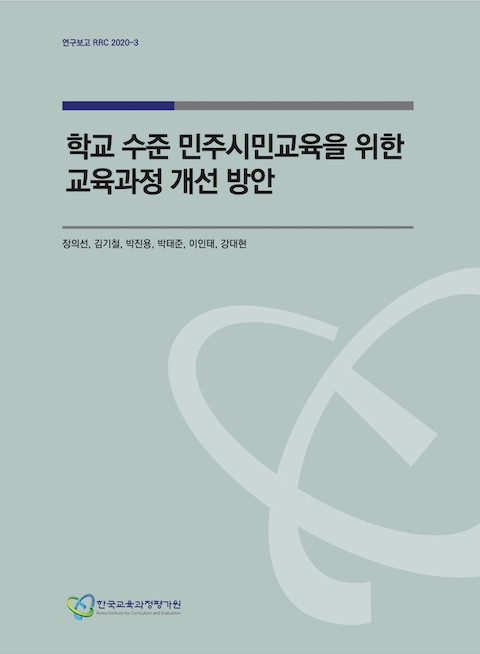 학교 수준 민주시민교육을 위한 교육과정 개선 방안 Year of publication: 2020 Author: 장의선 | 김기철 | 박진용 | 박태준 | 이인태 | 강대현 | 정윤미 Corporate author: 한국교육과정평가원 본 연구의 목적은 먼저 세계화가 이미 일상화 된 21세기의 학생들에게 요구되는 민주시민성을 폭넓게 성찰하고, 이를 측정할 수 있는 민주시민성 지표를 구안한 후, 구안한 지표를 준거로 민주시민성 인식 및 교육과정 현황 등 민주시민교육 관련 주요 실태와 요구를 분석하여, 민주시민교육 강화를 위한 교육과정 개선안을 도출하는 데 있다.