
Resources
Explore a wide range of valuable resources on GCED to deepen your understanding and enhance your research, advocacy, teaching, and learning.
3,446 Results found
 School Violence and Bullying: Global Status Report Year of publication: 2017 Corporate author: UNESCO School violence and bullying occurs throughout the world and affects a significant proportion of children and adolescents. It not only negatively impacts their educational outcomes, but harms their physical health and emotional well-being.This report aims to provide an overview of the most up-to-date available data on the nature, extent and impact of school violence and bullying and efforts to address the problem. It was prepared by UNESCO and the Institute of School Violence and Prevention at Ewha Womans University for the International Symposium on School Violence and Bullying: From Evidence to Action, Seoul, Republic of Korea, 17 – 19 January, 2017.
 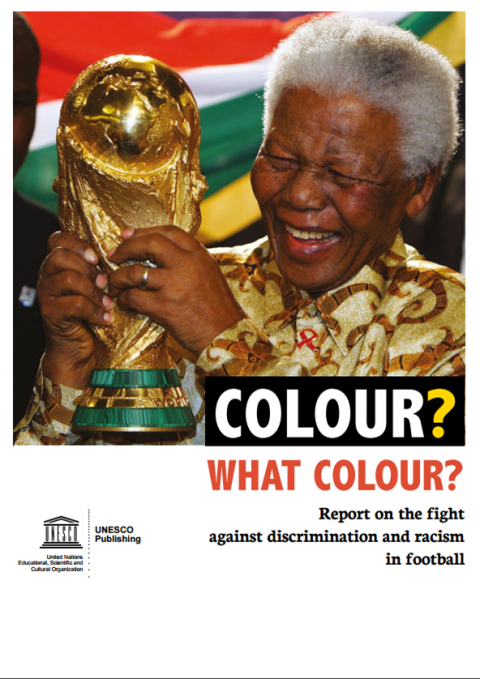 Colour? What colour? Report on the fight against discrimination and racism in football Year of publication: 2015 Author: Albrecht Sonntag | David Ranc Corporate author: UNESCO Football has been shown to be a mirror of society, it may also be viewed as providing a temporary suspension of reality for an interlude of high emotion and idealized hopes and dreams. Football’s public transcends differences of age, gender, culture, religion, and socioeconomic status to unite in support of their team. The broad diversity of backgrounds of football players represents tangible evidence of equal opportunity and meritocracy. The sport itself has team solidarity, fair play and mutual respect among members and for opponents ingrained within its rules and practices. Yet, the ‘beautiful game’ is one with an imbedded paradox. Football is also a game that may in many vaguely resemble war, where opponents face each other in a struggle to win over the other side, with the noisy and emphatic support of the spectators. An ‘us’ and ‘them’ mentality is an integral part of trying to help a team reach the objective, which is to win the game. This setting naturally produces a desire by supporters to intimidate the other side by encouraging their team and expressing both confidence and superiority through their words and actions. When the ‘us’ and ‘them’ mentality turns into symbolic exclusion of others, language of disparagement and insult based on racism or discrimination, or physical confrontation, the ‘beautiful game’ is debased. The existence of racism and discrimination in football is not a secret, but it is a shame on the game. Although much is already being done, both observers and experts feel too many problems persist and measures to tackle them have not been effective enough. This report was commissioned by UNESCO within the framework of UNESCO’s partnership with Juventus. It focuses on discrimination and racism in professional football and to some extent the amateur clubs that funnel into the leagues. It provides an overview of the historic and theoretical background. It reports on the state of affairs on the ground. It summarizes what has been done and is being done to mitigate racism and discrimination in domestic and international football, how the effects of these actions may be evaluated, and which new avenues for further, complementary action are promising. The report is based on a literature review, desk research, regional reports from the Unesco network and a field survey among a purposive sample of experts and actors in a number of countries. The report has a somewhat European focus, in its sources and examples. Europe has a unique position Executive Summary in the world of football, with its leading competitions, championships and clubs. It is the region where racism and discrimination in football has been most intensively researched. A number of civil society organisations from Europe have played a pioneering role in the fight against racism and discrimination in football. Moreover, the pressure that comes with the money invested in and generated by western European football, as well as its exposure in the media, has also made clubs, federations and UEFA particularly sensitive to the negative impact that discrimination can have on the game and its image, within Europe and worldwide. Europe must therefore occupy a central role in a study of the fight against discrimination in professional football and in determined policies to mitigate racism and discrimination related to football wherever they occur. The examples of incidents of discrimination and racism, as well as of existing measures to combat them have been selected to be as wide-ranging as possible. The authors do not, however, claim the report to be a comprehensive listing. Similarly, the examples of best practice have been collected through extensive reading and contacts, but must be looked at as an overview rather than as a directory. They are chosen by the authors to illustrate types of actions and institutions with the potential for greatest impact. The report also does not deal with the methods of allocation of resources to football, with issues of employment, or with womens’ football. While these are significant topics on which concerns can be expressed, the necessary focus of a report of this type means that they are alluded to without being treated in depth.
  Cracking The Code: Girls’ and Women’s Education in Science, Technology, Engineering and Mathematics (STEM) Year of publication: 2017 Corporate author: UNESCO Despite significant improvements in recent decades, education is not universally available and gender inequalities persist. A major concern in many countriesis not only limited numbers of girls going to school, but also limited educational pathways for those that step into the classroom. This includes, more specifically,how to address the lower participation and learning achievement of girls in science, technology, engineering and mathematics (STEM) education. STEM underpins the 2030 Agenda for Sustainable Development, and STEM education can provide learners with the knowledge, skills, attitudes and behavioursrequired for inclusive and sustainable societies. Leaving out girls and women in STEM education and careers is a loss for all. This report aims to ‘crack the code’, or to decipher the factors that hinder or facilitate girls’ and women’s participation, achievement and continuation in STEMeducation, and what can be done by the education sector to promote girls’ and women’s interest in, and engagement with, STEM. Déchiffrer le Code: L'Éducation des Filles et des Femmes aux Sciences, Technologie, Ingénierie et Mathématiques (STEM) Year of publication: 2017 Corporate author: Organisation des Nations Unies pour l'éducation, la science et la culture (UNESCO) Malgrédes améiorations notables ces dernièes déennies, l’éucation n’est pas universellement disponible et les inéalité entre les genres persistent, souvent en déaveur des filles. Des facteurs socio-culturels et éonomiques complexes et lié entre eux pèent non seulement sur les possibilité de scolarisation des filles mais aussi sur la qualitéde l’éucation qu’elles recevront, les éudes qu’elles suivront et, au bout du chemin, leurs carrièes et leurs parcours de vie. Une préccupation majeure tient àla faiblesse de la participation et des réultats des filles dans les éudes de sciences, technologie, ingéierie et mathéatiques (STEM). Les STEM sous-tendent le Programme de déeloppement durable àl’horizon 2030 et l’éucation aux STEM peut apporter aux apprenants les connaissances, les compéences et les comportements néessaires àdes sociéé inclusives et durables. Laisser les filles et les femmes àl’éart de l’éucation et des professions des STEM non seulement les prive de la possibilitéde contribuer aux STEM et d’en bééicier, mais aussi perpéue le fosséentre les sexes et, plus gééalement, les inéalité sociales et éonomiques. Le présent rapport vise à« déhiffrer le code » en déryptant les facteurs qui entravent ou facilitent la participation, la réssite et la réention des filles et des femmes dans l’éucation aux STEM et, en particulier, ce que peut faire le secteur de l’éucation pour promouvoir l’intéê et l’engagement des filles et des femmes dans l’éucation aux STEM et finalement dans les carrièes des STEM. Il entend constituer une ressource pour les parties prenantes de l’éucation et autres personnes qui travaillent àpromouvoir l’éalitédes genres.
  From insult to inclusion: Asia-Pacific report on school bullying, violence and discrimination on the basis of sexual orientation and gender identity Year of publication: 2015 Corporate author: UNESCO This review recognises the complexity in terminology globally, and within the region, on sex, sexuality and gender. For simplicity, ‘SOGIE-based bullying, violence and discrimination’ is used to refer to the various anifestations of violence and exclusion based on gender discrimination, gender role expectations and stereotypes, intersex prejudice, and societal expectations for heterosexual relationships. This is sometimes referred to as homophobic or transphobic bullying, violence and discrimination. This report considers violence experienced by children and young people because of actual or perceived sexual orientation and gender identity or expression, or because their bodies differ from typical definitions of male or female. The term ‘LGBTI people/youth’ is used in this report when inclusive of intersex persons, and LGBT when the situation or needs of intersex people/ youth have not been considered. Local terms and those from original studies are also included, and the glossary provides information for readers on concepts and terms in this report. De l'insulte à l'inclusion: Rapport sur l'Asie-Pacifique sur les brimades à l'école, la violence et la discrimination sur la base de l'orientation sexuelle et l'identité de genre Year of publication: 2015 Corporate author: Organisation des Nations Unies pour l'éducation, la science et la culture (UNESCO) Cet avis reconnaît la complexité de la terminologie au niveau mondial, et dans la région, sur le sexe, la sexualité et le genre. Par souci de simplicité, ‘sur la base Sogie l'intimidation, la violence et la discrimination’ est utilisé pour désigner les différents anifestations de violence et d'exclusion fondées sur la discrimination entre les sexes, les attentes de rôle de genre et les stéréotypes, les préjugés intersexe et attentes de la société pour les relations hétérosexuelles. Ceci est parfois désigné comme homosexuels ou les transsexuels intimidation, la violence et la discrimination. Ce rapport considère la violence vécue par les enfants et les jeunes en raison de l'orientation et l'identité ou l'expression sexuelle réelle ou perçue, ou parce que leurs corps diffèrent des définitions typiques de sexe masculin ou féminin. Le terme «personnes LGBTI / jeunesse» est utilisé dans ce rapport lorsque compris les personnes intersexuées et LGBT lorsque la situation ou les besoins des personnes intersexuées / jeunes n'ont pas été pris en considération. Les termes locaux et ceux des études originales sont également inclus, et le glossaire fournit des informations pour les lecteurs sur les concepts et termes utilisés dans ce rapport.
  Survey on Privacy in Media and Information Literacy with Youth Perspectives Year of publication: 2017 Author: Sherri Hope Culver | Alton Grizzle Corporate author: UNESCO Media and information literate individuals are more empowered to make informed decisions about their privacy online and offline, among other things. Accordingly, governments and policy-makers who are committed to ensuring that the privacy of citizens is respected should also be committed to media and information literacy (MIL) for all. If they are not, then their efforts will be less sustainable. Equally, private and public enterprises that genuinely want to respect the privacy of citizens should purposefully contribute to MIL awareness among users qua citizens. Two research surveys are referenced in this report. The first investigated youth attitudes towards MIL and social and democratic discourses. One of the seven themes addressed in the context of social and democratic discourses was privacy. The research was carried out by UNESCO. The second survey studied privacy in MIL courses globally and was conducted for UNESCO by the UNESCO-UNAOC University Network on Media and Information Literacy and Intercultural dialogue (MILID Network), and members of the Global Alliance for Partnerships in Media and Information Literacy (GAPMIL). The report responds to UNESCO’s efforts to stimulate global research into privacy in MIL. Ultimately, this report aims to provide conceptual, development and policy recommendations to foster privacy in MIL, while enabling the critical engagement of people, including young women and men, in an environment conducive to sustainable development and to freedom of expression online and offline. It seeks to provide clarity on the complex issue of how MIL and privacy intersect.
  A Decade of progress on education for sustainable development: reflections from the UNESCO Chairs Programme Year of publication: 2017 Author: Michelsen, Gerd | Wells, Peter J. Corporate author: 유네스코 The UNITWIN/UNESCO Chairs Programme, launched in 1992, today forms an extensive network of inter-university cooperation involving more than 700 higher education institutions in 128 countries worldwide. Through knowledge sharing and collaborative research in the priority areas of UNESCO’s work in education, the natural and social sciences, culture, communication and information, the Chairs provide a vital contribution to the Organization’s mission. The current volume focuses on the activities undertaken by UNESCO Chairs dedicated to the field of Education for Sustainable Development (ESD) within the context of the UN Decade of ESD which culminated in the UNESCO World Conference on ESD, held in AichiNagoya, Japan, 2014. The case studies included, showcase the good practices, applied research and curricula innovations pioneered by the individual UNESCO Chairs, as well as highlighting the challenges and lessons learned both for the new follow-up Global Action Programme (GAP) on ESD and the wider Education 2030 Agenda.
  Informe de las Naciones Unidas sobre el desarrollo de los recursos hídricos en el mundo 2016: agua y empleo Year of publication: 2016 Corporate author: Organización de las Naciones Unidas para la Educación, la Ciencia y la Cultura (UNESCO) Three out of four jobs worldwide rely on water. As such, water shortages and lack of access may limit economic growth in the years to come, according to the World Water Development Report 2016. From its collection, through various uses, to its ultimate return to the natural environment, water is a key factor in the development of job opportunities either directly related to its management (supply, infrastructure, wastewater treatment, etc.) or in economic sectors that are heavily water-dependent such as agriculture, fishing, power, industry and health. In its analysis of the economic impact of access to water, the report cites numerous studies that show a positive correlation between investments in the water sector and economic growth. It also highlights the key role of water in the transition to a green economy.
  Human rights: questions and answers Year of publication: 2009 Author: Leah Levin Corporate author: UNESCO This 5th edition presents an overview of the scope and content of international human rights law, procedures to monitor its implementation, organizations and institutions working for human rights, major international events, as well as new developments and challenges. It also offers a brief commentary on the articles of the Universal Declaration of Human Rights explaining their meaning and providing examples on their practical implications. A permanent feature of this publication, and one of the reasons of its success, are the cartoons of Plantu, a well-known French political cartoonist and a devoted human rights activist.