
Resources
Explore a wide range of valuable resources on GCED to deepen your understanding and enhance your research, advocacy, teaching, and learning.
1,322 Results found
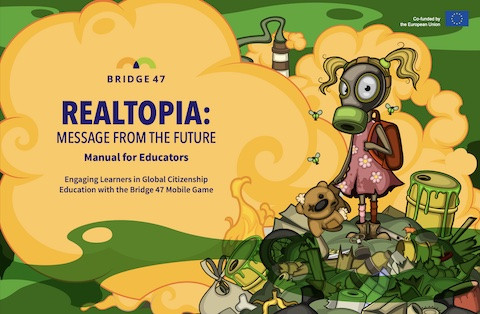 Realtopia: Message From the Future, Manual For Educators; Engaging Learners in Global Citizenship Education With the Bridge 47 Mobile Game Year of publication: 2021 Author: Jakub Žaludko | Kristine Liepina | Gillion Vaughn | Jana Stahl | Timo Holthoff Corporate author: Bridge 47 Realtopia is a game that displays a post-apocalyptic future, a scenario that humanity possibly faces if it does not change its current trajectory. It raises awareness about the urgency and sever- ity of the real challenges we encounter and at the same time tries to convey that a different future is possible if we all actively dream and work towards it. It aims to motivate and empower players to take real action in the present to navigate humanity towards a more positive future path.This manual gives insights into the development process, a detailed tutorial of how to play the game and some ideas and methods for using it as an educational tool in different settings, both online and hybrid.
 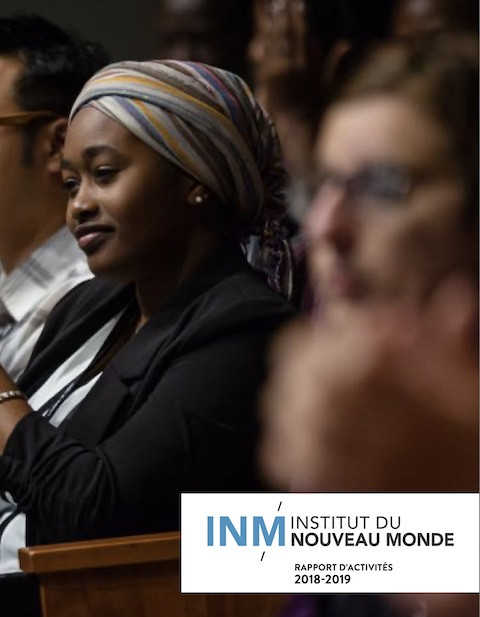 Institut du Nouveau Monde (INM): Rapport d'activités 2018-2019 Year of publication: 2019 Corporate author: Institut du Nouveau Monde (INM) Le 15e anniversaire de l’INM a été une année très occupée. L’équipe à mis la main à la pâte afin de permettre à plus de 20 200 citoyennes et citoyens d’être consultés et de participer à l’une des 266 activités auxquelles l’INM a contribué. En pleine année électorale provinciale et à l’approche des élections fédérale, les activités de l’INM présentées dans ce bilan soutiennent, plus que jamais, que la participation citoyenne renforce la démocratie.
  Media Education and Citizenship: An Analysis of the Quebec Preschool and Elementary Education Program (No. 80) Year of publication: 2018 Author: Normand Landry | Chantal Roussel Corporate author: Lien social et Politiques In Canada, the limited level of knowledge on media education content that is conveyed by academic curricula hinders its critical evaluation. This article presents the ways in which media education is introduced in the Quebec Education Program (QEP) at the preschool and elementary level. More specifically, it highlights the connections at work between media education, childhood and citizenship in the program. Our method tracks and extracts a set of statements related to information and communications technologies (ICTs) and the media, then conducts their automated classification into four principal categories: speech, verbs used that reflect the actions undertaken by categories of actors (school, pupils, teachers), learning objectives and suggestions. A subsequent classification allows for the emergence of verbs and learning objectives associated to the notion of citizenship. The latter are then subject to speech analysis. Our analysis intends to demonstrate the message conveyed by the QEP on media and ICTs. It highlights the roles, tasks and responsibilities of its various actors in relation to the acquisition of knowledge and skill development. In addition, it features the actions taken by these actors to operationalize the academic goals of the program. Our conclusion indicates a low subject implementation of the statements associated to media education and citizenship, relevant content, although thematically limited, along with the conception of students as capable of a reflection and critical thinking process. Articuler éducation aux médias et citoyenneté : Une analyse du Programme de formation de l’école québécoise préscolaire-primaire (nº 80) Year of publication: 2018 Author: Normand Landry | Chantal Roussel Corporate author: Lien social et Politiques Au Canada, le faible niveau de connaissance des contenus en éducation aux médias véhiculés par les curricula scolaires proscrit leur évaluation critique. Cet article présente les façons selon lesquelles l’éducation aux médias est introduite dans le Programme de formation de l’école québécoise (PFEQ) des niveaux préscolaire et primaire. Plus spécifiquement, il témoigne des articulations entre éducation aux médias, enfance et citoyenneté. La méthode utilisée procède au repérage et à l’extraction d’énoncés associés aux technologies de l’information et de la communication (TIC) et aux médias, puis à leur classement en quatre catégories principales : discours, verbes témoignant des actions de chaque catégorie d’acteurs (école, élève, enseignant), objets d’apprentissage et suggestions d’utilisation des TIC. Une classification permet de faire émerger les verbes et les objets d’apprentissage référant à la notion de citoyenneté en utilisant la définition et les composantes associées. Ces derniers sont ensuite soumis à une analyse de discours. Notre analyse fait émerger les discours véhiculés par le PFEQ sur les médias et les TIC. Elle met en exergue les rôles, les tâches et les responsabilités des différents acteurs en lien avec l’acquisition de connaissances et le développement de compétences. En outre, elle présente les actions menées par ces acteurs afin d’opérationnaliser les intentions pédagogiques du programme. La conclusion montre un faible ancrage disciplinaire des énoncés traitant de l’éducation aux médias et à la citoyenneté, des contenus pertinents, mais limités thématiquement, ainsi qu’une représentation de l’élève en tant qu’individu capable de réflexion et de pensée critique.
 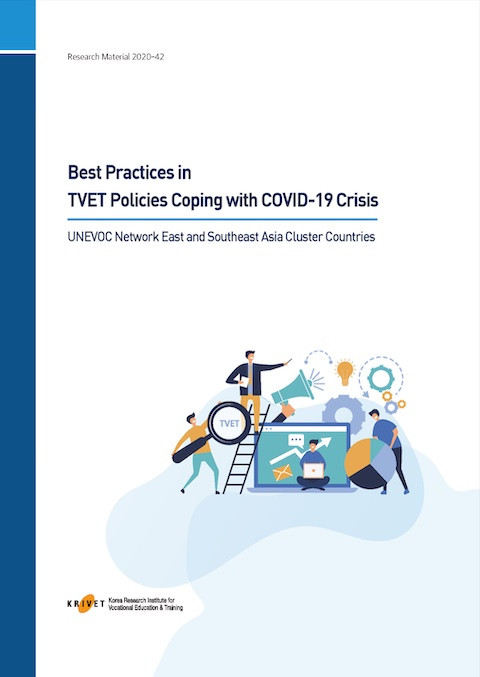 Best Practices in TVET Policies Coping with COVID-19 Crisis: UNEVOC Network East and Southeast Asia Cluster Countries Year of publication: 2020 Author: Jihee Choi | Hanbyul Lee | Kunjoo Lim | Hyunsik Choi | Jongtaek Han Corporate author: UNESCO International Centre for Technical and Vocational Education and Training (UNEVOC) | Korea Research Institute for Vocational Education and Training (KRIVET) This book presents the best practices with regard to TVET policies to cope with COVID-19 crisis. It includes 8 cases of manuscripts from 6 countries in total. The topics covered range from the national TVET policies responding to COVID-19 crisis to open and digital learning, migrant female workers, and TVET strategies to deal with youth unemployment. UNESCO-UNEVOC 동아시아 동남아시아 클러스터: TVET 정책 우수사례집 Year of publication: 2020 Author: 최지희 | 이한별 | 임건주 | 최현식 | 한종택 Corporate author: UNESCO International Centre for Technical and Vocational Education and Training (UNEVOC) | 한국직업능력개발원 본 자료는 COVID-19시대에 대응하는 국가전략에 관한 동남아지역 우수사례를 소개하고 있다. 총 6개국의 8개 사례를 포함하고 있으며, COVID-19에 대한 TVET의 대응에서 원격 및 디지털 학습, 청년실업, 이주 여성 근로자 문제 등 다양한 주제에 대해 각국의 정책까지 다양한 사례를 다루고 있다. 본 저작물은 ‘한국직업능력연구원’에서 ‘2020’년 작성하여 공공누리 4유형으로 개방한 ‘ UNESCO-UNEVOC 동아시아 동남아시아 클러스터: TVET 정책 우수사례집 (작성자: 최지희; 이한별; 임건주; 최현식; 한종택) ’을 이용하였으며, 해당 저작물은 ‘한국직업능력연구원(www.krivet.re.kr)’에서 무료로 다운받으실 수 있습니다.
 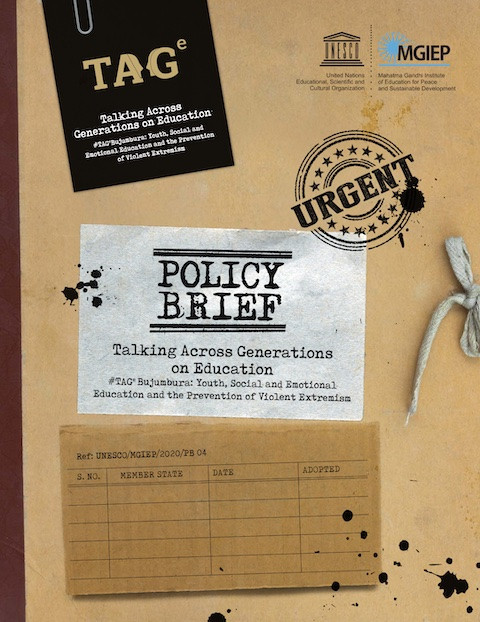 Policy Brief: Talking Across Generations on Education; #TAGe Bujumbura: Youth, Social and Emotional Education and the Prevention of Violent Extremism Year of publication: 2020 Corporate author: Mahatma Gandhi Institute of Education for Peace and Sustainable Development (MGIEP) With the aim to mainstream the voices of Burundi youth and include them in the policymaking process in the areas of education for peace, sustainable development and global citizenship, UNESCO MGIEP, YELI-Burundi (Youth Empowerment and Leadership Initiative Burundi) and the Government of Burundi organised a series of high-level #TAGeBujumbura dialogues. These were an integral part of the Annual Prevention of Violent Extremism (PVE) Youth Blast, which was organised by YELI-Burundi on September 16-17, 2019 in Bujumbura, Burundi. H.E Everlyne Butoyi, Minister of Youth, IT and Posts, inaugurated the event. The theme of the main TAGe plenary was The Place of the Youth and Social and Emotional Learning for the Prevention of Violent Extremism – within the broader context of United Nations Security Council Resolution 2250.This unique UNESCO MGIEP TAGe modality for actionable dialogue comprised the following components – month-long online discussions, live TAGe and actionable outputs. The preceding online discussion had over 1,000 participants, and witnessed rich discussion threads being compressed into insightful, actionable ideas. Subsequently, based on the online engagement and the on-ground work done, six representatives were chosen from these participants to represent the collective voices of the youth. They were joined by three distinguished senior decision-makers (from the Government of Burundi and civil society) in a live TAGe exchange, where they delved into issues and unearthed creative solutions in front of an audience of over 200.
  Back to Basics: Quality in Digital Learning Year of publication: 2021 Author: Alejandra Acosta | Iris Palmer | Lupita Romo-González Corporate author: New America | Bill and Melinda Gates Foundation The pandemic was, in some ways, a sneak preview of higher education’s future, one in which technology-mediated and -enabled education is ubiquitous, but with the potential for deep inequities in access to high-quality learning. This report describes some of the ways in which higher education succeeded and fell short during the remarkable 2020–21 year of distance learning. It proposes a trio of federal policy changes to build the ecosystem needed for online learning to ensure it is more equitable for students of color and low-income students, and to improve the quality for everyone (Acosta et al., 2021, p. 6).
  AI in Education: Change at the Speed of Learning Year of publication: 2020 Author: Steven Duggan Corporate author: UNESCO Institute for Information Technologies in Education (IITE) The policy brief “AI in Education: Change at the Speed of Learning” published by the UNESCO Institute for Information Technologies in Education (UNESCO IITE) opens a new series of publications “Digital Transformation of Education”. The new publication describes the advancements in technology, including data, analytics and personalized learning, Artificial Intelligence (AI), cloud computing and machine learning, and explores the promises of AI for students, teachers, school leaders, parents and education administrators. The publication also highlights the ethical aspects of AI implementation and challenges that it might bring. Искусственный интеллект в образовании: Изменение темпов обучения Year of publication: 2020 Author: Steven Duggan Corporate author: UNESCO Institute for Information Technologies in Education (IITE) Аналитическая записка «Искусственный интеллект в образовании: Изменение темпов обучения», опубликованная Институтом ЮНЕСКО по информационным технологиям в образовании (ИИТО ЮНЕСКО), открывает издание новой серии публикаций «Цифровая трансформация образования». В новой публикации представлены достижения в области технологий, включая данные, аналитику и персонализированное обучение, искусственный интеллект (ИИ), облачные вычисления и машинное обучение, а также рассматриваются многообещающие возможности ИИ для учащихся, педагогов, родителей, руководителей учебных заведений и администраторов системы образования. В публикации также обозначены этические аспекты и вызовы, связанные с применением ИИ.