
Resources
Explore a wide range of valuable resources on GCED to deepen your understanding and enhance your research, advocacy, teaching, and learning.
685 Results found
 Articuler éducation aux médias et citoyenneté : une analyse du Programme de formation de l’école québécoise préscolaire-primaire Year of publication: 2018 Author: Normand Landry | Chantal Roussel Corporate author: Revue Lien social et Politiques Au Canada, le faible niveau de connaissance des contenus en éducation aux médias véhiculés par les curricula scolaires proscrit leur évaluation critique. Cet article présente les façons selon lesquelles l’éducation aux médias est introduite dans le Programme de formation de l’école québécoise (PFEQ) des niveaux préscolaire et primaire. Plus spécifiquement, il témoigne des articulations entre éducation aux médias, enfance et citoyenneté. La méthode utilisée procède au repérage et à l’extraction d’énoncés associés aux technologies de l’information et de la communication (TIC) et aux médias, puis à leur classement en quatre catégories principales : discours, verbes témoignant des actions de chaque catégorie d’acteurs (école, élève, enseignant), objets d’apprentissage et suggestions d’utilisation des TIC. Une classification permet de faire émerger les verbes et les objets d’apprentissage référant à la notion de citoyenneté en utilisant la définition et les composantes associées. Ces derniers sont ensuite soumis à une analyse de discours. Notre analyse fait émerger les discours véhiculés par le PFEQ sur les médias et les TIC. Elle met en exergue les rôles, les tâches et les responsabilités des différents acteurs en lien avec l’acquisition de connaissances et le développement de compétences. En outre, elle présente les actions menées par ces acteurs afin d’opérationnaliser les intentions pédagogiques du programme. La conclusion montre un faible ancrage disciplinaire des énoncés traitant de l’éducation aux médias et à la citoyenneté, des contenus pertinents, mais limités thématiquement, ainsi qu’une représentation de l’élève en tant qu’individu capable de réflexion et de pensée critique.
  L’ÉDUCATION À LA CITOYENNETÉ Author: Nathalie Mons | Éric Favey | Jean-Michel Zakhartchouk Corporate author: CANOPé Le Parcours citoyen a pour ambition de favoriser une culture de l’engagement durant le temps scolaire. Si l’élève acquiert des connaissances et des compétences avec l’Éducation morale et civique (EMC), ou bien l’Éducation aux médias et à l’information (ÉMI), il devient par ailleurs véritablement sujet et acteur à travers une participation et des prises de responsabilité au sein des instances (conseils de classe, conseils d’administration, etc.), d’une classe coopérative ou dans la vie associative, par exemple. C’est par cette implication réelle et concrète qu’il éprouvera le mieux son rôle de citoyen.
  A Policy Review: Building Digital Citizenship in Asia-Pacific through Safe, Effective and Responsible Use of ICT Year of publication: 2016 Corporate author: UNESCO Bangkok This report is a major output of the project. The policy review described in this report took stock of national policies in 22 Member States in the Asia-Pacific region and assessed the capacity of their education sectors to foster digital citizenship among children aged 0-18.It is encouraging to note from the study that surveyed Member States’ policies to promote ICT opportunities mature alongside policies that address potential risks, at varying levels of policy maturity. However, while the surveyed Member States recognize the importance of equipping children with ICT skills and providing basic infrastructure, the findings indicate that there is much to be done for young learners (e.g. early childhood education and lower primary education) in introducing the concept of safe, effective and responsible use of ICT to their national curriculum as well as to their teacher professional development programmes.
 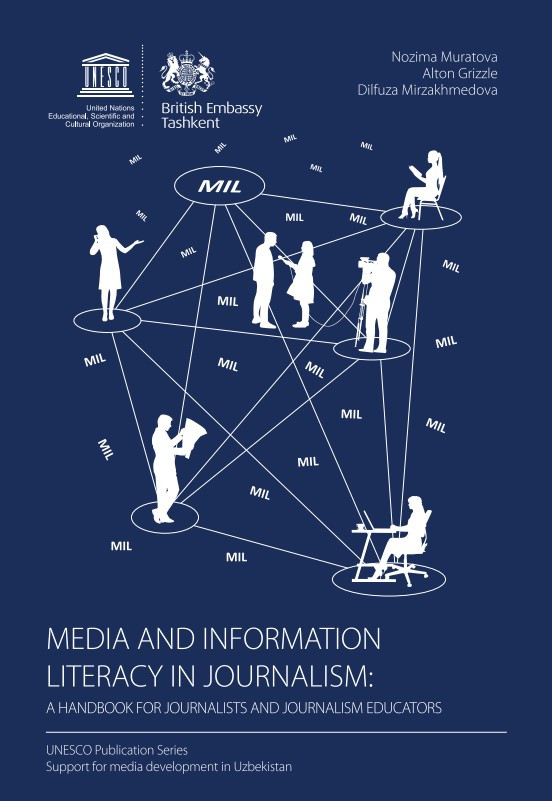 Media and Information Literacy in Journalism: A Handbook for Journalists and Journalism Educators Year of publication: 2019 Author: N. Muratova | A. Grizzle | D. Mirzakhmedova Corporate author: UNESCO Tashkent This handbook aims at being an important and practical tool for journalists in fulfilling their professional activities and mainly in media information literacy (MIL).The first three parts of the Handbook include theoretical material and are accompanied with exercises and case studies; the last part consists entirely of practical tools and exercises that aim to ensure that the material was understood. The Handbook deals with "fake news" and disinformation, provides a conceptual framework for media and information literacy, shows its importance, and explores principles and role of the MIL in journalism education. Also, the Handbook covers topics such as ethics on the Internet, human rights and work with sources, journalistic skills in collecting and processing information, ways to verify and provide reliable information, and the identification of fakes that may adversely affect the public. Медиа- и информационная грамотность в журналистике: Пособие для журналистов и преподавателей журналистики Year of publication: 2019 Author: N. Muratova | A. Grizzle | D. Mirzakhmedova Corporate author: UNESCO Tashkent Данное руководство нацелено на то, чтоб стать важным и практичным инструментом журналистов в осуществлении их профессиональной деятельности и главным образом в овладении медиа информационной грамотностью (МИГ).Первые три части книги включают в себя теоретический материал и сопровождены заданиями и кейсами по теме, последняя часть всецело состоит из практического инструментария и упражнений, которые направлены на закрепление изученного материала. В пособии рассматривается работа с «фэйковыми новостями» и дезинформацией, приведёна концептуальная основа, на которой строится медийная и информационная грамотность, показана ее важность, исследованы принципы и роль МИГ в журналистском образовании. Кроме этого в пособии рассмотрены такие темы, как этика в интернете, права человека и работа с источниками, мастерство журналиста в сборе и обработке информации, способы проверки и предоставления достоверных сведений, выявление фейков, которые могут отрицательно повлиять на общественность.
 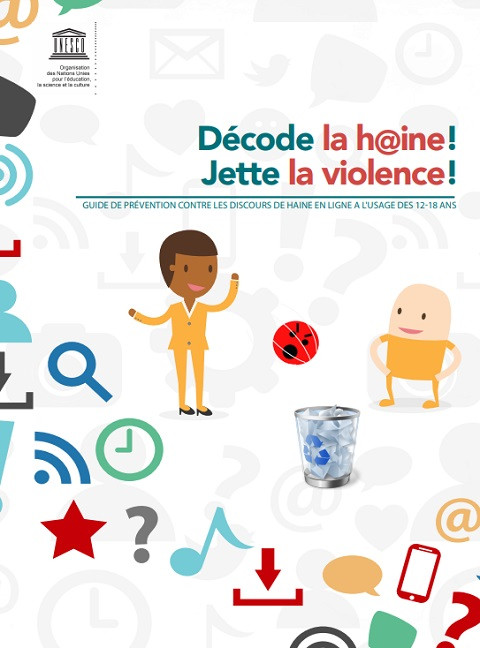 Décode la h@ine! Jette la violence!: Guide de prévention contre les discours de haine en ligne à l'usage des 12-18 ans Year of publication: 2019 Author: Khalid Aoutail Corporate author: UNESCO Rabat Ce guide, conçu à partir d'une collecte des données sur l'expression de la haine en ligne sous toutes ses formes, et de leur analyse, propose des modules simples à comprendre afin d'accompagner celles et ceux qui le souhaitent dans la création d'un réseau virtuel d'échange pacifié. Les recommandations présentes ici ne se limitent pas à l'expression de la haine en ligne mais abordent toutes les formes de violences qui peuvent exister.
  From Maker to Creative Citizens: Maker Citizens and Its Cultivation from the Perspective of Smart Education Year of publication: 2019 Author: Wang Youmei | Wan Ping | Zhao Wenzhu | Yang Gang Corporate author: Digital Education Studies The goal of smart education is to cultivate talents with good value orientation, high thinking quality and strong decisive ability, which provides a brand new target framework and value pursuit for maker education. Firstly, this paper starts from the connotation of makers, clarifies the logical relationship between the concepts of maker citizens and creative citizens, and builds the capability dimension and literacy structure of maker citizens. Secondly, based on the International MakEY creator citizen project, this paper analyzes the paths and strategies of the UK and Iceland to cultivate students’ creativity through maker space in detail, and illustrates the role of maker space in cultivating the digital literacy and creativity of children and adolescents. Finally, this paper, on the basis of case analysis and the development of smart education in China, proposes the realization path and some strategies to cultivate maker citizens in China, and establishes the concept and system of citizenship education for “Lifelong, All People, Whole Process, All Space, and Whole Society”, which provides theoretical basis and case references for the cultivation of Chinese makers’ citizens, and promotes the integral development of maker education and smart education. 从创客到创造性公民:智慧教育视野下的 创客公民及其培养 Year of publication: 2019 Author: Wang Youmei | Wan Ping | Zhao Wenzhu | Yang Gang Corporate author: Digital Education Studies 智慧教育的目标在于培养具有良好价值取向、较高思维品质和较强施为能力的人才,这为创客教育提供了 全新的目标框架与价值追求。文章首先从创客内涵出发,厘清创客公民、创造性公民等概念之间的逻辑关系,构建创客公民 的能力维度与素养结构;其次基于国际 MakEY 创客公民项目,通过案例研究,详细分析了英国和冰岛通过创客空间培养 学生创造力的路径与策略,阐释创客空间在培养儿童与青少年数字素养和创造力方面的作用;最后在案例分析的基础 上,基于国内智慧教育发展,提出了我国创客公民培养的实现路径和若干策略,建立“终身、全民、全程、全空间、全社会” 创客公民教育理念与体系,为我国创客公民培养提供理论依据和案例参考,推进创客教育与智慧教育融合发展。
  Virtual Conference: How Can We Prevent Bullying and Cyberbullying? Year of publication: 2019 Author: Enrique Chaux Corporate author: Red Papaz This conference presents strategies that can contribute to preventing and managing bullying and cyberbullying situations, especially emphasizing the role that mothers, fathers, caregivers and teachers can have. Conferencia virtual: ¿Cómo acompañar a nuestros hijos para usar de forma segura las TIC? Year of publication: 2019 Author: Enrique Chaux Corporate author: Red Papaz En esta conferencia se presentan estrategias que pueden contribuir a prevenir y manejar las situaciones de bullying y Cyberbullying, enfatizando especialmente el rol que pueden tener madres, padres, cuidadores y docentes.