
Resources
Explore a wide range of valuable resources on GCED to deepen your understanding and enhance your research, advocacy, teaching, and learning.
1,187 Results found
 人工智能时代传统教育反思与应对: 以ChatGPT为例 (教育进展; Vol.13, No.5) Year of publication: 2023 Author: 罗蕾 | 张祖国 | 幸丽君 新世纪以来,科学技术的进步犹如滚滚的浪潮不断加速前进,关于人工智能应用的讨论,在教育领域内一直是一个比较热点的话题,而ChatGPT推出,立即引起了国内教育行业的重大震荡。如何应对ChatGPT对教学活动造成的巨大冲击,成为当下急需思考、解决的问题。本文在人工智能技术持续影响传统教学模式的背景下,以ChatGPT对现有教学引发的反应为介入点,通过对传统教学模式固有利弊的审视,及智能化教学所带来的机遇与挑战进行深入的分析,尝试提出相关有效措施,力求探寻人工智能影响下教育发展新方向。
  أدوات التقييم الخاصة بتطبيق أداة تعليم المهارات الحياتية والمواطنة: قياس المهارات الحياتية بناءً على إطار العمل الإقليمي لتعليم المهارات الحياتية والمواطنة في منطقة الشرق الأوسط وشمال أفريقيا; امللخص التنفيذي Year of publication: 2021 Corporate author: UNICEF Middle East and North Africa "إن تعليم المهارات الحياتية مُهم للغاية لتمكين الأطفال والشباب من تحقيق النجاح في التعليم والعمل والأهداف الشخصية. ومع ذلك، قد أدرجت القليل من الأنظمة التعليمية المهارات الحياتية في نظامها التعليمي. ومن أسباب ذلك هو التحديات المتعلقة بنقص المعرفة الخاصة بكيفية قياس المهارات الحياتية وتقييمها. وبناءً على إطار العمل الإقليمي لتعليم المهارات الحياتية والمواطنة في الشرق الأوسط وشمال أفريقيا، فإن منظمة اليونيسف والبنك الدولي قد طورا أداة تعليم المهارات الحياتية والمواطنة لقياس المستوى الوطني لنتائج طلبة الصف السابع في ثماني مهارات حياتية بوصفه تقييم وطني واسع النطاق. يرجى أيضًا الاطلاع على منشور قياس المهارات الحياتية." LSCE Measurement Instrument: Measuring Life Skills in the Context of Life Skills and Citizenship Education in the Middle East and North Africal; Advocacy Brief Year of publication: 2021 Corporate author: UNICEF Middle East and North Africa Teaching and learning life skills is incredibly important for empowering children and young people to achieve success in education, employment, and personal goals. Nevertheless, few education systems have integrated life skills into their education systems. One of the reasons for this is challenges concerning the lack of knowledge as to how life skills can be measured, assessed, and evaluated. Building on the regional Life Skills and Citizenship Education (LSCE) framework in the Middle East and North Africa (MENA), UNICEF and The World Bank have developed this LSCE Measurement Instrument, to measure the national level of grade 7 students’ scores in eight life skills as national large-scale assessment.
  An Experimental Study of Constructing Maker Teaching Model (Educational Journal ; Vol.49, No.2) Year of publication: 2021 Author: 沈翠莲 Makers studying at university are the main powerful pioneers for developing innovative knowledge society. This research aimed to construct a feasible model of maker teaching, to explore the differences of learning perception of the maker instructional model, and to develop the subsequent process of product creation. Nonequivalent pretest-posttest designs of the quasi-experimental research was employed. Research participants included 132 college students from three classes of creativity-related courses, who participated a 6-week experiment. They were divided into the experimental group and two control groups. A questionnaire was employed to test their differences of learning perception. Results found that: (a) for the maker instructional model, CEO-I2M2E2-SF, a collaborative constructive relationship should be built between instructor and makers; (b) in terms of the performances of learning perception under the maker instructional model, significant differences were found in the dimensions of creativity, creative problem solving, and maker instructional design; (c) there were educational and marketing values in the subsequent process of product creation by makers. 建构大学创各教学模式的实验研究 (教育学报; Vol.49, No.2) Year of publication: 2021 Author: 沈翠莲 创客是大学教育为了发展未来创新知识社会的主力。本研究旨在:建构大学实践创客教学设计的可行模式,探析创客教学设计模式的学习知觉差异,发展创客产出创意作品的后续研发历程。研究方法采取准实验研究的不等组前后测设计,研究对象为开设在大学创意课程的三班共132位大学生,经由6周教学实验,并以「大学生参与教学设计表现想像创意作品的实验效益调查问卷」施测,分析教学实验前后的学习知觉差异。研究提出以下结论:(1)大学创客教学设计模式需要师生共构共变;(2)大学创客教学模式的学习知觉,在创造力、创意问题解决和创客教学设计上获得显着验证;(3)大学创客教学设计课堂作品接力研发为商品,具有教育意义和市场价值。
  Imagining the Classroom Full of Learning in the Future: Effective Teaching With Social Constructive Learning (Educational Journal ; Vol.48, No.2) Year of publication: 2020 Author: 洪瑜佩 This article used an observation scale, together with literature exploration and film observation, to imagine the future classroom. From literature review, it was found that constructivist teaching helps students acquire new knowledge and develop cognition through connecting new and old knowledge. Teaching with the social constructivism approach regards learning as the result of interaction with society and culture. This article aimed to explore the social constructivist teaching context, as well as to observe which aspects and connotations teachers should pay attention to in curriculum arrangement. The researcher amended the observation scale designed by Good & Lavigne (2018) with five steps: (a) raising questions;(b) collaboration and suggestions; (c) assessment and discussions; (d) application to scenarios; and (e) summarizing knowledge. Teachers’ teaching was observed and assessed based on the five steps. The following results were found: (a) students should have the responsibilities of learning;(b) teachers must have good questioning and guidance skills; (c) teachers need to incorporate learning into real-life situations; (d) students’ cognition must be reviewed and monitored frequently. The researcher believes that a classroom full of learning is not imaginary. Teachers already have the ability to construct effective classrooms and should treat students as the learning agent. 想像未来充满学习的教室──以社会建构学习谈有效教学 (教育学报; Vol.48, No.2) Year of publication: 2020 Author: 洪瑜佩 本文采用观察量表分析,透过文献探讨和影片观察,提出未来课堂教室的想像。从文献中发现建构主义的教学是透过连结新知识与旧知识,帮助学生获得新知、发展认知,而社会建构主义的教学则认为学习是与社会、文化互动所得的结果。本文目的是探究社会建构主义的教学情境建构,观察教师的课程安排有哪些该注意的面向和内涵。研究者从good & lavigne(2018)设计的观察量表修正成一份由提出问题、协作建议、评估讨论、应用情境、总结知识五步骤的量表,看待教师的社会建构主义教学,发现以下特征:(1)将学习责任逐步交还给学生;(2)教师须具备良好的提问与引导技巧;(3)将学习加入生活情境脉络之中;(4)必须时时刻刻检视学生的认知。研究者认为充满学习的教室并非想像,现场教师已有能力建构有效教学的教室,应将学习主体还给学生。
 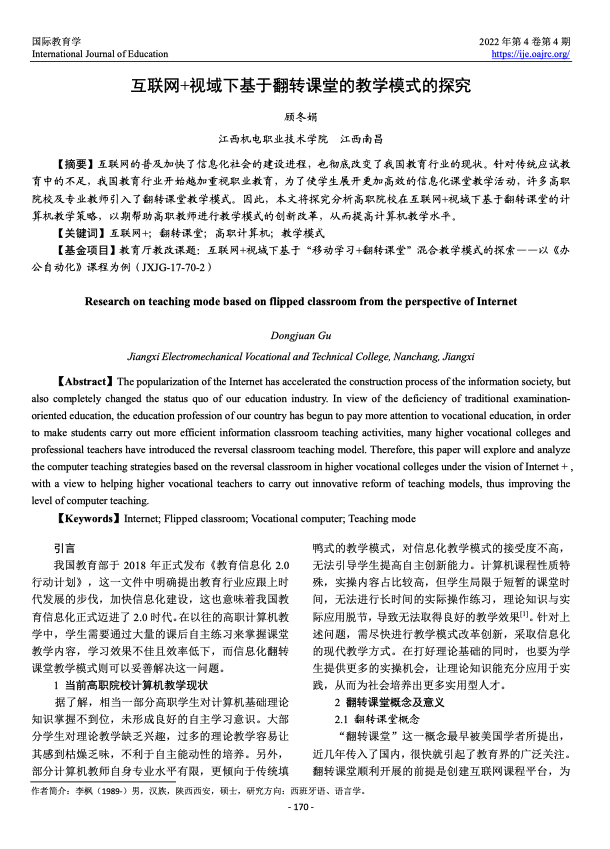 互联网+视域下基于翻转课堂的教学模式的探究 Year of publication: 2022 Author: 顾冬娟 互联网的普及加快了信息化社会的建设进程,也彻底改变了我国教育行业的现状。针对传统应试教育中的不足,我国教育行业开始越加重视职业教育,为了使学生展开更加高效的信息化课堂教学活动,许多高职院校及专业教师引入了翻转课堂教学模式。因此,本文将探究分析高职院校在互联网+视域下基于翻转课堂的计算机教学策略,以期帮助高职教师进行教学模式的创新改革,从而提高计算机教学水平。
 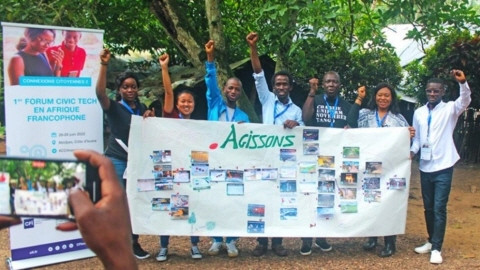 Civic Tech in Africa: When Citizen’s Connections Work for Democracy Year of publication: 2022 Author: Raphaëlle Constant Corporate author: Radio France International (RFI) The first civic tech forum in French-speaking Africa was held at the end of June in Abidjan, Côte d'Ivoire, at the initiative of CFI. For "L'atelier des médias", Raphaëlle Constant spoke to the people who are developing digital initiatives in several African countries to improve the flow of information and mobilise citizens to influence public debate. Civic tech en Afrique: Quand des connexions citoyennes œuvrent pour la démocratie Year of publication: 2022 Author: Raphaëlle Constant Corporate author: Radio France International (RFI) Le premier forum civic tech en Afrique francophone s’est tenu fin juin à Abidjan, en Côte d’Ivoire, à l'initiative de CFI. Pour L’atelier des médias, Raphaëlle Constant y a tendu son micro à celles et ceux qui développent des initiatives numériques dans plusieurs pays africains pour améliorer la circulation de l’information et déclencher des mobilisations citoyennes pour peser dans le débat public.