
Resources
Explore a wide range of valuable resources on GCED to deepen your understanding and enhance your research, advocacy, teaching, and learning.
3,446 Results found
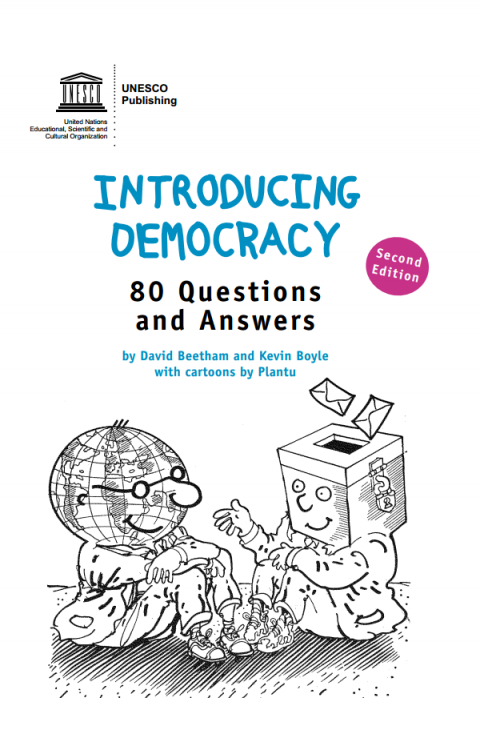 Introducing democracy: 80 questions and answers Year of publication: 2009 Author: David Beetham | Kevin Boyle Corporate author: UNESCO Humorously illustrated by Plantu, the famous cartoonist of the French newspaper Le Monde, this book is a valuable tool for all those who want to know more about democracy and human rights, whether it be students, activists, civil servants, or simply as interested citizens. What is democracy? What is the relation between democracy and individual rights? Is majority rule always democratic? How can democracy be maintained and improved? This book tackles these and other questions about democracy, covering six broad areas: basic concepts and principles; free and fair elections; open and accountable government; individual rights and their defence; democratic or civil society; the future of democracy. Démocratie: questions et réponses Year of publication: 2009 Author: David Beetham | Kevin Boyle Corporate author: Organisation des Nations Unies pour l'éducation, la science et la culture (UNESCO) Humorously illustrated by Plantu, the famous cartoonist of the French newspaper Le Monde, this book is a valuable tool for all those who want to know more about democracy and human rights, whether it be students, activists, civil servants, or simply as interested citizens. What is democracy? What is the relation between democracy and individual rights? Is majority rule always democratic? How can democracy be maintained and improved? This book tackles these and other questions about democracy, covering six broad areas: basic concepts and principles; free and fair elections; open and accountable government; individual rights and their defence; democratic or civil society; the future of democracy. الديمقراطية: أسئلة وأجوبة Year of publication: 2009 Author: David Beetham | Kevin Boyle Corporate author: منظمة الأمم المتحدة للتربية والعلم والثقافة (UNESCO) Humorously illustrated by Plantu, the famous cartoonist of the French newspaper Le Monde, this book is a valuable tool for all those who want to know more about democracy and human rights, whether it be students, activists, civil servants, or simply as interested citizens. What is democracy? What is the relation between democracy and individual rights? Is majority rule always democratic? How can democracy be maintained and improved? This book tackles these and other questions about democracy, covering six broad areas: basic concepts and principles; free and fair elections; open and accountable government; individual rights and their defence; democratic or civil society; the future of democracy.
 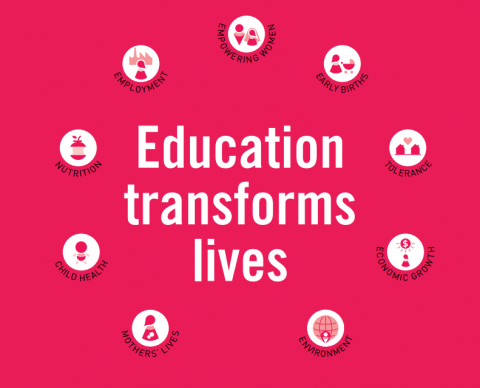 Education Transforms Lives Year of publication: 2013 Corporate author: UNESCO Education lights every stage of the journey to a better life, especially for the poor and the most vulnerable. Education’s unique power to act as a catalyst for wider development goals can only be fully realized, however, if it is equitable. That means making special efforts to ensure that all children and young people – regardless of their family income, where they live, their gender, their ethnicity, whether they are disabled – can benefit equally from its transformative power. Education empowers girls and young women, in particular, by increasing their chances of getting jobs, staying healthy and participating fully in society – and it boosts their children’s chances of leading healthy lives. To unlock the wider benefits of education, all children need the chance to complete not only primary school but also lower secondary school. And access to schooling is not enough on its own: education needs to be of good quality so that children actually learn. Given education’s transformative power, it needs to be a central part of any post-2015 global development framework. L'Education transforme nos existences Year of publication: 2013 Corporate author: Organisation des Nations Unies pour l'éducation, la science et la culture (UNESCO) Education lights every stage of the journey to a better life, especially for the poor and the most vulnerable. Education’s unique power to act as a catalyst for wider development goals can only be fully realized, however, if it is equitable. That means making special efforts to ensure that all children and young people – regardless of their family income, where they live, their gender, their ethnicity, whether they are disabled – can benefit equally from its transformative power. Education empowers girls and young women, in particular, by increasing their chances of getting jobs, staying healthy and participating fully in society – and it boosts their children’s chances of leading healthy lives. To unlock the wider benefits of education, all children need the chance to complete not only primary school but also lower secondary school. And access to schooling is not enough on its own: education needs to be of good quality so that children actually learn. Given education’s transformative power, it needs to be a central part of any post-2015 global development framework. La Educación transforma la vida Year of publication: 2013 Corporate author: Organización de las Naciones Unidas para la Educación, la Ciencia y la Cultura (UNESCO) Education lights every stage of the journey to a better life, especially for the poor and the most vulnerable. Education’s unique power to act as a catalyst for wider development goals can only be fully realized, however, if it is equitable. That means making special efforts to ensure that all children and young people – regardless of their family income, where they live, their gender, their ethnicity, whether they are disabled – can benefit equally from its transformative power. Education empowers girls and young women, in particular, by increasing their chances of getting jobs, staying healthy and participating fully in society – and it boosts their children’s chances of leading healthy lives. To unlock the wider benefits of education, all children need the chance to complete not only primary school but also lower secondary school. And access to schooling is not enough on its own: education needs to be of good quality so that children actually learn. Given education’s transformative power, it needs to be a central part of any post-2015 global development framework.
  Ensuring the right to equitable and inclusive quality Education: results of the ninth consultation of Member States on the implementation of the UNESCO Convention and Recommendation against Discrimination in Education Year of publication: 2017 Corporate author: UNESCO The Convention and Recommendation against Discrimination in Education reflect UNESCO’s constitutional mission of instituting collaboration among nations to ‘advance the ideal of equality of educational opportunities without regard to race, sex, or any distinctions, economic or social.’ The purpose of these instruments, recently recognized as a cornerstone of the Education 2030 Agenda, is not only the elimination of discrimination in education, but also the adoption of concrete measures aimed at promoting equality of opportunities and treatment in this field. They cover the right to education comprehensively. The purpose of reporting is to illustrate the steps taken to implement the instruments, the progress made and the difficulties encountered by Member States. Eight Member State consultations have been conducted on the measures taken for the implementation of the 1960 Convention and Recommendation since the adoption of these instruments by the General Conference of UNESCO. Each of the consultations led to a global report containing the results of the consultation for submission to the UNESCO Executive Board’s Committee on Conventions and Recommendations and for consideration by the General Conference.
  [Summary] Accountability in Education: Meeting Our Commitments: Global Education Monitoring Report Summary, 2017/8 Year of publication: 2017 Corporate author: UNESCO This summary of the 2017/8 GEM Report shows the entire array of approaches to accountability in education. It ranges from countries unused to the concept, where violations of the right to education go unchallenged, to countries where accountability has become an end in itself instead of a means to inclusive, equitable and high-quality education and lifelong learning for all.The report emphasizes that education is a shared responsibility. While governments have primary responsibility, all actors – schools, teachers, parents, students, international organizations, private sector providers, civil society and the media – have a role in improving education systems. The report emphasizes the importance of transparency and availability of information but urges caution in how data are used. It makes the case for avoiding accountability systems with a disproportionate focus on narrowly defined results and punitive sanctions. In an era of multiple accountability tools, the report provides clear evidence on those that are working and those that are not. [Résumé] Rendre des Comptes en Matière Déducation: Tenir nos Engagements, Résumé du Rapport Mondial de Suivi sur l'éducation, 2017/8 Year of publication: 2017 Corporate author: Organisation des Nations Unies pour l'éducation, la science et la culture (UNESCO) La deuxième édition du Rapport mondial de suivi sur l’éducation (Rapport GEM) présente les dernières données disponibles sur les progrès accomplis à l’échelle mondiale dans la réalisation des cibles des objectifs de développement durable des Nations Unies relatives à l’éducation.À l’heure où des centaines de millions de personnes sont encore non scolarisées et où beaucoup quittent l’école sans avoir acquis les compétences fondamentales, il est évident que les systèmes éducatifs sont bien loin d’atteindre les objectifs mondiaux. Les populations marginalisées en supportent actuellement la plupart des conséquences, mais sont également celles qui bénéficieront le plus des résultats obtenus, pour peu que les décideurs prêtent suffisamment d’attention à leurs besoins. Face à de tels défis, et compte tenu des restrictions budgétaires et de l’importance accrue accordée à la rentabilité axée sur les résultats, les pays sont à la recherche de solutions. Parmi celles-ci, une plus forte obligation de rendre des comptesarrive souvent en tête de liste.Le présent résumé du Rapport GEM 2017/2018 passe en revue les différentes approches qui existent en matière de reddition de comptes dans l’éducation, depuis les pays qui ne sont pas familiarisés avec le concept et où les violations du droit à l’éducation sont monnaie courante, jusqu’aux pays où l’obligation de rendre des comptes constitue une fin en soi et non plus un moyen de parvenir à une éducation inclusive, équitable et de qualité et un apprentissage tout au long de la vie pour tous.Le rapport souligne que l’éducation est une responsabilité partagée. Si celle-ci incombe en premier lieu aux gouvernements, tous les acteurs – établissements scolaires, enseignants, parents, élèves, organisations internationales, prestataires du secteur privé, société civile et médias – ont un rôle à jouer dans l’amélioration des systèmes éducatifs. Le rapport insiste sur l’importance de la transparence et de la disponibilité des informations, mais appelle à une utilisation prudente desdonnées. Il préconise d’éviter les systèmes de reddition de comptes qui reposent dans une trop large mesure sur une évaluation restrictive des performances et sur des sanctions punitives. Enfin, à l’heure où les outils de reddition de comptes se multiplient, le rapport démontre clairement quels sont ceux qui sont efficaces et ceux qui ne le sont pas. [Resumen] Rendir Cuentas en el Ámbito de la Educación: Cumplir Nuestros Compromisos, Resumen del Informe de Seguimiento de la Educación en el Mundo, 2017/8 Year of publication: 2017 Corporate author: Organización de las Naciones Unidas para la Educación, la Ciencia y la Cultura (UNESCO) El segundo Informe de Seguimiento de la Educación en el Mundo (el Informe GEM) presenta las pruebas más recientes de los progresos alcanzados en el mundo en cuanto a la consecución de las metas relativas a la educación de los Objetivos de Desarrollo Sostenible de las Naciones Unidas.Puesto que hay centenares de millones de personas que todavía no están escolarizadas y muchas que no adquieren unas competencias mínimas en la escuela, es evidente que los sistemas educativos no llevan camino de alcanzar los objetivos mundiales. Las personas marginadas son quienes sufren actualmente la mayoría de las consecuencias, pero también son las que más se beneficiarán si los encargados de formular políticas prestan suficiente atención a sus necesidades. Ante estos retos, junto con presupuestos muy ajustados y una mayor importancia concedida a obtener rendimiento del dinero en forma de resultados, los países están buscando soluciones, entre las cuales a menudo la rendición de cuentas ocupa el primer lugar.Este resumen del Informe GEM 2017/18 muestra todos los diversos enfoques de la rendición de cuentas en el ámbito de la educación. Abarca desde los países que no están acostumbrados al concepto, en los que no se cuestionan las violaciones del derecho a la educación, hasta aquellos en los que la rendición de cuentas se ha convertido en un fin en sí misma, en lugar de un medio para alcanzar una educación y un aprendizaje a lo largo de toda la vida para todos que sean inclusivos, equitativos y de gran calidad.En el informe se recalca que la educación es una responsabilidad compartida.Aunque son los gobiernos los principales responsables de ella, a todos los actores – las escuelas, los docentes, los padres, los estudiantes, las organizaciones internacionales, los prestatarios del sector privado, la sociedad civil y los medios de comunicación – les corresponde desempeñar un papel en la mejora de los sistemas educativos. El informe recalca la importancia de la transparencia y la disponibilidad de la información, pero exhorta a manejar con prudencia los datos. Explica por qué debemos evitar unos sistemas de rendición de cuentas que den una importancia desproporcionada a unos resultados definidos de manera demasiado restringida y a sanciones punitivas. En una época en la que existen y se emplean múltiples instrumentos para rendir cuentas, el informe demuestra palmariamente con pruebas empíricas cuáles funcionan y cuáles no dan buenos resultados.