
Resources
Explore a wide range of valuable resources on GCED to deepen your understanding and enhance your research, advocacy, teaching, and learning.
3,229 Results found
 ESD Implementation in Learning Cities Year of publication: 2021 Corporate author: UNESCO Institute for Lifelong Learning (UIL) This publication aims to share the best practice cases from nine cities on ESD implementation (policy and practice) following a lifelong learning approach. These cases showcase innovative local initiatives that have embedded ESD into lifelong learning systems through policy/ strategy development or project implementation, focusing on the following priority areas of action and local activities laid down in the ESD for 2030 roadmap: Local policy/strategy development on ESD: The development of an action plan that determines how the community as a whole can become a learning laboratory for sustainable development. Capacity-building for educators and local authorities: Lifelong learning initiatives for systematic and comprehensive ESD capacity development for educators in the formal and non-formal education sectors, and for local government officials. Efforts to foster engagement with local communities, including: • formal education institutions’ engagement with local communities for the promotion of ESD; • non-formal education institutions (e.g. community learning centres) serving as a hub for lifelong learning on ESD in their communities. Empowerment and mobilization of youth: Lifelong learning initiatives for ESD that focus on young people. Innovative use of local spaces for ESD: Designated areas or spaces that inspire learning and host projects that promote sustainability. In addition to the five priority areas listed above, the case studies share one cross-cutting theme: • Multi-stakeholder approach: How people from different walks of life or professional sectors come together to contribute to local ESD initiatives at either the policy or the project level.
  Global Inventory of Regional and National Qualifications Frameworks 2017, Vol. I: Thematic Chapters Year of publication: 2017 Corporate author: European Centre for the Development of Vocational Training (CEDEFOP) | European Training Foundation (ETF) | UNESCO | UNESCO Institute for Lifelong Learning (UIL) The global inventory 2017 further strengthens the knowledge base on developments in national and regional qualifications frameworks, as implemented by countries and regions, by end of 2016. It acts as an observatory of progress in establishing NQFs, as well as the challenges and success factors in implementation. The thematic chapters (Volume I) discuss key trends and policy issues emerging from qualifications frameworks and learning outcomes reforms and developments. Volume II consists of NQF case studies of 100 countries from all continents and seven regional qualifications frameworks (RQF). The case studies look at the educational, social, economic and political context in which an NQF is embedded, main policy objectives, implementation of learning outcomes, stakeholder involvement and institutional arrangements. They also show how NQFs open for and link to validation arrangements, support recognition and learning pathways. They conclude with important lessons and future plans.The global inventory draws on inventories from four agencies: the European Centre for the Development of Vocational Training (Cedefop), the European Training Foundation (ETF), the United Nations Educational, Scientific and Cultural Organisation (UNESCO) and the UNESCO Institute for Lifelong Learning (UIL), working and communicating with country officials and experts. It also draws on extensive international research in qualifications reforms, comparability of qualifications, and use of learning outcomes.
  Global Inventory of Regional and National Qualifications Frameworks 2017, Vol. II: National and Regional Cases Year of publication: 2017 Corporate author: European Centre for the Development of Vocational Training (CEDEFOP) | European Training Foundation (ETF) | UNESCO | UNESCO Institute for Lifelong Learning (UIL) The global inventory 2017 further strengthens the knowledge base on developments in national and regional qualifications frameworks, as implemented by countries and regions, by end of 2016. It acts as an observatory of progress in establishing NQFs, as well as the challenges and success factors in implementation. The thematic chapters (Volume I) discuss key trends and policy issues emerging from qualifications frameworks and learning outcomes reforms and developments. Volume II consists of NQF case studies of 100 countries from all continents and seven regional qualifications frameworks (RQF). The case studies look at the educational, social, economic and political context in which an NQF is embedded, main policy objectives, implementation of learning outcomes, stakeholder involvement and institutional arrangements. They also show how NQFs open for and link to validation arrangements, support recognition and learning pathways. They conclude with important lessons and future plans.The global inventory draws on inventories from four agencies: the European Centre for the Development of Vocational Training (Cedefop), the European Training Foundation (ETF), the United Nations Educational, Scientific and Cultural Organisation (UNESCO) and the UNESCO Institute for Lifelong Learning (UIL), working and communicating with country officials and experts. It also draws on extensive international research in qualifications reforms, comparability of qualifications, and use of learning outcomes.
 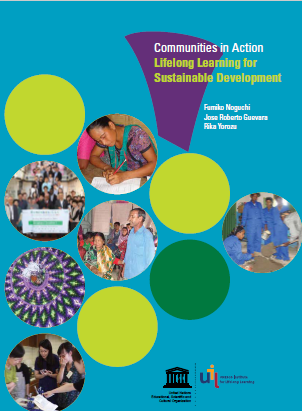 Communities in action: lifelong learning for sustainable Year of publication: 2015 Author: Fumiko Noguchi | Jose Roberto Guevara | Rika Yorozu Corporate author: UNESCO Institute for Lifelong Learning (UIL) This handbook identifies principles and policy mechanisms to advance community-based learning for sustainable development based on the commitments endorsed by the participants of the Kominkan-CLC International Conference on Education for Sustainable Development, which was in Okayama City, Japan, in October 2014. To inform policymakers and practitioners new to this field, the handbook clarifies the international vision and goals for sustainable development and Education for Sustainable Development, and identifies the potential contributions of community-based learning centres and organizations. It documents both policy and practice from different regions and concludes with a summary of principles and policy support mechanisms.
  Counting the Cost: Achieving Literacy in Countries of the Global Alliance for Literacy Year of publication: 2021 Corporate author: UNESCO Institute for Lifelong Learning (UIL) This paper seeks to determine the cost of achieving Sustainable Development Goal 4 (SDG 4) Target 4.6: 'By 2030, ensure that all youth and a substantial proportion of adults, both men and women, achieve literacy and numeracy'. In an effort to answer this question, UNESCO ran simulations and identified the cost and funding gap for the 29 member countries of the Global Alliance for Literacy within the Framework of Lifelong Learning (GAL). This paper argues that 739 million youth and adults require additional literacy programmes of which 580 million are located in 9 of the 29 member countries (the E-9 countries). Based on the results of the simulation, an estimated US$ 190 billion is needed to achieve Target 4.6 by 2030 in the 29 GAL countries. The E-9 countries account for 80% of this cost as the large majority of the global population of youth and adults who lack basic literacy skills live in these territories. The estimation considers the impact of the COVID-19 crisis on GDP growth and presents several scenarios for consideration. If the 29 member countries allocate the recommended 3 per cent of their national education budget to youth and adult literacy, a funding gap of US$ 17 billion will still remain. However, this gap is greater in the 20 non-E9 countries, which account for US$ 12 billion of the funding gap. These 20 non-E9 countries already experience massive challenges for investing in their public education system due to low economic growth and low education development outcomes. A detailed description of the UNESCO GAL simulation model used to estimate the total cost and identify the financing gap for the 29 countries is presented to help interpret the results. The paper ends with a set of recommendations for governments and the international community to work together and ensure the availability of lifelong learning opportunities for all, especially those often left behind.
  How Can a Lifelong Learning Perspective Enhance the Relevance and Impact of the 1974 Recommendation?: Thematic Paper Year of publication: 2022 Corporate author: UNESCO Institute for Lifelong Learning (UIL) Lifelong learning is rooted in the integration of learning with participation in society. It includes learning activities for people of all ages, in all life-wide contexts and spaces (family, school, community, workplace and more), and through a variety of modalities (formal, non-formal and informal).The purpose of this background paper is to propose ways in which the significance of lifelong learning can be reflected in the revision of the 1974 Recommendation concerning Education for International Understanding, Cooperation and Peace and Education relating to Human Rights and Fundamental Freedoms. It does this by recalling previous international contributions to the promotion of lifelong learning, including the landmark publications Learning to Be: The World of Education Today and Tomorrow (Faure et al., 1972) and Learning: The Treasure Within (Delors et al., 1996), which show the benefits of lifelong learning not only for employment but for the whole life of an individual and their participation in society.
  Making Lifelong Learning a Reality: A Handbook Year of publication: 2023 Corporate author: UNESCO Institute for Lifelong Learning (UIL) This handbook provides education stakeholders with practical guidance on lifelong learning. With an overview of key concepts, policy issues, technical knowledge and practical approaches, it demonstrates how lifelong learning can be strengthened in policy-making and implemented at national, regional, local and institutional levels. The handbook supports those experts and professionals in the field of education who wish to develop their understanding of lifelong learning, and offers tips, information and examples targeted at learners, facilitators, institutional leaders, policy-makers and legislators. More broadly, it illustrates how lifelong learning can address complex political, social, economic and environmental issues affecting people around the world. 让终身学习成为现实:手册 Year of publication: 2023 Corporate author: UNESCO Institute for Lifelong Learning (UIL) 这本关于终身学习的手册试图描绘一个全面立体、包罗万象的终身学习愿景, 并将其塑造成教育利益攸关者的实用指南。本手册并未详尽无遗地介绍所有的终 身学习形式,而是阐明了终身学习的本质,通过制定国家政策和实施战略,使之 得到广泛的了解、认可、推广和具体应用。本手册第一章明确了终身学习的概念,介绍了联合国教科文组织对终身学习及 其关键维度的理解。之后解释了提倡终身学习的原因,为读者提供了一系列循证观 点,说明终身学习将如何应对世界面临的大规模严峻挑战。因此,第一章为政策制 定者、政府官员、机构负责人、相关从业者或研究人员提供了一个起点,以推进终 身学习,将其作为一种政策措施,来应对学习系统当前的挑战和长期的问题。要使终身学习从一个抽象的概念转变成为可以实际增加学习机会和改善学习 体验的行动,政策层面需要有所作为。因此,第二章明确了终身学习政策的定义 和政策制定过程, 并提出了制定有效终身学习政策的多个因素。 这些因素表明, 终身学习政策在根本上应符合国情和地方实际情况、打造全面终身学习愿景、制 定治理方案、具有财政可行性、以实证作为监测和评估的基础,并通过磋商实现 多方参与的终身学习政策制定。第三章侧重于终身学习的实施,并通过国家终身学习实施战略的视角讨论了 不同的实施方式。此外,这一章还展示了实施战略如何在正规、非正规和非正式 学习方面融入终身学习理念并增加终身学习机会。在学习形式之间建立联系,第 三章还提供了有关灵活学习途径的建议,并指导如何使用国家资历框架和学习成 果认证机制等相关政策来创建灵活学习途径。随后,第三章论述了信息通信技术 对于终身学习的重要价值,以及多层级治理在终身学习实施过程中的关键作用。第四章则关注地方层面,首先概述了城市地区的终身学习情况,并重点介绍 了联合国教科文组织全球学习型城市网络的学习型城市模式。之后,通过贝塔市 的研究案例具体展示了终身学习的政策制定过程,并揭示了那些与设计终身学习 实施战略有关的考虑因素如何应用于具体的终身学习政策。立足全球视角,基于实践经验,本手册的最终目标是为读者提供全面、可行 的指导意见,让全民终身学习成为现实。
  5th Global Report on Adult Learning and Education: Citizenship Education; Empowering Adults for Change Year of publication: 2023 Corporate author: UNESCO Institute for Lifelong Learning (UIL) Lifelong learning is not only a right; it is also a crucial asset in facing social and economic uncertainty and environmental and digital disruption. It is a culture that must be developed to ensure social cohesion, equal opportunities, gender equality and the economic vitality of societies.The Global Reports on Adult Learning and Education (GRALE) play a key role in meeting UNESCO's commitment to monitor and report on countries' implementation of the Belem Framework for Action. In this Framework, countries agreed to improve ALE across five areas of action: policy; governance; financing; participation, inclusion and equity; and quality. This report contributes to these goals by providing international reference data to support and inform public policies. 成人学习与教育全球报告(五): 公民教育; 增强成人的变革能力 Year of publication: 2023 Corporate author: UNESCO Institute for Lifelong Learning (UIL) 本报告的宗旨有两个 。首先是为了执行《贝伦行动框架》授予教科文组织的任 务,明确记录第六届国际成人教育大会参 与国为“定期收集和分析按性别与其他因素分类的有关……成人教育方案的数据和信息,以评估不同时期的变化并分享好的 做法”(UIL, 2010,第9页)所做的投入。 因此,本报告第一部分根据《贝伦行动框 架》确定的五个关键指标跟踪和分析在成人学习与教育方面取得的进展:政策、治 理、筹资、参与和质量。在报告第二部分中提及的第二个宗旨,是为全球和积极公民 意识以及成人学习与教育在追求这些公民 意识方面的作用提供详细的主题讨论和 分析。除了监测该领域的全球进展并深入探 讨成人学习者的公民教育的主题外,本报 告还为2022年6月在摩洛哥举行的第七 届国际成人教育大会开展进一步讨论奠定 了基础。《全球报告(五)》的最终目标是提 高主要利益相关方对成人学习与教育的认 识,并确保政策制定者对此给予更多关注 。 该报告提供了关于创新实践和良好做法的 案例,并为国际进展的评估工作提供了证 据基础。它还有助于了解成人学习与教育 对实现可持续发展目标 4的整体贡献,并 理解其具有的远远不局限于任何一个具体 目标的广泛效益的潜力 。尽管本报告概述了取得的成就和进 展,但成人学习与教育在教育政策中经常 面临“不受青睐”和资金不足的问题。《全 球报告(四)》要求政策制定者将成人学习 与教育置于实现可持续经济和社会所作的 努力的中心,并认识到其在开发综合全面 的解决方案方面起到的关键作用。该报告 则更进一步表明,建立将人类和地球置于 发展核心的公民意识是何其必要。