
Resources
Explore a wide range of valuable resources on GCED to deepen your understanding and enhance your research, advocacy, teaching, and learning.
3,446 Results found
 Report on the survey on the implementation of the road map for arts education Year of publication: 2010 Corporate author: UNESCO The Road Map for Arts Education is a reference document that aims to explore the role of arts education in meeting the need for creativity and cultural awareness in the 21st Century, while placing emphasis on the strategies required to introduce or promote arts education in the learning environment. Within this conceptual framework, all UNESCO Member States interested in initiating or developing arts education practices can mould their own national policy guidelines, adapted to their socio-cultural specificities. With the Road Map, UNESCO advocates the essential role of arts education within societies, to create a common ground of understanding for all stakeholders. The development of the Road Map for Arts Education was a lengthy and comprehensive consultation process. The document was first elaborated by a group of experts and UNESCO, then presented at the First World Conference on Arts Education (Lisbon, 2006) and later revised and updated, following recommendations from NGOs and Member States. The Road Map was finally distributed to the UNESCO Member States in November 2007 in English and French and then translated into Spanish and Russian following popular demand. More than a year after this distribution, UNESCO launched a wide-ranging survey in order to assess the implementation of the Road Map in its 193 Member States. Through its National Commissions, the Organization relayed this document to Ministries of both Education and Culture. The aim of this exercise was threefold: to learn whether the Road Map was being applied and to what extent it was influencing policy decisions at national level; to act as a reminder of the importance of the UNESCO reference document and encourage its use; finally, to assess the situation of arts education in the responding countries. Thus, this survey not only acted as a catalyst for the implementation of the Road Map, but also provided precious knowledge on arts education around the world. The Member States’ responses also contributed greatly to the Second World Conference on Arts Education (Seoul, May 2010), inspiring one of its main themes and the topics for a number of workshops. They also encouraged a more integral participation of these States in the conference through preparatory consultations.
  Thinkpiece on education and conflict Year of publication: 2009 Author: Lynn Davies Corporate author: UNESCO This paper looks first at the learning sites generally (violent schools, schools as a weapon of war, curriculum and textbooks). It then focuses on specific groups in conflict – gender, language, refugees, child soldiers. Thirdly it discusses education policy and donor intervention; and finally talks of the role of research. All these overlap hugely. This is not a prescription for how the Global Monitoring Report should be structured, but identification of themes and lessons learned that seem the most significant. Pensez pièce sur l'éducation et les conflits Year of publication: 2009 Author: Lynn Davies Corporate author: Organisation des Nations Unies pour l'éducation, la science et la culture (UNESCO) Ce document examine d'abord les sites d'apprentissage en général (écoles violentes, les écoles comme une arme de guerre, programmes et manuels). Elle se concentre ensuite sur des groupes spécifiques dans les conflits - le sexe, la langue, les réfugiés, les enfants soldats. Troisièmement, il discute de la politique de l'éducation et de l'intervention des bailleurs de fonds; et, enfin, parle du rôle de la recherche. Tous ces chevauchent énormément. Ce n'est pas une prescription pour la façon dont le rapport Suivi mondial devrait être structuré, mais l'identification des thèmes et des leçons apprises qui semblent les plus importants. Bonnes pratiques en matière d'éducation pour le développement durable: utilisation de la Charte de la Terre Year of publication: 2007 Corporate author: Organisation des Nations Unies pour l'éducation, la science et la culture (UNESCO) | Earth Charter International Secretariat Cette publication a été conçue pour offrir des histoires - études de cas de partout dans le monde - qui mettent en évidence comment les groupes et les individus utilisent la Charte de la Terre comme outil d'éducation pour le développement durable. Ces histoires viennent de contextes éducatifs non formels et formels et décrivent une variété d'expériences, y compris l'élaboration de guides pour les enseignants du primaire, l'inclusion des valeurs de durabilité dans les départements des universités de l'éducation, du droit, du génie et des études générales; le remaniement des programmes d'études locaux, régionaux et nationaux; et la création de programmes et d'ateliers vitaux et attrayants pour les enfants et les jeunes. Recorridos nacionales rumbo a la educación para el desarrollo sostenible, 2011: análisis de las experiencias de los países Chile, Indonesia, Kenya, Omán, Países Bajos Year of publication: 2011 Author: I. Mulà | Daniella Tilbury Corporate author: Organización de las Naciones Unidas para la Educación, la Ciencia y la Cultura (UNESCO) This publication has sourced information from a series of national reviews commissioned by UNESCO in 2010 and written by authoritative stakeholders in Chile, Indonesia, Kenya, the Netherlands and Oman. The selection of countries was based on: i) work showcased at the 2009 World Conference on Education for Sustainable Development held in Bonn, Germany; ii) submissions to the monitoring and evaluation process for the Decade of Education for Sustainable Development (DESD); as well as iii) through evaluation material submitted by UNESCO staff in regional bureaux of education. The countries showcased in this report are not necessarily the ‘best’ examples of the region, as many other countries are also progressing effectively towards implementing ESD. Rather, the countries selected illustrate the wide diversity of ESD approaches and initiatives taking place in different parts of the learnt world. The national studies were then edited and harmonized before common themes and lessons learned were identified to support other national efforts in moving towards the second half of the UN Decade of Education for Sustainable Development. Des pays en marche vers l'éducation pour le développement durable, 2011: examen des expériences nationales; Chili, Indonésie, Kenya, Oman, Pays-Bas Year of publication: 2011 Author: I. Mulà | Daniella Tilbury Corporate author: Organisation des Nations Unies pour l'éducation, la science et la culture (UNESCO) This publication has sourced information from a series of national reviews commissioned by UNESCO in 2010 and written by authoritative stakeholders in Chile, Indonesia, Kenya, the Netherlands and Oman. The selection of countries was based on: i) work showcased at the 2009 World Conference on Education for Sustainable Development held in Bonn, Germany; ii) submissions to the monitoring and evaluation process for the Decade of Education for Sustainable Development (DESD); as well as iii) through evaluation material submitted by UNESCO staff in regional bureaux of education. The countries showcased in this report are not necessarily the ‘best’ examples of the region, as many other countries are also progressing effectively towards implementing ESD. Rather, the countries selected illustrate the wide diversity of ESD approaches and initiatives taking place in different parts of the learnt world. The national studies were then edited and harmonized before common themes and lessons learned were identified to support other national efforts in moving towards the second half of the UN Decade of Education for Sustainable Development.
  Молодежь и насильственный экстремизм в социальных медиа: Сопоставление исследований Year of publication: 2017 Author: Séraphin Alava | Divina Frau-Meigs | Ghayda Hassan Corporate author: Организация Объединенных Наций по вопросам образования, науки и культуры (UNESCO) Приводят ли социальные сети уязвимых людей к насилию? Многие люди верят, что это так. И они отвечают на такую возможность введением цензуры, слежкой и контрпропагандой. Но что мы действительно знаем об Интернете как о причине и что мы знаем о влиянии этих реакций? Во всем мире правительства и интернет-компании принимают решения на основе предположений о причинах и средствах защиты от насильственных нападений. Задача состоит в том, чтобы обеспечить надежные обоснования для проводимого анализа и принимаемых ответных мер. Необходима политика, которая строится на основе фактов и доказательств, а не основывается на догадках - или движимая паникой и страхом. Именно в этом контексте ЮНЕСКО заказала исследование под названием «Молодежь и насильственный экстремизм в социальных сетях». В данной работе представлено глобальное сопоставление исследований (проведенных в основном в период 2012-2016 гг.), посвященных изучению предполагаемой роли, которую играют социальные сети в процессах насильственной радикализации, особенно когда они затрагивают молодежь и женщин.
  Human Right and Encryption Year of publication: 2016 Author: Wolfgang Schulz | Joris van Hoboken Corporate author: UNESCO This publication follows UNESCO’s new approach to Internet issues, as endorsed in November 2015 on the occasion of its 38th General Conference. Our 195 Member States have adopted the CONNECTing the Dots Outcome Document, in which 38 options for future action from UNESCO are set out; and the Internet Universality principles (R.O.A.M.),which advocates for a Human-rights-based, Open and Accessible Internet, governed by Multi-stakeholder participation.Encryption is a hot topic in the current global discussion on Internet governance. This research delves into the subject, to outline a global overview of the various means of encryption, their availability and their potential applications in the media and communications landscape. The research explains how the deployment of encryption is affected by different areas of law and policy, and it offers detailed case studies of encryption in selected jurisdictions.It analyzes in-depth the role of encryption in the media and communications landscape, and the impact on different services, entities and end users. Built on this exploration and analysis, the research provides recommendations on encryption policy that are useful for various stakeholders. These include signaling the need to counter the lack of gender sensitivity in the current debate, and also highlighting ideas for enhancing “encryption literacy”.
 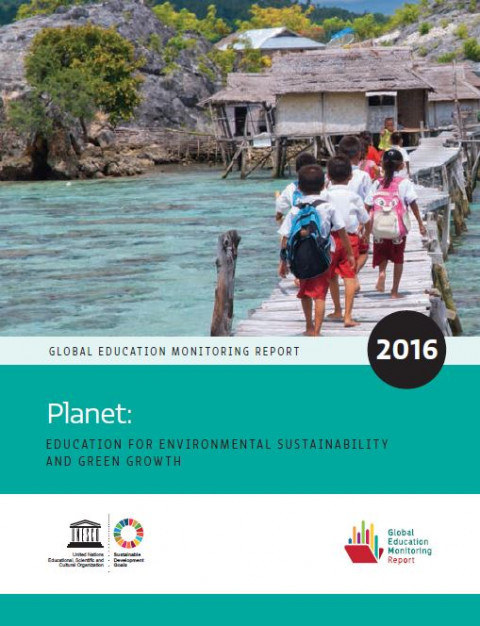 Global Education Monitoring Report, 2016: Planet: Education for Environmental Sustainability and Green Growth Year of publication: 2016 Corporate author: UNESCO PLANET: Education for environmental sustainability and green growth, a publication taken from the full 2016 Global Education Monitoring Report, explores the knowledge and skills needed for sustainable and inclusive economic growth that does not damage our planet.This publication demonstrates how education can help people understand and respond to environmental issues and climate change. Environmental education can increase green knowledge and build sustainability practices. The publication warns that while education contributes to economic growth, education systems must be careful not to encourage unsustainable lifestyles and all learners must acquire the knowledge and skills needed to promote sustainable development.It also argues that we must continue to learn throughout our lives in order to make production and consumption sustainable, and to provide green skills for green industries. Creating green industries relies on high-skill workers with specific training, yet by 2020 there could be 40 million too few workers with tertiary education relative to demand. Higher education and research should also be oriented towards green innovation and growth; innovation depends on cooperation in higher education and investment in research and development to transform production in vast swaths of the economy.It also recognises that education must change in order to keep up with the changing face of work. Green and transferable skills should be taught in both school and the workplace. The greening of industries requires not only the production of more high-skill workers, but the continued training and education for low and medium skill workers, often on the job. “To ensure the Sustainable Development Goals are implemented, everyone involved needs to think, to work, to organise, to communicate and to report in ways that are completely different from what has been done up till now. Education truly is key to a wide appreciation not just of the SDGs but the new ways of thinking and working that are going to be necessary to fulfil them. So the challenge to all of us is to re-learn, and that does not just apply to educators, but it applies to all of us.”
 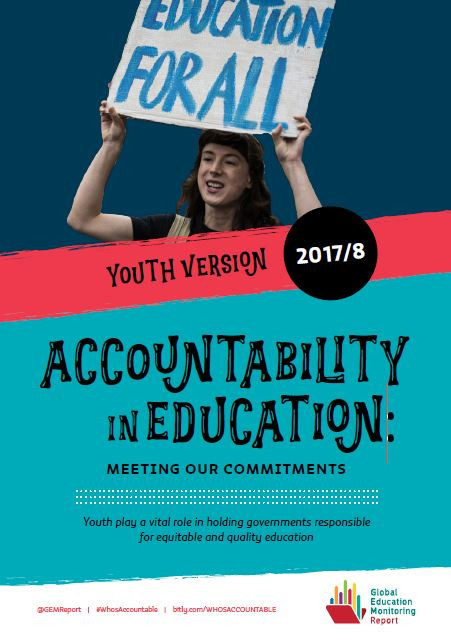 Accountability in Education: Meeting our Commitments; Global Education Monitoring Report, Youth Version, 2017/8 Year of publication: 2017 Corporate author: UNESCO This Youth Report, based on findings and conclusions from the 2017/8 Global Education Monitoring report, asks how young people are involved in the process of accountability in education. As students, what are we responsible for in our education and how are we held accountable? How can we make sure other actors – like schools, universities and governments – are held accountable for their responsibilities? These are critical questions, because we know that there’s a long way to go before all young people around the world have access to a quality education: absent teachers, overcrowded classrooms, illegitimate diplomas, unregulated private schools and truancy are all issues that education systems are struggling to overcome.It’s sometimes tempting to say that these problems aren’t ours to fix, that the responsibility lies with the government or with an older generation. But this simply isn’t true: education is a shared responsibility, and young people have an important role to play. In this Report, you’ll hear the stories of young people around the world who have stood up for the right to education in their communities and who have been integral in triggering change. You’ll also read about how you can become involved in our campaign to make sure governments can be held to account for education. This means making sure that citizens can take their governments to court if they are not meeting their education responsibilities. From creating video clips to holding awareness-raising events, there is a range of ways to make your voice heard. Your involvement is integral in making sure the world is on the right path to meeting our education goals.