
Resources
Explore a wide range of valuable resources on GCED to deepen your understanding and enhance your research, advocacy, teaching, and learning.
3,446 Results found
 Citizenship and Culture of Peace in Educational Reform Year of publication: 2005 Author: Raúl Zepeda López, María del Rosario Toj, Edgar Florencio Montúfar Corporate author: UNESCO The concern raised by the themes and contents of civic education and the culture of peace in childhood and youth are issues that are felt in various academic sectors, in social organizations and educational authorities that sometimes translate into articles in the media, where, among other things, one speaks of "the loss of values", generally having as reference to the young generations and making invisible that this loss is mainly present in the adult generations, which are responsible for this situation. These concerns, in spite of that conscious ambiguity, are not gratuitous. They can be a starting point to become aware of the need to develop new capacities and values, the absence of which young Latin Americans identify in their political and social leaders, as has been pointed out in cited studies, carried out by UNICEF for Latin America and for Beatriz de Cazali for Guatemala. The need to respond to this concern is also present in the participants in the dialogues and municipal consensus (2000), as well as among authorities and curriculum developers of MINEDUC in the last five-years. Ciudadanía y cultura de paz en la reforma educativa Year of publication: 2005 Author: Raúl Zepeda López, María del Rosario Toj, Edgar Florencio Montúfar Corporate author: Organización de las Naciones Unidas para la Educación, la Ciencia y la Cultura (UNESCO) La preocupación planteada por los temas y contenidos de la formación ciudadana y la cultura de paz en la niñez y la juventud son cuestiones sentidas en diversos sectores académicos, en organizaciones sociales y autoridades educativas que algunas veces se traducen en sendos artículos en los medios de comunicación en donde, entre otras cosas, se habla de “la pérdida de valores” a secas, generalmente teniendo como referencia a las jóvenes generaciones e invisibilizando que esta pérdida principalmente está presente en las generaciones adultas, las cuales son responsables de esta situación. Estas inquietudes, a pesar de aquella consciente ambigüedad, no son gratuitas. Pueden ser punto de partida para tomar conciencia de la necesidad de desarrollo de nuevas capacidades y valores, cuya ausencia, los jóvenes latinoamericanos identifican en sus dirigentes políticos y sociales, como ha quedado antes señalado en estudios citados, realizados por UNICEF para América Latina y por Beatriz de Cazali para Guatemala. La necesidad de responder a esta preocupación está presente, además, en los participantes en los diálogos y consensos municipales (2000), así como entre autoridades y curriculistas del MINEDUC en los últimos quinquenios.
  Implementing the Right to Education: a Compendium of Practical Examples Year of publication: 2016 Corporate author: UNESCO This publication is a compilation of practical examples of measures taken by Member States in implementing the provisions of the UNESCO Convention and Recommendation against Discrimination in Education. These examples are taken from national reports submitted to UNESCO for the Eighth Consultation of Member States on the implementation of these two international standard-setting instruments. The Convention and the Recommendation celebrated their fi fty-fi fth anniversary in 2015. Both express the fundamental principles of non-discrimination and equality of educational opportunities enshrined in UNESCO’'s Constitution. Since these fundamental principles were essential in the process of Education for All, the instruments have naturally become the cornerstone of this important domain.The Education 2030 development agenda will provide further opportunity to mobilise the Convention and the Recommendation in guiding Member States in the effective realization of the right to education. This compendium seeks to provide an overview of promising measures taken to ensure equality of educational opportunities and non-discrimination, while also serving as a tool for information sharing and advocacy in connection with the right to education.
  Regional overview: Central and Eastern Europe and Central Asia Year of publication: 2015 Corporate author: UNESCO Central and Eastern Europe (CEE) and Central Asia (CA) have both made significant advances towards Education for All (EFA) since 1999. However, the 2015 EFA Global Monitoring Report shows that despite progress, Education For All remains unfinished business, including in Central and Eastern Europe and in Central Asia. This must be taken into account in the post-2015 agenda. Региональный обзор: Центральная и Восточная Европа и Центральная Азия Year of publication: 2015 Corporate author: Организация Объединенных Наций по вопросам образования, науки и культуры (UNESCO) В настоящем региональном обзоре, где рассматривается прогресс, достигнутый с 2000 г., кратко излагаются ответы на важнейшие вопросы, которым посвящен Всемирный доклад по мониторингу (ВДМ) ОДВ за 2015 г. В ВДМ за 2015 г. показано, что, несмотря на прогресс, цели образования для всех еще не до конца достигнуты, в том числе в Центральной и Восточной Европе и Центральной Азии.
 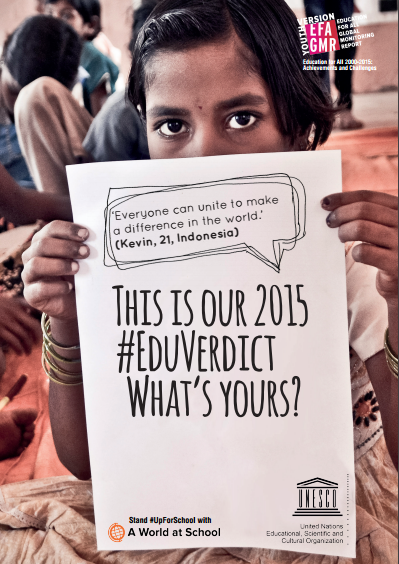 这是我们的2015 教育回望#EduVerdict 你的呢? Year of publication: 2015 Corporate author: 联合国教科文组织 (UNESCO) This report highlights the progress and challenges that countries have faced over 15 years, brining together the voices of young people to show how Education for All (EFA) has affected their lives.
  Analysis of Determinants of a Measure of Sustainability Literacy Year of publication: 2017 Author: Aurélien Decamps Corporate author: UNESCO This paper highlights the contribution of the Sulitest to analyse the determinants of sustainability literacy in higher education. Sulitest is an open online training and assessment tool designed to assess and improve sustainability literacy. It is a multi-stakeholder initiative supported by several UN agencies and academic networks. Based on collaboration through the volunteer contribution of an international community, this tool aims to be internationally recognized and locally relevant by addressing global as well as local issues. With a growing community of more than 500 higher education institutions and other organizations from more than 50 countries, Sulitest begins to be recognized as a standard to assess and improve sustainability literacy. As the use of the tool is expanding, the data collected provides tangible indicators to map the current level of sustainability literacy and to monitor progress over time.
  Teacher Training for Multicultural Education in Favour of Democracy and Sustainable Development: the Territorial Approach Year of publication: 1995 Author: Raúl Galiardi | Paula Bernadini Mosconi Corporate author: UNESCO This publication is part of the book Teacher Training and Multiculturalism: National Studies. This book presents the outcomes concerning the initial training systems of teachers in eight countries at different levels of development in different regions of the world but who are faced with a common challenge to educate for cultural diversity. Both the conclusions of each particular study and the general outcomes demonstrate the complexity of the problems and the benefits of comparative analysis. Overcoming prejudices and stereotypes is not an easy task nor likely to be achieved in the short term. Mentalities change far more slowly than knowledge and, because of this, educational strategies need to be applied in the long term. This study also shows that it is necessary to improve the exchange of experiences as well as contacts between people and institutions who are confronted with the same problems in different contexts. The publication of the initial outcomes of this project is intended to enrich the quality of discussions between specialists and institutions who, in different parts of the world, are concerned by multicultural education as an instrument to promote understanding, respect and dialogue between cultures.
  Non-formal and Informal Programs and Activities that Promote the Acquisition of Knowledge and Skills in Areas of Global Citizenship Education (GCED) and Education for Sustainable Development (ESD) Year of publication: 2016 Author: Ashley Stepanek Lockhart Corporate author: UNESCO This study will examine the nature of, and how, non-formal and informal programs and activities contribute to the acquisition of knowledge and skills for children, adolescents, youth and adults in precise areas of Target 4.7. This will be done by highlighting different definitions, conceptual approaches and history, along with policies of GCED and ESD and non-formal education and informal learning, comparing attempts to operationalize GCED and ESD to indicators for measurement and monitoring and challenges therein, and by identifying relevant sample programs and activities from around the world to analyze and consider using as data sources. How non-formal and informal provision related to GCED and ESD links to formal education will be considered, along with its connection to the larger notion of lifelong learning.
  How Does Education About the Holocaust Advance Global Citizenship Education? Year of publication: 2018 Author: E. Doyle Stevick Corporate author: UNESCO Can education about past genocides shape our understanding of how violence occur in today’s world? Can it foster a sense of belonging to a common humanity and empower young people to become active citizens who work globally for peace and human rights? How does learning about such crimes, which profoundly affect the core dignity of human beings, support the objectives of Global Citizenship Education (GCED), a priority of the 2030 Education Agenda?This paper, commissioned by UNESCO, offers an overview of empirical research on teaching and learning about the Holocaust and how such education may impact leaners’ cognitive, socio-emotional and behavioural skills and competencies. It provides insights for educators on how effective lessons about the Holocaust can meet some of the key expected outcomes of Global Citizenship Education (GCED), such as critical thinking skills, attitudes of empathy and solidarity, and motivation to take action to prevent human rights abuses.