
Resources
Explore a wide range of valuable resources on GCED to deepen your understanding and enhance your research, advocacy, teaching, and learning.
3,433 Results found
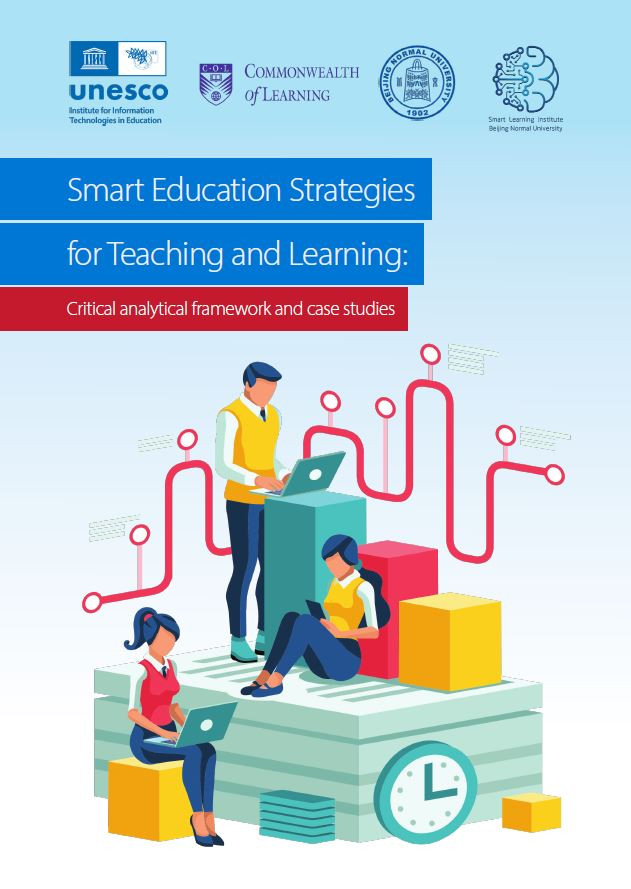 Smart Education Strategies for Teaching and Learning: Critical Analytical Framework and Case Studies Year of publication: 2022 Author: Shafika Isaacs | Sanjaya Mishra Corporate author: UNESCO Institute for Information Technologies in Education (IITE) | Beijing Normal University This electronic publication about smart education strategies for building the resilience of education and training systems in the postpandemic environment provides a framework to develop appropriate policy and strategy in existing and emerging forms of schooling, higher education, technical and vocational education, and training (TVET), adult education and lifelong learning, including formal, nonformal and informal educational environments. The publication reviews the status of smart education policies in 10 countries. It includes 15 case studies within the six policy themes: infrastructure, curriculum and pedagogy, digital education resources and platforms, skills and competencies, governance, management and administration, and partnership.
  Toward one world or many? A comparative analysis of OECD and UNESCO global education policy documents Year of publication: 2019 Author: Vaccari, Victoria | Gardinier, Meg P. Education policymaking has gone global. The 2030 Agenda for Sustainable Development aims to galvanize efforts to promote sustainable development, decrease global inequalities, and realize universal quality education. Supporting these efforts, two leading international organizations, UNESCO and the OECD, have set out normative frameworks for their vision of global education. This paper examines the policy discourses of these organizations in light of SDG 4–Education. Specifically, through a comparative analysis of selected terms and underlying concepts in key policy documents, the paper distinguishes between UNESCO's notion of global citizenship and the OECD's framework for global competence. Ultimately, the authors discuss whether the organizations' agendas are aimed at a common global vision, or, alternatively, towards two distinct and divergent conceptualizations of an imagined future.
  Global citizenship curriculum in higher education: evolving policy and practice and a future research agenda; proceedings of a symposium held on 9-10 December 2013 in Hong Kong Year of publication: 2013 Corporate author: Bath Spa University | General Education Centre (Hong Kong) | Polytechnic University This symposium was an outgrowth of a UK Economic and Social Research Council (ESRC) funded International Networking Project. A collaboration between academics in the United Kingdom/Europe, North America, and Asia, this project responds to the fact that there is an increasing interest in understanding how universities can educate students to become more engaged and globally-minded citizens. The premise is that higher education should contribute to the public good by training more global citizens with cultural awareness, a strong sense of civic responsibility and skills to participate in a knowledge-based global economy. The following report documents the symposium proceedings, summarises the presentations and provides key insights drawn from presentations. Comments made by individuals are paraphrased and/or synthesized. Programme de Citoyenneté Mondiale dans l'enseignement supérieur: la politique et la pratique en évolution et un futur programme de recherche; actes d'un colloque tenu les 9-10 Décembre 2013 à Hong Kong Year of publication: 2013 Corporate author: Bath Spa University | General Education Centre (Hong Kong) | Polytechnic University Ce symposium était une excroissance du Conseil de la recherche économique et sociale du Royaume-Uni (en. ESRC) financé Projet international de réseautage. Une collaboration entre les universitaires au Royaume-Uni / Europe, Amérique du Nord, et en Asie, ce projet répond au fait qu'il ya un intérêt croissant pour comprendre comment les universités peuvent éduquer les élèves à devenir des citoyens plus engagés et ouverts sur le monde. La prémisse est que l'enseignement supérieur doit contribuer au bien public par la formation des citoyens plus globales avec la conscience culturelle, un fort sentiment de responsabilité et les compétences civiques de participer à une économie mondiale fondée sur le savoir. Le rapport suivant documente les actes du colloque, résume les présentations et fournit des informations clés tirées des présentations. Commentaires formulés par les individus sont paraphrasés et / ou synthétisés.
  Six ways to ensure higher education leaves no one behind Year of publication: 2017 Corporate author: UNESCO International Institute for Educational Planning (IIEP) This policy paper, written in partnership with the UNESCO International Institute for Education Planning (IIEP), makes policy recommendations for equitable and affordable higher education to better support the implementation of the SDG agenda. To do this, it reviews recent trends in higher education expansion, identifies disparities in student participation, examines policy tools and practices for fostering equity, and explores ways to target assistance at those who need it most. Six façons de garantir que l'enseignement supérieur ne laisse personne sur le carreau Year of publication: 2017 Corporate author: UNESCO International Institute for Educational Planning (IIEP) This policy paper, written in partnership with the UNESCO International Institute for Education Planning (IIEP), makes policy recommendations for equitable and affordable higher education to better support the implementation of the SDG agenda. To do this, it reviews recent trends in higher education expansion, identifies disparities in student participation, examines policy tools and practices for fostering equity, and explores ways to target assistance at those who need it most. Seis maneras de asegurar que la educación superior no deje a nadie atrás Year of publication: 2017 Corporate author: UNESCO International Institute for Educational Planning (IIEP) This policy paper, written in partnership with the UNESCO International Institute for Education Planning (IIEP), makes policy recommendations for equitable and affordable higher education to better support the implementation of the SDG agenda. To do this, it reviews recent trends in higher education expansion, identifies disparities in student participation, examines policy tools and practices for fostering equity, and explores ways to target assistance at those who need it most.
 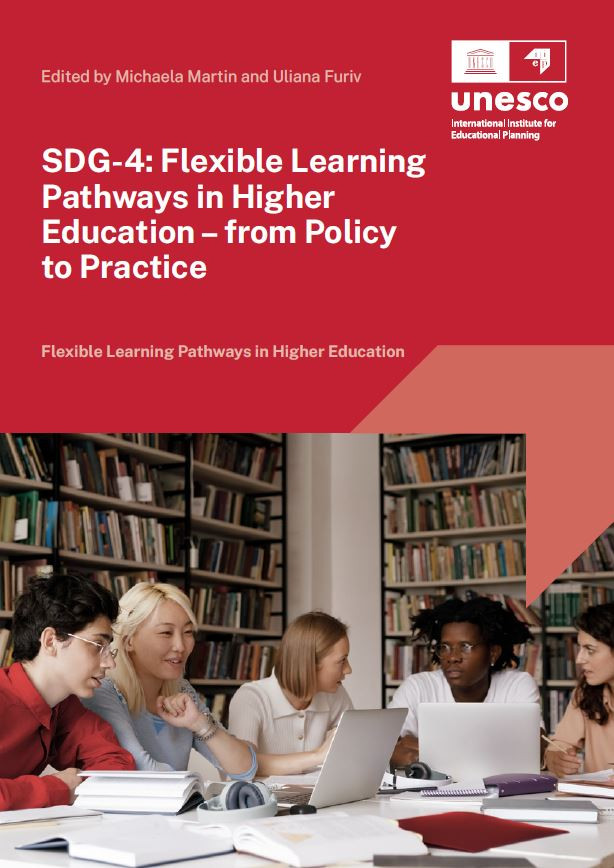 SDG-4: Flexible Learning Pathways in Higher Education – from Policy to Practice: An International Comparative Analysis Year of publication: 2022 Author: Michaela Martin | Uliana Furiv Corporate author: UNESCO International Institute for Educational Planning (IIEP) Higher education systems across the world are currently faced with a massive influx of learners with more diverse needs. They are expected to respond to this growing diversity through a more flexible learning offer and pathways that allow all learners, including those from disadvantaged groups, to access, progress through, and complete, higher education.To enhance knowledge on how to provide increased flexibility in higher education, IIEP–UNESCO undertook an international research project on SDG-4: Planning for Flexible Learning Pathways (FLPs) in Higher Education. The project included a stocktaking of policies, instruments, and practices, an international survey among UNESCO Member States, and eight in-depth country studies on Chile, Finland, India, Jamaica, Malaysia, Morocco, South Africa, and the UK.This book presents the findings from the research, including a cross-country analysis of available FLP policies and practices, and how they enhance equitable higher education systems. It also presents a series of country experiences with innovative approaches to alternative entry, flexible progression, and governance systems in support of FLPs. Discours de Mme Irina Bokova, Directrice générale de l'UNESCO, à l'occasion de l'ouverture de laconférenceinternationale sur l'enseignement supérieur pour le développement durable: Au-delà de l'enseignement supérieur 2014 Year of publication: 2014 Corporate author: UNESCO. Director-General, 2009-2017 (Bokova, I.G.) Cette adresse a été faite par Irina Bokova, Directrice générale de l'UNESCO, à l'occasion de l'ouverture de la conférence internationale sur l'enseignement supérieur pour le développement durable: Au-delà de l'enseignement supérieur 2014. Address by Irina Bokova, Director-General of UNESCO, on the occasion of the Opening of the International Conference on Higher Education for Sustainable Development: Higher Education Beyond 2014; Nagoya University, Aichi, Japan, 9 November 2014 Year of publication: 2014 Corporate author: UNESCO. Director-General, 2009-2017 (Bokova, I.G.) This address had been made by Irina Bokova, Director-General of UNESCO, on the occasion of the opening of the International Conference on Higher Education for Sustainable Development: Higher Education Beyond 2014.