
Resources
Explore a wide range of valuable resources on GCED to deepen your understanding and enhance your research, advocacy, teaching, and learning.
685 Results found
 Education for Transformation Year of publication: 2012 Author: Marcelo Cabrol | Miguel Székely Corporate author: Inter-American Development Bank This book presents a diagnosis of the state of educational quality and its priorities (academic achievement, citizenship education, adolescent desertion, and teacher training) in Latin America and the Caribbean at the beginning of the 21st century. It also shows the public policies that can modify this reality. Educación para la transformación Year of publication: 2012 Author: Marcelo Cabrol | Miguel Székely Corporate author: Inter-American Development Bank Este libro presenta un diagnóstico sobre el estado de la calidad educativa y sus prioridades (logro académico, formación en ciudadanía, deserción adolescente y formación docente) en América Latina y el Caribe a inicios del siglo XXI. También muestra las políticas públicas que pueden modificar dicha realidad.
  자유학기제와 미디어리터러시: 학교교사와 미디어교육 강사를 위한 가이드북 Year of publication: 2018 Author: 김양은 | 박한철 | 배은주 | 박정원 Corporate author: 시청자미디어재단 | 방송통신위원회 자유학기제에서 이루어지는 미디어교육을 담당하는 학교교사와 강사를 위한 미디어리터러시 교육 가이드북이다. 교육방법, 수업설계, 수업모형 및 미디어교육 참고자료 등 미디어교육과 관련한 교수학습자료를 다양하게 수록하였으며, 호주 및 캐나다의 미디어교육 사례도 참고할 수 있다.
  생애주기별 미디어정보 리터러시 교재: 미디어 역기능 예방 교육 가이드 Year of publication: 2018 Author: 김은규 | 정수진 | 김수정 Corporate author: 시청자미디어재단 본 교재의 목적은 과잉 정보 시대에 온라인, 소셜 미디어 등을 통해 전달되는 허위정보에 대응 하는 시민의 ‘미디어정보 리터러시’ 함양에 있다. 교재는 기본적으로 미디어정보의 의미와 활용, 미디어정보의 영향력, 좋은 정보와 거짓 정보의 구별, 허위정보의 유해성 등의 내용이 차시별로 제시되도록 구성했으며, 학교 중심의 미디어교육에서 벗어나 어린이, 청소년, 학부모, 성인, 실버세대의 다섯영역으로 유형화한 것이 특징이다. 또한, 이론식 수업이 아니라 실습 활동이 되도록 체험활동, 토론 등 다양한 수업 방식을 제시함으로써 각 개인이 수업 내용을 쉽게 체득할 수 있도록 했다.
  Educación para la ciudadanía y la convivencia: ciberciudadanía para la paz, una aldea digital de la que haces parte; ciclo cinco (décimo, undécimo, duodécimo) Year of publication: 2015 Corporate author: Secretaría de Educación del Distrito (SED) | Fe y Alegría These twelve modules make reference to a series of activities that focus on how children from all the educative grades understand and live citizenship, strengthening and facilitating the learning processes based on autonomy. This educative materials, which are aimed at being implemented inside the classrooms, attempt to serve as input resources for educators and other agents that work on or are interested in working with citizenship education and coexistence. The overall objective is to provide quality education.
  Investigation and Analysis on the Service Status of University Libraries in Digital Citizen Education (Library Work in Colleges and Universities; No. 4) Year of publication: 2020 Author: Tangyi | Liulu Corporate author: College library and Information Committee of Hunan Provincial This paper investigated the status of the service provided by university libraries in China to cultivate digital citizens and the cognition of responsibility of cultivating digital citizens provided by university libraries. The survey found that: firstly, the number of service in the digital citizen education provided by the university library is related to the university’s level; secondly, university libraries provide the most abundant service in the areas of digital literacy, digital access and digital communication, and less service in the areas of digital law, digital etiquette and digital power; thirdly, university libraries provide the scarcest service in the area of digital trade and most university libraries consider it is no responsible to provide this service or just hold an uncertain attitude; fourthly, there is no significant correlation between the service on digital citizen education provided by university libraries and the cognition status of responsibility. 高校图书馆在数字公民教育中的服务现状调查与分析 (高校图书馆工作; No. 4) Year of publication: 2020 Author: Tangyi | Liulu Corporate author: College library and Information Committee of Hunan Provincial 文章调查了我国高校图书馆为培养数字公民所提供的服务状况和高校图书馆培养数字公民的责任 认知状况。调查发现: 第一,高校图书馆在数字公民教育各层面所提供的服务数量与院校等级有关; 第二,在 数字素养、数字获取与数字交流这三个方面提供的服务最为丰富,在数字法律、数字礼仪以及数字权力与义 务这三个方面提供的服务数量较少; 第三,在数字贸易方面提供的服务最为稀缺,且认为无责任提供此方面 服务或者持不确定态度的高校图书馆数量最多; 第四,高校图书馆在数字公民教育中所提供的服务情况与其 责任认知状况并不存在显著性相关联系。
  Digital Citizenship Education: The Policy and Practice in Asia-Pacific Region (International and Comparative Education; Vol. 8) Year of publication: 2019 Author: Zhou Xiaoli | Wang Fangzhou Corporate author: Beijing Normal University With the advent of the network informational age, digital citizenship has gradually become a concept for in-depth exploration. At the same time, the education of digital citizenship has also increasingly become an important part of the education system of many countries around the world. In Asia-Pacific area, UNESCO Bangkok has started to launch the digital citizenship project, while those member states are actively exploring and working on all aspects of relevant policy and practice. As the countries with high information level, Singapore, Australia and Korea have been carrying out better digital citizenship educations, especially in terms of cyber wellness courses, cyber security education and internet addiction prevention and treatment. The status and experience of the digital citizenship education in Asia-Pacific countries can provide some enlightenment for the future advancements of digital citizenship education in China. 数字公民教育:亚太地区的政策与实践 (比较教育研究; Vol. 8) Year of publication: 2019 Author: Zhou Xiaoli | Wang Fangzhou Corporate author: Beijing Normal University 随着网络信息时代的到来,在国际学术界,数字公民已成为一个被深入探讨 的概念 ;在全球教育领域,数字公民教育日益成为世界各国教育体系的重要组成部分。在 亚太地区,联合国教科文组织曼谷办事处已经启动了数字公民培育项目,各成员国在政策 与实践方面正作出积极的探索和努力。作为信息化程度较高的国家,新加坡、澳大利亚和 韩国的数字公民教育开展得较好,尤其在网络健康课程、网络安全教育及网络成瘾预防和 治疗等方面表现更为出色,这些经验可为数字公民教育的推进提供若干启示。
 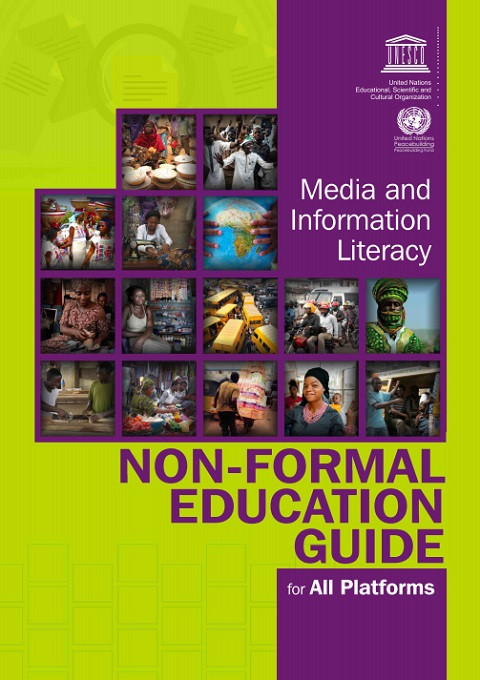 Media and Information Literacy: Non-Formal Education Guide for All Platforms Year of publication: 2019 Author: Nosa Owens-Ibie | Ifedolapo Ademosu | Abiodun Oyeleye Corporate author: UNESCO Dakar The aim of this book is to provide a basic understanding of the idea of media and information literacy (MIL). This book is meant to teach people how to access, understand and evaluate information, the different types of governance systems that exist and how it affects them as citizens. It is also meant to ensure that users know how to use and share information responsibly.