
Resources
Explore a wide range of valuable resources on GCED to deepen your understanding and enhance your research, advocacy, teaching, and learning.
1,187 Results found
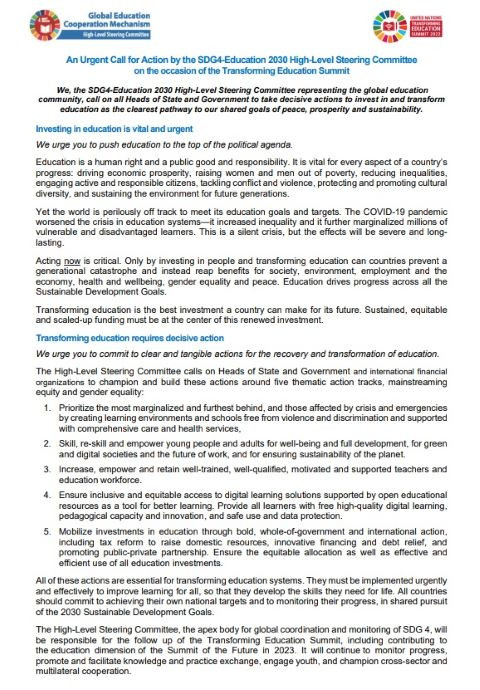 可持续发展目标 4—2030 年教育高级别指导委员会 在教育变革峰会之际的紧急行动呼吁 Year of publication: 2022 Corporate author: United Nations (UN) 我们,代表全球教育界的 SDG4-Education 2030 高级别指导委员会,呼吁所有国家元首和政府首脑采取果断行动,对教育进行投资和改造,作为实现和平、繁荣和可持续发展这一共同目标的最清晰途径 .
 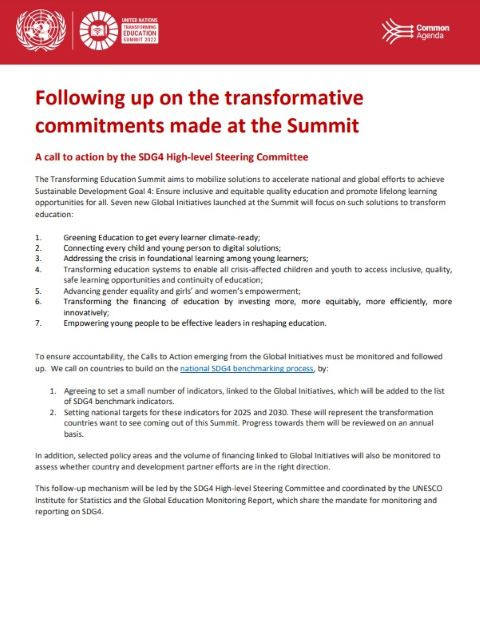 Following Up on the Transformative Commitments Made at the Summit: A Call to Action by the SDG4 High-level Steering Committee Year of publication: 2022 Corporate author: United Nations (UN) The Transforming Education Summit aims to mobilize solutions to accelerate national and global efforts to achieve Sustainable Development Goal 4: Ensure inclusive and equitable quality education and promote lifelong learning opportunities for all. Seven new Global Initiatives launched at the Summit will focus on such solutions to transform education.
 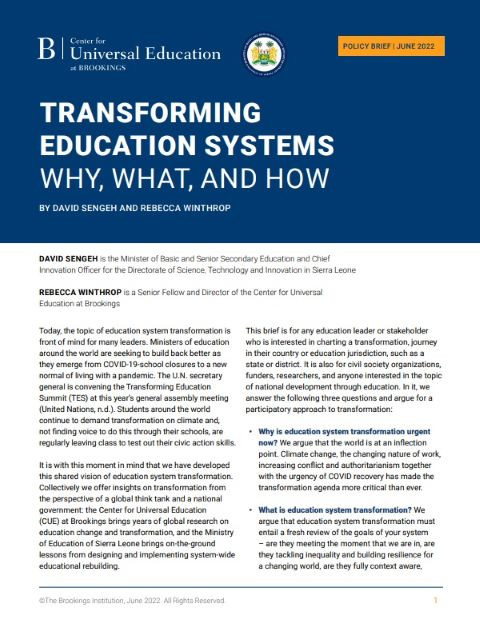 Transforming Education Systems: Why, What, and How Year of publication: 2022 Author: Rebecca Winthrop | David Sengeh Corporate author: Brookings Institution This brief is for any education leader or stakeholder who is interested in charting a transformation journey in their country or education jurisdiction such as a state or district. It is also for civil society organisations, funders, researchers, and anyone interested in the topic of national development through education. In it, the authors answer the following three questions and argue for a participatory approach to transformation: Why is education system transformation urgent now? The world is at an inflection point. Climate change, the changing nature of work, increasing conflict and authoritarianism together with the urgency of COVID recovery has made the transformation agenda more critical than ever. What is education system transformation? Education system transformation must entail a fresh review of the goals of your system – are they meeting the moment that we are in, are they tackling inequality and building resilience for a changing world, are they fully context aware, are they owned broadly across society – and then fundamentally positioning all components of your education system to coherently contribute to this shared purpose. How can education system transformation advance in your country or jurisdiction? Three steps are crucial: Purpose (developing a broadly shared vision and purpose), Pedagogy (redesigning the pedagogical core), and Position (positioning and aligning all components of the system to support the pedagogical core and purpose). Deep engagement of educators, families, communities, students, ministry staff, and partners is essential across each of these 3P steps.
 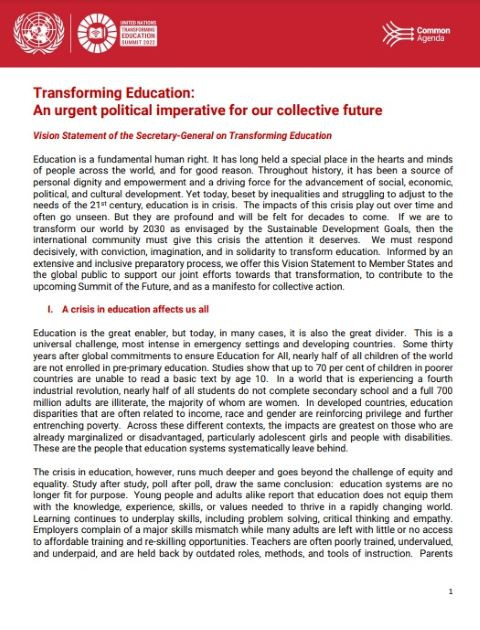 Transforming Education: An Urgent Political Imperative for Our Collective Future; Vision Statement of the Secretary-General on Transforming Education Year of publication: 2022 Corporate author: United Nations (UN) Education is a fundamental human right. It has long held a special place in the hearts and minds of people across the world, and for good reason. Throughout history, it has been a source of personal dignity and empowerment and a driving force for the advancement of social, economic, political, and cultural development.Yet today, beset by inequalities and struggling to adjust to the needs of the 21st century, education is in crisis. The impacts of this crisis play out over time and often go unseen. But they are profound and will be felt for decades to come. If we are to transform our world by 2030 as envisaged by the Sustainable Development Goals, then the international community must give this crisis the attention it deserves. We must respond decisively, with conviction, imagination, and in solidarity to transform education. Informed by an extensive and inclusive preparatory process, we offer this Vision Statement to Member States and the global public to support our joint efforts towards that transformation, to contribute to the upcoming Summit of the Future, and as a manifesto for collective action.
  New Facets of Educational Inequality in Countries Central Asia: From Problem Measurement to Policy Changes Year of publication: 2021 Author: Saule Aliyeva | Kamila Kovyazina Corporate author: Paperlab Research Center (Kazakhstan) This report summarizes the results of a research project to study the problem of educational inequality in the region, carried out by the Research Center PaperLab (Kazakhstan) together with partners from Kyrgyzstan, Tajikistan, and Uzbekistan. A regional approach to studying the problem of educational inequality will help assess the role and effectiveness of measures taken by governments of different countries in ensuring access to education, and to identify the strengths and weaknesses of each country in the transition to a post-pandemic environment. Promoting this expertise in the media and social networks will start a discussion about the importance of education in terms of reducing social inequality in the region and get new ideas on equalizing opportunities in access to education as one of the key public goods. Новые грани образовательного неравенства в странах Центральной Азии: От измерения проблемы к изменениям политик Year of publication: 2021 Author: Saule Aliyeva | Kamila Kovyazina Corporate author: Исследовательский центр Paperlab (Казахстан) Настоящий отчет обобщает результаты исследовательского проекта по изучению проблемы образовательного неравенства в регионе, выполненного исследовательским центром PaperLab (Казахстан) совместно с партнерами из Кыргызстана, Таджикистана, Узбекистана. Региональный подход к изучению проблемы образовательного неравенства поможет оценить роль и эффективность мер, принимаемых правительствами разных стран в обеспечении доступа к образованию, а также выявить слабые и сильные стороны каждой страны в переходе к условиям постпандемии. Продвижение этих экспертных знаний в массмедиа и социальных сетях позволит запустить дискуссию о значимости образования с точки зрения снижения социального неравенства в регионе и получить новые идеи по выравниванию возможностей при доступе к образованию как одному из ключевых общественных благ.
 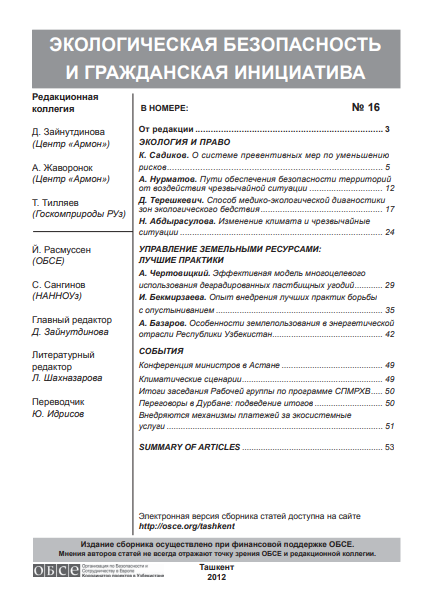 Environmental Safety and Civil Initiative (Bulletin; no. 16) Year of publication: 2012 Author: D. Zaynutdinova | A. Zhavoronok | T. Tillyaev | J. Rasmussen | S. Sanginov | L. Shakhnazarova Corporate author: Organization for Security and Co-operation in Europe (OSCE) The articles included in the first section of the bulletin focus on issues of ensuring the safety of the population in emergency situations. The materials of the second section of the bulletin are devoted to the topic of multipurpose land use as an effective way to combat desertification processes. Экологическая безопасность и гражданская инициатива (Бюллетень; №16) Year of publication: 2012 Author: D. Zaynutdinova | A. Zhavoronok | T. Tillyaev | J. Rasmussen | S. Sanginov | L. Shakhnazarova Corporate author: Organization for Security and Co-operation in Europe (OSCE) Статьи, вошедшие в первый раздел бюллетеня, акцентируют внимание на вопросах обеспечения безопасности населения при чрезвычайных ситуациях. Теме многоцелевого использования земель как эффективного способа борьбы с процессами опустынивания посвящены материалы второго раздела бюллетеня. نداء عاجل من أجل العمل صادر عن اللجنة التوجيهية الرفيعة املستوى املعنية هبدف التنمية املستدامة 4 اخلاص ابلتعليم حىت عام 2 مبناسبة قمة التحول املنشود يف التعليم Year of publication: 2022 Corporate author: United Nations (UN) نحن ، اللجنة التوجيهية رفيعة المستوى للهدف الرابع من أهداف التنمية المستدامة للتعليم لعام 2030 التي تمثل مجتمع التعليم العالمي ، ندعو جميع رؤساء الدول والحكومات إلى اتخاذ إجراءات حاسمة للاستثمار في التعليم وتحويله باعتباره أوضح مسار لأهدافنا المشتركة المتمثلة في السلام والازدهار والاستدامة. An Urgent Call for Action by the SDG4-Education 2030 High-Level Steering Committee Year of publication: 2022 Corporate author: United Nations (UN) We, the SDG4-Education 2030 High-Level Steering Committee representing the global education community, call on all Heads of State and Government to take decisive actions to invest in and transform education as the clearest pathway to our shared goals of peace, prosperity and sustainability.