
Resources
Explore a wide range of valuable resources on GCED to deepen your understanding and enhance your research, advocacy, teaching, and learning.
2,772 Results found
 5th UNESCO Forum on Transformative Education for Sustainable Development, Global Citizenship, Health and Well-being (Strand 1) Year of publication: 2021 Author: Shadreck Majwabe | Thomas Greiner | Taka Horio | Niveen Jouhar | Arjen Wals | Lynndina Essack | Didier Jourdan | James O’Higgins Norman | Bolorchimeg Dagva Corporate author: UNESCO | APCEIU Plenary session 1In this first plenary, countries shared their vision, practice and progress underpinning their understanding of “transformative education”. The impact of current practices related to learners’ behavior and the educational system was discussed, highlighting success indicators.Moderator: Ms Krista Pikkat, Director, UNESCO Almaty OfficeMr Shadreck Majwabe, Director of the Department of Curriculum Development and Evaluation, Ministry of Basic Education, BotswanaMr Thomas Greiner, Head of Subdivision, Lifelong Learning, Federal Ministry of Education and Research, GermanyMs Taka Horio, Assistant Secretary-General, the Japanese National Commission for UNESCO & ASP National Coordinator, Ministry of Education, Culture, Sports, Science and Technology, JapanMs Niveen Jouhar, Member of Directorate of Curricula, Ministry of Education, Jordan Concurrent sessions 1Following the plenary session, the concurrent sessions discussed the different components that need to be transformed in the education system, and how to bring about these changes and further advance. Session 1.1 – PolicyModerator: Ms Akpezi Ogbuigwe, Founder, Anpez Centre for Environment and Development, Nigeria Mr Arjen Wals, UNESCO Chair, Social Learning and Sustainable Development, University of Wageningen, Netherlands Ms Anna-Karin Johansson, Swedish National Commission for UNESCO, Ministry of Education, Sweden Mr Felipe de Souza Costa, São Paulo Municipal Secretariat of Education, Brazil Mr El Hadji Gueye, Founder, Banlieu UP, Senegal Session 1.2 – Curricula, pedagogy and assessmentModerator: Mr Yao Ydo, Director, UNESCO International Bureau of Education (IBE)Dr Esther Care, Professor, University of Melbourne, AustraliaMs Lynndina Essack, Senior Education Officer, Department of Education Services, Ministry of Education, SeychellesMr Daehoon Jho, Professor, Sungshin Women's University, Republic of KoreaDr Jinan Karameh Chaya, Principal, Al Manar Modern School (UNESCO Associated Schools Network member), Lebanon Session 1.3 – Learning environmentModerator: Mr Chris Castle, Chief of Section of Education for Health and Well-being, UNESCOProf Didier Jourdan, UNESCO Chair and Head of the World Health Organization (WHO) Collaborating Center "Global Health & Education"Prof James O’Higgins Norman, Director of the National Anti-Bullying Centre, the Dublin City University, Ireland & UNESCO Chair on Tackling Bullying in Schools and CyberspaceMs Bolorchimeg Dagva, Adolescents and HIV Specialist, UNICEF, Mongolia Links to Strand 2 & Special session / Strand 3 / Strand 4
  5th UNESCO Forum on Transformative Education for Sustainable Development, Global Citizenship, Health and Well-being (Strand 2 & Special Session) Year of publication: 2021 Author: Miho Taguma | Leanne Riley | Valeria Damiani | Nandini Chatterjee | Valerie Shapiro | Pablo Pincheira | Nicolas Jonas | Denis Barrett | Doug McCall | Antoine Marivin | Cheoljin Yang | Sunkyung Lee Corporate author: UNESCO | APCEIU Strand 2 – What does progress in transformative education look like – a look at recent global and regional data Plenary session 2Building upon Strand 1, this session examined transformative education through the lens of regional and global comparative data in relation to SDG Target 4.7. The discussion identified the progress made, and remaining gaps in existing monitoring and assessment frameworks.Moderator: Mr Sobhi Tawil, Director, Future of Learning and Innovation, UNESCOMs Miho Taguma, Senior Policy Analyst on OECD Learning Compass 2030 and SDG 4.7Ms Leanne Riley, Unit Head, Surveillance, Monitoring and Reporting, Department of Noncommunicable Diseases (NCDs), World Health OrganizationMs Valeria Damiani, Associate Professor, La Libera Università Maria SS. Assunta (LUMSA) University, ItalyMr Carlos Henríquez Calderon, Coordinator of the Latin American Laboratory for Assessment of the Quality Education (LLECE), Regional Bureau for Education in Latin America and the Caribbean (OREALC), UNESCO Santiago Office Concurrent sessions 2The concurrent sessions engaged in an in-depth discussion on three selected major gaps in transformative education, identified opportunities and made suggestions on the way forward. Session 2.1 – How to address social and emotional dimensions of learning in assessment?The increasing integration of social and emotional learning (SEL) into curricula has raised questions regarding feedback and assessment. Drawing on research, policy and practice, this session examined possibilities and gaps in SEL.Moderator: Ms Cecilia Barbieri, Chief, Section of Education for Global Citizenship & Peace, UNESCOMs Nandini Chatterjee, Senior National Project Officer, UNESCO Mahatma Gandhi Institute of Education for Peace and Sustainable Development (MGIEP)Ms Valerie Shapiro, Associate Professor, University of California Berkeley, USAMr Pablo Pincheira, Training Director, Forja Chile, Chile Session 2.2 – Making adult learning and education visible within lifelong learning: strengthening non-formal education for individual, social and system level transformationThis session presented local initiatives that have embedded ESD and GCED into lifelong learning systems through policy/strategy development and project implementation, as well as progress made in building learning cities. Moderator: Mr Jose Roberto Guevara, President, International Council for Adult EducationSpeakers:Mr Nicolas Jonas, Programme Specialist, UNESCO Institute for Lifelong Learning (UIL)Ms Mo Winnie Wang, Programme Specialist, UNESCO Institute for Lifelong Learning (UIL)Mr Denis Barrett, Coordinator of Cork Learning City, Ireland Session 2.3 – What do we need to monitor/measure/assess in transformative education - gaps and opportunities?The session focused on promising practices and remaining gaps in capturing the transformation of individuals, societies and education. The key question addressed was how quality teaching and learning can be guided based on the evidence available.Moderator: Dr Marcia McKenzie, Director, MEECE Project and SEPN, and Professor, the University of Melbourne, AustraliaMr Doug McCall, Executive Director, International School Health NetworkMr Antoine Marivin, Project Manager, UNICEF-East Asia and Pacific Regional Office (EAPRO)Dr Julia Kim, Programme Director, the Gross National Happiness Centre, Bhutan Special Session by the Host Country (Plenary) – Experiences from the Republic of Korea and Beyond: Progress, Challenges and New VisionsThe Special Session discussed the Korean experience on SDG Target 4.7, at the domestic and international level. Good practices, emerging trends and lessons learnt were shared, suggesting key agendas, challenges, and visions towards 2030 and transformative education.Moderator: Mr Soon-yong Pak, Professor, Yonsei University, Republic of KoreaSpeakers:Mr Hwanbo Park, Professor, Chungnam University, Republic of KoreaMr Cheol-Jin Yang, Teacher at Songwoo Middle School & Co-Founder/Director of Neuroo, Republic of KoreaDiscussants:Ms Sun-Kyung Lee, Professor, Cheongju National University of Education, Republic of KoreaMr Aaron Benavot, Professor, University of Albany, USA Links to Strand 1 / Strand 3 / Strand 4
 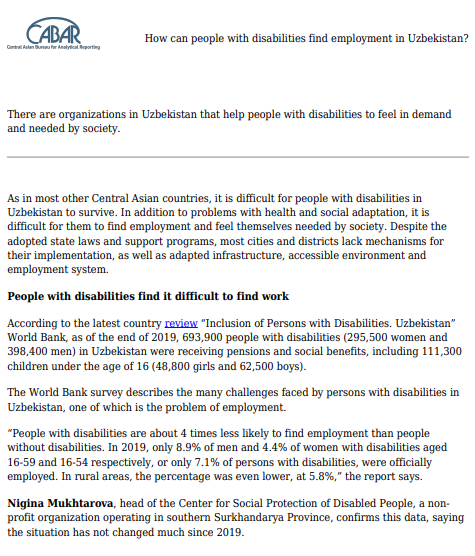 How Can People With Disabilities Find Employment in Uzbekistan? Year of publication: 2023 Author: Abror Kurbanmuratov As in most other Central Asian countries, it is difficult for people with disabilities in Uzbekistan to survive. In addition to problems with health and social adaptation, it is difficult for them to find employment and feel themselves needed by society. Despite the adopted state laws and support programs, most cities and districts lack mechanisms for their implementation, as well as adapted infrastructure, accessible environment and employment system. Как трудоустроиться людям с инвалидностью в Узбекистане? Year of publication: 2023 Author: Abror Kurbanmuratov Как и в большинстве других стран Центральной Азии, людям с инвалидностью в Узбекистане выживать сложно. Помимо проблем со здоровьем, социальной адаптацией, им трудно трудоустроиться, почувствовать себя нужными обществу гражданами. Несмотря на принятые государственные законы и программы поддержки, в большинстве городов и районов отсутствуют механизмы их реализации, как и адаптированная инфраструктура, доступная среда и система трудоустройства.
 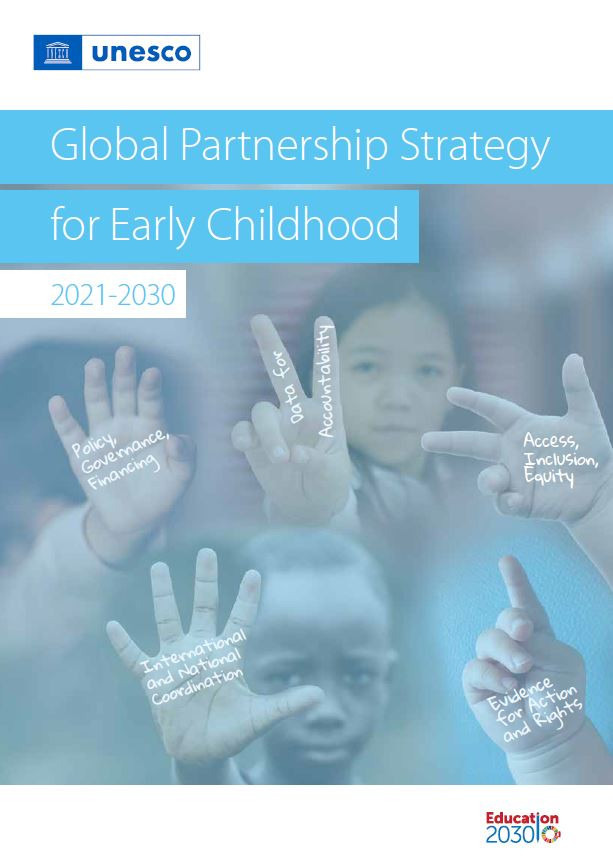 Global Partnership Strategy for Early Childhood, 2021-2030 Year of publication: 2022 Corporate author: UNESCO The Global Partnership Strategy for early childhood is the result of inter-agency efforts to counter the negative trend in education and to overcome the reduction and closure of services for health, nutrition, sanitation, and child protection in all regions of the world during the COVID-19 pandemic. Well-designed and implemented policies and services for early childhood care, education and development enable all countries to protect and guarantee child rights, achieve high rates of return on their investments in child and family development and widen avenues for transforming societies and lives. Stratégie de partenariat mondial pour la petite enfance, 2021-2030 Year of publication: 2022 Corporate author: Organisation des Nations Unies pour l'éducation, la science et la culture (UNESCO) La Stratégie de Partenariat mondial pour la petite enfance est le résultat des efforts interagences pour contrer la tendance négative dans l’éducation et pour surmonter la réduction et la fermeture des services de santé, de nutrition, d’assainissement et de protection de l’enfance dans toutes les régions du monde pendant la pandémie de COVID-19. Des politiques et des services bien conçus et mis en oeuvre pour la protection, l’éducation et le développement de la petite enfance permettent à tous les pays de protéger et de garantir les droits de l’enfant, d’obtenir des taux de rendement élevés sur leurs investissements dans le développement de l’enfant et de la famille et d’élargir les possibilités de transformation des sociétés et des vies.
  Addressing Conspiracy Theories: What Teachers Need to Know Year of publication: 2022 Corporate author: UNESCO This document is a first introduction for educators, working in and outside of formal schooling, on how to identify, prevent and address conspiracy theories in education settings. It seeks to provide educators with key definitions and essential knowledge to grasp the complexity of the phenomenon and alert learners about the key characteristics and harmful effects of conspiracy theories for a first, immediate response. To support educators in this endeavour, this document outlines strategies to prevent the belief in conspiracy theories as well as to engage with learners who already believe in them.
  Translation: From One World to Another (The UNESCO Courier No. 2; April-June 2022) Year of publication: 2022 Corporate author: UNESCO To translate is “to say almost the same thing”, in the words of the Italian writer Umberto Eco. A whole world is contained in this “almost”. To translate is to confront the other, the different, the unknown. It is often the essential prerequisite for those who want to access a universal, multiple, diverse culture. It is therefore no coincidence that the League of Nations took up the issue in the 1930s, envisaging the creation of an Index Translationum.Taken over by UNESCO in 1948, this Index allowed the first census of translated works in the world. Two years later, the Representative Works programme was launched to translate masterpieces of world literature. UNESCO’s support for the publication last year of a lexicon of words from indigenous languages of Mexico that are untranslatable into Spanish is a continuation of these efforts.Although their disappearance was predicted as early as the 1950s, translators – who are most often women – have never been as numerous as they are today. The machines developed in the aftermath of the war have not been able to outdo this behind-the-scenes profession. Nor have digital translation tools, which have become the standard feature of our globalized conversations, even if they have contributed to transforming the job.This is because language is more than just a means of communication. It is that, and much more. It is what written or oral works make of it, contributing to forge what is sometimes called the ‘genius of the language’, which the most powerful applications cannot restore.
  [Résumé] Repenser nos futurs ensemble: Un nouveau contrat social pour l’éducation Year of publication: 2021 Corporate author: International Commission on the Futures of Education | Organisation des Nations Unies pour l'éducation, la science et la culture (UNESCO) Devant la menace qui pèse sur les futurs communs de l’humanité et de la planète Terre, il est devenu urgent d’entreprendre une action commune pour changer de cap et repenser nos futurs. Des responsabilités nouvelles, pressantes et importantes incombent notamment à l’éducation, un secteur qui a été et continue d’être un puissant vecteur de changement positif. Publié par la Commission internationale sur Les futurs de l’éducation, le présent rapport est le résultat d’une consultation mondiale qui a mobilisé près d’un million de personnes. Il invite les gouvernements, les institutions, les organisations et les citoyens à travers le monde à élaborer un nouveau contrat social pour l’éducation qui nous aidera à construire, ensemble et pour tous, des futurs pacifiques, justes et durables. À travers un examen approfondi de différentes questions ayant trait aux technologies numériques, au changement climatique, au recul démocratique, à la polarisation sociétale et à l’avenir incertain du marché du travail, ce rapport entend non seulement lancer un débat ouvert sur l’éducation pour susciter la réflexion, mais aussi inciter chacun d’entre nous à agir ; son argument central étant que grâce à des millions d’actes individuels et collectifs de courage, de leadership, de résistance, de créativité et d’intérêt pour autrui, nous parviendrons à changer de cap et à transformer l’éducation pour favoriser l’avènement de futurs justes, équitables et durables. [Резюм] Совместное переосмысление наших перспектив: Новый социальный договор в интересах образования Year of publication: 2021 Corporate author: International Commission on the Futures of Education | Организация Объединенных Наций по вопросам образования, науки и культуры (UNESCO) Все человечество и планета Земля находятся под угрозой. Для изменения ситуации и переосмысления будущего необходимы безотлагательные действия, предпринятые каждым из нас. Перед образованием, которое уже давно признано влиятельным фактором позитивных изменений, стоит новая, срочная и важная задача. Данный доклад Международной комиссии по Перспективам образования, основанный на глобальном процессе консультаций с участием около миллиона человек, предлагает правительствам, учреждениям, организациям и гражданам всего мира заключить новый общественный договор в области образования, который поможет нам построить мирные отношения, создавая справедливое и устойчивое будущее вместе и для каждого. В докладe подробно рассматриваются цифровые технологии, изменение климата, отсутствие успеха в достижении демократии и поляризация общества, а также неопределенные перспективы трудоустройства. Доклад направлен не только на то, чтобы стимулировать обсуждение о вопросах образования и побудить к размышлениям, но и на то, чтобы призвать каждого из нас к активным действиям. Основная его идея заключается в том, что только через миллионы индивидуальных и коллективных актов мужества, лидерства, сопротивления, творчества и заботы мы сможем изменить курс и преобразить систему образования для построения справедливого, равноправного и устойчивого будущего.