
Resources
Explore a wide range of valuable resources on GCED to deepen your understanding and enhance your research, advocacy, teaching, and learning.
3,777 Results found
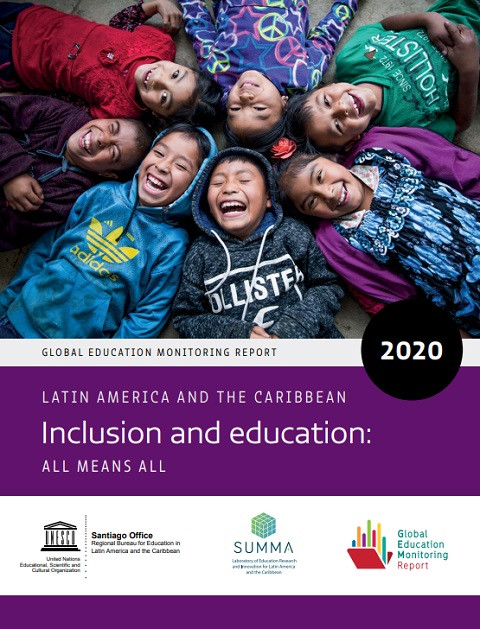 Latin America and the Caribbean 2020: Inclusion and Education; All Means All (Global Education Monitoring Report) Year of publication: 2020 Corporate author: Global Education Monitoring Report Team | UNESCO | Laboratory of Education Research and Innovation for Latin America and the Caribbean (SUMMA) Latin America and the Caribbean has the largest and most challenging socio-economic inequalities in the world, which have shaped its education systems over the decades. This report looks at everyone both in and excluded from education in the region, pinpointing barriers facing learners, especially when multiple disadvantages intersect. The report also explores challenges in education posed by COVID-19 and the need for urgent action to prevent an exacerbation of inequalities. Produced by the Global Education Monitoring (GEM) Report team, in partnership with the UNESCO Regional Bureau for Education in Latin America and the Caribbean (OREALC) and the Laboratory of Education Research and Innovation for Latin America and the Caribbean (SUMMA), the report assesses key solutions for greater inclusion through several case studies from the region. It provides in-depth analysis on challenges to inclusion in education arising from migration and displacement in Colombia and Costa Rica; remoteness in Brazil and Suriname; disability in Cuba and Nicaragua; gender in Peru and Jamaica; sexual orientation, gender identity and expression in Chile and Mexico; poverty in the Dominican Republic and Honduras; ethnicity in Bolivia and Ecuador; and incarceration in El Salvador and Uruguay. Building on the 2020 Global Education Monitoring Report, this regional edition concludes that strong laws and policies in Latin America and the Caribbean demonstrate a commitment to inclusion, but that the daily realities faced by learners suggest implementation is lagging. Recommendations are aimed at promoting more inclusive education systems to benefit all children and youth, no matter their background, identity or ability. The recommendations provide a systematic framework for identifying and dismantling barriers for vulnerable populations, according to the principle that ‘every learner matters and matters equally’. América Latina y el Caribe 2020: Inclusión y educación; Todos y todas sin excepción (Informe de seguimiento de la educación en el mundo) Year of publication: 2020 Corporate author: Global Education Monitoring Report Team | UNESCO | Laboratory of Education Research and Innovation for Latin America and the Caribbean (SUMMA) América Latina y el Caribe es la región con las mayores y más tenaces desigualdades socioeconómicas del mundo. Durante decenios estas desigualdades se han reflejado en sus sistemas educativos. El presente informe examina a quiénes incluyen y a quiénes excluyen estos sistemas y llama la atención sobre las barreras que enfrentan los educandos, especialmente cuando están expuestos a múltiples desventajas. El informe también explora los nuevos retos educativos que plantea la pandemia de la Covid-19 y la necesidad de actuar sin dilación para evitar que se agraven las desigualdades. El informe, elaborado por el equipo del Informe de Seguimiento de la Educación en el Mundo (Informe GEM), en colaboración con la Oficina Regional de Educación para América Latina y el Caribe (OREALC/ UNESCO Santiago) y el Laboratorio de Investigación e Innovación en Educación para América Latina y el Caribe -SUMMA, evalúa algunas de las principales iniciativas emprendidas para mejorar la inclusión, basándose en varios estudios de casos de la región. Analiza en profundidad algunos ejemplos de los grandes desafíos que amenazan la inclusión en la educación: migración y desplazamiento en Colombia y Costa Rica; aislamiento rural en el Brasil y Suriname; discapacidad en Cuba y Nicaragua; discriminación de género en el Perú y Jamaica; orientación sexual e identidad y expresión de género en Chile y México; pobreza en la República Dominicana y Honduras; etnicidad en Bolivia y el Ecuador; y jóvenes en situación de privación de libertad en El Salvador y el Uruguay. Esta edición regional del Informe de Seguimiento de la Educación en el Mundo 2020 concluye que, si bien las leyes y políticas de América Latina y el Caribe demuestran la firme determinación de promover la inclusión, la realidad cotidiana de los alumnos y las alumnas sugiere que la aplicación práctica lleva retraso. Se formulan recomendaciones con el objeto de promover sistemas de educación más inclusivos en beneficio de todos los niños, niñas y jóvenes, sin distinción de origen, identidad o capacidad. Las recomendaciones brindan un marco sistemático que permite identificar y eliminar barreras para las poblaciones marginadas, conforme al principio de que “cada alumno es importante y todos los alumnos importan por igual”.
  Gender, migration and non-formal learning for women and adolescent girls Year of publication: 2019 Author: Amy North Corporate author: Global Education Monitoring Report Team Processes of international migration and displacement are highly gendered. Who migrates, and how they experience migration and displacement, is affected by gender norms and relations in both in countries of origin and countries of settlement, the gendered dynamics of conflict and violence, and the gendered nature of global and local labour markets. These gendered dynamics of migration both affect and are affected by education in often complex ways, as education may both facilitate processes of migration, and be enabled or limited by them, and as gendered engagements with education prior to and during migration and settlement may have a significant influenced on how these processes are experienced. This paper is concerned with exploring this gender-migration- education nexus through a focus on the educational engagements and experiences of migrant and refugee women and adolescent girls. It first considers the wider body of research that has explored the relationship between gender, migration and displacement, particularly in relation to the experiences of migrant women and girls, before drawing out some of the key conceptual ideas from this, considering their implications for education, and presenting a conceptual diagram to represent this relationship. It then focuses more specifically on experiences of non-formal education for women and adolescent girls in refugee contexts and in host countries. Finally it identifies a number of key issues and recommendations emerging from this research.
 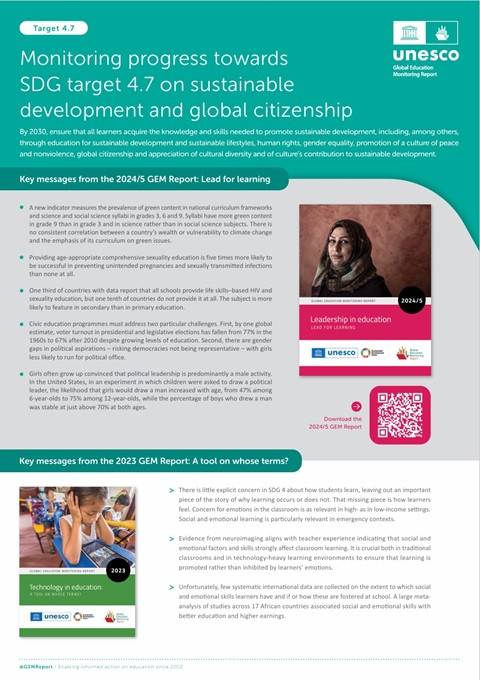 Monitoring Progress towards SDG Target 4.7 on Sustainable Development and Global Citizenship Year of publication: 2024 Corporate author: UNESCO | Global Education Monitoring Report Team This document introduces key messages from the GEM Reports and other related publications and online resources regarding the progress towards SDG Target 4.7.
 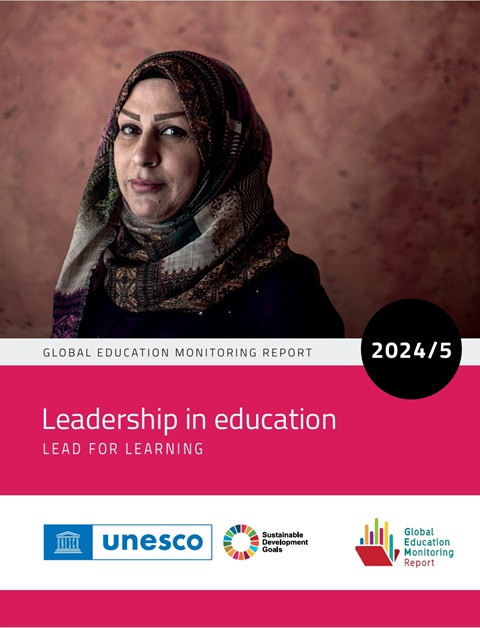 Global Education Monitoring Report 2024/5: Leadership in Education; Lead for Learning Year of publication: 2024 Corporate author: Global Education Monitoring Report Team Leadership matters in education. Strong leaders are needed to help institutions, systems and societies change for the better. Strong leaders work in collaboration with other actors towards the same goals. At the school level, they are the principals but also those who surround them, in the school and in the community, in positions of responsibility. At the system level, they are civil servants working as district officers, supervisors or planners. At the societal level, they are political leaders, as well as a very broad range of actors who help shape education goals, from unions and researchers to civil society and the media.Entitled Lead for learning, this report argues that, in pursuing specific goals, education leaders are more than just managers. They are change agents, who need the time, trust and support to focus on setting a vision and developing the people they serve and work with. The report calls for investment in and empowerment of school and system leaders. There should be fair hiring processes and growth opportunities that recognize the full scope of leaders’ roles. Moreover, leadership works best when it is shared, empowering others to lead as they can within their roles.There is no one leadership style that works. Different contexts, capacities and personalities mean that styles vary, and rightfully so. This, combined with the different goals that each leader is trying to achieve, means that their impact is hard to fully assess. Yet, all research points towards the critical need for strong leaders to continuously improve education quality. School leaders are second only to teachers for transforming student outcomes. Meanwhile, politicians wield huge influence in making equitable and inclusive education a national priority.Supporting this seventh Global Education Monitoring Report is a new series of country profiles on PEER, an online resource supporting policy dialogue and describing policies and regulations on school principal selection, preparation and development in the world’s education systems.
  Rapport mondial de suivi sur l'éducation 2024/5, Leadership dans l'éducation : diriger pour apprendre Year of publication: 2025 Corporate author: Global Education Monitoring Report Team Le Rapport mondial de suivi sur l'éducation 2024/5 évalue les progrès accomplis dans la réalisation des objectifs du Programme 2030 et montre que, si le nombre d'enfants scolarisés et achevant l'enseignement secondaire n'a jamais été aussi élevé, de nombreux domaines connaissent une stagnation. Le leadership joue un rôle central pour y remédier. Aucune école n’améliore les résultats des élèves sans un bon leader pour montrer la voie. Sur la base d’un examen des lois et politiques concernant la sélection, la préparation et les conditions de travail des chefs d'établissement de 211 systèmes éducatifs, le rapport analyse les leviers stratégiques permettant d'attirer et de retenir des leaders de talent.Les possibilités d’exercer un leadership ne se limitent pas aux dirigeants des écoles, elles s’étendent à des personnes qui occupent d’autres postes dans le système éducatif et en dehors de celui-ci, telles que les directeurs adjoints, les enseignants et les élèves lorsque le leadership est partagé, les responsables politiques, la société civile, les organisations internationales, les syndicats et les médias, qui contribuent à définir les objectifs en matière d’éducation.Le rapport préconise que des efforts soient faits pour former des leaders dans quatre dimensions essentielles : fixer des objectifs, donner la priorité à l’apprentissage, encourager la collaboration et faire évoluer les personnes. Pour que ces dimensions se concrétisent, il faut faire confiance aux personnes occupant des postes de direction et leur donner les moyens d’agir ; il faut les recruter grâce à des pratiques d’embauche équitables ; les soutenir dans leur évolution ; et les encourager à mettre en place une culture de collaboration. Le rapport appelle également à investir dans la capacité des responsables de l'éducation à jouer un rôle de leader au sein du système, en mettant particulièrement l'accent sur la direction pédagogique et l'assurance qualité
  Informe de seguimiento de la educación en el mundo, 2024/5: Liderazgo en la educación: liderar por el aprendizaje Year of publication: 2025 Corporate author: Global Education Monitoring Report Team El Informe de seguimiento de la educación en el mundo 2024-2025 evalúa los avances hacia el logro de las metas de 2030 y muestra que, aunque hay más niños escolarizados y que finalizan la educación secundaria que nunca, en muchos ámbitos hay estancamientos. El liderazgo es fundamental para abordar esta cuestión. Ninguna escuela puede mejorar los resultados de los alumnos sin un buen líder que muestre el camino a seguir. Partiendo de un examen de la legislación y las políticas relativas a la selección, preparación y condiciones laborales de los directores de escuela de 211 sistemas educativos, el informe analiza instrumentos de política para atraer y retener a líderes talentosos.El potencial de liderazgo no se limita a los líderes escolares, sino que abarca también a las personas que ocupan otros puestos en el sistema educativo, así como fuera de él, desde subdirectores, docentes y alumnos, cuando el liderazgo es compartido, hasta líderes políticos, la sociedad civil, organizaciones internacionales, sindicatos y medios de comunicación, que contribuyen a definir los objetivos de la educación.El informe insta a adoptar medidas para que los líderes desarrollen sus capacidades en las cuatro dimensiones fundamentales del liderazgo: establecer expectativas, centrarse en el aprendizaje, fomentar la colaboración y favorecer el perfeccionamiento personal. Para llevar a la práctica estas dimensiones, es esencial confiar en quienes ocupan puestos de liderazgo y empoderarlos; reclutarlos mediante prácticas de contratación justas; brindarles apoyo para que se perfeccionen; y motivarlos a fomentar culturas de colaboración. Asimismo, el informe pide que se invierta en fortalecer las capacidades de los funcionarios de educación para que actúen como líderes del sistema, especialmente en el liderazgo pedagógico y la garantía de la calidad.
  [Summary] Global Education Monitoring Report Summary 2024/5: Leadership in Education; Lead for Learning Year of publication: 2024 Corporate author: Global Education Monitoring Report Team The 2024/5 Global Education Monitoring Report assesses progress towards the 2030 targets and shows that, while more children are in school and completing secondary education than ever before, there is stagnation in many areas. Leadership is central to addressing this. There are no schools that improve student outcomes without a good leader showing the way. Building on a review of legislation and policies on the selection, preparation and working conditions of school principals in 211 education systems, the report discusses policy levers to attract and retain talented leaders.Leadership’s potential is not limited to school leaders: it extends to individuals in positions elsewhere in the education system as well as outside of it, from assistant principals, teachers and students, when leadership is shared, to political leaders, civil society, international organizations, unions and the media, who help shape education goals.The report calls for efforts to develop leaders in four key leadership dimensions so that they can set expectations, focus on learning, foster collaboration and develop people. For these dimensions to be realized, people in leadership positions should be trusted and empowered; recruited through fair hiring practices; supported to grow; and encouraged to develop collaborative cultures. The report also calls for investment in education officials’ capacity to serve as system leaders, with a particular emphasis on instructional leadership and quality assurance.
  Global Education Monitoring Report 2023: Technology in Education; A Tool on Whose Terms? Year of publication: 2023 Corporate author: UNESCO | Global Education Monitoring Report Team This report recommends that technology should be introduced into education on the basis of evidence showing that it would be appropriate, equitable, scalable and sustainable. In other words, its use should be in learners’ best interests and should complement face-to-face interaction with teachers. It should be seen as a tool to be used on these terms. Midway to the deadline, the 2023 Global Education Monitoring Report assesses the distance still to go to reach the 2030 education targets. Education is the key to unlocking the achievement of other development objectives, not least the goal of technological progress.
  Opportunities for Media and Information Literacy in the Middle East and North Africa: Yearbook 2016 Year of publication: 2016 Author: Magda Abu-Fadil | Jordi Torrent | Alton Grizzle Corporate author: International Clearinghouse on Children, Youth and Media (Sweden) Opportunities for Media and Information Literacy in the Middle East and North Africa is the seventeenth Yearbook published by the Clearinghouse and fills a gap in the existing body of literature about the progress of media and information literacy work in different parts of the world. This book also helps educators in the Middle East and North Africa region looking for opportunities to bring to their classrooms elements of MIL education.