
Resources
Explore a wide range of valuable resources on GCED to deepen your understanding and enhance your research, advocacy, teaching, and learning.
3,376 Results found
 International conference: reorienting TVET policy towards education for sustainable development: final report Year of publication: 2010 Corporate author: UNESCO International Centre for Technical and Vocational Education and Training (UNEVOC) | Internationale Weiterbildung und Entwicklung | Colombo Plan Staff College for Technician Education This publication reports on the ESD review-responsive and future-oriented programme on “Reorienting TVET Policy Towards Education for Sustainable Development”, jointly organized by the UNESCO-UNEVOC International Centre in Bonn, Germany, InWEnt – Capacity Building International, Germany and Colombo Plan Staff College for Technician Education in Manila, Philippines. Educação: um tesouro a descobrir, relatório para a UNESCO da Comissão Internacional sobre Educação para o Século XXI (destaques) Year of publication: 2010 Author: Jacques Delors Corporate author: UNESCO Brasilia Learning: The Treasure Within, commonly referred to as the 'Delors Report', proposes a holistic and integrated vision of education based on the paradigms of lifelong learning, and the four pillars of learning to be, to know, to do, and to live together.
 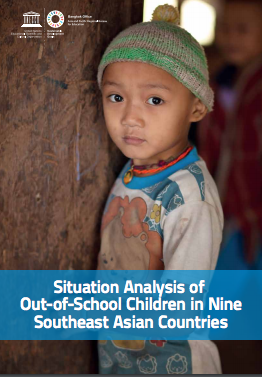 Situation analysis of out-of-school children in nine southeast Asian countries Year of publication: 2017 Corporate author: UNESCO Bangkok In a world that continually aspires for every child and youth to have access to education, there are still large numbers of out-of-school children (OOSC) who are yet to claim their right to basic education. In 2013, the number of children who are not in school, who have dropped out, and who have never been to school have risen to 124 million after seeing the numbers continuously drop for much of the first decade of the 21st century. In much of Southeast Asia, close to seven million children of both primary and lower secondary school-age find themselves in the same situation. In an effort to assist the countries in Southeast Asia to develop more robust policies and programmes for OOSC in their respective countries, this report was commissioned to map out the current legislations, policies, characteristics, and interventions on out-of-school children in nine countries across the region, which include Cambodia, Indonesia, Lao PDR, Malaysia, Myanmar, the Philippines, Thailand, Timor-Leste and Vietnam. Using a desk review of available and relevant secondary data, the study covered OOSC of primary and lower secondary school-age. Situation analysis of out-of-school children in nine southeast Asian countries Year of publication: 2017 Corporate author: UNESCO Bangkok In a world that continually aspires for every child and youth to have access to education, there are still large numbers of out-of-school children (OOSC) who are yet to claim their right to basic education. In 2013, the number of children who are not in school, who have dropped out, and who have never been to school have risen to 124 million after seeing the numbers continuously drop for much of the first decade of the 21st century. In much of Southeast Asia, close to seven million children of both primary and lower secondary school-age find themselves in the same situation. In an effort to assist the countries in Southeast Asia to develop more robust policies and programmes for OOSC in their respective countries, this report was commissioned to map out the current legislations, policies, characteristics, and interventions on out-of-school children in nine countries across the region, which include Cambodia, Indonesia, Lao PDR, Malaysia, Myanmar, the Philippines, Thailand, Timor-Leste and Vietnam. Using a desk review of available and relevant secondary data, the study covered OOSC of primary and lower secondary school-age. Situation analysis of out-of-school children in nine southeast Asian countries Year of publication: 2017 Corporate author: UNESCO Bangkok In a world that continually aspires for every child and youth to have access to education, there are still large numbers of out-of-school children (OOSC) who are yet to claim their right to basic education. In 2013, the number of children who are not in school, who have dropped out, and who have never been to school have risen to 124 million after seeing the numbers continuously drop for much of the first decade of the 21st century. In much of Southeast Asia, close to seven million children of both primary and lower secondary school-age find themselves in the same situation. In an effort to assist the countries in Southeast Asia to develop more robust policies and programmes for OOSC in their respective countries, this report was commissioned to map out the current legislations, policies, characteristics, and interventions on out-of-school children in nine countries across the region, which include Cambodia, Indonesia, Lao PDR, Malaysia, Myanmar, the Philippines, Thailand, Timor-Leste and Vietnam. Using a desk review of available and relevant secondary data, the study covered OOSC of primary and lower secondary school-age.
  LEARNING to Realize Education’s Promise Corporate author: World Bank The World Development Report 2018 (WDR 2018)—LEARNING to Realize Education’s Promise—is the first ever devoted entirely to education. And the timing is excellent: education has long been critical to human welfare, but it is even more so in a time of rapid economic and social change. The best way to equip children and youth for the future is to place their learning at the center. The 2018 WDR explores four main themes: 1) education’s promise; 2) the need to shine a light on learning; 3) how to make schools work for learners; and 4) how to make systems work for learning.
 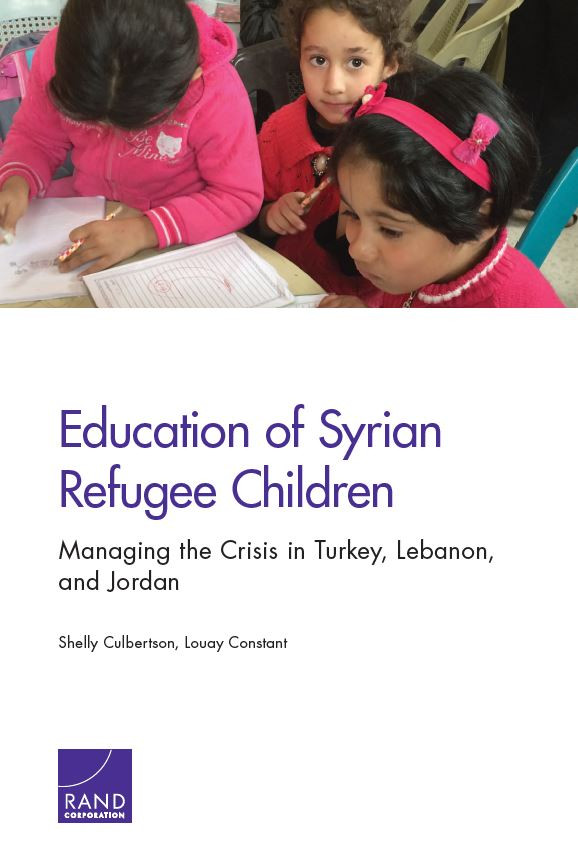 تعليم اللاجئين السوريين: إدارة الازمة في تركيا ولبنان والأردن Year of publication: 2015 Author: Shelly Culbertson | Louay Constant Corporate author: RAND Corporation مع وجود أربعة ملايين لاجئ سوري اعتبارًا من سبتمبر 2015 ، هناك حاجة ملحة لتطوير مناهج قصيرة وطويلة الأجل لتوفير التعليم لأطفال هذه الفئة من السكان. يستعرض هذا التقرير تعليم اللاجئين السوريين للأطفال في البلدان الثلاثة المجاورة التي تضم أكبر عدد من اللاجئين - تركيا ولبنان والأردن - ويحلل أربعة مجالات: الوصول والإدارة والمجتمع والجودة. وتشمل آثار السياسة إعطاء الأولوية للحاجة الملحة لزيادة فرص الحصول على التعليم بين اللاجئين ؛ الانتقال من استجابة إنسانية قصيرة المدى إلى استجابة إنمائية طويلة المدى ؛ الاستثمار في كل من قدرة الحكومة على توفير التعليم وفي البدائل الرسمية عالية الجودة لأنظمة المدارس العامة ؛ تحسين البيانات لدعم صنع القرار ؛ تطوير استراتيجية تداولية حول كيفية دمج أو فصل الأطفال السوريين وأطفال الدول المضيفة في المدارس لتعزيز التماسك الاجتماعي ؛ الحد من عمالة الأطفال وتمكين التعليم من خلال وضع سياسات توظيف للبالغين ؛ وتنفيذ خطوات معينة لتحسين جودة التعليم لكل من اللاجئين والمواطنين.
 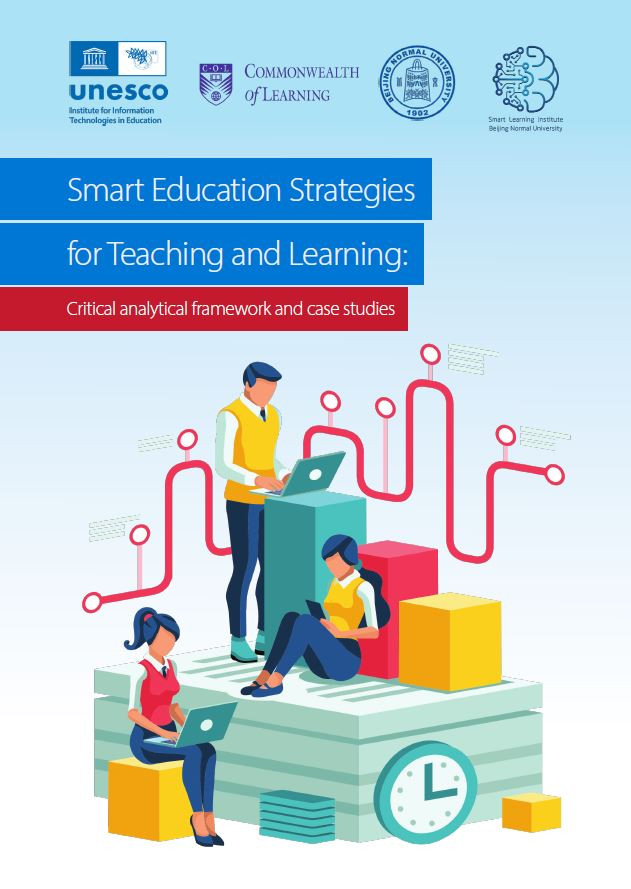 Smart Education Strategies for Teaching and Learning: Critical Analytical Framework and Case Studies Year of publication: 2022 Author: Shafika Isaacs | Sanjaya Mishra Corporate author: UNESCO Institute for Information Technologies in Education (IITE) | Beijing Normal University This electronic publication about smart education strategies for building the resilience of education and training systems in the postpandemic environment provides a framework to develop appropriate policy and strategy in existing and emerging forms of schooling, higher education, technical and vocational education, and training (TVET), adult education and lifelong learning, including formal, nonformal and informal educational environments. The publication reviews the status of smart education policies in 10 countries. It includes 15 case studies within the six policy themes: infrastructure, curriculum and pedagogy, digital education resources and platforms, skills and competencies, governance, management and administration, and partnership.
  Toward one world or many? A comparative analysis of OECD and UNESCO global education policy documents Year of publication: 2019 Author: Vaccari, Victoria | Gardinier, Meg P. Education policymaking has gone global. The 2030 Agenda for Sustainable Development aims to galvanize efforts to promote sustainable development, decrease global inequalities, and realize universal quality education. Supporting these efforts, two leading international organizations, UNESCO and the OECD, have set out normative frameworks for their vision of global education. This paper examines the policy discourses of these organizations in light of SDG 4–Education. Specifically, through a comparative analysis of selected terms and underlying concepts in key policy documents, the paper distinguishes between UNESCO's notion of global citizenship and the OECD's framework for global competence. Ultimately, the authors discuss whether the organizations' agendas are aimed at a common global vision, or, alternatively, towards two distinct and divergent conceptualizations of an imagined future.
 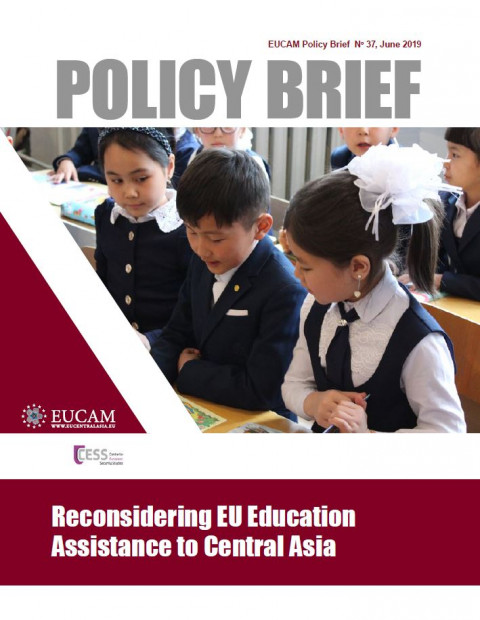 Reconsidering EU Education Assistance to Central Asia (EUCAM Policy Brief No. 37, June 2019) Year of publication: 2019 Author: Sebastien Peyrouse Corporate author: Europe-Central Asia Monitoring (EUCAM) This paper is based on broader research on education in Central Asia that includes interviews with local stakeholders (teachers, parents and students) in Kazakhstan, Kyrgyzstan and Uzbekistan. Some views were taken from Sebastien Peyrouse, ‘How to Strengthen Western Engagement in Central Asia: Spotlight on EU Education Assistance in Uzbekistan’, PONARS Policy Memo, no. 524, April 2018,http://www.ponarseurasia.org/memo/strengthen-western-engagement-central-asia-spotlight-eu-education-assistance-uzbekistan.