
Resources
Explore a wide range of valuable resources on GCED to deepen your understanding and enhance your research, advocacy, teaching, and learning.
3,224 Results found
 L'éducation pour le Développement d'ONU Citoyen Omanais Mondiale: Pratiques et Défis Actuels Year of publication: 2014 Author: Saif Al-Maamari Corporate author: Redfame Publishing Oman est un pays en développement qui a réformé son système éducatif en 1998 dans le but de relever les défis du 21e siècle, en particulier les défis économiques. Force de l'identité nationale et de développer un sentiment de citoyenneté mondiale étaient parmi les priorités de la nouvelle réforme de l'éducation. Cet article est basé sur un examen des pratiques actuelles concernant L'éducation à la citoyenneté Mondiale (ECM) dans le système éducatif. Le but de cette étude théorique était d'explorer la disposition actuelle des aspects de L'éducation à la citoyenneté Mondiale (ECM) dans les écoles omanaises. Plus précisément, l'étude tente d'identifier les pratiques actuelles qui sont mises en œuvre par les écoles omanaises pour aider les étudiants omanais à développer un sentiment de citoyenneté mondiale efficace. L'étude indique que l'éducation omanaise est pas centrée à l'échelle nationale car elle vise à développer chez les élèves qui ont la conscience globale. L'étude montre en utilisant différentes approches pour développer le sens de la citoyenneté mondiale, à savoir, un sujet d'écoles séparées; thème intégré dans l'enseignement des études sociales, la participation à des initiatives internationales en matière d'éducation à la citoyenneté mondiale, et célébrant les jours et les décennies internationales. Global education in Austria Corporate author: North-South Centre of the Council of Europe This National Report on Global Education in Austria is part of the European Global Education Peer Review Process, which was initiated in 2002 with the purpose of increasing and improving global education in Council of Europe member states. This report is the culmination of a peer review process led by an international peer review team. Through research and interviews with key stakeholders, information was gathered and critical perspectives developed about the current state of, and the future prospects for, global education in Austria. This year–long process, facilitated by the North-South Centre of the Council of Europe, was developed in partnership with the Austrian Strategy Group for Global Education as the national counterpart in the process. It involved the Ministry of Foreign Affairs, the Ministry of Education, the Austrian Development Agency (ADA), KommEnt, and the NGO and academic communities.This Peer Review report recognises the relatively strong tradition of global education in Austria. Austrian support for GE is reflected in the range of committed organisations involved in GE, and the many initiatives and projects in the formal and non-formal education sectors, and in civil society. Chapter 1 below provides an introduction to the report and the process generally. Chapter 2 outlines the context of global education in Austria. Chapter 3 examines global education in the formal education sector. Chapter 4 focuses on the important and varied work taking place in non-formal education, civil society organisations and other sectors in this field. Chapter 5 provides, in summary fashion, an outline of the key observations and recommendations of the Peer Review.
  Schools for Conflict or for Peace in Afghanistan Year of publication: 2015 Author: Dana Burde The publication provides a systematic analysis of the relationship between education and conflict, tracing how different approaches have been applied in Afghanistan as the rationale for aid has shifted from a policy of benign neglect, to an effort to support war, to an effort to mitigate conflict. Using this history as a case study, the book explores how foreign intervention in education can contribute either to conflict or to peace.. Schools for Conflict or for Peace in Afghanistan Year of publication: 2015 Author: Dana Burde Cette publication est une analyse de la relation entre l'éducation et les conflits, retraçant l’évolution des motifs mobilisés pour justifier le recours à une aide extérieure en Afghanistan, et le passage d’une politique du laissez faire à celle de soutien à l’effort de guerre, puis aux tentatives d’apaisement du conflit. En s’appuyant sur cet exemple, cet ouvrage analyse comment l'intervention étrangère en matière d'éducation peut aussi bien contribuer à la guerre qu’à la paix. Conférence internationale: réorienter la politique de l'EFTP vers l'éducation pour le développement durable: rapport final Year of publication: 2010 Corporate author: UNESCO International Centre for Technical and Vocational Education and Training (UNEVOC) | Internationale Weiterbildung und Entwicklung | Colombo Plan Staff College for Technician Education Cette publication rend compte du programme EDD examen sensible et orienté vers l'avenir sur "Réorienter la politique d'EFTP vers l'éducation pour le développement durable», organisé conjointement par le Centre international UNESCO-UNEVOC à Bonn, Allemagne, InWEnt - Capacity Building International, Allemagne et Plan de Colombo Collège du personnel de l'éducation Technicien à Manille, Philippines. International conference: reorienting TVET policy towards education for sustainable development: final report Year of publication: 2010 Corporate author: UNESCO International Centre for Technical and Vocational Education and Training (UNEVOC) | Internationale Weiterbildung und Entwicklung | Colombo Plan Staff College for Technician Education This publication reports on the ESD review-responsive and future-oriented programme on “Reorienting TVET Policy Towards Education for Sustainable Development”, jointly organized by the UNESCO-UNEVOC International Centre in Bonn, Germany, InWEnt – Capacity Building International, Germany and Colombo Plan Staff College for Technician Education in Manila, Philippines.
 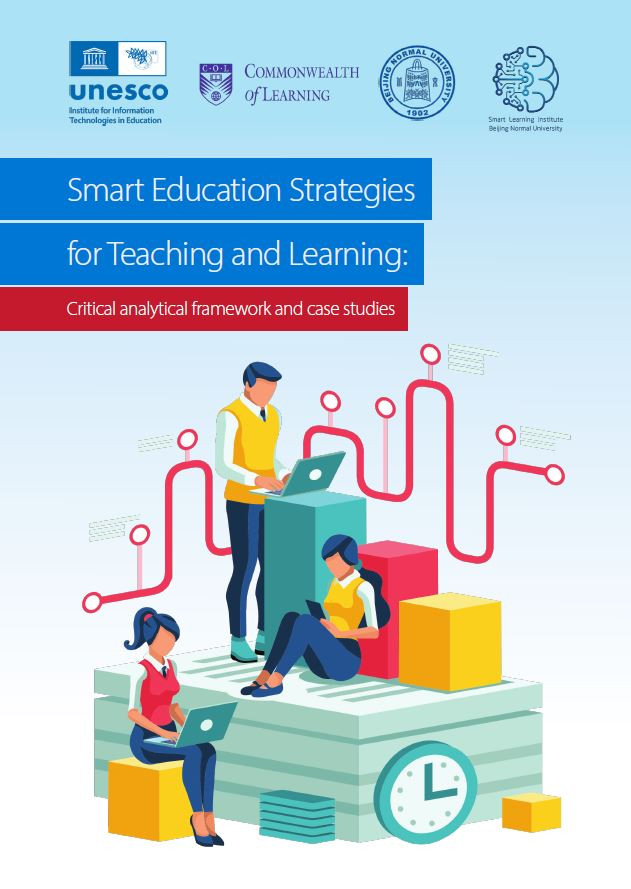 Smart Education Strategies for Teaching and Learning: Critical Analytical Framework and Case Studies Year of publication: 2022 Author: Shafika Isaacs | Sanjaya Mishra Corporate author: UNESCO Institute for Information Technologies in Education (IITE) | Beijing Normal University This electronic publication about smart education strategies for building the resilience of education and training systems in the postpandemic environment provides a framework to develop appropriate policy and strategy in existing and emerging forms of schooling, higher education, technical and vocational education, and training (TVET), adult education and lifelong learning, including formal, nonformal and informal educational environments. The publication reviews the status of smart education policies in 10 countries. It includes 15 case studies within the six policy themes: infrastructure, curriculum and pedagogy, digital education resources and platforms, skills and competencies, governance, management and administration, and partnership.
 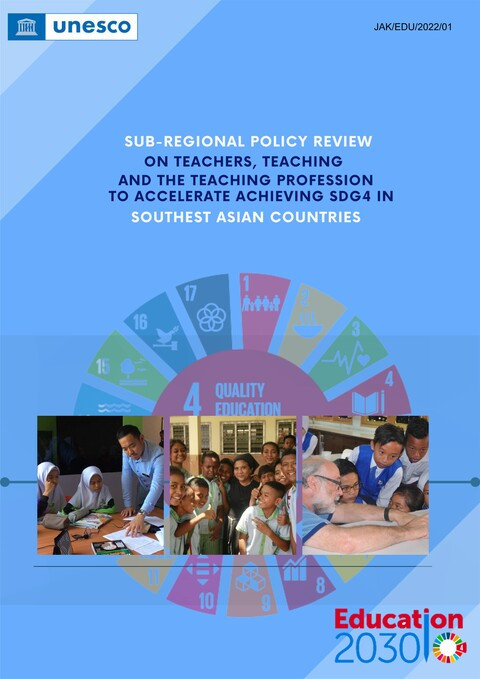 Sub-regional Policy Review on Teachers, Teaching and the Teaching Profession to Accelerate Achieving SDG4 in Southeast Asian Countries Year of publication: 2022 Author: Azlina Abdul Aziz | Kamisah Osman | Khairul Farhah Khairuddin | Meeyoung Choi Corporate author: UNESCO Jakarta The objectives of this report are to analyse existing national policies related to Teachers, Teaching and the Teaching Profession and examine their implementation in the five UNESCO cluster countries, namely Brunei, Indonesia, Malaysia, the Philippines and Timor-Leste. Eight themes have emerged from the systematic review of literature and they are i) Teacher Standard Competence, ii) Teacher professional Development, iii) Teacher Support, iv) Teaching Quality, v) Formative and Summative Assessment Framework on Teaching, vi) Showcasing and Rewarding Best Teaching Practices, vii) Teacher Professionalism and finally viii) Teacher Career Development.
  Переосмысление школьного обучения ДЛЯ XXI ВЕКА Состояние образования ради мира, устойчивого развития и глобальной гражданственности в Азии Year of publication: 2017 Corporate author: Mahatma Gandhi Institute of Education for Peace and Sustainable Development (MGIEP) В публикации «Переосмысление школьного образования в XXI веке: состояние образования в интересах мира, устойчивого развития и в духе глобальной гражданственности в Азии» Института ЮНЕСКО Махатмы Ганди по образованию в интересах мира и устойчивого развития (МГИЭП) обсуждается о необходимости изменения фундаментальных целей школьного образования, включая идеалы образования в интересах устойчивого развития, в духе глобальной гражданственности и мира и (ЦУР 4.7). Кроме того, в исследовании рассматривается разработка сравнительных показателей – так называемые «бенчмарки», позволяющие оценить будущий прогресс в этой области.В этом отчете приняли участие более 60 исследователей из 22 стран Азии и он также основан на анализе ключевой образовательной политики и образовательных стандартов этих стран. Отчет также включает обширный обзор литературы по школьному образованию в Азии. В шестой главе публикации можно найти анализ текущего состояния и вопросов, стоящих по внедрению образования в интересах мира, устойчивого развития и в духе глобальной гражданственности в различных субрегионах Азии, включая Центральной Азии. Во-первых, глава раскрывает реформы в школьном образовании в постсоветской Центральной Азии, которые проводились в целях удовлетворения потребности в быстром создании собственной государственности в странах региона, которые не были готовы к независимости при распаде СССР. Во-вторых, в главе подчеркивается трансформация понимания советского восприятия образования как «общего блага» и его вытеснение, по крайней мере, на уровне политического дискурса, с неустанным акцентом на образование как инструмента развития «человеческих ресурсов» с учетом спроса рынка на компетенции.Глобальное сообщество обязалось достичь целей устойчивого развития (ЦУР), включая ЦУР4 по образованию, к 2030 году. Задача ЦУР4.7 направлена на предоставление учащимся знаний и компетенций, необходимых им для реализации всех целей устойчивого развития. Основное внимание уделяется когнитивным, социально-эмоциональным и поведенческим результатам обучения, которые помогают учащимся решать конкретные задачи, рассматриваемые ЦУР. Поскольку государства-члены Организации Объединенных Наций работают над достижением ЦУР, им предлагается переосмыслить образование для внесения вклада в ЦУР. В то время как ЦУР4.7 обеспечивает необходимую структуру в этом отношении.
  Toward one world or many? A comparative analysis of OECD and UNESCO global education policy documents Year of publication: 2019 Author: Vaccari, Victoria | Gardinier, Meg P. Education policymaking has gone global. The 2030 Agenda for Sustainable Development aims to galvanize efforts to promote sustainable development, decrease global inequalities, and realize universal quality education. Supporting these efforts, two leading international organizations, UNESCO and the OECD, have set out normative frameworks for their vision of global education. This paper examines the policy discourses of these organizations in light of SDG 4–Education. Specifically, through a comparative analysis of selected terms and underlying concepts in key policy documents, the paper distinguishes between UNESCO's notion of global citizenship and the OECD's framework for global competence. Ultimately, the authors discuss whether the organizations' agendas are aimed at a common global vision, or, alternatively, towards two distinct and divergent conceptualizations of an imagined future.