
Resources
Explore a wide range of valuable resources on GCED to deepen your understanding and enhance your research, advocacy, teaching, and learning.
685 Results found
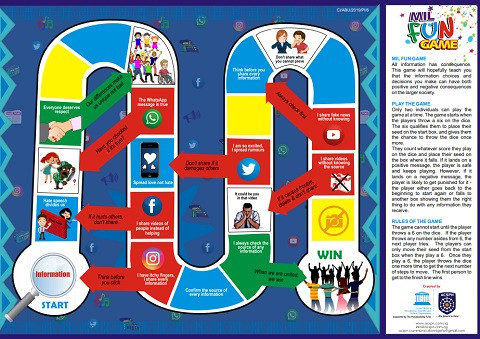 Media and Information Literacy: Fun Game Year of publication: 2019 Corporate author: UNESCO Dakar | Association of Communication Scholars & Professionals of Nigeria (ACSPN) This game will teach you that the information choices and decisions you make can have both positive and negative consequences on the larger society.
 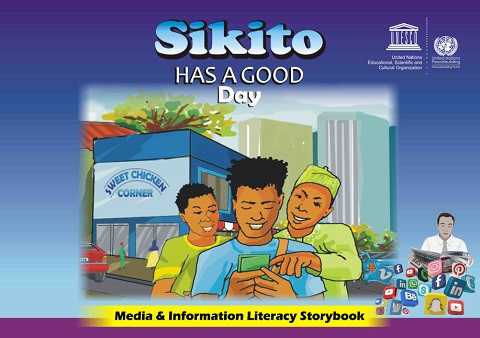 Sikito Has a Good Day: Media & Information Literacy Storybook Year of publication: 2019 Corporate author: UNESCO Dakar | Association of Communication Scholars & Professionals of Nigeria (ACSPN) Today's world is shaped by the quality of information produced, accessed and consumed at individual and social levels. This determines the quality of our decisions and actions. Increasingly, current digital realities and their social media manifestations, have enabled more opportunities for expression. Increased access to the internet is promoting freedom, with consequences for peace and conflict. Students will learn responsible online communication and media information &l literacy from the story.
  Global Citizenship and Multimedia: Guidelines for Teachers and Educators Year of publication: 2019 Author: Giorgia Bailo | Mirca Ognisanti | Simona Bruni | Adriana Aralica | Sandra Oliveira | Fernando Catarino | Celia Quico | Maria Leonida | Dimitra Deroyiannis | Alessandro Soriani | Charlot Cassar Corporate author: WeWorld Onlus | European Union (EU) The objective of this book is to strengthen and systematize the effectiveness of global citizenship education through the use of new technologies, within and outside the school context. The aim is to provide theoretical basis and specific tools that can be used directly in educational activities, to promote critical thinking and the active involvement of young people in topics such as human rights, migration, climate change and the Sustainable Development Goals. Both the theoretical and practical sections have been laid out starting from the good practices already tested in several European countries, and the proposed educational methodologies intend to foster technology as an inclusive tool, therefore as an incentive for participation and dialogue between different cultures.
  Theoretical Basis and Training System of Digital Citizenship Year of publication: 2020 Author: Zheng Yunxiang | Zhong Jinping | Huang Liuhui | Yanghao Corporate author: China Educational Technology Nowadays, cases of abuse and misuse of information technology are not uncommon, causing many negative effects and social problems that are extremely harmful to people, such as Internet fraud and cyberbullying. Practice all over the world shows that enhancing digital citizenship is an effective way to solve these problems. In order to call for emphasis on digital citizenship, this paper discussed its theoretical basis and training system in detail. Specifically, it firstly defined the concept of digital citizenship, then comprehensively discussed the content of digital citizenship through literature research, which constituted four first-level content indicators and eleven sub-indicators. After clarifying the connotation and extension of digital citizenship, this paper continued to discuss its uniqueness and irreplaceability, so as to highlight its necessity. Then the importance and meaning of implementing digital citizenship education were stated respectively. Based upon this theoretical foundation and our national conditions, a three-oriented digital citizenship training system was finally proposed. The cultivation of qualified digital citizens is imperative, as it helps to enhance the overall improvement of core literacy and Digital Intelligence Quotient, and facilitate the construction of a civilized and harmonious digital society and the achievement of Lide Shuren goal as well. 数字公民素养的理论基础与培养体系 Year of publication: 2020 Author: Zheng Yunxiang | Zhong Jinping | Huang Liuhui | Yanghao Corporate author: China Educational Technology 当前,技术的滥用、误用产生了诸如网络诈骗、网络欺凌等社会问题,带来了负面影响和危害。世界各国的实践证明,提升数字公民素养是解决这些问题的有效途径。为倡议并呼吁重视数字公民素养,该文围绕数字公民素养的理论基础和培养体系展开论述。首先界定了数字公民素养的概念,通过文献研究法详细探讨了数字公民素养的主要内容,包括4项一级内容指标和11项二级内容指标。在界定数字公民素养的内涵与外延后,该文深入论述了它的独特性与不可替代性,以凸显其必要性。然后阐述了数字公民素养的重要性以及实施数字公民教育的意义所在,并在此基础上结合国情提出基于“三面向”的数字公民素养培养体系。合格数字公民的培育势在必行,数字公民素养的提升能带动核心素养和数字智商的全面提高,从而促进文明、和谐数字社会的构建和立德树人目标的实现。
  Research on Digital Competence of EU Citizens: A Comparative Analysis Based on the Dig Comp1.0, 2.0 and 2.1 (International and Comparative Education; No. 6) Year of publication: 2020 Author: Zheng Xudong | Fan Xiaoyu Corporate author: Beijing Normal University The explosive development of digital technology has revolutionized the competences of social citizens. In 2006, EU proposed digital competence, based on it, EU established A Framework for Developing and Understanding Digital Competence in Europe (Dig Comp 1.0). After releasing two revisions of Dig Comp 1.0, the Digital Competence Framework for Citizens (Dig Comp 2.1) was officially released in 2017. Compared with the former versions, Dig Comp 2.1 expanded digital competences areas, revised the competences names, no longer described the specific competences from KSA (knowledge, skill and attitude) perspective, and the proficiency of the competences were divided into more detailed 8 proficiency level. The Dig Comp 2.1 contained the following values: a. the transformation of the concept of digital citizenship education; b. paying attention to the competences of complex problem solving and innovation; c. looking forward to the future development of intelligent society; d. supporting the development of lifelong learning and developing qualified digital citizens. Dig Comp 2.1 has enlightenment for building a learning society in China, and that of improving the digital competences of Chinese citizens. 欧盟公民数字胜任力研究: 基于三版欧盟公民数字胜任力框架的比较分析 (比较教育研究; No. 6) Year of publication: 2020 Author: Zheng Xudong | Fan Xiaoyu Corporate author: Beijing Normal University 数字科技的爆发式发展对公民的能力素养产生了革命性影响。欧盟在 2006 年 提出数字胜任力的基础上,于 2013 年制定了欧盟公民数字胜任力框架 1.0,在经过连续两 次修订后,于 2017 年正式发布了欧盟公民数字胜任力框架 2.1。与旧版相比,新版框架对 胜任力域进行了拓展,修订了具体能力的名称,不再从知识、技能和态度方面描述具体能 力,能力熟练度也划分成更详细的 8 个水平。新版框架体现了欧盟数字公民教育的理念转 变,对复杂问题解决与创新创造能力培养的重视,对终身学习能力和合格数字公民培养的 关注,以及对未来智能社会发展需求的前瞻,对我国建设学习型社会、构建全民终身学习 体系和提升国民数字胜任力具有借鉴意义。
  Mapping Digital Literacy Policy and Practice in the Canadian Education Landscape Year of publication: 2015 Author: Michael Hoechsmann | Helen DeWaard Corporate author: MediaSmarts This paper Mapping Digital Literacy Policy and Practice in the Canadian Landscape draws on policy and curriculum documents from across Canada to synthesize key concepts and best practices in current digital literacy education.
  Eduquer à la citoyenneté mondiale et solidaire pendant le confinement Year of publication: 2020 Corporate author: Fédération Francophone et Germanophone des Associations de Coopération au Developpement (ACODEV) | Annoncer la Couleur (ALC) | Îles de Paix Dans le cadre de la période de confinement inédite que nous vivons actuellement toutes et tous, l’ensemble des ONG actives en éducation à la citoyenneté mondiale, regroupées dans la fédération ACODEV et Annoncer la Couleur, avec la collaboration de Iles de Paix, poursuivent leur mission de soutien aux enseignant·e·s de tous niveaux, tous réseaux et toutes disciplines confondues. Ensemble, nous vous proposons ici une liste – non exhaustive – d’outils pédagogiques digitaux clé sur porte que vous pouvez partager à vos élèves, pour leur demander de réagir, pour leur proposer une ouverture virtuelle sur le monde, sa diversité, ses richesses et ses interdépendances, ou tout simplement pour garder le contact d’une manière à la fois ludique et éducative. Voici déjà quelques jeux, capsules vidéo et autres webdocumentaires qui permettent, en très peu de temps, de se familiariser avec une thématique ou d’interpeller sur un enjeu de société à échelle mondiale.
 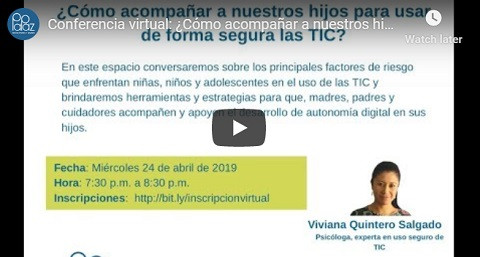 Virtual Conference: How to Accompany Our Children to Use ICT Safely? Year of publication: 2019 Author: Viviana Quintero Corporate author: Red Papaz This conference discusses the main risk factors faced by girls, boys and adolescents in the use of ICTs and provides tools and strategies so that, from home, mothers, fathers and caregivers accompany and support the development of digital autonomy in their children.