
Resources
Explore a wide range of valuable resources on GCED to deepen your understanding and enhance your research, advocacy, teaching, and learning.
2,657 Results found
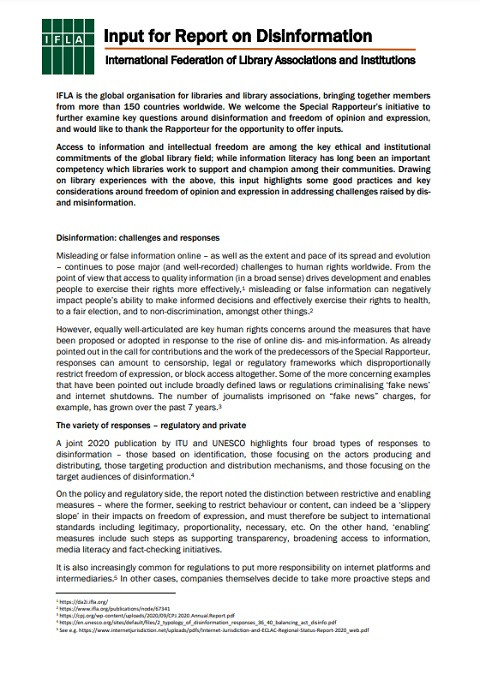 Input for Report on Disinformation Year of publication: 2021 Corporate author: International Federation of Library Associations and Institutions (IFLA) IFLA responded to a call for inputs about human rights impacts of measures against disinformation, issued by the United Nations Special Rapporteur on the promotion and protection of the right to freedom of opinion and expression. Concerns over – and dialogue about ways to address – the negative impacts of false and misleading information online have remained high on the agenda over the past months, particularly in light of prominent examples of health and electoral dis- and mis-information.Disinformation, uniquely challenging in the increasingly dense and complex digital information environment, interferes with individuals’ ability to make informed decisions and realise their essential human rights. However, the new call for inputs by the UN Special Rapporteur also draws attention to the concerns about human rights impacts of measures which different stakeholders – from states to online platforms, human rights organisations and others – take to combat disinformation.These include, of course, the impacts of broadly- or vaguely-defined “fake news” laws on freedom of expression and opinion; or internet shutdowns that bear a heavy cost on people’s access to information as a driver of development and rights.In light of this, IFLA’s submission highlights the potential of media and information literacy interventions to help address the challenges of mis- and dis-information. Drawing on the global library field’s experiences, it points to some possible good practices and insights from the ongoing work and research in this field – from targeted and tailored outreach initiatives that can help reach those who are not currently in formal education, to scalability and replicability of interventions.Of course, this is an emerging field. Our understanding of how media and information literacy interventions can be effectively leveraged against disinformation, pitfalls to avoid and ways to maximise impact, continues to evolve. That’s why the submission emphasises the need for more research and cross-stakeholder collaboration – and libraries can and do offer valuable practical and theoretical insights for this ongoing discussion.
  Engaging Girls, Boys and Youth as Active Citizens: Plan International’s Position Paper Year of publication: 2020 Corporate author: Plan International Plan International believes that every child and young person has the right to express their views freely and safely; influence decisions and take action on issues that matter to them. However, around the world children and young people – particularly girls and young women – face significant challenges in realising this right. They tend to be wrongly dismissed as insufficiently mature to participate in political and civic processes. They also tend to be stigmatised as potential perpetrators of disruption, not as valued citizens and contributors to society who can lead and drive positive change. Plan International is calling for a paradigm shift in the way the international community talks about, engages and partners with children and young people. Children and young people are not just the future. They are the present. Young people constitute almost half of the world’s population, yet they are dramatically underrepresented – even excluded – in political decision-making. It is critical that their views and needs are taken into account politically, socially, legally and economically. Promoting the voices and views of children and young people – especially girls and women – in all their diversity and supporting them to actively engage in decision-making on issues that affect their lives must be an urgent priority for the world’s power holders. Realising children and young people’s civil and political rights is a prerequisite for building sustainable and peaceful societies, and a gender just world envisioned in international human rights frameworks and the 2030 Agenda’s Sustainable Development Goals (SGDs).Across the 75+ countries Plan International works in, young people have consistently identified the denial of their political and civil rights as a priority issue. In March 2017, Plan International conducted consultations with young women and men aged 14 to 30 from 14 countries. In every country, young people reported a sense of “citizen responsibility” and an interest in public life, yet identified the lack of platforms to meaningfully engage with decision-makers and inability to ensure their opinions are taken seriously as key barriers. Girls and young women in particular have called for the removal of gendered norms that increase those barriers, silence their voices and disproportionately hold them back from leadership and active citizenship. Impliquer les filles, garçons et jeunes en tant que citoyens actifs : Prise de position de Plan International Year of publication: 2020 Corporate author: Plan International Ce rapport expose la position de Plan International sur le droit à la participation à la vie publique, ainsi qu’une analyse : du cadre juridique et politique ; de l’impact des normes sociales et genrées sur la participation ; et des problèmes spécifiques relatifs à l’émancipation politique et à la citoyenneté active. Ce rapport appuie 100 Millions de Raisons, la Stratégie Mondiale 2017-2022 de Plan International, dont la priorité principale est le soutien des filles, des garçons et des jeunes en tant qu’acteurs actifs du changement. Il défend notre travail en relation avec l’Agenda 2030 et les Objectifs de Développement Durable – plus spécifiquement les objectifs 5, 10 et 16. Un certain nombre de recommandations importantes sont incluses afin de guider le plaidoyer. Involucrar a niñas, niños y jóvenes como ciudadanos activos: Documento de Posición de Plan International Year of publication: 2020 Corporate author: Plan International En este documento se expone la posición de Plan International sobre el derecho a participar en la vida pública, así como el análisis del marco jurídico y político; las repercusiones de las normas sociales y de género en la participación; y aspectos específicos relacionados con el empoderamiento político y la ciudadanía activa. Este instrumento apunta a 100 Millones de Razones, la Estrategia Global de Plan International 2017-2022, que define como prioridad apoyar a las niñas, los niños y las/los jóvenes como motores del cambio. También apoya nuestra labor en relación con la Agenda 2030 y los Objetivos de Desarrollo Sostenible, en particular los Objetivos 5, 10 y 16. Para orientar las actividades de incidencia se incluyen varias recomendaciones de alto nivel.
 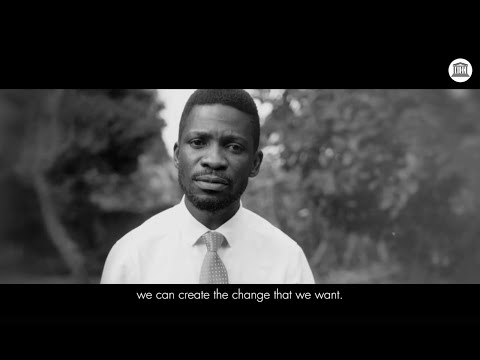 United Against Racism Year of publication: 2020 Corporate author: UNESCO We all can do something against racism. You too. Join UNESCO and leading personalities from all over the world in denouncing mounting racial discrimination.This video features messages by the following prominent women and men from the worlds of cinema, the media, music, sport and science alongside UNESCO Director-General Audrey Azoulay: Charlotte Gainsbourg, Freida Pinto, Naomi Campbell, UNESCO Goodwill Ambassador Jean-Michel Jarre, UNESCO Artist for Peace Marcus Miller, Jorge Ramos, UNESCO Goodwill Ambassador Yalitza Aparicio, Rossy de Palma, UNESCO Goodwill Ambassador Sumaya bint Al Hassan, Bobi Wine, UNESCO Goodwill Ambassador Herbie Hancock, UNESCO Goodwill Ambassador Forest Whitaker, UNESCO Champion for Girls’ and Women’s Education Nadia Nadim, Amadou Gallo Fall, Ada Hegerberg and UNESCO Artist for Peace Gilberto Gil.UNESCO has been on the forefront of the fight against racism since its creation in 1945. In 1978, it adopted the Declaration on Race and Racial Prejudice which reaffirms that “All human beings belong to a single species and are descended from a common stock. They are born equal in dignity and rights and all an integral part of humanity.”Learn more: Fight against Racism and Discrimination
  Artificial Intelligence: Media and Information Literacy, Human Rights and Freedom of Expression Year of publication: 2020 Author: Igor Shnurenko | Tatiana Murovana | Ibrahim Kushchu Corporate author: UNESCO Institute for Information Technologies in Education (IITE) | TheNextMinds The collection of papers “Artificial Intelligence: Media and Information Literacy, Human Rights and Freedom of Expression” continues the UNESCO IITE’s series of publications entitled “Digital Transformation of Education”.The publication describes the fundamentals of artificial intelligence and AI-based technologies, their impact on the modern information and media environment, new challenges in the field of media and information literacy associated with the growing automation of the processes of creating, disseminating and accessing information, the use of AI in decision-making and control systems in various areas. There is a strong focus on the growing risks of reducing individual agency, people’s ability to interpret reality autonomously and to act according to their own agenda.These issues are more relevant now than ever before for education undergoing digital transformation. The publication seeks to contribute to a critical understanding of the digital environment in which learning and teaching unfold, and strategies and tactics for the use of new technologies and the digitalization of educational interactions.
 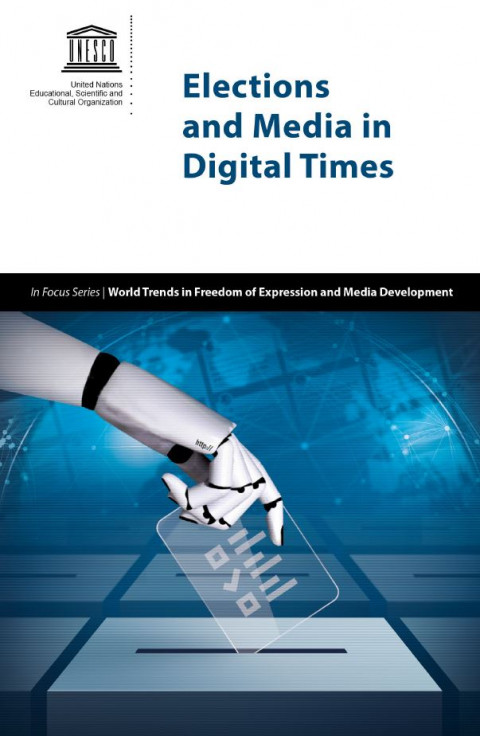 Elections and Media in Digital Times (In Focus Series: Global Trends in Freedom of Expression and Media Development) Year of publication: 2019 Author: Tarlach McGonagle | Maciek Bednarski | Mariana Francese Coutinho | Arthur Zimin Corporate author: UNESCO Digital companies are enabling politicians, political parties and voters to communicate in unprecedented ways, and expanding opportunities for seeking, receiving and imparting political information and ideas. Alongside positive developments, there also growing concerns about emerging and increasing threats to the integrity and credibility of elections, as well as the media's contribution to free, fair, transparent and peaceful electoral processes.This report highlights three converging trends in media and elections in digital times: the rise of disinformation, intensifying attacks on journalists, and disruptions linked to the use of information and communication technology in electoral arrangements. Offering possible responses to the challenges at hand, this study is a tool for governments, election practitioners, media organizations, journalists, civil society, the private sector, academia and individuals. Выборы и СМИ в цифровую эпоху (Серия в фокусе: Мировые тенденции в области свободы выражения мнений и развития СМИ) Year of publication: 2019 Author: Tarlach McGonagle | Maciek Bednarski | Mariana Francese Coutinho | Arthur Zimin Corporate author: UNESCO ИТ компании дают возможность политикам, политическим партиям и избирателям общаться беспрецедентными способами, расширяют возможности для поиска, получения и распространения политической информации и идей. Наряду с позитивными сторонами растет озабоченность по поводу вырисовывающихся и усиливающихся угроз целостности и авторитету выборов, а также вкладу средств массовой информации в свободные, справедливые, транспарентные и мирные избирательные процессы.В настоящем докладе освещаются три сходящиеся тенденции, связанные со СМИ и выборами в цифровую эпоху: рост дезинформации, усиление нападений на журналистов и перебои в предоставлении информационно-коммуникационных технологий в период выборов. Это исследование, предлагая возможные ответы на стоящие перед нами проблемы, является своего рода инструментом для правительств, специалистов по проведению выборов, организаций средств массовой информации, журналистов, гражданского общества, частного сектора, научных кругов и отдельных лиц.
  초등학교 교육과정 분석을 통한 동물권 교육의 위계 방안 모색: 동물복지 교육을 중심으로 Year of publication: 2018 Author: 박헌우 | 강연실 | 채희숙 | 문승준 | 장은정 | 표수연 | 송재경 | 김은숙 | 이봉희 | 박아름 Corporate author: 서울특별시교육청 교육연구정보원 | 서울교육정책연구소 반려동물을 기르는 인구수가 천만을 넘어서고 반려동물에 대한 국민적 관심과 인식 수준이 높아지고 있는 상황을 고려할 때, 지금이 동물의 복지와 권리에 대한 학생들의 올바른 이해와 준비가 필요한 시점이다.본 연구는 학생들의 동물권에 대한 인식을 제고하기 위하여 초등학교 현장에서 적용 가능한 초등학교 동물복지 교육의 위계를 설정하고, 동물복지 교육 프로그램을 개발하는 데 그 목적이 있다. 서울특별시교육청교육연구정보원이(가) 창작한 [정책-17-32] 초등학교 교육과정 분석을 통한 동물권 교육의 위계 방안 모색-동물복지 교육을 중심으로- 저작물은 "공공누리 제4유형(출처표시-상업적 이용금지-변경금지)" 조건에 따라 이용 할 수 있습니다.
  How Human Rights Shape Social Citizenship: On Citizenship and the Understanding of Economic and Social Rights (Washington University Global Studies Law Review. Vol.13, No.2) Year of publication: 2014 Author: Ulrike Davy Corporate author: Washington University This Article reconceptualizes citizenship, a notion usually tied to the nation state, as “layered.” Human rights may serve as the international “layer” of citizenship, addressing nationals and non-nationals alike. It took some time, however, for “social” citizenship to emerge as a human rights issue and, hence, for human rights to become an international layer for social citizenship rights granted on the national level. Around 1993, states started to accept a human rights-based obligation toward the poor, requiring social policies to focus on targeted, individual welfare. Nowadays, poverty mitigation is the human rights core of “social” citizenship. Nowadays, poverty mitigation is the human rights core of “social” citizenship.