
Resources
Explore a wide range of valuable resources on GCED to deepen your understanding and enhance your research, advocacy, teaching, and learning.
3,376 Results found
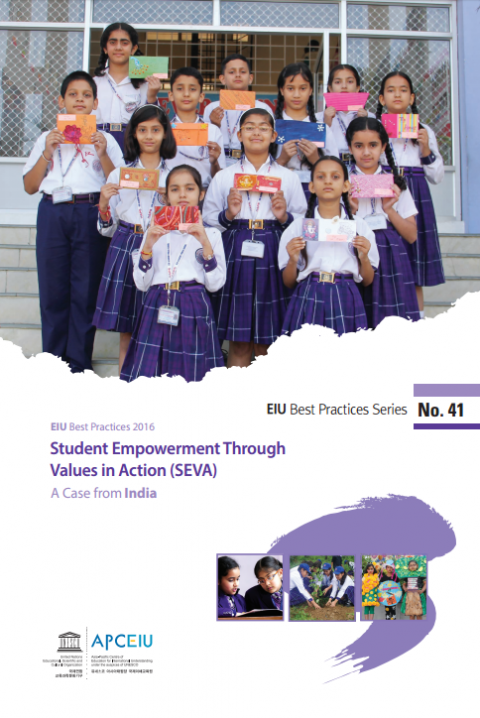 EIU Best Practices Series No. 41: Student Empowerment Through Values in Action (SEVA) Year of publication: 2016 Corporate author: APCEIU This monograph is one of APCEIU's EIU Best Practices Series, which aims to encourage educators, scholars, and activists to implement and share local initiatives on EIU. The Series No. 41 introduces a programme called “Student Empowerment through Values in Action (SEVA)" carried out by a school in India. The programme encouraged students to put the values of respect, responsibility, care, integrity, resilience and cyber-wellness in day to day actions. The programme has been successful in motivating the school staffs to enthusiastically participate in the programme as they witnessed the impact of the progarmme on the students. The programme sends out important messages to the school education system, where evaluation of success tends to be heavily based on academic performance.
  EIU Best Practices Series No. 43: Embracing Sustainability: You Can Make a Difference Year of publication: 2016 Corporate author: APCEIU This monograph is one of APCEIU's EIU Best Practices Series, which aims to encourage educators, scholars, and activists to implement and share local initiatives on EIU. The Series No. 43 introduces a programme called “Embracing Sustainability: You Can Make a Difference”, designed by a teacher in New Zealand to allow his students to think about sustainability from a global perspective. The programme has been successful in engaging disengaged youth by giving them a sense of self-worth and helping them to understand sustainability and see their place in the global society. The valuable insights provided in this case will also be able to inform those who intend to embed EIU/GCED principles in the existing curriculum.
 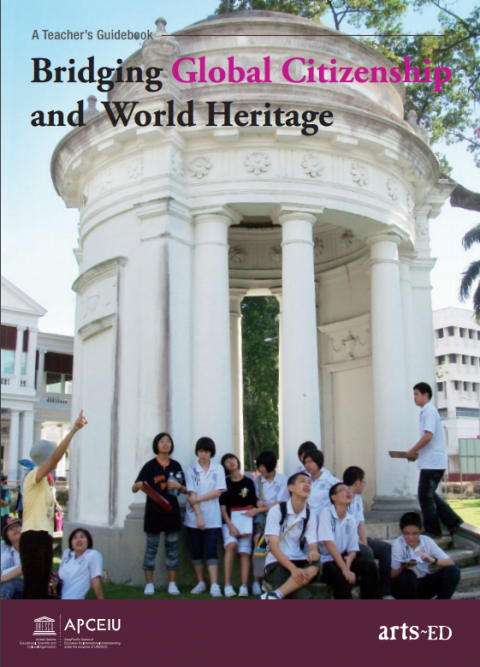 GCED Teacher's Guidebook Bridging Global Citizenship and World Heritage Year of publication: 2016 Corporate author: APCEIU APCEIU, in collaboration with Arts-ED Penang, a non-profit organisation for art and culture education, has published a Global Citizenship Education(GCED) Teacher’s Guidebook Bridging Global Citizenship and World Heritage. This guidebook was developed as a project of GCED Material Development on World Heritage, in order to promote awareness of cultural diversity as well as mutual understanding. This Teacher’s guidebook not only provides literature on both World Heritage in Malaysia and GCED but also gives case examples and lesson plans to provide teachers with practical assistance in designing and conducting GCED class utilizing World Heritage. <Contents>ForewordList of Figures and ImagesChapter 1. Introduction to the World Heritage Site of George Town and MelakaChapter 2. Global Citizenship Education: Empowering Citizens to Create a Better World TogetherChapter 3. How to Design Lessons Using Global Citizenship Education and Heritage ResourcesChapter 4. Case Examples and Lesson PlansReferences 세계문화유산 활용 세계시민교육 교사 지침서 Year of publication: 2016 Corporate author: 유네스코 아시아태평양 국제이해교육원 문화다양성과 상호이해 증진을 위한 세계유산 활용 세계시민교육 자료개발 사업의 일환으로 발간된 이 교사 지침서는 말레이시아의 세계문화유산을 활용해 진행했던 실천사례와 수업예시 등을 담고 있어 일선 교사들이 향후 세계시민교육 수업을 구성하고 진행하는데 실질적인 도움을 줄 것으로 기대된다.<목차>발간사도표와 그림1장. 믈라카와 조지타운 세계유산 소개2장. 세계시민교육: 더 나은 세상을 함께 만들기 위한 시민의 역량을 기르다.3장. 세계유산과 세계시민교육을 활용한 수업 구성하기4장. 실천 사례 및 수업 교안참고자료
 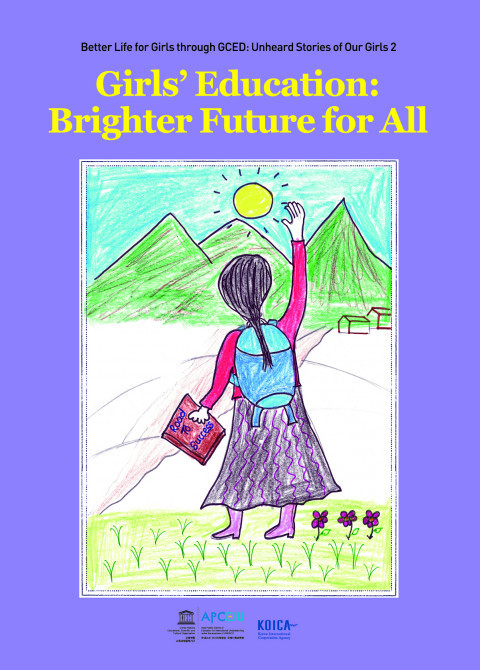 Better Life for Girls through GCED: Unheard Stories of Our Girls 2: Girl's Education: Brighter Future for All Year of publication: 2016 Corporate author: APCEIU The "Better Life for Girls through GCED: Unheard Stories of Our Girls" series depict stories of girls from different parts of the world. Coming from Africa and Asia, 25 educators have written stories about their girls during the programme to share with readers all over the world. As the title implies, these series are about real people living on the fringes of society especially girls in their neighbor having challenges on their way to access quality education.
 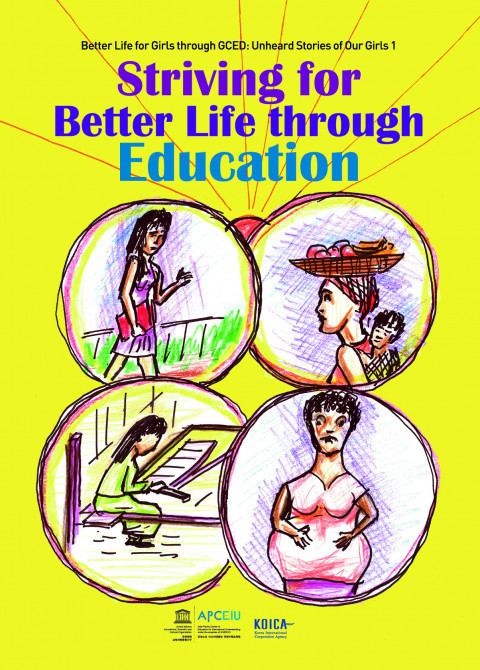 Better Life for Girls through GCED: Unheard Stories of Our Girls 1: Striving for Better Life through Education Year of publication: 2016 Corporate author: APCEIU 2016 UNESCO/KOICA Fellowship Programme Better Life for Girls through GCED: Unheard Stories of Our Girls The "Better Life for Girls through GCED: Unheard Stories of Our Girls" series depict stories of girls from different parts of the world. Coming from Africa and Asia, 25 educators have written stories about their girls during the programme to share with readers all over the world. As the title implies, these series are about real people living on the fringes of society especially girls in their neighbor having challenges on their way to access quality education.
 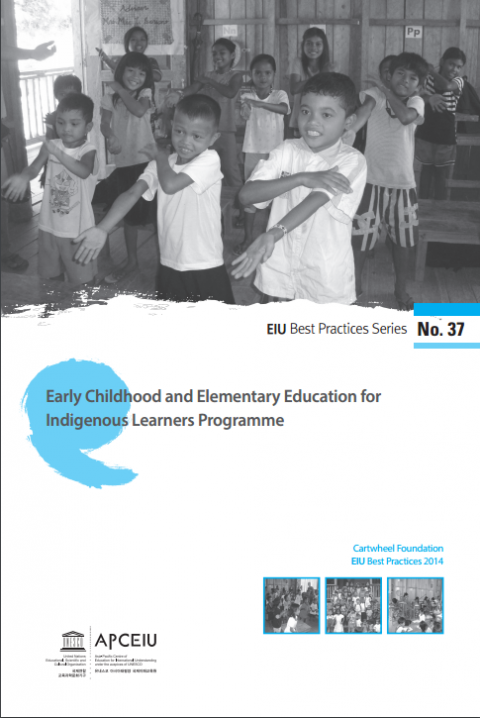 EIU Best Practices Series No. 37: Early Childhood and Elementary Education for Indigenous Learners Programme Year of publication: 2014 Author: Bricks Sabella Sintaon Corporate author: APCEIU This monograph is one of APCEIU's EIU Best Practices Series, which aims to encourage educators, scholars, and activists to implement and share local initiatives on EIU. The Series No.37 introduces the Early Childhood and Elementary Education (ECEE) for Indigenous Learners Programme initiated in the Philippines. The indigenous peoples (IP) reside in the mountainous regions, away from basic social services and struggling with poverty, malnutrition, and lack of proper education. The aim of ECEE is to facilitate access to quality and culturally-relevant early childhood and elementary education for the Higaonon indigenous children. To achieve this, activities such as curriculum indigenization and teacher training are provided in collaboration with the community members. As the program creates learning process for all through openness, sharing, and collaboration, this is an exemplary case of EIU/GCED pedagogical approach.
 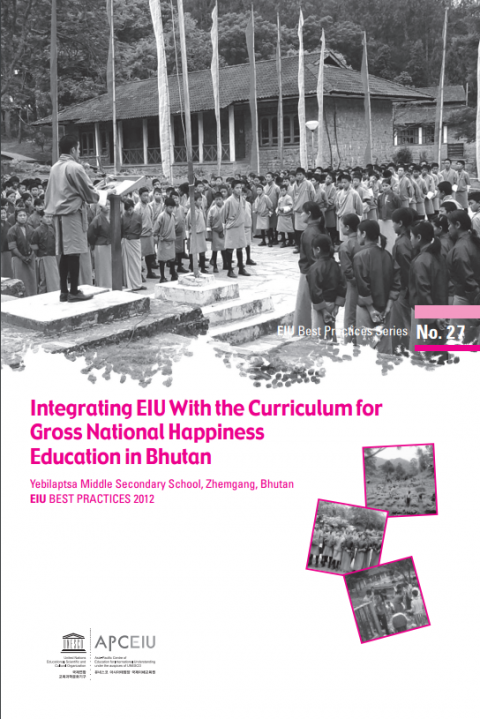 EIU Best Practices Series No. 27: Integrating EIU with the Curriculum for Gross National Happiness Education in Bhutan Year of publication: 2012 Author: Udhim Subba Corporate author: APCEIU This monograph is one of APCEIU's EIU Best Practices Series, which aims to encourage educators, scholars, and activists to implement and share local initiatives on EIU. The Series No.27 introduces Bhutan’s Yebilaptsa Middle Secondary School, in its effort to promote values of EIU as a complementary component of the Gross National Happiness Education efforts. Activities such as UNESCO club community activities, environmental learning, EIU cultural night, international exchange altogether exemplify effective ways to integrate EIU practices in the curriculum and extracurricular programs of schools.
 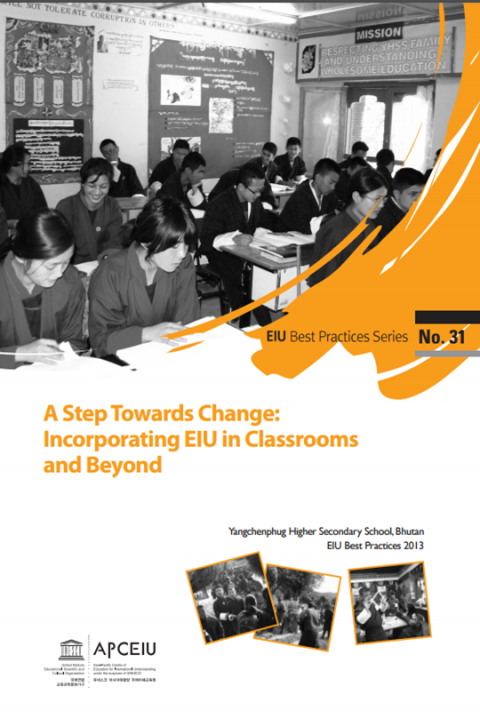 EIU Best Practices Series No.31: A Step towards Change: Incorporating EIU in Classrooms and Beyond Year of publication: 2013 Corporate author: APCEIU This monograph is one of APCEIU's EIU Best Practices Series, which aims to encourage educators, scholars, and activists to implement and share local initiatives on EIU. The Series No.31 introduces a case study in which Bhutanese school carried out activities and curriculum development to successfully promote EIU and ESD for students and teachers. While the school’s curriculum already embodies a degree of EIU, the school strived to be more creative in upholding the existing content by exploring newer issues of media ethics, human rights, culture, and environmental conservation for fruitful engagement. This in turn allowed the target audience to learn the values of EIU/ESD for a culture of peace.
 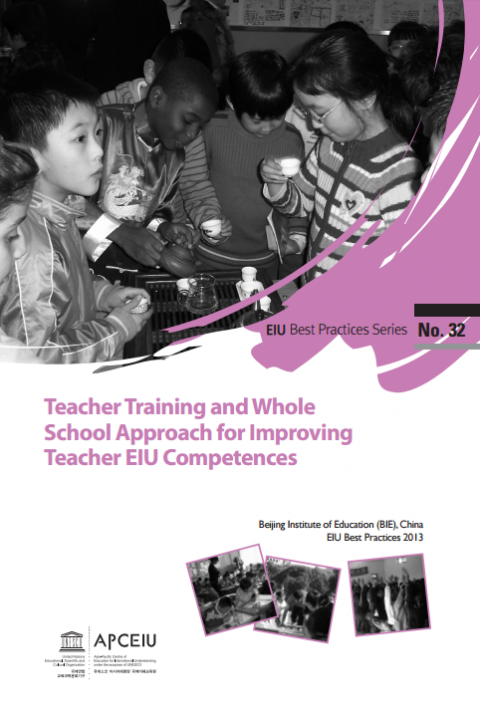 EIU Best Practices Series No.32: Teacher Training and Whole School Approach for Improving Teacher EIU Competences Year of publication: 2013 Corporate author: APCEIU This monograph is one of APCEIU's EIU Best Practices Series, which aims to encourage educators, scholars, and activists to implement and share local initiatives on EIU. The Series No.32 introduces two cases in which primary and secondary school teachers in Beijing were trained to promote EIU in respective communities. As teachers developed their EIU competence and awareness, students learned to be more open-minded, respectful, and tolerant. The issue highlights the important role educators have in instilling EIU values and shaping perception.