
Resources
Explore a wide range of valuable resources on GCED to deepen your understanding and enhance your research, advocacy, teaching, and learning.
3,438 Results found
 Being and Becoming Global Citizens: Measuring Progress toward SDG 4.7 (Phase I: Monitoring teacher and school readiness to enact global citizenship in the Asia-Pacific region) Year of publication: 2023 Author: Rachel Parker | Jennie Chainey | Payal Goundar | Sarah Richardson | Anna Dabrowski | Amy Berry | Claire Scoular Corporate author: Australian Council for Educational Research (ACER) | APCEIU Since 2022, APCEIU and the Australian Council for Educational Research (ACER) have conducted a study to identify enhanced tools and resources for schools and systems in the Asia-Pacific region to monitor and evaluate GCED in line with SDG 4.7.The Report of the Research for Phase 1 is available in three forms: Full report; Summary; and Policy Brief.
 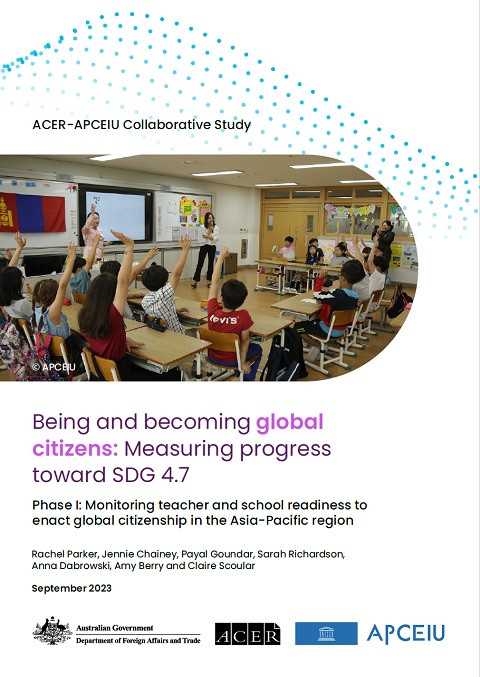 [Summary] Being and Becoming Global Citizens: Measuring Progress toward SDG 4.7 (Phase I: Monitoring teacher and school readiness to enact global citizenship in the Asia-Pacific region) Year of publication: 2023 Author: Rachel Parker | Jennie Chainey | Payal Goundar | Sarah Richardson | Anna Dabrowski | Amy Berry | Claire Scoular Corporate author: Australian Council for Educational Research (ACER) | APCEIU This is a summary report of the Being and Becoming Global Citizens: Measuring Progress toward SDG 4.7 (Phase I: Monitoring teacher and school readiness to enact global citizenship in the Asia-Pacific region), conducted by APCEIU and ACER in since 2022.
 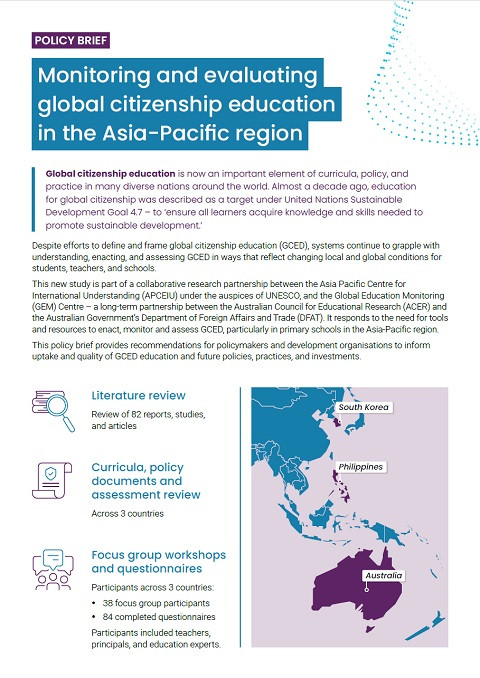 [Policy Brief] Monitoring and Evaluating Global Citizenship Education in the Asia-Pacific Region Year of publication: 2023 Author: Payal Goundar | Rachel Parker Corporate author: Australian Council for Educational Research (ACER) | APCEIU This is a policy brief version of the reserach report, Being and Becoming Global Citizens: Measuring Progress toward SDG 4.7 (Phase I: Monitoring teacher and school readiness to enact global citizenship in the Asia-Pacific region), conducted by APCEIU and ACER in since 2022.
  2022 세계시민교육 국내 모니터링 체제 구축 연구 Year of publication: 2022 Author: 박환보 | 박경희 | 최원석 | 길혜지 | 조대훈 | 엄정민 Corporate author: 유네스코 아시아태평양 국제이해교육원 본 연구는 유네스코 아시아태평양 국제이해교육원(이하 유네스코 아태교육원)이 지속가능발전목표4.7(SDG4.7) 의 국내 이행 노력을 효과적으로 모니터링하기 위해 다년간 실시해온 연구의 일환으로, 국내 모니터링 체제 구축 방안 모색을 목적으로 한다. 특히 본 연구에서는 SDG4.7 목표 이행과 모니터링의 초점을 세계시민교육을 통한 학습자의 변화와 성장에 두고, 세계시민교육 정책, 교사의 세계시민교육 역량, 학습자의 세계시민역량의 세 가지 측면에서 모니터링 방안을 모색하였다. 이를 위해 우선 유네스코 아태교육원이 본 모니터링 연구 의 연속선상에서 수행해 온 선행연구에서 제안한 세계시민교육 주제영역과 개념틀을 활용하여 시·도교육청의 세계시민교육 이행 실태와 변화 추이를 분석하고, 정책의 주류화라는 관점에서 모니터링 방안에 관해 논의하였다. 그리고 기존 투입 중심의 연구 한계를 극복하기 위해, 세계시민교육의 이행 과정과 산출이라는 관점에서 교사의 세계시민교육 역량과 학습자의 세계시민성 수준을 측정하기 위한 문항을 개발하였다.
  2021 Study on the Monitoring Framework of GCED in South Korea Year of publication: 2021 Author: Hwanbo Park | Daehoon Jho | Kyunghee Park | Sungho Park | Jeongmin Eom Corporate author: APCEIU The purpose of this study is to establish a feasible monitoring system for the implementation of Global Citizenship Education (GCED) in South Korea that can both align itself with the global indicator (SDG 4.7.1) and reflect the domestic context and feasibility. To this end, the study continues to examine the extent to which GCED is mainstreamed in education policies in Korea by utilizing the monitoring tool developed by the aforementioned 2020 study. In so doing, it aims to build sustaining and robust data in the area of GCED policies with the consistent monitoring tool developed. Second, the study explores enabling aspects as well as gaps between policies or programmes and how GCED is implemented on the ground by schools and teachers. Through this analysis, the study draws implications for further refining of the developed monitoring system. Third, the study surveys and analyzes existing monitoring tools developed by other fields and the data accumulated through those existing tools to assess learners' knowledge acquisition, values, skills and attitudes relevant to global citizenship competences, In so doing, it explores possibilities and makes recommendations for effectively monitoring learners’ competences by utilizing and modifying existing tools as well as developing new ones. 2021 세계시민교육 국내 모니터링 체제 구축 연구 보고서 Year of publication: 2021 Author: 박환보 | 조대훈 | 박경희 | 박성호 | 엄정민 Corporate author: 유네스코 아시아태평양 국제이해교육원 유네스코 아태교육원은 세계시민교육의 국내 모니터링을 체계화하기 위한 노력의 일환으로 2018년의 기초연구를 시작으로 매년 꾸준히 글로벌 지표(SDG 4.7.1)에 부합하면서도 국내 맥락과 실효성이 반영된 국내용 모니터링 도구를 마련하고, 세계시민교육의 주류화 정도를 시범적으로 조사해왔다. 2021년도 연구는 2020년도 연구를 통해 확립된 지표체계를 기반으로 꾸준히 실시하는 시・도교육청의 세계시민교육 정책분야 분석과 함께 구체적인 정책 이행 사례를 보다 미시적으로 분석하였다. 이와 더불어, 세계시민교육을 통한 성취라는 측면에서 국내의 다양한 패널데이터를 활용하여 초중등학교 학생들의 세계시민성 수준을 분석하였다. 마지막으로 이러한 연구 결과를 토대로 국내 세계시민교육 이행 모니터링 지표의 정교화 및 모니터링 체제 구축에 필요한 시사점을 도출하였다.
  평생교육 내 세계시민교육 이행현황 연구 Year of publication: 2019 Corporate author: 유네스코 아시아태평양 국제이해교육원 유네스코 아태교육원은 “국내 평생교육 내 세계시민교육 이행현황 연구” 보고서를 발간하였다. 동 교육원은 국내 세계시민교육의 효과적이고 체계적인 이행을 위해서는 이행현황 분석연구가 필요함을 인식하여, 2018년에는 유ㆍ초중등학교 교육과정에 담긴 세계시민교육의 국내 이행현황을 연구하였다. 본 연구보고서는 이 작업에 대한 후속 연구로서 성인을 대상으로 하는 평생교육 영역에서의 시민교육 실천양상 및 그 안에서 나타나는 세계시민교육의 형성, 현황 및 이행과정을 검토하고 잠재적 활성화 가능성에 대해 탐색한다.
  Establishing a Monitoring System for Global Citizenship Education in South Korea: A Preliminary Study with a Focus on Policy Area Year of publication: 2019 Corporate author: APCEIU The Asia-Pacific Centre of Education for International Understanding published a report titled "Establishing a Monitoring System for Global Citizenship Education in South Korea: A Preliminary Study with a Focus on Policy Area." The purpose of this research report is to provide implications for the development of indicators for Global Citizenship Education (GCED) which is the target 4.7 of the Sustainable Development Goals (SDGs) and the establishment of a Korean monitoring system for data accumulation. It is difficult for GCED to set up common indicators to monitor the implementation of each country, as it comprehensively deals with the direction and contents of education, whereas other targets of SDG4 are relatively clear targets and goals such as guaranteeing educational opportunities and improving educational conditions. For this reason, this study proposed Korean indicators based on domestic and international trends and analysis of issues concerning the development of SDG4.7.1 indicators and reviewed the domestic status in implementation based on them, thereby contributing to the development and consolidation of global indicators development and monitoring systems in the future. 세계시민교육 지표 개발 및 데이터 축적을 위한 모니터링 체제 구축 연구 Year of publication: 2019 Corporate author: 유네스코 아시아태평양 국제이해교육원 유네스코 아태교육원은 “세계시민교육 지표 개발 및 데이터 축적을 위한 모니터링 체제 구축 연구” 보고서를 발간하였다. 본 연구보고서는 지속가능발전목표(SDGs)의 4번 교육 목표 중 7번째 세부목표(SDG4.7)인 세계시민교육의 지표 개발과 데이터 축적을 위한 국내 모니터링 체제 구축을 위한 시사점을 제공하는데 목적이 있다. SDG4.7이 추구하는 세계시민교육은 교육기회의 보장이나 교육여건 개선 등 비교적 대상과 목표가 명확한 다른 SDG4의 세부목표와 달리 교육의 방향성과 내용을 포괄적으로 다루기 때문에, 국가별로 이행 여부를 모니터링하기 위한 공동의 지표 설정에 어려움이 있다. 이와 같은 이유로, 본 연구에서는 SDG4.7.1 지표 개발에 대한 국내외 동향과 쟁점 분석을 토대로 국내 지표를 제안하고 이를 바탕으로 국내 이행 수준을 검토함으로써, 향후 글로벌 지표 개발과 모니터링 체제를 발전 및 공고화하는데 기여하고자 하였다.
  Global Citizenship Education Tools and Piloting Experiences of Four Countries: Cambodia, Colombia, Mongolia and Uganda Year of publication: 2018 Author: Opertti Renato | Hyekyung Kang | Magni Giorgia Corporate author: UNESCO International Bureau of Education (IBE) | APCEIU This report analyses the progresses made by Cambodia, Colombia, Mongolia and Uganda in the development and piloting of GCED tools, designed within the framework of UNESCO Asia-Pacific Centre of Education for International Understanding (APCEIU)’s and International Bureau of Education (IBE)’s three-year cooperation project, “Global Citizenship Education Curriculum Development and Integration”. Based on the needs identified through the situational analyses carried out during Phase I, the four countries have developed tailored tools to mainstream GCED in their own context and piloted them during Phase II. Through an in-depth analysis of the tools as well as of their piloting processes, this report aims at understanding the extent to which GCED concepts are embedded and integrated into these tools and the way in which these tools contribute to the overall GCED teaching and learning practices in each context. What results from the findings is that the four countries, despite some setbacks due mainly to the strict timeline, have made significant progress in developing innovative strategies to integrate GCED principles into their education policies and practices. Finally, this report concludes with the suggestions for these tools to be effectively implemented during Phase III, particularly for this project, and for any further initiative around GCED areas.