
Resources
Explore a wide range of valuable resources on GCED to deepen your understanding and enhance your research, advocacy, teaching, and learning.
109 Results found
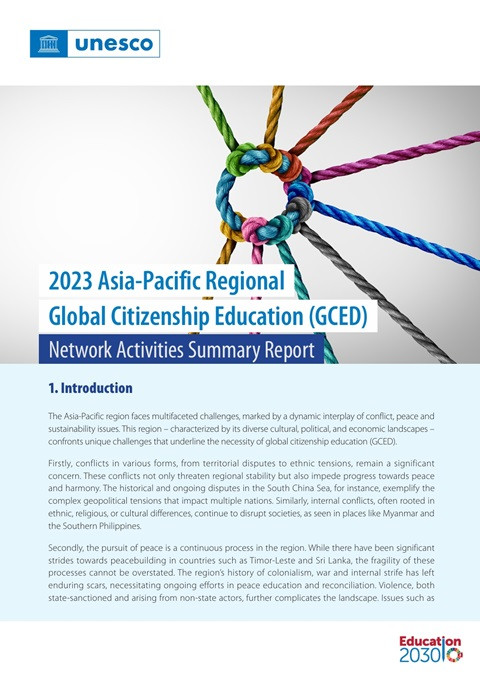 2023 Asia-Pacific Regional Global Citizenship Education (GCED): Network Activities Summary Report Year of publication: 2023 Author: Seek Ling Tan Corporate author: UNESCO Bangkok This is a summary report from the Global Citizenship Education (GCED) network activities in Asia-Pacific in 2023. The Asia-Pacific Regional Global Citizenship Education Network, spearheaded by UNESCO Bangkok and the Asia-Pacific Centre of Education for International Understanding (APCEIU), has illuminated the path to empower learners to become global citizens since its inception in 2018. In 2023, their journey was punctuated by significant milestones and a revitalized commitment to propel GCED across the region. This commitment is particularly evident in the key priority areas of advocacy, capacity building, learning/teaching materials, policy and research and the synergizing of regional collaboration towards Education 2030.
  Integrating education for sustainable development & education for international understanding: conceptual issues and pedagogical principles for teacher education to address sustainability Year of publication: 2006 Author: Swee-Hin Toh Corporate author: UNESCO Bangkok It is in this spirit that this essay seeks to “integrate” two active and expanding fields of 2 educational innovation and transformation worldwide, namely ESD (education for sustainable development or sustainability) and EIU (education for international understanding). The key conceptual issues and themes of both of these movements will be clarified and shared values and understandings highlighted. It will also be argued that both ESD and EIU , in order to effectively fulfill their goals of building a peaceful, just and sustainable world order, rests on some key common pedagogical principles and processes. Another introductory caveat is also essential here, namely the question of paradigm. Among policy-makers, theorists and practitioners, there may well be and often are distinct differences in conceptualization according to their paradigmatic interpretations, with consequently alternative implications for policies and practices. Integrating education for sustainable development & education for international understanding: conceptual issues and pedagogical principles for teacher education to address sustainability Year of publication: 2006 Author: Swee-Hin Toh Corporate author: UNESCO Bangkok Il est dans cet esprit que cet essai vise à «intégrer» deux champs actifs et en expansion de 2 innovations pédagogiques et de transformation dans le monde entier, à savoir l'EDD (éducation pour le développement durable ou la durabilité) et ECI (éducation pour la compréhension internationale). Les principaux problèmes conceptuels et les thèmes de ces deux mouvements seront clarifiés et des valeurs et une compréhension partagées mis en évidence. Il sera fait également valoir que les deux EDD et ECI, en vue de remplir efficacement leurs objectifs de construction, un ordre pacifique juste et durable monde, repose sur quelques principes pédagogiques communs clés et des processus. Une autre mise en garde d'introduction est également essentiel ici, à savoir la question de paradigme. Parmi les décideurs, les théoriciens et les praticiens, il pourrait bien être souvent des différences distinctes dans la conceptualisation en fonction de leurs interprétations paradigmatiques, ayant des implications en conséquence alternatives pour les politiques et les pratiques. 지속가능발전교육과 국제이해교육의 통합: 지속가능성 문제 해결에 대한 교사 교육의 개념적 문제와 교육학적 원칙 Year of publication: 2006 Author: Swee-Hin Toh Corporate author: UNESCO Bangkok 이것은 ESD(지속가능한발전 혹은 지속가능성을 위한 교육)와 EIU(국제이해교육)이라는 교육 혁신과 전 세계의 변화, 이 두 가지 확장 개념과 활동을 ‘통합’하고자 한다. 아울러 이 두 운동의 주요 개념적 문제와 주제는 명확히 되고, 공유된 가치와 이해가 강조될 것이다. 또한 평화롭고 지속가능한 세계 질서 구축이라는 목표를 효과적으로 수행하기 위해서, ESD와 EIU는 몇 가지 주요 공통 교수법과 과정에 그 성패가 달려있다고 보인다. 여기에 또 다른 입문주의 사항(introductory caveat), 즉 패러다임의 문제가 필수적이다. 정책 입안자, 이론가 및 실무자 사이에선 결과적으로 정책과 관행에 대한 대안적 함의와 함께 그들의 패러다임 해석에 따른 개념화의 뚜렷한 차이점이 종종 나타날 수 있다. The heart of education: learning to live together; selected papers presented at the 16th UNESCO-APEID international conference Year of publication: 2014 Corporate author: UNESCO Bangkok To help frame current thinking on education in a changing world, UNESCO Bangkok, the Ministry of Education in Thailand, the Asian-Pacific Network for International Education and Values (APNIEVE), Pearson Thailand and J.P. Morgan co-organized the 16th UNESCO-APEID International Conference, The Heart of Education: Learning to Live Together in November 2012 in Bangkok, Thailand. The Conference provided a forum for participants to share their knowledge and experiences, raise critical questions, provide constructive feedback and, most of all, express their commitment to imbue and translate the essence of learning to live together in their respective educational efforts. This report contains selected papers presented at the Conference to reflect the linkages between learning and social development, showcase approaches and tools, and identify enabling policies and instruments to promote learning to live together. Le cœur de l'éducation: apprendre à vivre ensemble; articles sélectionnés présentés à la 16e Conférence internationale UNESCO-APEID Year of publication: 2014 Corporate author: UNESCO Bangkok Pour aider à encadrer la réflexion actuelle sur l'éducation dans un monde en mutation, l'UNESCO à Bangkok, le Ministère de l'éducation en Thaïlande, le Réseau Asie-Pacifique pour l'éducation et les valeurs internationales (APNIEVE), Pearson Thaïlande et JP Morgan co-organisé le 16 UNESCO-APEID internationale Conférence, The Heart of Education: Apprendre à vivre ensemble en Novembre 2012 à Bangkok, Thaïlande. La conférence a fourni un forum pour les participants de partager leurs connaissances et expériences, soulèvent des questions critiques, fournir une rétroaction constructive et, surtout, expriment leur engagement à imprégner et de traduire l'essence de l'apprentissage à vivre ensemble dans leurs efforts éducatifs respectifs. Ce rapport contient des documents présentés à la conférence afin de refléter les liens entre l'apprentissage et le développement social, les approches de la vitrine et des outils, et d'identifier des politiques favorables et des instruments pour promouvoir l'apprentissage à vivre ensemble sélectionné. Kit de Plaidoyer pour la promotion de l'éducation multilingue: y compris les exclus Year of publication: 2007 Corporate author: UNESCO Bangkok
 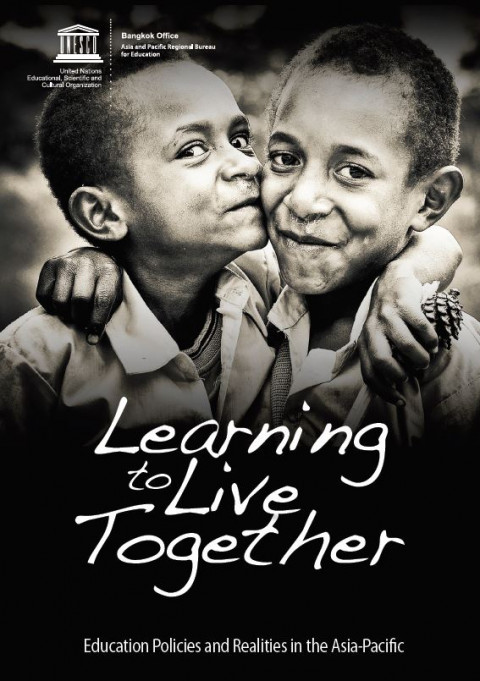 Learning to live together Year of publication: 2014 Corporate author: UNESCO Bangkok The importance of LTLT has increased in recent years. Indeed, relevant competencies appear to be gaining focus in international frameworks and educational initiatives across countries. This is all the more necessary as Voogt and Roblin (2012) argue, given the demands of our increasingly knowledge-based society in which “ideas and knowledge function as commodities” (p. 299 –300) and to which effective social and emotional skills are critical. It is perhaps all the more critical given the multivariate global challenges in the 21st Century and the need for unified global commitment to effectively combat these challenges. In this context, the significance of LTLT is reflected in both the rise of and growing interest in Global Citizenship Education (GCE), Education for Sustainable Development (ESD), Education for International Understanding (EIU) as well as peace and human rights education. The UN Secretary-General’s Global Education First Initiative, which lists ‘Fostering Global Citizenship’ as one of its three global priorities, also implicitly recognizes the significance of LTLT as a precursor to the building of a more peaceful society, one in which discrimination is intolerable and common challenges such as climate change and abject poverty are tackled together.Yet despite the significance of LTLT in the 21st Century, and despite numerous international initiatives to foster LTLT competencies, there is a large gap of evidence identifying how this supposition is translated into effective policy and curricula, and eventually into the reality of schools, teachers and learners. This report is a response to this gap, and attempts to understand how ten selected countries in the Asia-Pacific region – Afghanistan, Australia, Indonesia, Malaysia, Myanmar, Nepal, The Philippines, Republic of Korea, Sri Lanka and Thailand – have reflected and integrated LTLT into their education policies and initiatives. This variety of countries aims to reflect their diverse experiences in terms of reflecting LTLT through their education systems. By exploring a number of areas, namely policy, curricula, teachers and assessment, this study aims to identify what has so far been achieved in education systems of the Asia-Pacific region in the area of LTLT.This report is therefore targeted predominantly at education policy makers, researchers, academics as well as education practitioners of the Asia-Pacific region. Given its connection to Global Citizenship Education and other relevant international initiatives around sustainability and peace education, this report is also relevant to UNESCO’s partner organizations and the broader educational development community.This report will first present the research framework for the study, before exploring the social and economic contexts in the ten selected countries and wider regional factors in the Asia-Pacific in relation to global challenges in Chapter Two. Chapter Three will then examine national policy frameworks, including the vision of those policies in defining LTLT in education. Chapter Four focuses on the national curriculum in selected countries and the extent to which they incorporate learning objectives, subjects, and extra-curricular activities reflecting the concept of LTLT and related skills and competencies. In Chapter Five, teaching practices are examined, including the role of teachers and teacher education, as well as teaching methods and application of media and information literacy (MIL) in the classroom. Chapter Six then looks at assessment, and how far countries have attempted to develop assessment frameworks that measure the skills and competencies related to LTLT. Finally, Chapter Seven provides reflections and conclusions based on the main findings of the study, while also identifying trends across policy domains, shortcomings and some policy considerations.
 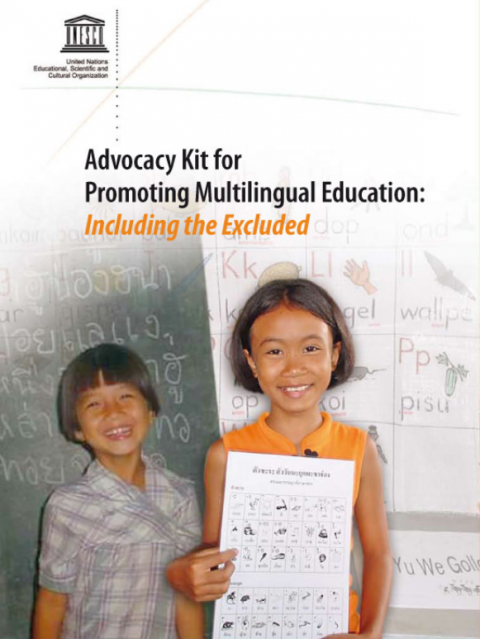 Advocacy kit for promoting multilingual education: including the excluded Year of publication: 2007 Corporate author: UNESCO Bangkok Who Can Use This Kit? This kit was prepared for all of those who want to ensure that “Education for All” does, indeed, include everyone! The kit will be especially valuable for policy makers, education practitioners and specialists who want to improve access to and quality of education for those excluded by language. It will also be helpful for speakers of ethnic minority languages who want to improve the education situation in their own communities.This kit is designed to raise awareness on the importance of mother tongue-based multilingual education (MLE). It presents key arguments and facts about MLE and provides important insights about the value and benefits of providing education in learners’ mother tongue. The kit also presents ideas, research findings and concrete examples that you can use to think about your own situation and suggests steps for taking actions to make your school system more responsive to linguistic diversity.The kit is not a definitive textbook, and it will not have an answer for every problem that you might face. To help you as much as possible, at the end of each booklet we have included lists of references. In addition, each booklet contains a glossary of terms and, at the front of each booklet is a one-page summary of its contents.How Can You Use This Kit? This kit contains three main booklets. Each booklet has a designated audience: 1) policy makers, 2) education programme planners and practitioners and 3) community members. Please remember that developing MLE requires contributions from everyone at all levels. For that reason, we encourage you to use all three booklets along with other available resources as you work together to plan, implement and sustain your MLE programmes.This kit can be used in many different ways. For those who are already involved in MLE programmes, you might use these ideas to help you to promote mother tongue instruction and strengthen your programme. Those who are not familiar with multilingual education but want to improve educational access for minority language students might use these booklets to identify specific points that they can investigate and discuss in their own contexts. Advocacy kit for promoting multilingual education: including the excluded Year of publication: 2007 Corporate author: UNESCO Bangkok This kit was prepared for all of those who want to ensure that “Education for All” does, indeed, include everyone! The kit will be especially valuable for policy makers, education practitioners and specialists who want to improve access to and quality of education for those excluded by language. It will also be helpful for speakers of ethnic minority languages who want to improve the education situation in their own communities. This kit is designed to raise awareness on the importance of mother tongue-based multilingual education (MLE). It presents key arguments and facts about MLE and provides important insights about the value and benefits of providing education in learners’ mother tongue. The kit also presents ideas, research findings and concrete examples that you can use to think about your own situation and suggests steps for taking actions to make your school system more responsive to linguistic diversity. The kit is not a definitive textbook, and it will not have an answer for every problem that you might face. To help you as much as possible, at the end of each booklet we have included lists of references. In addition, each booklet contains a glossary of terms and, at the front of each booklet is a one-page summary of its contents. This kit contains three main booklets. Each booklet has a designated audience: 1) policy makers, 2) education programme planners and practitioners and 3) community members. Please remember that developing MLE requires contributions from everyone at all levels. For that reason, we encourage you to use all three booklets along with other available resources as you work together to plan, implement and sustain your MLE programmes. This kit can be used in many different ways. For those who are already involved in MLE programmes, you might use these ideas to help you to promote mother tongue instruction and strengthen your programme. Those who are not familiar with multilingual education but want to improve educational access for minority language students might use these booklets to identify specific points that they can investigate and discuss in their own contexts.