
Resources
Explore a wide range of valuable resources on GCED to deepen your understanding and enhance your research, advocacy, teaching, and learning.
63 Results found
 Jugendliche aus Einwandererfamilien und die Geschichte des Nationalsozialismus Year of publication: 2003 Author: V. B. Georgi Based on 55 interviews with young Germans with immigrant family background from the age of 15–20, Giorgi constructs a typology of how they position themesleves to the German Nazi past.
  Trauerimperativ: Jugendliche und ihr Umgang mit dem Holocaust (-Denkmal) Year of publication: 2013 Author: M. Klein Corporate author: Bundeszentrale für politische Bildung The author analyzes German student’s visit at the memorial for the murdered Jews in Berlin. Empirical qualitative study.The above abstract is taken from the International Holocaust Remembrance Alliance Education Research Project. Please also consult the full list of abstracts in 15 languages and the accompanying publication Research in Teaching and Learning about the Holocaust: A Dialogue Beyond Borders.Ed: IHRA, Monique Eckmann, Doyle Stevick, Jolanta Ambrosewicz-Jacobs, 2017, Metropol Verlag at http://www.holocaustremembrance.com/publications.
 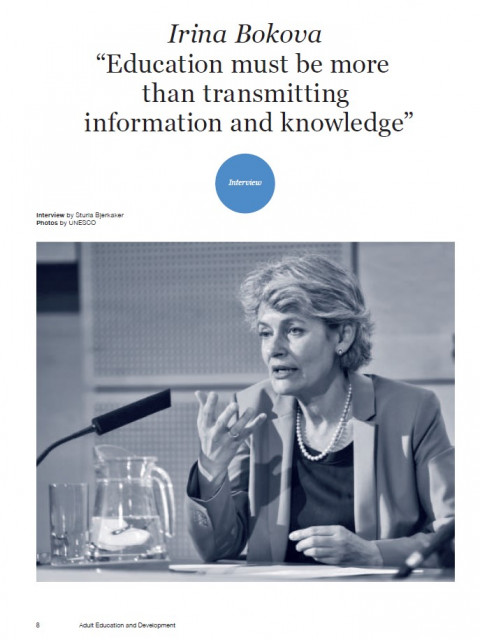 Education must be more than transmitting information and knowledge Year of publication: 2015 Author: Sturla Bjerkaker Corporate author: UNESCO. Director-General, 2009-2017 (Bokova, I.G.) Irina Bokova has been the Director-General of UNESCO since November 2009. She is the first woman to lead the organisation. Ms Bokova has served as Bulgaria’s Secretary of State for European Integration, Minister of Foreign Affairs, Ambassador to France and Monaco and Permanent Delegate to UNESCO, among other positions. She has been actively engaged in international efforts to advance quality education for all, gender equality, human rights, cultural dialogue and scientific cooperation. She also serves as Executive Secretary of the Steering Committee of the UN Secretary-General’s Global Education First Initiative.
  جدول أعمال 2030 للتنمية المستدامة Year of publication: 2018 Corporate author: United Nations System Staff College (UNSSC) من خلال تأييد خطة التنمية المستدامة لعام 2030 وأهدافها السبعة لعام 2015 ، أكد المجتمع الدولي على التنمية المستدامة. في هذا الجدول ، تعهدت مائة وتسع وثلاثون دولة من الدول الأعضاء بضمان نمو اقتصادي شامل ومستدام ، والاندماج الاجتماعي ، وحماية البيئة وتعزيز المجتمعات السلمية والعادلة والشاملة للجميع من خلال شراكة عالمية جديدة. إن جدول أعمال 2030 قائم على الحقوق وطموح. إنه خطة عمل طموحة للبلدان ، ومنظومة الأمم المتحدة ، وجميع الجهات الفاعلة الأخرى. تتجاوز الأجندة الخطابة وتوجه دعوة ملموسة للناس والكوكب والازدهار ، وتشجعنا على اتخاذ خطوات جريئة وتحويلية مطلوبة بشكل عاجل لتوجيه العالم نحو طريق مستدام ومرن. 2030 Agenda for Sustainable Development Year of publication: 2018 Corporate author: United Nations System Staff College (UNSSC) By endorsing the 2030 Agenda for Sustainable Development and its seven goals for 2015, the international community emphasized sustainable development. In this table, one hundred and ninety three Member States pledged to ensure inclusive and sustained economic growth, social inclusion, environmental protection and the promotion of peaceful, just and inclusive societies through a new global partnership. The Agenda 2030 is rights-based and ambitious.It is an ambitious plan of action for countries, the United Nations system, and all other actors. The agenda goes beyond rhetoric and makes a concrete call to people, the planet and prosperity, and it encourages us to take bold and transformative steps urgently needed to guide the world towards a sustainable and resilient path. La educación no solo debería consistir en transmitir información y conocimientos Year of publication: 2015 Author: Sturla Bjerkaker Corporate author: UNESCO. Director-General, 2009-2017 (Bokova, I.G.) Irina Bokova ha sido Directora General de la UNESCO desde noviembre de 2009. Ha sido la primera mujer al frente de la institución. En el Gobierno de Bulgaria, la señora Bokova ha ocupado, entre otros cargos, el de Secretaria de Estado para la Integración Europea, Ministra de Asuntos Exteriores, embajadora en Francia y Mónaco, al igual que delegada permanente en la UNESCO. Ha participado activamente en las iniciativas internacionales destinadas a promover una educación de calidad para todos, la igualdad entre los géneros, los derechos humanos, el diálogo cultural y la cooperación científica. También es Secretaria General del Comité Directivo de la Iniciativa Mundial “La educación ante todo” del Secretario General de la ONU (Global Education First Initiative - GEFI). L’éducation doit faire plus que transmettre des informations et du savoir Year of publication: 2015 Author: Sturla Bjerkaker Corporate author: UNESCO. Director-General, 2009-2017 (Bokova, I.G.) Irina Bokova est Directrice générale de l’UNESCO depuis novembre 2009. Elle est la première femme à la tête de cette organisation. Auparavant, madame Bokova a, entre autres, été secrétaire d’État à l’Intégration européenne et ministre des Aff aires étrangères en Bulgarie, ambassadrice en France et à Monaco, et déléguée permanente auprès de l’UNESCO. Elle s’est engagée activement dans des eff orts internationaux pour faire progresser la qualité de l’éducation pour tous, l’égalité des sexes, les droits humains, le dialogue culturel et la coopération scientifi que. Elle est également secrétaire exécutive de l’Initiative mondiale du secrétaire général de l’ONU pour l’éducation avant tout.
  Global Citizenship in Sub-Saharan Africa Year of publication: 2015 Author: Akemi Yonemura Corporate author: Éducation des Adultes et Développement Learners today are required to develop a comprehensive understanding of local, national and global challenges, so that they can influence the political, social, cultural, economic and environmental development both in their societies and their personal lives. UNESCO has been promoting education for peace and sustainable development as the overarching goal of its education programme, focusing on transformative education through Global Citizenship Education (GCED). This paper discusses GCED in Sub-Saharan Africa in the context of the post-2015 education agenda, with a particular focus on adult education. Ciudadanía mundial en el África Subsahariana Year of publication: 2015 Author: Akemi Yonemura Corporate author: Éducation des Adultes et Développement En la actualidad, a los alumnos se les exige desarrollar una concepción global de los problemas locales, nacionales y mundiales, para que sean capaces de influir en el desarrollo político, social, cultural y económico, tanto en su sociedad como en su vida personal. La UNESCO ha estado promoviendo la educación para la paz y el desarrollo sostenible como objetivo integral de su programa de educación, concentrándose en la educación transformativa por medio de la educación para la ciudadanía mundial (ECM). En este trabajo se analiza la ECM en el África Subsahariana (ASS), en el contexto de la agenda educativa posterior a 2015, con especial énfasis en la educación de adultos.
  De qué manera puede el trabajo en red ayudar a construir la ciudadanía mundial en Japón Year of publication: 2015 Author: Hideki Maruyama Corporate author: Éducation des Adultes et Développement En el artículo se explican y esbozan algunos de los numerosos y diversos desafíos que afrontan las escuelas japonesas al enseñar sobre el desarrollo sostenible. Se mencionan ejemplos concretos y se entregan algunas propuestas de iniciativas.