
Resources
Explore a wide range of valuable resources on GCED to deepen your understanding and enhance your research, advocacy, teaching, and learning.
32 Results found
 Global Citizenship and Lingual Identity: The Ability to Perform in Different Lingual Settings Year of publication: 2011 Author: Ann-Christin Torpsten Corporate author: SAGE Publications The aim of this article is to interpret second-language pupils’ encounter with the Swedish school regarding first- and second-language learning. An empirical context called experienced learning is investigated by interpreting student teachers’ oral and written narrated learning memories. Using a life-story approach, the interpretation focuses on lingual skills, lingual identity and citizenship. The study looks at participation in Swedish as a second language and mother tongue education when the subjects encountered the Swedish school system. Participating in those lessons is described as positive. Participating made it easier to improve skills in the second language and mother tongue. Mother tongue skills were transferred to the second-language improvement. It became much easier to continue developing the second language when skills in the mother tongue increased. Language skills were positive for continued learning, linguistic development, development of bilingualism and multilingualism. Through widened linguistic horizons it becomes possible to develop identity as multilingual persons. When skills increase in different languages such as Swedish as a second language and mother tongue, the subjects become aware of their identities as multilingual persons. They become aware of their possibilities of being active, multicultural, global citizens. Their ability to perform in different lingual settings becomes visible. Citoyenneté mondiale et Identité linguale : la capacité d'exécuter dans différents contextes linguales Year of publication: 2011 Author: Ann-Christin Torpsten Corporate author: SAGE Publications Le but de cet article est d'interpréter la rencontre des élèves de langue seconde à l'école suédoise au sujet de première et de l'apprentissage de la langue seconde. Un contexte empirique appelé apprentissage expérimenté est étudié en interprétant des souvenirs d'apprentissage orales et écrites narrés des enseignants aux étudiants. En utilisant une approche histoire de vie, l'interprétation se concentre sur les compétences linguales, l'identité et la citoyenneté lingual. L'étude se penche sur la participation en suédois comme langue seconde et éducation en langue maternelle lorsque les sujets ont rencontré le système scolaire suédois. La participation à ces leçons est décrit comme positif. La participation a rendu plus facile d'améliorer les compétences dans la langue seconde et langue maternelle. Compétences en langue maternelle ont été transférés à l'amélioration de la langue seconde. Il est devenu beaucoup plus facile de continuer à développer la deuxième langue lorsque les compétences dans la langue maternelle ont augmenté. Les compétences linguistiques ont été positifs pour l'apprentissage continu, le développement linguistique, le développement du bilinguisme et le multilinguisme. A travers élargi les horizons linguistiques, il devient possible de développer une identité en tant que personnes multilingues. Lorsque les compétences augmentent dans différentes langues comme le suédois comme langue seconde et la langue maternelle, les sujets prennent conscience de leur identité en tant que personnes multilingues. Ils prennent conscience de leurs possibilités d'être multiculturelles, des citoyens actifs. Leur capacité à effectuer dans différents contextes linguales devient visible.
  Global Citizenship and Youth Participation in Europe Year of publication: 2016 Author: Douglas Bourn Corporate author: Oxfam | Oxfam Italia | UCL Institute of Education | CARDET | Pah Global Citizenship has been recognized as an important component of education by UNESCO through the Sustainable Development Goals launched in 2015 and the recent Global Education Congress in Croatia.While there has been considerable activity across Europe in encouraging youth engagement in democratic institutions, this report suggests that insufficient attention has been given to the linkages young people make between their outlook on the world, their personal and social identity and the ways they use tools such as social networking to engage in societies.The report also suggests to teachers that they need to address and respond to the interests of young people in issues such as refugees and migration, climate change and global terrorism by equipping them with the knowledge and skills to effectively engage in these debates.
 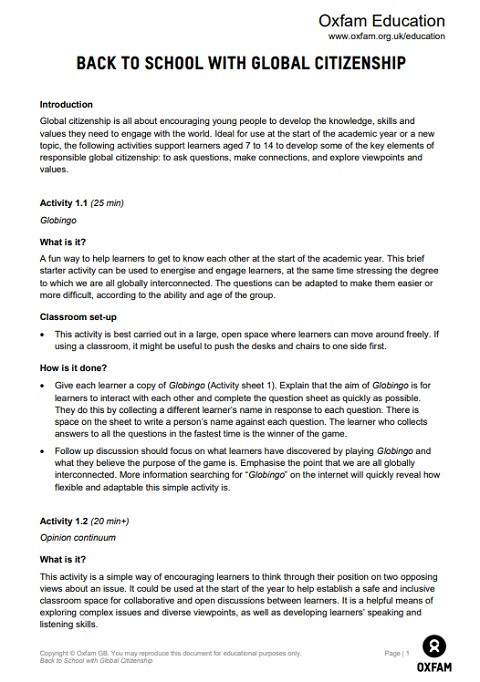 Back to School With Global Citizenship Corporate author: Oxfam GB Global citizenship is all about encouraging young people to develop the knowledge, skills and values they need to engage with the world. Ideal for use at the start of the academic year or a new topic, the following activities support learners aged 7 to 14 to develop some of the key elements of responsible global citizenship: to ask questions, make connections, and explore viewpoints and values.
 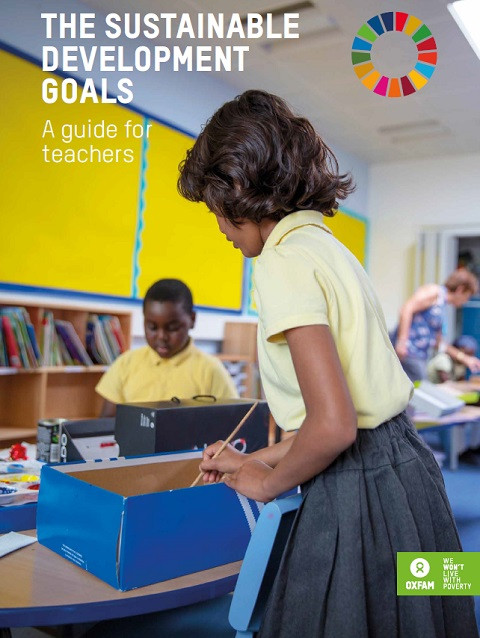 The Sustainable Development Goals: A Guide for Teachers Year of publication: 2019 Corporate author: Oxfam GB This guide supports teachers and educators working with young people to deepen their understanding of education about and for the SDGs and to see how global citizenship education (GCE) approaches and methodologies can underpin good practice. The guide also explores the benefits and challenges of using the SDG framework with learners in schools.
 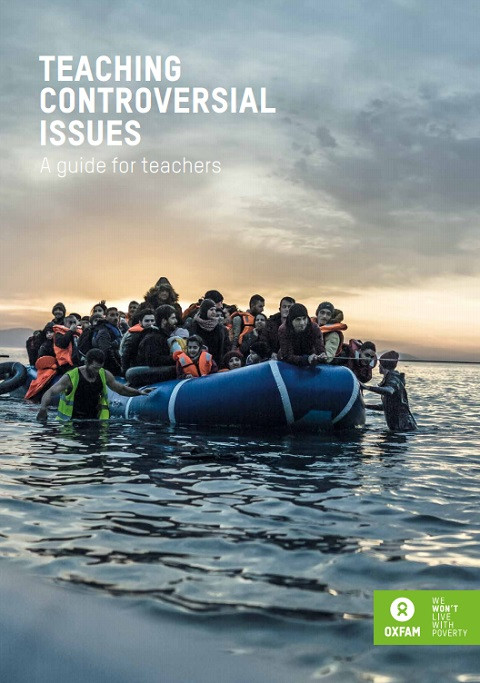 Teaching Controversial Issues: A Guide for Teachers Year of publication: 2018 Corporate author: Oxfam GB This revised and updated version of Oxfam’s popular guide recognises the changes in social and political contexts in recent years and seeks to support educators in their discussions with young people in this complex environment. In increasingly divisive and polarised times, the need for young people to feel confident in tackling controversial issues is more pressing than ever. Advances in technology and the rise of social media mean that it is more important than ever for young people to think critically to become effective global citizens.This guide explores:• What controversial issues are.• Reasons for teaching controversial issues.• The value of a global citizenship education approach.• Guidance and classroom strategies for handling and exploring controversial issues.• Some practical activities for teaching controversial issues.
  Youth Participation and Global Citizenship: Challenges and Recommendations for Future Youth School Forums Year of publication: 2016 Author: Anna Jarkiewicz | Joanna Leek Corporate author: Oxfam GB | University of S odz (Poland) The overall purpose of this report is to identify the needs of the Future School Youth Forums on youth participation and global citizenship education. The study synthesizes information from Cyprus, Italy, Lithuania, Poland and the United Kingdom in order to understand similarities and differences, and compare them with wider European trends to understand transversal needs across Europe. It discusses in greater detail the current application of global citizenship youth forums and global citizenship/youth participation in each of the 5 countries – and therefore across 7 national systems (as Wales and Scotland have their own systems), and also transversally across Europe. The report will help Partners to better understand the project’s needs, so that they can design project outputs more effectively.
  Putting the Voice of Young People at the Heart of Global Citizenship Education Year of publication: 2014 Author: Douglas Bourn Corporate author: UCL Institute of Education | Erasmus+ This briefing is aimed at policy-makers across Europe who are engaged with, or interested in ensuring that education and international development programmes give consideration to the voices of young people. It also aims to contribute to policy-makers responses to how they are implementing the Sustainable Development Goals.
  Discussing Controversial Issues in the Classroom Year of publication: 2012 Author: Michael Hand | Ralph Levinson Discussion is widely held to be the pedagogical approach most appropriate to the exploration of controversial issues in the classroom, but surprisingly little attention has been given to the questions of why it is the preferred approach and how best to facilitate it. Here we address ourselves to both questions. Discussing Controversial Issues in the Classroom Year of publication: 2012 Author: Michael Hand | Ralph Levinson Engager la discussion est largement considéré comme l'approche pédagogique la plus appropriée pour aborder les questions controversées dans la salle de classe. Toutefois, l’analyse et la compréhension de ce statut privilégié n’a soulevé que peu d’attention, de même que la question de savoir par quels moyens faciliter cette approche dans la salle de classe. L'article traite de ces deux questions.