
Resources
Explore a wide range of valuable resources on GCED to deepen your understanding and enhance your research, advocacy, teaching, and learning.
130 Results found
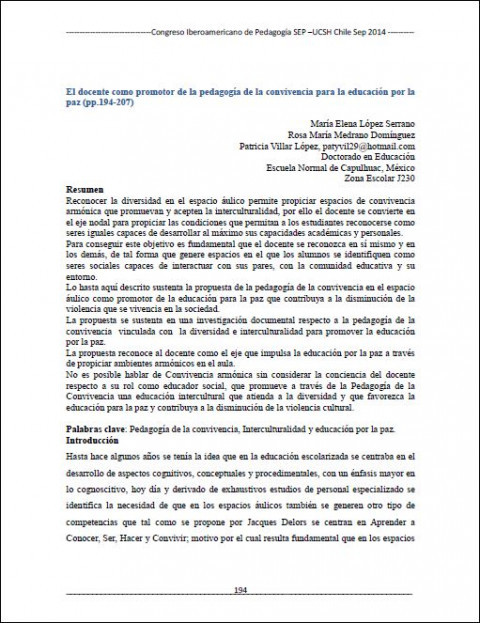 The Teacher as a Promoter of the Pedagogy of Coexistence for Education for Peace Year of publication: 2014 Author: María Elena López Serrano | Rosa María Medrano Domínguez | Patricia Villar López Corporate author: Universidad Católica Silva Henríquez Recognizing the diversity in the aulic space allows to create spaces of harmonious coexistence that promote and accept interculturality, for this the teacher becomes the nodal axis to propitiate the conditions that allow the students to recognize themselves as equal beings capable of developing their capacities to the maximum academic and personal. To achieve this goal it is essential that the teacher recognizes himself and others, in such a way that generates spaces in which students identify as social beings able to interact with their peers, the educational community and their environment. What has been described here supports the proposal of the pedagogy of coexistence in the aulic space as a promoter of education for peace that contributes to the reduction of the violence experienced in society. The proposal is based on a documentary research on the pedagogy of coexistence linked to diversity and interculturality to promote education for peace. The proposal recognizes the teacher as the axis that drives education for peace through fostering harmonious environments in the classroom. It is not possible to speak of harmonic coexistence without considering the teacher's awareness of his role as a social educator, which promotes through Pedagogy of Coexistence an intercultural education that attends to diversity and that favors education for peace and contributes to the decrease of cultural violence. El docente como promotor de la pedagogía de la convivencia para la educación por la paz Year of publication: 2014 Author: María Elena López Serrano | Rosa María Medrano Domínguez | Patricia Villar López Corporate author: Universidad Católica Silva Henríquez Reconocer la diversidad en el espacio áulico permite propiciar espacios de convivencia armónica que promuevan y acepten la interculturalidad, por ello el docente se convierte en el eje nodal para propiciar las condiciones que permitan a los estudiantes reconocerse como seres iguales capaces de desarrollar al máximo sus capacidades académicas y personales. Para conseguir este objetivo es fundamental que el docente se reconozca en sí mismo y en los demás, de tal forma que genere espacios en el que los alumnos se identifiquen como seres sociales capaces de interactuar con sus pares, con la comunidad educativa y su entorno. Lo hasta aquí descrito sustenta la propuesta de la pedagogía de la convivencia en el espacio áulico como promotor de la educación para la paz que contribuya a la disminución de la violencia que se vivencia en la sociedad. La propuesta se sustenta en una investigación documental respecto a la pedagogía de la convivencia vinculada con la diversidad e interculturalidad para promover la educación por la paz.La propuesta reconoce al docente como el eje que impulsa la educación por la paz a través de propiciar ambientes armónicos en el aula. No es posible hablar de Convivencia armónica sin considerar la conciencia del docente respecto a su rol como educador social, que promueve a través de la Pedagogía de la Convivencia una educación intercultural que atienda a la diversidad y que favorezca la educación para la paz y contribuya a la disminución de la violencia cultural.
  IX and X Days of Educational Cooperation with Iberoamerica on Special Education and Educational Inclusion Year of publication: 2015 Corporate author: UNESCO Santiago This publication includes the main presentations made by experts in educational inclusion presented at the IX and X Conference on Educational Cooperation with Ibero-America on special education and educational inclusion, held in Cartagena de Indias, Colombia (2012) and Santa Cruz, Bolivia ( 2013), respectively. The workshops have been organized by the Ministry of Education of Spain with the support of the Regional Office of Education for Latin America and the Caribbean (OREALC / UNESCO Santiago). We hope that this publication will contribute to the dissemination of the reflections that RIINEE has developed on critical issues in the field of the educational inclusion of people with disabilities and / or special educational needs, and in this way, constitute a contribution to advance in the guarantee of the rights indicated in the Convention on the Rights of Persons with Disabilities, approved in 2006 by the Member States of the United Nations Organization. IX y X Jornadas de Cooperación Educativa con Iberoamérica sobre Educación Especial e Inclusión Educativa Year of publication: 2015 Corporate author: UNESCO Santiago En esta publicación se incluyen las principales ponencias realizadas por personas expertas en inclusión educativa presentadas en las IX y X Jornadas de Cooperación Educativa con Iberoamérica sobre educación especial e inclusión educativa, realizadas en Cartagena de Indias, Colombia (2012) y Santa Cruz, Bolivia (2013), respectivamente. Las jornadas han sido organizadas por el Ministerio de Educación de España con el apoyo de la Oficina Regional de Educación para América Latina y el Caribe (OREALC/UNESCO Santiago). Esperamos que con esta publicación se contribuya a la difusión de las reflexiones que la RIINEE ha desarrollado sobre nudos críticos en el ámbito de la inclusión educativa de personas con discapacidades y/o necesidades educativas especiales, y de esta forma, constituya un aporte para avanzar en la garantía de los derechos señalados en la Convención sobre los Derechos de las Personas con Discapacidad, aprobada el año 2006 por los Estados Miembro de la Organización de las Naciones Unidas.
  The Challenges to Build Citizenship: Media as a Platform for Dialogue Year of publication: 2010 Author: Claudia Lagos Corporate author: Universidad de Chile The OREALC / UNESCO Santiago and the UNESCO National Commission, the Regional Delegation for Cooperation in the Southern Cone and Brazil, the French Embassy in Chile, the Freedom of Expression Program of the Institute of Communication and Image of the University of Chile and the UNESCO Chair "Media and citizen participation" of the Universidad Diego Portales, commemorated the World Day for Press Freedom 2009 with the seminar "The challenges to build citizenship. Media as a platform for dialogue ", held on May 5, 2009 at the Central House of the University of Chile. The meeting, with national and international guests, made it possible to reflect on and discuss the main issues -although not the only ones- that are currently in the hands of issues related to the promotion of pluralism and diversity; the challenges for journalism and the media in a context of high technological renewal and economic crisis; the lines of work in the matter for the design and execution of public policies, and research in communication. This publication collects the presentations of the speakers during the Seminar, as well as leaves testimony of the commitments assumed by the presidential candidates that we hope will become an agenda not only for the 2010-2014 administration, but also for the political sectors that represent each one of those who signed the document. Seminario Los Desafíos para Construir Ciudadanía: Medios de Comunicación como Plataforma de Diálogo Year of publication: 2010 Author: Claudia Lagos Corporate author: Universidad de Chile La OREALC/UNESCO Santiago y la Comisión Nacional UNESCO, la Delegación Regional de Cooperación para el Cono Sur y Brasil, de la Embajada de Francia en Chile, el Programa de Libertad de Expresión del Instituto de la Comunicación e Imagen de la Universidad de Chile y la Cátedra UNESCO “Medios de comunicación y participación ciudadana” de la Universidad Diego Portales, conmemoraron el Día Mundial por la Libertad de Prensa 2009 con el seminario “Los desafíos para construir ciudadanía. Medios de comunicación como plataforma de diálogo”, realizado el 5 de mayo de 2009 en la Casa Central de la Universidad de Chile. El encuentro, con invitados nacionales e internacionales, permitió reflexionar y discutir sobre los principales -aunque no los únicos- problemas que hoy están en carpeta en cuestiones referidas al fomento del pluralismo y la diversidad; los desafíos para el periodismo y los medios en un contexto de alta renovación tecnológica y crisis económica; las líneas de trabajo en la materia para el diseño y ejecución de políticas públicas, y la investigación en comunicación. Esta publicación recoge las presentaciones de los expositores durante el Seminario, así como también deja testimonio de los compromisos asumidos por los candidatos presidenciales que esperamos se transforme en una agenda no sólo para la administración 2010-2014, sino que también para los sectores políticos que representa cada uno de quienes suscribieron el documento.
  Inequidad de género en los logros de aprendizaje en educación primaria ¿Qué nos puede decir TERCE?; resumen ejecutivo Year of publication: 2016 Author: Denisse Gelber, Ernesto Treviño, Pamela Inostroza Corporate author: UNESCO Santiago This premise of work clearly establishes that promoting learning opportunities for all will be one of the priorities in the Education 2030. Within this framework, UNESCO Santiago has its own instrument that allows delivering diagnosis and analysis in depth about the learning inequality within the region; the Thrid Regional Comparative and Explanatory Study, TERCE - carried out by the Latin American Laboratory for Assessment of the Quality of Education, LLECE, body bringing together 15 countries and coordinated by our Office.
  I International Congress: Good Training Practices for the Professional Development of Teachers 2023 Year of publication: 2023 Corporate author: Chile. Ministry of Education | Organization of Ibero-American States for Education, Science and Culture (OEI) This book is the result of the First International Congress of Good Training Practices for the Professional Development of Teachers, held on December 5 and 6, 2023 at the Center for Improvement, Experimentation and Pedagogical Research (CPEIP) of the Ministry of Education of Chile (Mineduc), in conjunction with the Organization of Ibero-American States (OEI). It includes practices for training with a focus on rights and for sustainable development. I Congreso Internacional: Buenas prácticas formativas para el desarrollo profesional docente 2023 Year of publication: 2023 Corporate author: Chile. Ministry of Education | Organización de Estados Iberoamericanos para la Educación, la Ciencia y la Cultura (OEI) Este libro es el resultado del Primer Congreso Internacional de Buenas Prácticas Formativas para el Desarrollo Profesional Docente, desarrollado los días 5 y 6 de diciembre del 2023 en dependencias del Centro de Perfeccionamiento, Experimentación e Investigaciones Pedagógicas (CPEIP) del Ministerio de Educación de Chile (Mineduc), en conjunto con la Organización de Estados Iberoamericanos (OEI). Incluye prácticas para la formación con enfoque de derechos y para el desarrollo sostenible.
 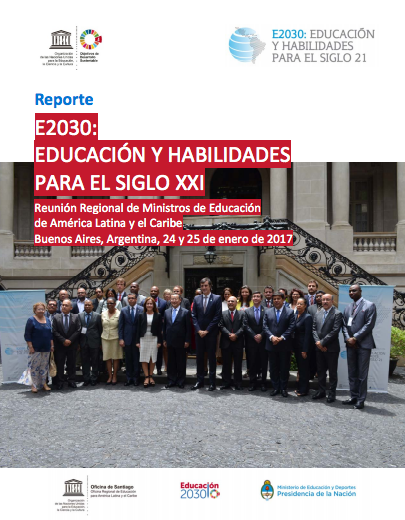 E2030: education and skills for the 21st century, report Year of publication: 2017 Corporate author: UNESCO Santiago The UNESCO Regional Bureau for Education in Latin America and the Caribbean, OREALC/UNESCO Santiago, in collaboration with the Ministry of Education and Sport of the Republic of Argentina, organized the Regional Meeting of Ministers of Education of Latin America and the Caribbean – “E2030: Education and skills for the 21st century”. Ministers of Education and high-level representatives of the education sector of the Member States of LAC; bilateral, regional and multilateral organizations; United Nations agencies; representatives of civil society; stakeholders and UNESCO experts participated in the meeting, which was held on 24-25 January 2017 in Buenos Aires, Argentina. This was the first ministerial meeting to be organized within the framework of the 2030 Agenda for Sustainable Development and its 17 Sustainable Development Goals (SDGs), in particular SDG 4 – “Ensure inclusive and quality education for all and promote lifelong learning”. It provided a space for dialogue between ministers of education and other stakeholders to debate SDG 4 in the context of the 2030 SDG Agenda. Discussions and information sharing on various topics related to the SDG 4 targets, and on the coordination mechanisms and monitoring instruments conducive to the achievement of E2030 enabled LAC Member States to reach a common vision and understanding of E2030 in the region. This joint approach on E2030 for the region is laid down in the Declaration of Buenos Aires, which ministers adopted at the end of the meeting.