
Resources
Explore a wide range of valuable resources on GCED to deepen your understanding and enhance your research, advocacy, teaching, and learning.
1,322 Results found
 Education sector responses to climate change: background paper with international examples Year of publication: 2012 Corporate author: UNESCO Bangkok Through a review of academic articles and project documents, this paper explores the relationship between the education sector and climate change. It introduces how education is both impacted by and has an impact on this phenomenon, and proposes various sector responses. Different theoretical frameworks for where and how climate change education fits into the education sector are made concrete with case studies from across the globe. An essential introduction to climate change and education, this paper brings together theory, policy and practice. A useful read for those working in either the education sector or on climate change. Les réponses du secteur de l'éducation au changement climatique: document d'information avec des exemples internationaux Year of publication: 2012 Corporate author: UNESCO Bangkok Grâce à un examen des articles universitaires et des documents de projet, cet article explore la relation entre le secteur de l'éducation et le changement climatique. Il introduit comment l'éducation est à la fois touchée par et a un impact sur ce phénomène, et propose diverses réponses du secteur. Différents cadres théoriques pour où et comment le changement climatique l'éducation inscrit dans le secteur de l'éducation sont en béton avec des études de cas à travers le monde. Une introduction essentielle au changement climatique et de l'éducation, ce document rassemble la théorie, la politique et la pratique. Une lecture utile pour ceux qui travaillent soit dans le secteur de l'éducation ou sur le changement climatique. Outcome document on education and biodiversity conservation, adopted at the parallel event: international conference on biodiversity conservation and education for sustainable development: learning to conserve biodiversity in a rapidly changing world Year of publication: 2012 Corporate author: Centre for Environment Education The Outcome Document from the two day International Conference on Biodiversity Conservation and ESD, attended by over 250 participants including educators and held as a parallel event inside COP 11, outlines a way forward by providing recommendations towards a strategic plan of action for ESD in the context of biodiversity conservation. The role of education and training in sustainable development: social, economic and environmental dimensions Year of publication: 2006 Author: Mohammad Jabir Ali | Abdallah AmboSaeedi | Jilani Lamloumi | Sulieman Sulieman Corporate author: UNESCO Beirut Education, Training and Sustainable Development are three fields for life were selected to be the topic in the Regional Workshop on the Role of Education and Training in Sustainable Development (Manama - Kingdom of Bahrain, 19-21 September 2005), as part of TVET-UNEVOC programme for 2004-2005, and follow-up on Bonn Declaration issued at the end of the International Expert Meeting on “Learning for Work, Citizenship and Sustainability”, Bonn, 25-28 October 2004. Thirty five (35) officials, experts and specialists from thirteen (13) Arab countries, UNESCO Offices in Beirut and Doha, and the International Centre for TVET - Bonn Centre took part in Bahrain Workshop. The Organizing Committee for the Workshop had highlighted the social, economic and enviromental dimensions of sustainable development, according to the plan of action of the UN Decade on Education for Sustainable Development (2005-2014). The main working papers discussed in the Workshop were developed into a reference study in TVET-UNEVOC Searies to reflect on future orientations in the fields related to Sustainable Development in the Arab countries. Le rôle de l'éducation et de la formation dans le développement durable: les dimensions sociales, économiques et environnementales Year of publication: 2006 Author: Mohammad Jabir Ali | Abdallah AmboSaeedi | Jilani Lamloumi | Sulieman Sulieman Corporate author: UNESCO Beirut L’éducation, formation et développement durable sont trois champs pour la vie ont été choisis pour être le sujet à l'atelier régional sur le rôle de l'éducation et de la formation dans le développement durable (Manama - Royaume de Bahreïn, 19-21 Septembre 2005), dans le cadre de TVET- programme UNEVOC pour 2004-2005, et le suivi de la Déclaration de Bonn émis à la fin de la réunion internationale d'experts sur «Apprendre pour le travail, la citoyenneté et la durabilité», Bonn, 25-28 Octobre 2004. Trente-cinq (35) fonctionnaires, experts et des spécialistes de treize (13) pays arabes, Bureaux de l'UNESCO à Beyrouth et à Doha, et le Centre international pour l'EFTP - Centre de Bonn ont pris part à Bahreïn Atelier. Le Comité d'organisation de l'atelier a mis en évidence les dimensions sociales, économiques et Enviromental du développement durable, selon le plan d'action de la Décennie des Nations Unies sur l'éducation pour le développement durable (2005-2014). Les principaux documents de travail abordés dans l'atelier ont été mis au point dans une étude de référence dans l'EFTP-UNEVOC Searies à réfléchir sur les orientations futures dans les domaines liés au développement durable dans les pays arabes. Water education for sustainable development: a global synthesis Year of publication: 2012 Corporate author: International Hydrological Programme (IHP) Water education is key to achieve the water related MDGs. While there is a range of materials and projects focusing on water-related education, these are not well connected to offer customised solutions to individual countries. Some of the limitations identified with the existing water education include use of outdated, biased or irrelevant information; poor medium of instruction; lack of continuity between different levels of water education; lack of integration with the wider curriculum and with local knowledge; lack of practical relevance to local and community needs; lack of resources; and poor linkages with locally available professional bodies. The programme on “Water Education” is an initiative of the International Hydrological Programme (IHP) of UNESCO, Water and Sustainable Education focused on an integrated understanding of biological and hydrological processes at a catchment’s scale in order to create a scientific basis for a new, cost-effective and systemic approach to the sustainable management of freshwater resources. L'éducation relative à l'eau pour le développement durable: une synthèse globale Year of publication: 2012 Corporate author: International Hydrological Programme (IHP) L'éducation relative à l'eau est essentielle pour atteindre les OMD(Objectifs du Millénaire pour le Développement) liées à l'eau. Bien qu'il existe toute une gamme de matériels et de projets axés sur l'éducation relative à l'eau, ceux-ci ne sont pas bien reliés pour offrir des solutions personnalisées à chaque pays. Certaines des limitations identifiées avec l'éducation en matière d'eau existante incluent l'utilisation d'information périmée, biaisée ou non pertinente; Milieu pauvre d'instruction; Manque de continuité entre les différents niveaux de l'éducation relative à l'eau; Le manque d'intégration avec le programme d'études plus large et avec les connaissances locales; Manque de pertinence pratique pour les besoins locaux et communautaires; manque de ressources; Et les faibles liens avec les organismes professionnels disponibles sur place. Le programme sur l'éducation à l'eau est une initiative du Programme Hydrologique International (PHI) de l'UNESCO, Eau et éducation durable, axé sur une compréhension intégrée des processus biologiques et hydrologiques à l'échelle d'un bassin versant afin de créer une base scientifique pour une nouvelle, Rentable et systémique de la gestion durable des ressources en eau douce.
  파리협정 함께 보기 Year of publication: 2022 Corporate author: 대한민국 환경부 기후변화국제협력팀 | 한국환경공단 기후정책지원부 이 책자는 ‘파리협정(Paris Agreement)’에 대한 우리 국민의 이해를 높이고, 모든 사회 주체가 함께하는 파리협정 이행 체계를 조성하는데 도움이 되고자 제작되었습니다.이 책자는 환경부와 한국환경공단이 공동으로 발간한 「파리협정 길라잡이(’16.5)」와 「파리협정 이행규칙 안내서(’19.6)」를 통합·개정·증보한 것으로, 기존 발간 자료는 환경부 누리집(me.go.kr)>발행물>환경책자>알기쉬운 소책자에서 받아볼 수 있습니다. 발행처: 환경부 기후변화국제협력팀 (044-201-6601)발행일: 2022.3.31
 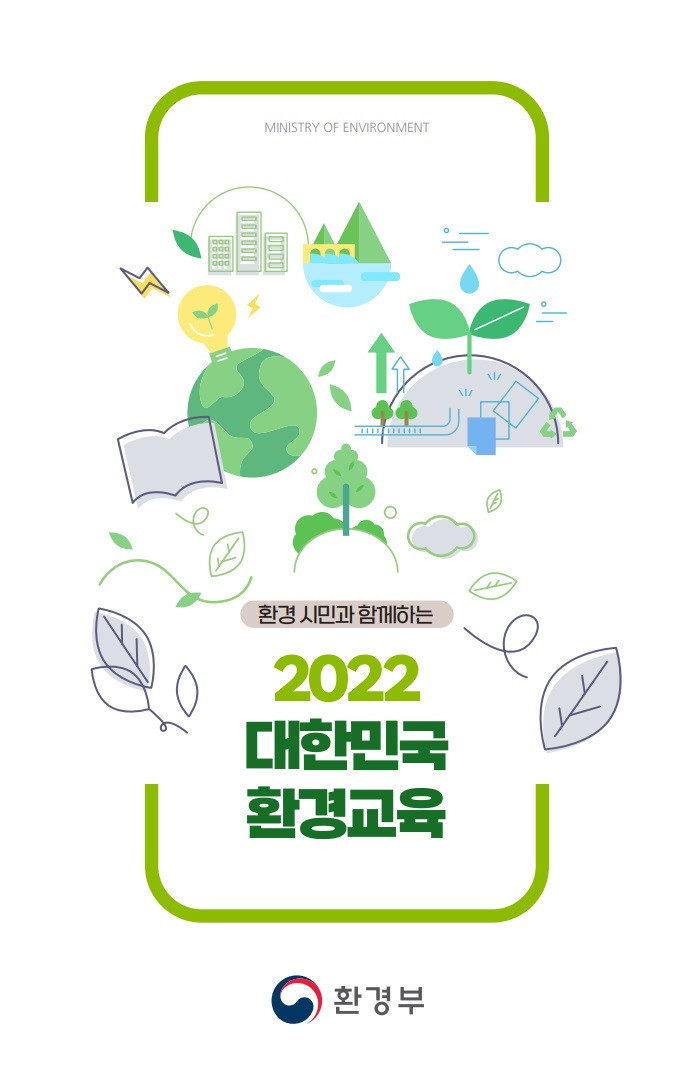 환경 시민과 함께하는 2022 대한민국 환경교육 Year of publication: 2022 Corporate author: 대한민국 환경부 이 발행물은 국민들에게 환경교육 정책과 사업을 알리고 정책의 발전을 함께 고민하고자 하는 목적으로 발행한 홍보물로 대한민국 환경교육 현황과 주요 국가의 초·중·고등학교와 일반인을 대상으로 하는 환경교육 사업을 조사하여 설명하고 있습니다.
 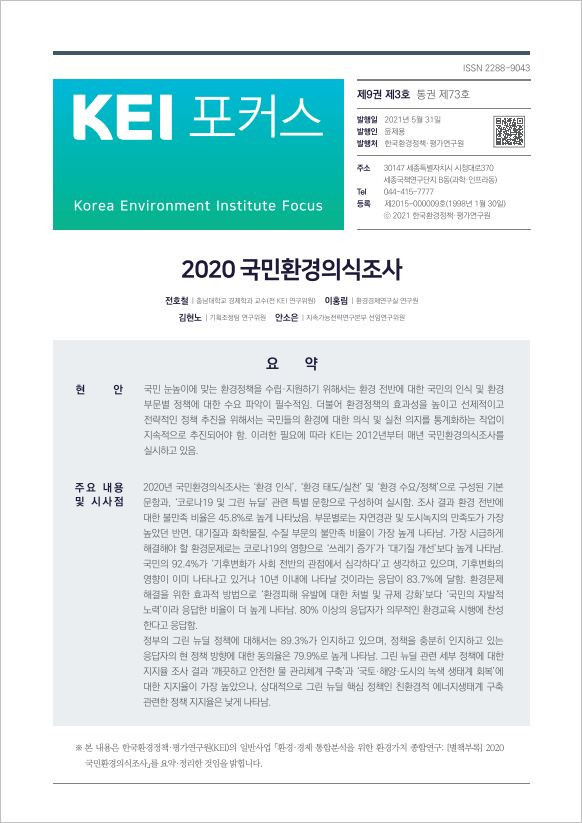 2020 국민환경의식조사 (KEI 포커스 제9권 통권 73호) Year of publication: 2021 Author: 전호철 | 이홍림 | 김현노 | 안소은 Corporate author: 한국환경정책·평가연구원 2020년 국민환경의식 조사는 '환경인식', '환경태도/실천' 및 '환경수요/정책/으로 구성된 기본 문항과 '코로나19 및 그린 뉴딜' 관련 특별 문항으로 구성하여 실시하였다. 조사 결과 환경 전반에 대한 불만족 비율은 45.8%로 높게 나타났으며 부문별로는 자연경관 및 도시녹지의 만족도가 가장 높았던 반면 대기질과 화학물질, 수질 부문의 불만족 비율이 가장 높게 나타났다. 가장 시급하게 해결해야 할 환경문제로는 코로나19의 영향으로 '쓰레기 증가'가 '대기질 개선' 보다 높게 나타났다. 본 저작물은 한국환경정책·평가연구원에서 2021년 작성하여 공공누리 제4유형으로 개방한 '2020 국민환경의식조사(작성자: 전호철)'을 이용하였으며, 해당 저작물은 한국환경연구원 홈페이지(https://www.kei.re.kr/)에서 무료로 내려받으실 수 있습니다.