
Resources
Explore a wide range of valuable resources on GCED to deepen your understanding and enhance your research, advocacy, teaching, and learning.
1,180 Results found
 Guardian@s del planeta Tierra: Gamificación en Educación Infantil Year of publication: 2020 Corporate author: Instituto Nacional de Tecnologías Educativas y de Formación del Profesorado (INTEF) The project "Inspiring Educational Experiences" is part of the Educational Digital Transformation Plan launched by INTEF, specifically "Guardians of planet Earth" whose main objective is the internalization by students of the importance of caring for our planet around three fundamental axes: recycling and treatment of waste, care of flora and fauna. With this, it intends to impregnate the students and their families with solid values that are internalized and endure over time and for this it uses different methodologies and active and participatory teaching strategies, in turn, favors the development of creativity and imagination in all activity of the project and explains how ICTs are a transversal element, offering the youngest population a variety of opportunities to use and enjoy technology.
 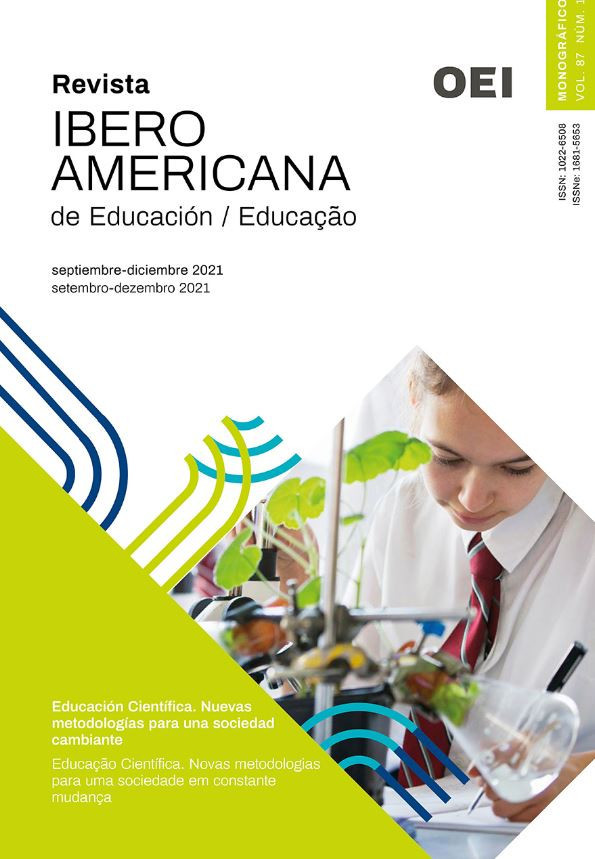 Scientific Education: New Methodologies for a Changing Society (Iberoamerican Journal of Education; vol. 87, no. 1) Year of publication: 2021 Author: F. Javier Perales | David Aguilera Corporate author: Organization of Ibero-American States for Education, Science and Culture (OEI) A society as changing as ours needs changes (innovations) and adaptations in the educational field that allow academics to be combined with social demands. We believe that this first monograph is representative of the richness and diversity of the proposals received which, in turn, constitute a sample of the strength of the community of teachers and researchers in their desire to make science education an attractive and efficient for new generations. Educación científica: Nuevas metodologías para una sociedad cambiante (Revista Ibero-americana de Educação; vol. 87, núm. 1) Year of publication: 2021 Author: F. Javier Perales | David Aguilera Corporate author: Organización de Estados Iberoamericanos para la Educación, la Ciencia y la Cultura (OEI) Una sociedad tan cambiante como la nuestra necesita de cambios (innovaciones) y adaptaciones en el ámbito educativo que permitan compaginar lo académico con las demandas sociales. Este primer monográfico estimamos que resulta representativo de la riqueza y diversidad de las propuestas recibidas que, a su vez, constituyen un muestrario de la pujanza de la comunidad de docentes e investigadores en su afán de hacer de la enseñanza de las ciencias una oferta atractiva y eficiente para las nuevas generaciones.
 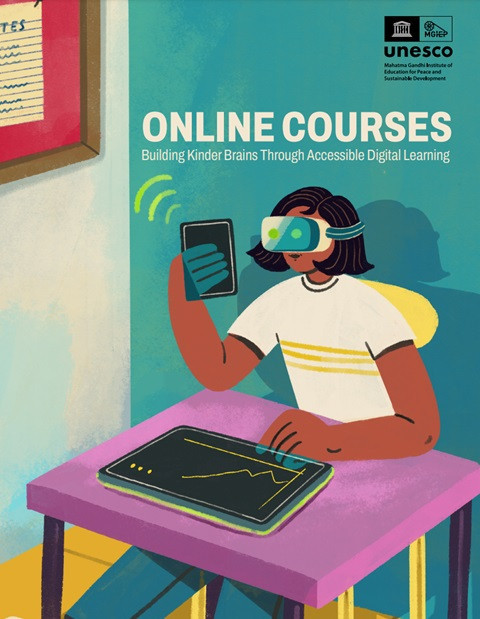 Online Courses: Building Kinder Brains Through Accessible Digital Learning Course Brochure Year of publication: 2023 Corporate author: Mahatma Gandhi Institute of Education for Peace and Sustainable Development (MGIEP) UNESCO MGIEP focuses on achieving the United Nations (UN) Sustainable Development Goal (SDG) 4, Target 7 towards education for building peaceful and sustainable societies across the world by developing programmes that promote social and emotional learning, innovate digital pedagogies and empower the youth. UNESCO MGIEP‘s Social Emotional Learning (SEL) courses are research and evidence based with built-in assessments. The courses are multi-modal, interactive and self-paced, and are designed to build intellectual and emotional intelligence among learners. Currently the courses are available in English and are being adapted to Hindi, Spanish and Russian.
  Environmental Education Toolkit Guide for Latin America and the Caribbean Year of publication: 2023 Author: Eloísa Tréllez Solís Corporate author: United Nations Environment Programme (UNEP) The Environmental Education Toolkit is aimed primarily at teachers, multipliers and facilitators in Latin America and the Caribbean (LAC), and aims to promote interdisciplinary approaches, with a view to the transversality of environmental education. In the new context of a post-COVID-19 health emergency world, this approach becomes more relevant and necessary to achieve a better vision and understanding of the relationships between humans and nature; between societies, cultures and with the ecosystems on which they depend. In the chapters that make up this publication, an approach is proposed through a methodological proposal for reflection and action, the Interdisciplinary Roundtables for Environmental Education towards Sustainability, whose main objective is to strengthen and complement the environmental education processes that are carried out both in educational centers and in community groups, from an interdisciplinary, transversal perspective and with systemic thinking. Guía de herramientas de educación ambiental para América Latina y el Caribe Year of publication: 2023 Author: Eloísa Tréllez Solís Corporate author: United Nations Environment Programme (UNEP) La Guía de Herramientas de Educación Ambiental está dirigida principalmente a docentes, multiplicadores y facilitadores de América Latina y el Caribe (ALC), tiene el propósito de impulsar enfoques interdisciplinarios, con miras a la transversalidad de la educación ambiental. En el nuevo contexto de un mundo post emergencia sanitaria COVID-19 este enfoque se vuelve más relevante y necesario para lograr una mejor visión y entendimiento de las relaciones entre el ser humano y la naturaleza; entre las sociedades, culturas y con los ecosistemas, de los que depende. Se propone, en los capítulos que integran esta publicación, un abordaje a través de una propuesta metodológica de reflexión y acción, las Mesas Interdisciplinarias de Educación Ambiental hacia la Sostenibilidad, cuyo objetivo principal es fortalecer y complementar los procesos de educación ambiental que se llevan a cabo tanto en centros educativos como en grupos comunitarios, desde una perspectiva interdisciplinaria, transversal y con pensamiento sistémico.
  In the Age of Lifelong Education, a Study on the Meaning of Teachers: Focused on the Plato’s Thought (The Journal of Korean Teacher Education; Vol. 36, No. 3) Year of publication: 2019 Author: 허지숙 Corporate author: 한국교원교육학회 The purpose of this study is to explore the essential meaning and role of teachers through Plato's educational thought. For this purpose, based on the four principles of UNESCO Lifelong Education, we examine how changes in and out of school and the role of teachers are required. Then, after reviewing Sophist, Socrates, Plato's Philosopher, and the metaphors of Cave from Plato's point of view, it reveals what meaning and value of the teacher image presented by Plato in today's lifelong education.Research shows that the role of teachers in the age of lifelong education is becoming more and more important, but this does not mean simply changing roles as guides and advisors. the changed face of the teacher is an ethical trainer to enrich their lives from a knowledge transferer, a collaborative learner through conversations and discussions outside the teacher-student relationship, a practitioner of inclusive teaching among learning alienation, learning inequality, a teacher as a lifelong learner who loves wisdom. This suggests implications for teachers 'new possibilities and meanings beyond the existing teacher' s role in the fall of the ruling right and the right of learning. 평생교육시대, 교사의 의미 탐색: 플라톤의 교육사상을 중심으로 (한국교원교육연구 제36권 제3호) Year of publication: 2019 Author: JiSuk Huh Corporate author: Korean Society for the Study of Teacher Education 본 연구는 평생교육시대의 변화에 부합하는 교사의 모습에 대한 재탐색이 필요하다는 문제의식 하에, 플라톤의 교육사상을 중심으로 교사의 본질적 의미와 역할에 대해 탐구하는데 목적이 있다. 이를 위해 먼저 UNESCO 평생교육의 네 가지 원리를 근거로 학교의 안팎의 변화와 교사의 역할이 어떻게 요구되고 있는지를 고찰하였다. 다음으로 플라톤의 관점에서 바라본 소피스트, 소크라테스, 플라톤의 철인, 동굴의 비유에 대해 살펴본 후, 플라톤이 제시한 교사상이 오늘날 평생교육시대에서 어떤 의미와 가치가 있는지 밝히고, 그 속에 내포된 교사로서의 역할과 의미를 구체적으로 탐색하였다.연구결과, 평생교육시대의 교사의 역할은 점점 더 중요해지고 있으나 이는 단순히 안내자, 조언자로서의 단순한 역할 변화를 의미하는 것이 아니다. 평생교육시대 교사의 변화된 모습은 지식전달자로부터 삶을 풍성하게 살아가기 위한 윤리적 훈련가로, 교사-학생의 관계에서 벗어나 대화와 토론을 통한 공동의 학습자로, 학습소외, 학습 불평등 가운데 포용적 교수의 실천가로, 열망을 가지고 끊임없이 배우는 생성적 존재로 모색된다. 이를 통해 오늘날 추락하는 교권과 학습권의 자리다툼 가운데 기존 교사의 역할을 넘어 교사가 지닌 새로운 가능성과 의미에 대해 시사점을 제안하였다.
  Teaching Students How to Learn: Setting the Stage for Lifelong Learning (Educational Practices Series No. 33) Year of publication: 2021 Author: Stella Vosniadou | Michael J. Lawson | Helen Stephenson | Erin Bodner Corporate author: UNESCO International Bureau of Education (IBE) | International Academy of Education In this Teaching How to Learn booklet, teachers can find information about some of the cognitive, metacognitive, emotional, and motivational capabilities that characterise self-regulated learners, and some of the actions that teachers can take to promote self-regulated learning in their students. These include giving students time to engage in constructive tasks independently or in collaboration with their peers and providing them with the knowledge and strategies that they can use to manage their learning and control their motivation and emotions while they complete these tasks successfully.
  Envision 4.7: Bridge 47 Global Event; Helsinki, Finland 5–7 November 2019: Report Year of publication: 2019 Corporate author: Bridge 47 | Frinland. Ministry of Education and Culture | Finland. Ministry for Foreign Affairs Global event Envision 4.7 was held in Helsinki in November 2019. The event brought around 200 people together to discuss ways to take the SDG Target 4.7 forward. In this report you can find summaries of all the speeches, panel discussions, workshops and working groups that were held at the event, together with a summary of discussions around all the different topics. You can also find pictures and drawings from the event at the report.