
Resources
Explore a wide range of valuable resources on GCED to deepen your understanding and enhance your research, advocacy, teaching, and learning.
662 Results found
 Discours de Mme Irina Bokova, Directrice générale de l'UNESCO à l'occasion du Séminaire sur les changements climatiques et l'éducation à l'Université des Nations Unies: Réagir aux changements climatiques commence par l'éducation Year of publication: 2010 Corporate author: UNESCO. Director-General, 1999-2009 (Matsuura, K.) Ce document est une adresse de Irina Bokova, Directrice générale de l'UNESCO à l'occasion du Séminaire sur les changements climatiques et l'éducation à l'Université des Nations Unies "Réagir aux changements climatiques commence par l'éducation" à Tokyo, le 26 Novembre 2010. Elle a souligné l'importance de la l'éducation au changement climatique pour l'avenir durable et a souligné l'importance de plusieurs programmes tels que Sandwatch et YouthXchange qui ont été prêcher par l'UNESCO. Learning to live with risk: disaster risk reduction to encourage education for sustainable development: concept note Year of publication: 2009 Author: Ria Hidajat Corporate author: International Strategy for Disaster Reduction | German Committee for Disaster Reduction In this paper the German Committee for Disaster Reduction and the UN ISDR Thematic Platform on Knowledge and Education introduced their reflection on linking Education for Sustainable Development and Disaster Risk Management. It is aimed in particular at the participants of the World Conference of Education for Sustainable Development and other stakeholders engaged in promoting Education, Sustainable Development and Disaster Risk Reduction at all levels. The paper elucidates how Disaster Risk Reduction supports Education for Sustainable Development or even shows that Disaster Risk Reduction is imperative for Sustainable Development. Disaster Risk Reduction is about preventing disasters caused by natural events, such as earthquakes, floods, landslides, storms or volcanic eruptions. Hazards are part of nature but can turn into disasters as a result of human interactions. Disasters are among the biggest obstacles to achieving the UN’s Millennium Development Goals for poverty reduction. Apprendre à vivre avec le risque: réduction des risques de catastrophe pour encourager l'éducation au développement durable: note conceptuelle Year of publication: 2009 Author: Ria Hidajat Corporate author: International Strategy for Disaster Reduction | German Committee for Disaster Reduction Dans ce document, le Comité allemand pour la prévention des catastrophes et la Plate-forme thématique de l'ISDR sur la connaissance et l'éducation ont présenté leur réflexion sur le lien entre l'éducation pour le développement durable et la gestion des risques de catastrophe. Il s'adresse en particulier aux participants à la Conférence mondiale sur l'éducation au développement durable et aux autres parties prenantes engagées dans la promotion de l'éducation, du développement durable et de la prévention des catastrophes à tous les niveaux. Le document élucide comment la réduction des risques de catastrophe soutient l'éducation pour le développement durable ou montre même que la réduction des risques de catastrophe est impérative pour le développement durable. La réduction des risques de catastrophe consiste à prévenir les catastrophes causées par des événements naturels tels que des tremblements de terre, des inondations, des glissements de terrain, des tempêtes ou des éruptions volcaniques. Les dangers font partie de la nature mais peuvent se transformer en désastres à la suite des interactions humaines. Les catastrophes figurent parmi les principaux obstacles à la réalisation des Objectifs du Millénaire pour le développement de l'ONU pour la réduction de la pauvreté. Address by Irina Bokova, Director-General of UNESCO, on the occasion of Ministerial Breakfast Meeting: Scaling up Action on Education for Sustainable Development; UNESCO, 8 November 2013 Year of publication: 2013 Author: UNESCO. Director-General, 2009-2017 (Bokova, I.G.) Corporate author: UNESCO. Director-General, 2009-2017 (Bokova, I.G.) This address was given by Irina Bokova, Director-General of UNESCO, on the occasion of Ministerial Breakfast Meeting "Scaling up Action on Education for Sustainable Development." Discours de Mme Irina Bokova, Directrice générale de l'UNESCO, à l'occasion de la ministérielle Petit-déjeuner: étendre l'action sur l'éducation pour le développement durable; UNESCO, le 8 Novembre 2013 Year of publication: 2013 Author: UNESCO. Director-General, 2009-2017 (Bokova, I.G.) Corporate author: UNESCO. Director-General, 2009-2017 (Bokova, I.G.) Cette adresse a été donnée par Irina Bokova, Directrice générale de l'UNESCO, à l'occasion de la Ministérielle Petit-déjeuner «Amplifier Action sur l'Éducation pour le Développement Durable. » Address by Irina Bokova, Director-General of UNESCO, on the occasion of the Opening of the UNESCO World Conference on Education for Sustainable Development; Aichi-Nagoya, Japan, 10 November 2014 Year of publication: 2014 Author: UNESCO. Director-General, 2009-2017 (Bokova, I.G.) Corporate author: UNESCO. Director-General, 2009-2017 (Bokova, I.G.) This address by Irina Bokova, Director-General of UNESCO was presented on the occasion of the Opening of the UNESCO World Conference on Education for Sustainable Development. Discours de Mme Irina Bokova, Directrice générale de l'UNESCO, à l'occasion de l'ouverture de l'Education Worldconférenceon UNESCO pour le développement durable; Aichi-Nagoya, au Japon, le 10 Novembre 2014 Year of publication: 2014 Author: UNESCO. Director-General, 2009-2017 (Bokova, I.G.) Corporate author: UNESCO. Director-General, 2009-2017 (Bokova, I.G.) Cette adresse par Irina Bokova, Directrice générale de l'UNESCO a été présenté à l'occasion de l'ouverture de la conférence mondiale de l'UNESCO sur l'éducation pour le développement durable.
 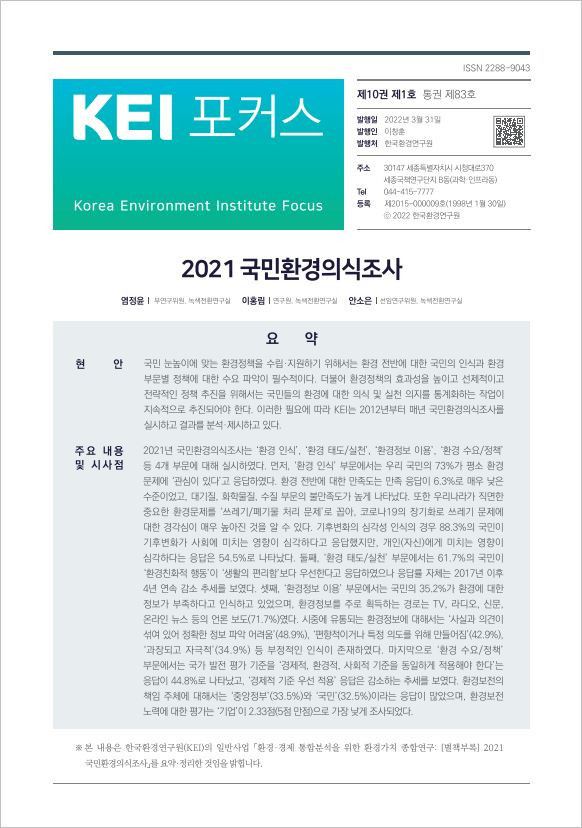 2021 국민환경의식조사 (KEI 포커스 제10권 통권 83호) Year of publication: 2022 Author: 염정윤 | 이홍림 | 안소은 Corporate author: 한국환경연구원 국민 눈높이에 맞는 환경정책을 수립·지원하기 위해서는 환경 전반에 대한 국민의 인식과 환경 부문별 정책에 대한 수요 파악이 필수적이다. 더불어 환경정책의 효과성을 높이고 선제적이고 전략적인 정책 추진을 위해서는 국민들의 환경에 대한 의식 및 실천 의지를 통계화하는 작업이 지속적으로 추진되어야 한다. 이러한 필요에 따라 KEI는 2012년부터 매년 국민환경의식조사를 실시하고 결과를 분석·제시하고 있다.2021년 국민환경의식조사는 '환경인식', '환경태도/실천', '환경정보 이용', '환경 수요/정책' 등 4개 부문에 대해 실시하였다. 본 저작물은 한국환경연구원에서 2022년 작성하여 공공누리 제4유형으로 개방한 '2021 국민환경의식조사(작성자: 염정윤, 이홍림, 안소은)'을 이용하였으며, 해당 저작물은 한국환경연구원 홈페이지(https://www.kei.re.kr/)에서 무료로 내려받으실 수 있습니다.
 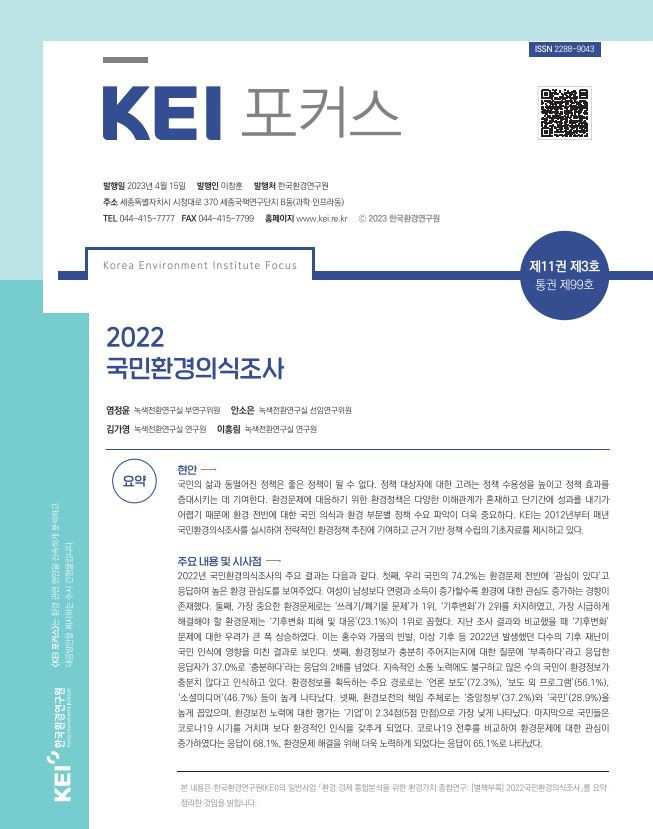 2022 국민환경의식조사 (KEI 포커스 제11권 통권 99호) Year of publication: 2023 Author: 염정윤 | 안소은 | 김가영 | 이홍림 Corporate author: 한국환경연구원 국민 눈높이에 맞는 환경정책을 수립·지원하기 위해서는 환경 전반에 대한 국민의 인식과 환경 부문별 정책에 대한 수요 파악이 필수적이다. 더불어 환경정책의 효과성을 높이고 선제적이고 전략적인 정책 추진을 위해서는 국민들의 환경에 대한 의식 및 실천 의지를 통계화하는 작업이 지속적으로 추진되어야 한다. 이러한 필요에 따라 KEI는 2012년부터 매년 국민환경의식조사를 실시하고 결과를 분석·제시하고 있다.2022년 국민환경의식조사는 '환경인식', '환경태도/실천', '환경정보 이용', '환경 수요/정책' 등 기본 분야 4개 부분과 '코로나19' 관련 특별 분야에 대해 온라인으로 설문을 시행하였다. 본 저작물은 한국환경연구원에서 2023년 작성하여 공공누리 제4유형으로 개방한 '2022 국민환경의식조사(작성자: 염정윤)'을 이용하였으며, 해당 저작물은 한국환경연구원 홈페이지(https://www.kei.re.kr/)에서 무료로 내려받으실 수 있습니다.
  Chakra the Invincible: Climate Change Year of publication: 2015 Author: Stan Lee | Sharad Devarajan | Gotham Chopra | Ashwin Pande | Thiago Vale | Sesha Sainan Devarajan | Aditya Bidikar | Nilesh S. Mahadik | Rakesh B. Mahadik Corporate author: Graphic India Pte. ltd | POW Entertainment The legendary Stan Lee and Sharad Devarajan bring their character Chakra the Invincible to teach children about the global goals! Chakra and Mighty Girl learn from other children around the world how climate change is doing damage and spring into action!