
Resources
Explore a wide range of valuable resources on GCED to deepen your understanding and enhance your research, advocacy, teaching, and learning.
3,376 Results found
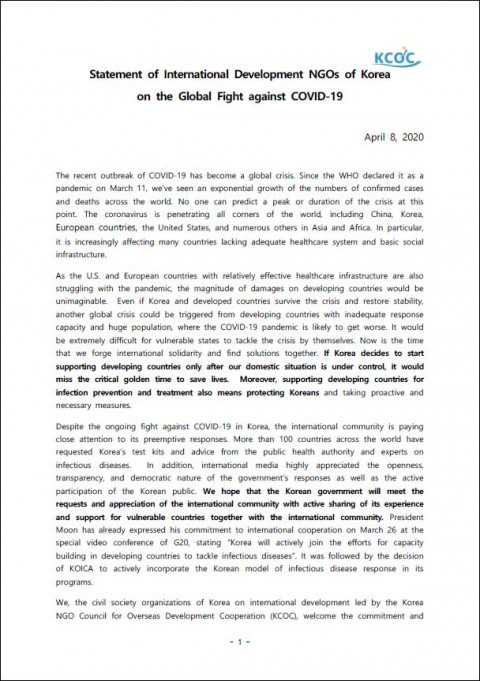 국제사회의 코로나19 퇴치를 위한 한국 국제개발협력 시민사회단체들의 호소문 Year of publication: 2020 Corporate author: Korea NGO Council for Overseas Development Cooperation (KCOC) 코로나19가 전 지구적 위기로 다가왔습니다. 지난 3월 11일 세계보건기구(WHO)가 팬데믹을 선언한 이래, 전 세계 확진자 및 사망자의 수가 기하급수적으로 증가하고 있고, 그 정점이 어디인지, 언제까지 이 사태가 계속될지 누구도 예측하지 못하는 상황입니다.보건 의료 인프라가 잘 갖춰진 미국과 유럽에서조차 팬데믹의 영향이 심각한 상황임을 감안할 때, 향후 개발도상국(이하 개도국)이 받게 될 피해의 정도를 가늠하기 어렵습니다. 취약한 나라일수록 스스로의 노력만으로 현 위기 상황을 타개하기란 매우 어렵기에 우리는 지금부터 국제적으로 연대하고 공동으로 해결방안을 모색해야 합니다. 또한 개도국의 감염예방 및 치료를 돕는 것이 곧 우리의 안전을 지키는 일이며, 필수적이고도 선제적인 예방책이 될 것이라는 점을 기억해야 합니다.
 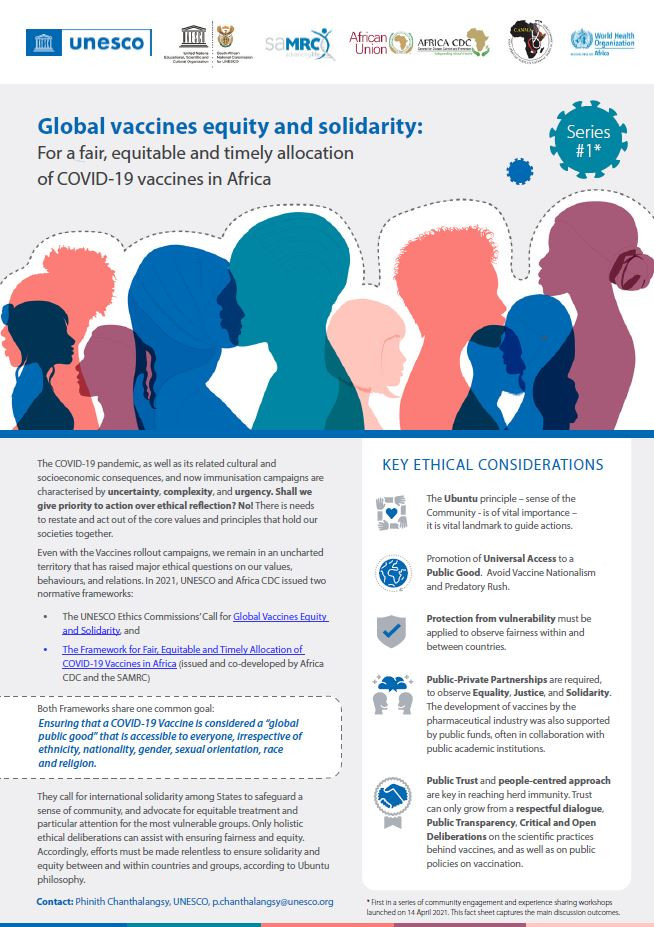 Global Vaccines Equity and Solidarity: For a Fair, Equitable and Timely Allocation of COVID-19 Vaccines in Africa; Series #1 Year of publication: 2021 Corporate author: UNESCO Harare African populations have been side-lined through the COVID-19 Vaccination roll-out process. A vaccination timeline taking Africa into 2023 would be unethical. African countries need to invest in their own structures and stop relying on colonial structures. There is a moral obligation to safeguard the population through equal distribution. This not only makes moral and ethical sense but also scientific and economic sense as a slow roll out in Africa will impact the rest of the world. First in a series of community engagement and experience sharing workshops launched on 14 April 2021. This fact sheet captures the main discussion outcomes.
  Global Education Monitoring Report 2019: Gender Report: Building Bridges for Gender Equality Year of publication: 2019 Corporate author: Global Education Monitoring Report Team Achieving gender equality in education participation, in the teaching and learning process and in access to social and economic opportunities that education can facilitate are key interlinked ambitions in two of the Sustainable Development Goals (SDGs) in the 2030 Agenda for Sustainable Development: SDG 4 on education and SDG 5 on gender equality. These aims are also key to the Education 2030 Framework for Action, which calls on countries to adopt strategies that not only cover access to education for all but also address substantive gender equality issues: ‘supporting gender-sensitive policies, planning and learning environments; mainstreaming gender issues in teacher training and curricula; and eliminating gender-based discrimination and violence in schools’. The 2019 Gender Report is based on a monitoring framework first introduced in the 2016 Global Education Monitoring Report.In addition to focusing on gender parity in education participation, attainment and learning achievement, the framework examines broad social and economic contexts (gender norms and institutions) and key education system characteristics (laws and policies, teaching and learning practices, learning environments, and resources). The framework also looks at the relationship between education and selected social and economic outcomes. For instance, a move towards parity in education attainment may increase women’s labour force participation rates, but low levels of labour force participation feed into existing norms and may constrain expansion of education opportunities for women.
  [Summary] Gender and EFA 2000-2015: Achievements and Challenges; EFA Global Monitoring Report 2015; Gender Summary Year of publication: 2015 Corporate author: Global Education Monitoring Report Team This report describes an array of country efforts, some quite effective, to achieve and go beyond gender parity in education. Many of these policies and programmes focus on the immediate school environment in which girls learn. Others focus on the informal and formal laws, social norms and practices that deny girls their right of access to, and completion of, a full cycle of quality basic education. The analyses and key messages in Gender and EFA 2000–2015: Achievements and Challenges deserve careful scrutiny as the world embarks on a universal, integrated and even more ambitious sustainable development agenda in the years to come.
  International Higher Education: Shifting Mobilities, Policy Challenges, and New Initiatives Year of publication: 2018 Author: Rajika Bhandari | Chelsea Robles | Christine Farrugia Corporate author: Global Education Monitoring Report Team | Institute of International Education (USA). Center for Academic Mobility Research and Impact Cross-border mobility in higher education, while still referring to a minority of people, is a large phenomenon that is increasingly taking new forms, extending from students and faculty member mobility to the movement of educational programs and institutions, including the spread of online courses facilitated by improvements in technology. It is also a phenomenon with major implications in facilitating the flow and exchange of ideas and knowledge, improving practices, generating resources for receiving countries, and attracting talent. For that reason, the internationalization of higher education puts pressure on countries to develop a strategy that would maximize the education, political and economic benefits while minimizing the costs.Based on an in-depth review of research and existing data, this paper examines key issues in the internationalization of higher education, assesses broad consequences, and discusses a selection of the latest trends. The paper also provides an overview of the key policy challenges and options facing governments in low, middle and high income countries as they seek to internationalize their higher education sectors while also sending their top talent overseas to acquire a global education.
  Beyond commitments 2019: how countries implement SDG 4 Year of publication: 2019 Corporate author: Global Education Monitoring Report Team Almost one-third of the time set to achieve the Sustainable Development Goals (SDGs) has elapsed. The 2019 High-level Political Forum (HLPF), the global SDG follow-up and review mechanism, represents a major stock-taking moment for countries, especially as regards SDG 4, the education goal, which is being reviewed for the first time. The international community relies primarily on quantitative measures to assess progress towards the SDGs. Acompanion publication by the UNESCO Institute for Statistics and the Global Education Monitoring Report for the 2019 HLPF, titled ‘Meeting commitments: Are countries on track to achieve SDG 4?’, shows that there are major challenges ahead. But increasingly, member states demand more than quantitative information. They ask for guidance on how to respond when their education systems do not reach their targets. To respond to this demand, this publication has the following purposes: Understand countries’ perceptions of SDG 4 based on responses to a questionnaire prepared for this publication, which asked countries to report on their flagship SDG 4 policies Distil those perceptions into a framework of the types of national policies that are best aligned with SDG 4 and whose implementation should be monitored Communicate the framework succinctly and provide a complementary input for the review of SDG 4 at the 2019 HLPF Provide an opportunity for countries to engage in dialogue on how they approach SDG 4. An analysis of the questionnaires submitted by 72 governments shows that most countries refer to SDG 4 as a framework in which they place their education planning. A core recommendation is that countries should align their education plans and policies with their international commitments.
  Meeting commitments: are countries on track to achieve SDG 4? Year of publication: 2019 Corporate author: Global Education Monitoring Report Team | UNESCO Institute for Statistics (UIS) The world is a third of the way towards the deadline of the 2030 Agenda for Sustainable Development, which includes the fourth Sustainable Development Goal on education, SDG 4. But it is behind on its commitments. This joint publication by the UNESCO Institute for Statistics and the Global Education Monitoring Report for the 2019 High-level Political Forum on Sustainable Development captures concisely how far the world is from achieving its education targets. This is the year that the generation of students that should finish secondary school by 2030 should be entering school for the first time. Yet, in low-income countries, only 60% of children complete primary school, while in some regions the percentage of students who achieve minimum proficiency in reading is even falling. There is no denying that the world is off track. It is time to put an end to complacency. The international community relies on data to report on the SDG 4 monitoring framework to assess progress. While clear improvements have been made in data collection, data gaps remain a major concern. This publication makes a call for countries and their international development partners to coordinate and finance the collection of data to monitor and deliver on SDG 4. Respecter les engagements: les pays sont-ils en bonne voie d'atteindre l'ODD 4? Year of publication: 2019 Corporate author: Global Education Monitoring Report Team | UNESCO Institute for Statistics (UIS) Le monde a parcouru un tiers du chemin vers l’échéance de l’Agenda de développement durable 2030, qui inclut le quatrième Objectif de développement durable (ODD 4), mais il est en retard sur la réalisation de ses engagements. Cette publication conjointe de l’Institut de statistique de l’UNESCO et du Rapport mondial de suivi sur l’éducation pour le Forum politique de haut niveau sur le développement durable 2019 expose de manière concise le retard dans la réalisation des cibles de l’éducation. Cette année est celle où la génération d’élèves qui terminera l’enseignement secondaire d’ici 2030 doit commencer l’école pour la toute première fois. Pourtant, dans les pays à revenu faible, seuls 60 % des enfants achèvent l’enseignement primaire, tandis que dans certaines régions, le pourcentage d’élèves qui possèdent les compétences minimales en lecture est même en baisse. On ne peut nier le fait que le monde est en retard. Il est temps de cesser ce laxisme. La communauté internationale dépend des données pour établir les rapports sur le cadre de suivi de l’ODD 4 afin d’évaluer les progrès accomplis. Des améliorations ont clairement été accomplies en matière de collecte de données mais les déficits de données demeurent une préoccupation majeure. Cette publication exhorte les pays et leurs partenaires internationaux du développement à coordonner et à financer la collecte de données pour suivre et réaliser l’ODD 4. Cumplir los compromisos: ¿van los países por el buen camino para alcanzar el ODS 4? Year of publication: 2019 Corporate author: Global Education Monitoring Report Team | UNESCO Institute for Statistics (UIS) El mundo ya ha recorrido un tercio del camino hacia la fecha límite para el cumplimiento de la Agenda 2030 para el Desarrollo Sostenible, que incluye el Objetivo de Desarrollo Sostenible 4, relativo a la educación, pero aún está muy atrasado en el cumplimiento de sus compromisos. Esta publicación conjunta del Instituto de Estadística de la UNESCO y el Informe de Seguimiento de la Educación en el Mundo para el Foro Político de Alto Nivel sobre el Desarrollo Sostenible de 2019 refleja de manera concisa lo lejos que está el mundo de alcanzar sus objetivos en materia de educación. Este es el año en que la generación de estudiantes que debería finalizar la educación secundaria en 2030 tendría que ingresar a la escuela. Sinembargo, en los países de ingresos bajos, solo el 60% de los niños terminan la educación primaria, mientras que en algunas regiones el porcentaje de estudiantes que alcanzan un nivel mínimo de competencia en lectura está incluso en disminución. No se puede negar que el mundo no está bien encaminado. Ya es hora de que cese la apatía. La comunidad internacional se apoya en los datos para informar al marco de seguimiento del ODS 4 con el fin de evaluar los progresos realizados. Si bien se han realizado claras mejoras en la producción de datos, los faltantes de información siguen siendo motivo de gran preocupación. En esta publicación se hace un llamado a los países y a sus asociados internacionales para que coordinen y financien la producción de datos para el seguimiento y a la consecución del ODS 4.
  Let's work together: education has a key role in helping achieve the Sustainable Development Goals Year of publication: 2019 Corporate author: Global Education Monitoring Report Team This publication has been produced on the occasion of the 2019 High-level Political Forum by the Global Eduation Monitoring Report. It draws upon findings from reports produced since 2015, showing the importance of education for the other goals in the 2030 agenda for sustainable development and calling for sectors to work together to achieve their aims.