
Resources
Explore a wide range of valuable resources on GCED to deepen your understanding and enhance your research, advocacy, teaching, and learning.
1,471 Results found
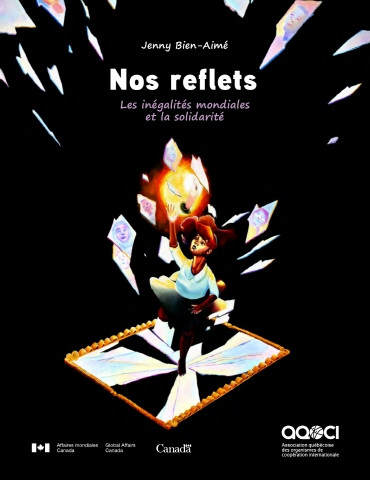 Our Reflections: Global Inequality and Solidarity Year of publication: 2022 Author: Jenny Bien-Aimé Corporate author: Quebec Association of International Cooperation Organizations (AQOCI) In 2022, the SDI took place from February 6 to 12, and the member organizations of AQOCI chose the theme "In the context of the COVID-19 pandemic: calling for the co-construction of a just and united world."With this theme, the public was invited to discuss the persistent global inequalities and injustices and to explore solutions for making our world more just, united, and equitable.For the occasion, the comic book Nos Reflets was created by the artist Jenny Bien-Aimée. Nos reflets: Les inégalités mondiales et la solidarité Year of publication: 2022 Author: Jenny Bien-Aimé Corporate author: Association québécoise des organismes de coopération internationale (AQOCI) En 2022, la SDI s'est déroulée du 6 au 12 février et les organismes membres de l’AQOCI ont choisi comme thématique « Dans le contexte de pandémie de COVID-19 : appeler à la coconstruction d’un monde juste et solidaire ».Avec cette thématique, le public a été convié à échanger sur les inégalités et les injustices persistantes à l’échelle mondiale et à discuter des solutions pour rendre notre monde plus juste, solidaire et équitable.Pour l'occasion, la bande dessinée Nos Reflets a été produite par l'artiste Jenny Bien-Aimée.
  حالة حقوق الإنسان في العالم: أبريل/نيسان 2024 Year of publication: 2024 Corporate author: Amnesty International Le Rapport d’Amnesty International décrit la situation des droits humains dans le monde en 2023 dans 155 pays différents. Les équipes de journalistes et d’enquêteurs de l'ONG peignent un portrait plutôt sombre, avec notamment un recul du droit des femmes, les conséquences dramatiques du réchauffement climatique sur les populations les plus vulnérables, le recul du droit de manifester, ou encore la prolifération de la haine en ligne dans le monde. La multiplication des conflits armés et le choc du 7 octobre ont également eu des conséquences dramatiques. Cependant, quelques bonnes nouvelles sont aussi à noter, avec des avancées pour les droits des personnes LGBTI par exemple. Amnesty International Report describes the human rights situation worldwide in 2023 in 155 different countries. TheNGO's teams of journalists and investigators paint a rather gloomy picture, with, in particular, a decline in women's rights, the dramatic consequences of global warming on the most vulnerable populations, a decline in the right to protest, and the proliferation of online hate around the world. The multiplication of armed conflicts and the shock of October 7 have also had dramatic consequences. However, there is some good news too, with advances in LGBTI rights for example. 世界人权状况:2024年4月 Year of publication: 2024 Corporate author: Amnesty International Le Rapport d’Amnesty International décrit la situation des droits humains dans le monde en 2023 dans 155 pays différents. Les équipes de journalistes et d’enquêteurs de l'ONG peignent un portrait plutôt sombre, avec notamment un recul du droit des femmes, les conséquences dramatiques du réchauffement climatique sur les populations les plus vulnérables, le recul du droit de manifester, ou encore la prolifération de la haine en ligne dans le monde. La multiplication des conflits armés et le choc du 7 octobre ont également eu des conséquences dramatiques. Cependant, quelques bonnes nouvelles sont aussi à noter, avec des avancées pour les droits des personnes LGBTI par exemple. Amnesty International Report describes the human rights situation worldwide in 2023 in 155 different countries. TheNGO's teams of journalists and investigators paint a rather gloomy picture, with, in particular, a decline in women's rights, the dramatic consequences of global warming on the most vulnerable populations, a decline in the right to protest, and the proliferation of online hate around the world. The multiplication of armed conflicts and the shock of October 7 have also had dramatic consequences. However, there is some good news too, with advances in LGBTI rights for example. 세계 인권 현황 보고서: 2024년 4월 Year of publication: 2024 Corporate author: Amnesty International Le Rapport d’Amnesty International décrit la situation des droits humains dans le monde en 2023 dans 155 pays différents. Les équipes de journalistes et d’enquêteurs de l'ONG peignent un portrait plutôt sombre, avec notamment un recul du droit des femmes, les conséquences dramatiques du réchauffement climatique sur les populations les plus vulnérables, le recul du droit de manifester, ou encore la prolifération de la haine en ligne dans le monde. La multiplication des conflits armés et le choc du 7 octobre ont également eu des conséquences dramatiques. Cependant, quelques bonnes nouvelles sont aussi à noter, avec des avancées pour les droits des personnes LGBTI par exemple. Amnesty International Report describes the human rights situation worldwide in 2023 in 155 different countries. TheNGO's teams of journalists and investigators paint a rather gloomy picture, with, in particular, a decline in women's rights, the dramatic consequences of global warming on the most vulnerable populations, a decline in the right to protest, and the proliferation of online hate around the world. The multiplication of armed conflicts and the shock of October 7 have also had dramatic consequences. However, there is some good news too, with advances in LGBTI rights for example.
  Alert 2024! : Report on Conflicts, Human Rights and Peacebuilding Year of publication: 2024 Corporate author: Escola de Cultura de Pau (ECP) Published since 2001, this yearbook analyses the state of the world in terms of conflict and peacebuilding based on three axes: armed conflict, tensions and gender, peace and security. The analysis of the most relevant events of the year and the nature, causes, dynamics, actors and consequences of the main scenarios of armed conflict and socio-political tension in the world allows for a comparative regional view and the identification of global trends, as well as elements of risk and preventive warning for the future. Likewise, the report also identifies opportunities for peacebuilding or for the reduction, prevention or resolution of conflicts. Alerta 2024!: Informe sobre conflictos, derechos humanos y construcción de paz Year of publication: 2024 Corporate author: Escola de Cultura de Pau (ECP) Editado desde 2001, este anuario analiza el estado del mundo en términos de conflictividad y construcción de paz a partir de tres ejes: conflictos armados, tensiones y género, paz y seguridad. El análisis de los hechos más relevantes del año y de la naturaleza, causas, dinámicas, actores y consecuencias de los principales escenarios de conflicto armado y tensión socio-política en el mundo permite ofrecer una mirada comparativa regional e identificar tendencias globales, así como elementos de riesgo y alerta preventiva de cara al futuro. Del mismo modo, el informe también identifica oportunidades para la construcción de paz o para la reducción, prevención o resolución de conflictos.
  Human Rights and Conflict Resolution: Palestinian Universities as a Case Study (Conceptual Paper) Year of publication: 2023 Author: Rashad Twam Corporate author: Palestinian Jurists Association Palestinian universities have consistently witnessed occasional conflicts, many of which have resulted in disrupting the educational process. While some of these conflicts originated outside the university walls, as an extension of societal violence, others stemmed from within the university itself, posing a threat to civil peace. This conceptual paper addresses this issue by examining the various forms of these conflicts over the past five years (2018-2022) and the stakeholders involved in resolving them. It adopts a differentiated approach between the perspectives and methodologies of human rights advocates and conflict resolution practitioners, with a focus on the case study of Birzeit University. حقوق الإنسان وحل النزاعات من منظور عملي: الجامعات الفلسطينية نموذجا (ورقة مفاهيمية) Year of publication: 2023 Author: Rashad Twam Corporate author: Palestinian Jurists Association ما انفكت الجامعات الفلسطينية تشهد بين الحين والآخر، حالات نزاع، كثيرا منها ما تسببت بتعطيل العملية التعليمية. وفيما بعض تلك النزاعات نفذت من خارج أسوار الجامعة، كامتداد لحالات عنف مجتمعية، فبعضها الآخر بالعكس، مصدرها داخل الجامعة، وكادت أن تمتد إلى خارج حرمها، مهددة السلم الأهلي. تعرض هذه الورقة المفاهيمية لهذا الإشكال، فتتناول أشكال تلك النزاعات خلال السنوات الخمسة الماضية (2018-2022)، والمتدخلين في حل هذا النزاعات، ضمن مقاربة التمييز بين منطلقات وأساليب عمل كل من فئة المدافعين عن حقوق الإنسان وفئة ممارسي حل النزاعات، وذلك بالتركيز على تجربة جامعة بيرزيت كحالة دراسية.
 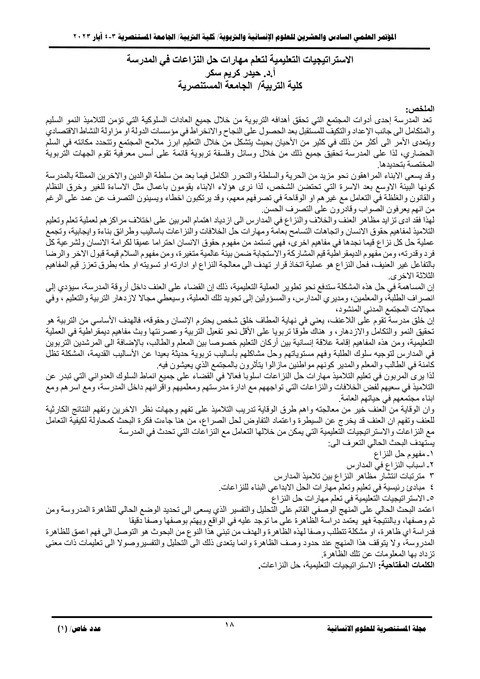 Instructional Strategies for Learning Conflict Resolution Skills in School (Mustansiriyah Journal of Humanities; Vol. 1-1, Special Issue) Year of publication: 2023 Author: Haider Kareem Sukar Corporate author: Mustansiriyah University The school is a community tool that achieves its educational goals through all behavioral habits that provide students with sound and integrated growth, as well as preparation and adaptation for the future after obtaining success and involvement in government institutions and the economy. In the civilizational scale, so the school must achieve all means of education and an educational philosophy based on foundations with educational entertainment Adolescent children may seek more freedom, power, and complete liberation later on from the authority of parents and others represented by the school, as it is the broader environment after the family that embraces the person, so we see these children doing actions such as abuse of others, violation of order and law, harshness in dealing with others, or rudeness in their behavior with them They may make mistakes and misbehave on purpose even though they know what is right and are able to act well. Therefore, the increasing manifestations of violence, disagreement and conflict in schools have led to an increase in the interest of educators of all positions in the process of learning and teaching students the concepts of human rights and the attitudes of tolerance in general and the skills of resolving differences and conflicts in constructive and positive ways and means.