
Resources
Explore a wide range of valuable resources on GCED to deepen your understanding and enhance your research, advocacy, teaching, and learning.
685 Results found
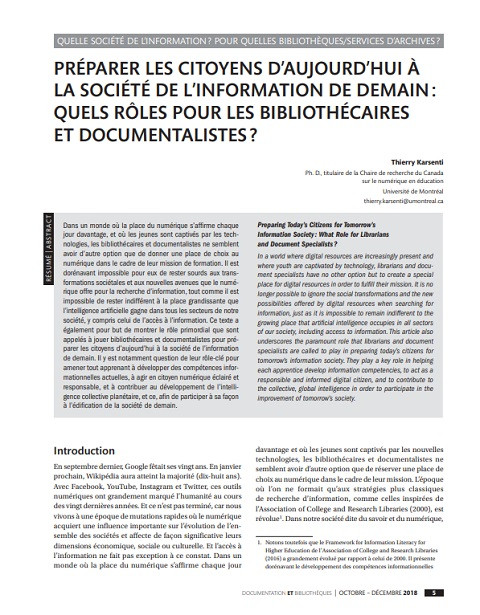 Préparer les citoyens d’aujourd’hui à la société de l’information de demain: Quels rôles pour les bibliothécaires et documentalistes ? (Documentation et bibliothèques; Vol.64, No.4) Year of publication: 2018 Author: Thierry Karsenti Corporate author: Association pour l'avancement des sciences et des techniques de la documentation (ASTED) Dans un monde où la place du numérique s’affirme chaque jour davantage, et où les jeunes sont captivés par les technologies, les bibliothécaires et documentalistes ne semblent avoir d’autre option que de donner une place de choix au numérique dans le cadre de leur mission de formation. Il est dorénavant impossible pour eux de rester sourds aux transformations sociétales et aux nouvelles avenues que le numérique offre pour la recherche d’information, tout comme il est impossible de rester indifférent à la place grandissante que l’intelligence artificielle gagne dans tous les secteurs de notre société, y compris celui de l’accès à l’information. Ce texte a également pour but de montrer le rôle primordial que sont appelés à jouer bibliothécaires et documentalistes pour préparer les citoyens d’aujourd’hui à la société de l’information de demain. Il y est notamment question de leur rôle-clé pour amener tout apprenant à développer des compétences informationnelles actuelles, à agir en citoyen numérique éclairé et responsable, et à contribuer au développement de l’intelligence collective planétaire, et ce, afin de participer à sa façon à l’édification de la société de demain
 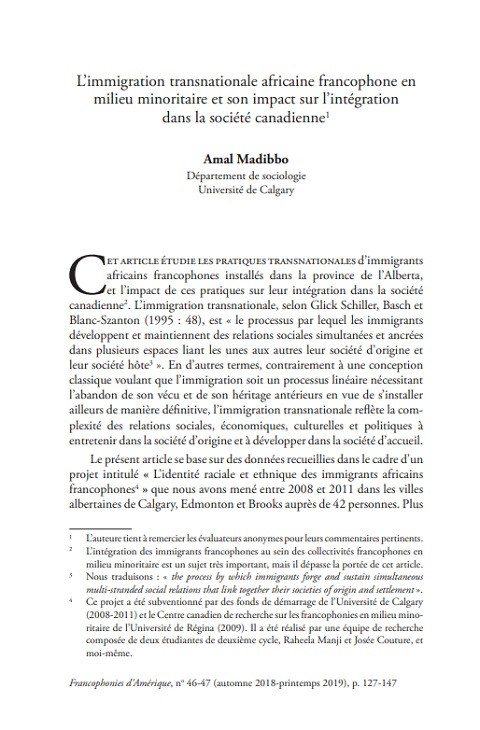 L’immigration transnationale africaine francophone en milieu minoritaire et son impact sur l’intégration dans la société canadienne Year of publication: 2019 Author: Amal Madibbo Corporate author: Les Presses de l'Université d'Ottawa | Centre de recherche en civilisation canadienne-française Dans un monde où la place du numérique s’affirme chaque jour davantage, et où les jeunes sont captivés par les technologies, les bibliothécaires et documentalistes ne semblent avoir d’autre option que de donner une place de choix au numérique dans le cadre de leur mission de formation. Il est dorénavant impossible pour eux de rester sourds aux transformations sociétales et aux nouvelles avenues que le numérique offre pour la recherche d’information, tout comme il est impossible de rester indifférent à la place grandissante que l’intelligence artificielle gagne dans tous les secteurs de notre société, y compris celui de l’accès à l’information. Ce texte a également pour but de montrer le rôle primordial que sont appelés à jouer bibliothécaires et documentalistes pour préparer les citoyens d’aujourd’hui à la société de l’information de demain. Il y est notamment question de leur rôle-clé pour amener tout apprenant à développer des compétences informationnelles actuelles, à agir en citoyen numérique éclairé et responsable, et à contribuer au développement de l’intelligence collective planétaire, et ce, afin de participer à sa façon à l’édification de la société de demain.
  코로나19와 교육: 교사전문성에 주는 시사점 Year of publication: 2020 Author: 조윤정 | 박휴용 Corporate author: 경기도교육연구원 코로나19는 우리 삶의 양태를 근본적으로 변화시키는 전환점이 되면서 교육적 위기와 사회적 위기를 빚어내고 있음. 교육에 있어서는 배움의 지체와 교육격차 현상이 심화되고 있으며, 코로나로 인해 자연과 자본 간 모순과 성장의 한계를 인식하게 되면서 생태의 중요성에 대해 눈을 뜨게 되었다. 또한 개인주의나 혐오와 차별이 횡행하고 국수주의로 회귀하는 현상이 나타나면서 인류는 고립과 연대 사이의 갈림길에 서 있다.코로나19는 우리가 당연시하였던 가치와 생활양식에 대해 성찰하는 계기로 작용하면서 우리에게 3가지 질문을 던져주고 있다. 첫째, 우리가 바라는 교육의 모습은 무엇인가? 둘째, 인간을 둘러싼 자연과 환경, 생태계와 어떻게 관계를 맺을 것인가? 셋째, 우리는 온라인 세상과 오프라인 세상에서 어떤 시민으로 살아가야 할 것인가?이 연구에서는 이상의 3가지 질문을 중심으로 포스트코로나 시대 학교교육의 방향과 교사전문성에 대해 고찰하였다. 첫째 우리가 바라는 교육의 모습은 배움과 성장의 지속성 확보이며, 이를 위해서 학습자 주도성을 살리는 교육, 학습동기를 높이고 상호작용과 소통을 강화하는 교육, 협력을 촉진하는 교육, 기초학력을 강화하고 교육격차를 완화하는 교육을 실천해야 한다. 둘째, 인간을 둘러싼 자연과 환경, 생태계와 어떻게 관계를 맺을 것인가?에 대해서는 생태적 전환을 실천하는 교육을 통해 인간과 생태계, 즉 모든 존재가 상호 창조하는 관계가 되어야 한다. 이를 위해서 교육자체가 생태적 전환이 되어야 하며, 학교를 생태적 전환의 리빙랩으로 전환하여야 하고, 지역사회를 순환경제로 전환하여야 하며 학교가 전환의 구심점이 되어야 한다. 셋째, 온라인 세상과 오프라인 세상에서 디지털 시민과 세계시민으로 살아가야 하며 이를 위해서 디지털 미디어 리터러시와 디지털 시민성을 키우는 교육, 범주 확장 교육, 글로벌 연대와 협력을 지향하는 세계시민교육을 실천해야 할 것이다.
  지역아동센터 관리자·교사가 알아야 할 디지털 시민성과 교육 Year of publication: 2019 Author: 김양은 | 최숙 | 김형태 | 배은주 | 박상호 | 장준영 | 박정원 Corporate author: 방송통신위원회 | 한국정보화진흥원 본 자료는 지역아동센터와 같은 지역사회 돌봄서비스 내에서 디지털시민성 교육을 진행할 수 있도록 제작된 가이드북이다.
  L'utilisation des médias sociaux dans l'éducation de l'Holocauste Corporate author: International Holocaust Remembrance Alliance (IHRA) Les médias sociaux est une forme en pleine expansion de la communication et de la communauté dans notre monde et dans l'éducation plus spécifiquement. éducateurs Holocauste sont chargés de déterminer la meilleure façon d'utiliser cet outil dans leur programmation sans programme ou l'intégrité objet compromettant. Ces lignes directrices décrivent les considérations et les pratiques dans le déploiement de médias sociaux dans l'environnement éducatif de l'Holocauste. Using social media in Holocaust Education Corporate author: International Holocaust Remembrance Alliance (IHRA) Social media is a rapidly expanding form of communication and community in our world and in education more specifically. Holocaust educators are tasked with determining how best to use this tool in their programming without compromising programme or subject integrity. These guidelines outline considerations and practices in deploying social media in the Holocaust educational environment.
  초등학교 교사를 위한 디지털 시민교육 활용 가이드북: 온-오프라인을 연결하는 디지털 시민교육 Year of publication: 2019 Author: 김양은 | 배은주 | 박정원 | 김형태 | 김영환 | 심성호 Corporate author: 방송통신위원회 | 한국정보화진흥원 초등교사들의 디지털시민교육 이해도를 높이고 교육현장에서 학생들과 함께 디지털시민역량을 기르기 위한 안내서이다. 본 교재에서는 디지털시민역량을 정체성, 웰빙, 권리와 책임, 소통과 관계, 정보리터러시, 사회참여 6가지로 제시한다.
  중·고등학교 교사를 위한 디지털 시민교육 활용 가이드북 : 온-오프라인을 연결하는 디지털 시민교육 Year of publication: 2019 Author: 김양은 | 배은주 | 박정원 | 김형태 | 김영환 | 심성호 Corporate author: 방송통신위원회 | 한국정보화진흥원 중·고등교사들의 디지털시민교육 이해도를 높이고 교육현장에서 학생들과 함께 디지털시민역량을 기르기 위한 안내서이다. 본 교재에서는 디지털시민역량을 정체성, 웰빙, 권리와 책임, 소통과 관계, 정보리터러시, 사회참여 6가지로 제시하며, 교육에 바로 적용할 수 있도록 활동지, 교수학습지도안 등을 포함하고 있다.
 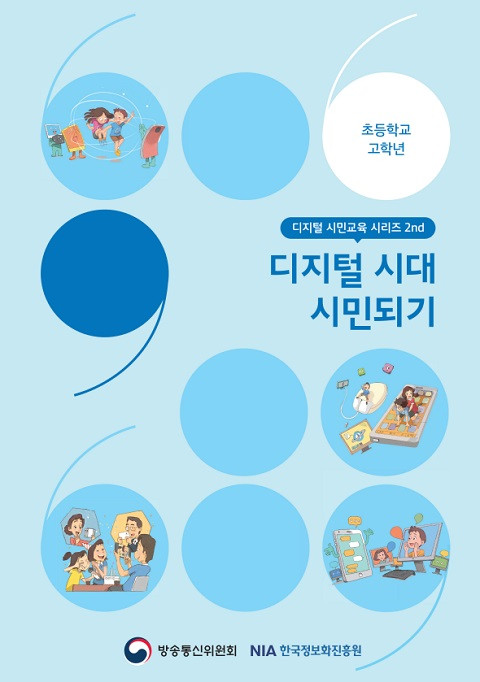 디지털 시대 시민되기: 초등학교 고학년 (디지털 시민교육 시리즈 2nd) Year of publication: 2019 Author: 김양은 | 배은주 | 박정원 | 김영환 | 김형태 | 심성호 Corporate author: 방송통신위원회 | 한국정보화진흥원 본 자료는 초등 고학년(5~6학년) 대상 디지털시민교육을 위한 교육자료이다. 6가지의 역량별로 교수학습지도안과 학생 활동지로 구성되어 있다.
 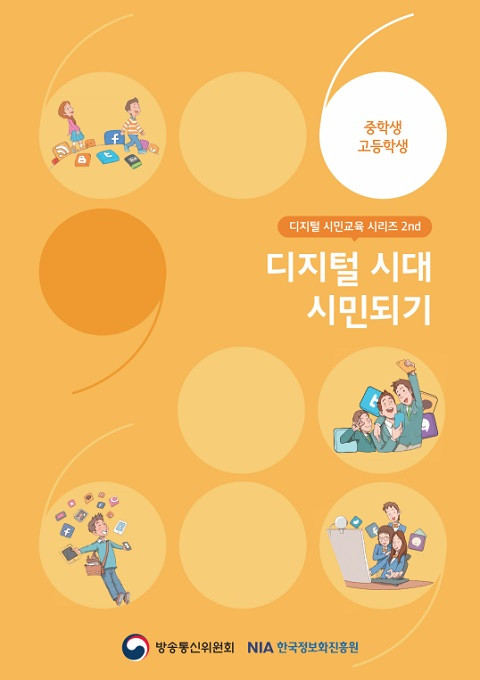 디지털 시대 시민되기: 중학생, 고등학생 (디지털 시민교육 시리즈 2nd) Year of publication: 2019 Author: 김양은 | 배은주 | 박정원 | 김영환 | 김형태 | 심성호 Corporate author: 방송통신위원회 | 한국정보화진흥원 본 자료는 중고등학생 대상 디지털시민교육을 위한 교육자료이다. 6가지의 역량별로 교수학습지도안과 학생 활동지 등으로 구성되어 있다.